
Published By: Pen & Sword
Publication Date: 2nd October 2018
I.S.B.N.: 9781526734556
Format: Hardback
Price: £15.99
Blurb
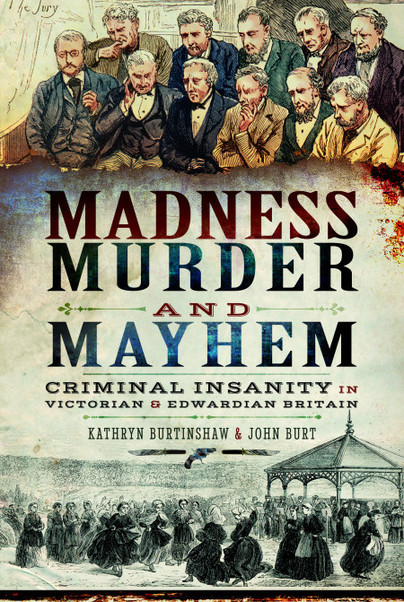
Following an assassination attempt on George III in 1800, new legislation significantly altered the way the criminally insane were treated by the judicial system in Britain. This book explores these changes and explains the rationale for purpose-built criminal lunatic asylums in the Victorian era.
Specific case studies are used to illustrate and describe some of the earliest patients at Broadmoor Hospital – the Criminal Lunatic Asylum for England and Wales and the Criminal Lunatic Department at Perth Prison in Scotland. Chapters examine the mental and social problems that led to crime alongside individuals considered to be weak-minded, imbeciles or idiots. Family murders are explored as well as individuals who killed for gain. An examination of psychiatric evidence is provided to illustrate how often an insanity defence was used in court and the outcome if the judge and jury did not believe these claims. Two cases are discussed where medical experts gave evidence that individuals were mentally irresponsible for their crimes but they were led to the gallows.
Written by genealogists and historians, this book examines and identifies individuals who committed heinous crimes and researches the impact crime had on themselves, their families and their victims.
My Review
As regular readers will know I have a few mental health issues, as well as being autistic. A hundred years ago I, and quite a few of my friends and acquaintances, would have ended up in asylums. Not as criminals, probably, but just because we’re a bit weird. Thank the gods, treatment and care has improved since then, even if some of the autism experts are bigots who don’t actually listen to us, and some people still think we need ‘curing’; those people are otherwise known as eugenicists. Anyway, as a result, I’m interested in the history of mental health issues and how the mentally ill were treat, historically.
During the nineteenth century changes in attitudes towards the mentally ill, and disabled people generally, started to change, and the nascent psychiatric and psychological disciplines of medicine emurged with the ‘alienist’ and the ‘mad doctor’. At a time when viable treatments was non-existent, families, institutions and communities had the burden of care for the sick.
But what about those who committed crimes while mentally ill? This book covers the subject, using biographies of ‘criminal lunatics’ and those detained at the monarch’s pleasure because they were found not guilty by reason of insanity but were also considered too dangerous to be out in society. It was during this time that Broadmoor was opened and its medical superintendents were considered to be experts in mental illness and the care of their patients/prisoners. During the nineteenth century doctors started to be called on as expert witnesses in trials where possible insanity was a cause. Many deemed insane were locked up, either for a fixed term, until deemed well or for life. Some were let out on licence only to kill because they were not cured, and some were still hanged, despite evidence of insanity.
The biographies of those covered in this book were interesting and sympathetically written, using contemporary sources and the change in attitudes from 1812 to 1912 are obvious. Medical care changed from manacles to keeping busy in a calm environment, although treatment and understanding of the causes was still lacking, awaiting scientific advances.
Such a pity that sanism and ableism is still alive and well over a century later.
A good book for those with an interest in the 19th century and its social attitudes, and those interested in the history of mental illness in Britain.

 Everything Is Better With Dragons