

Before you step into the jungle, there are a few things you need to know…
Join scientist Dr Rosa Vásquez Espinoza as she uncovers one of the most unexplored regions on the planet.
Dr Rosa is no stranger to the Amazon. Growing up with the rainforest as her back garden, she learnt the lessons of the rainforest from her grandmother, a native healer in natural medicine. She went on to pursue a classical education in science, gaining a PhD in the US, but has always been pulled
back to the heart of the Amazon.
As a leading biologist in her field, Rosa continues to explore the region through a unique blend of scientific inquiry and ancient insight.
In this debut, you’ll learn about Dr Rosa’s journeys in the Amazon: her treacherous encounters with a boiling river, her conservation work with stingless bees, her experience of taking ayahuasca as a natural psychedelic – and all the amazing biodiversity of the rainforest.
At the heart of Rosa’s expedition is her passion to combine science with the indigenous knowledge of the Amazon. She shares her experience of learning from the indigenous communities that she visits, and shows what they have to teach us – stretching beyond the realm scientific knowledge. Here Rosa learns the most important lessons in how to reconnect to
the natural world – and, in turn, will teach us to do the same.
In this book, Rosa celebrates the richness of Amazonian culture, the wonders of biodiversity, and the enduring spiritual connections between humanity and the natural world.
My Review
Thank you to the author and publisher for my copy of this book and to Anne at Random Things Tours for organising this tour.
Dr Vasquez Espinoza was raised in Peru and educated in the US. With strong family connections to the Amazon and the Andes, she has returned multiple times to the rainforest to meet indigenous people and learn from them, while exploring the rainforest’s wonders.
The people of the Andes-Amazonian region have lived in this environment for millennia and have developed ways to live there that don’t destroy the environment in the process. There is still much to be learnt from the forest. Animals that use plants as medicine, fluorescent plants and fungi that might contain useful medicine. We shouldn’t consider it a resource to be mined, but a protector of life.
Vasquez Espinoza speaks with passion about the rainforest and the life there. A complex system that is responsive to the human impact of extraction and climate change, the Amazon is a bell weather for the dangers of human abuse of the planet. Changes in rainfall, rising temperatures, wild fires, changes in water levels and fish populations, are all markers that we’ve properly fucked the planet.
Seriously, when the Amazon and the Arctic are burning, we’re screwed. And we did this. Our greed and selfishness.
The indigenous people of the Andes-Amazonian region have found a balance with their environment, but the actions of those treating the planet as resources to be extracted, are continuing to harm them, even though officially they are now humans with rights in the South American colonial states.
Dr Vasquez Espinoza mixes up spirituality and spiritualism, but that’s probably a linguistic thing; English is not her first language and it’s possible the two words are synonymous in Peruvian Spanish? Either way, there is a strong spiritual element of the relationship between the people and the forest, which is highly important to their understanding of how to live in the Amazon. This animism, a feeling that the world is imbued with spirit, that all life, the whole planet, the mountains, the rivers, has a spirit and can be negotiated with or propitiated if necessary. It is an ancient human impulse and one that survives in many indigenous populations and in some neo-pagan groups.
I’m only partly joking when I say we have to sacrifice a tourist to the Humber every year.
There are many things we can learn from the forest and from the people who live there. The relationship with the forest that they have is one of balance and reciprocity. The knowledge that they have of medicines and food is deeply understood. There is a danger that this knowledge could be abused by outside forces, and the forest damaged. Some food and dye plants that are well-known to indigenous people have been discovered by commercial organisations, and are being extracted in unsustainable quantities.
Scientists need to look into the medicines, dyes, etc. and work out what works and how. And then synthesise the active ingredients so that we don’t extract unsustainable quantities and harm the forest. And don’t patent the results, because humans didn’t invent this stuff, the plants and insects did.
The book is part memoir, part popular science and anthropology. It’s easy to read and informative, especially about local cultures and exploring the rainforest. The repeating motif of grandmother Rosa, and family connection, binds the book together over the 12 disparate chapters as Dr Vasquez Espinoza explores the history, anthropology, and biology of the rainforest.
A good read for those interested in environmentalism, the rainforest, indigenous groups, and spirituality.
About the Author
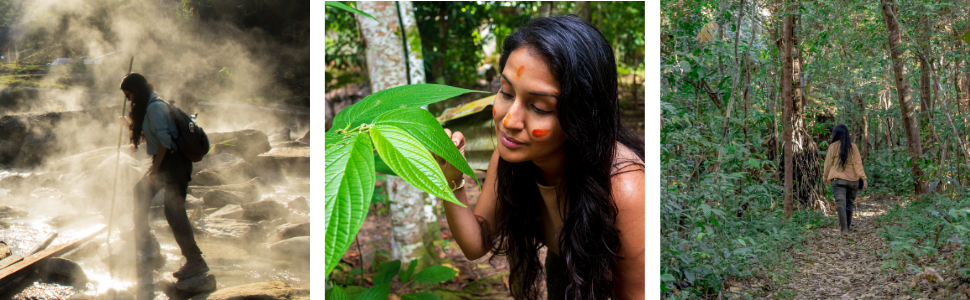
Dr. Rosa Vásquez Espinoza is a Peruvian and Andean Amazonian scientist, conservationist, TV presenter, award winning artist, and National Geographic Explorer that combines her curiosity with a deep-rooted passion for nature’s wonders. Today, Rosa travels to the most extreme
environments in the planet from the Amazon Rainforest to Yellowstone’s acidic, boiling waters to Alaska’s frozen lakes searching for new biodiversity and interconnecting science with indigenous knowledge to create
positive changes in the world.
Dr. Rosa is the founder and executive director of Amazon Research International (ARI), a foundation in Peru dedicated to advancing conservation and knowledge of Amazonian biodiversity and culture. In 2023,
Rosa was named Ashaninka International Ambassador to further amplify the voices of Amazonian communities and expand conservation efforts. In 2025 Rosa received the Order of Merit for Women for her work in conservation and biodiversity protection, the highest award Peru gives to
women.

 Everything Is Better With Dragons