
Published: March 21, 2019 by Two Roads
ISBN: 9781473661233 (ISBN10: 1473661234)
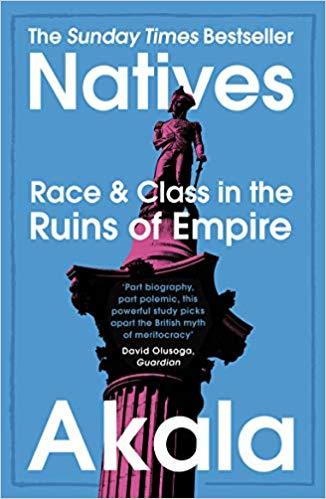
From the first time he was stopped and searched as a child, to the day he realised his mum was white, to his first encounters with racist teachers – race and class have shaped Akala’s life and outlook. In this unique book he takes his own experiences and widens them out to look at the social, historical and political factors that have left us where we are today.
Covering everything from the police, education and identity to politics, sexual objectification and the far right, Natives speaks directly to British denial and squeamishness when it comes to confronting issues of race and class that are at the heart of the legacy of Britain’s racialised empire.
Natives is the searing modern polemic and Sunday Times bestseller from the BAFTA and MOBO award-winning musician and political commentator, Akala.
My Review
I actually have two copies of this book. The one with the cover above and a yellow cover Left Book Club edition. I got the LBC edition last week and started reading it before I realised I had a copy on my TBR pile. I get a book every other month from Left Book Club, and I’ve been reading them slowly. I think I have a stack of books to read. I’ve given some away, I’ve managed to read two all the way through, and I’m currently reading 4 or 6, and I need to check my shelves to be certain how many I’ve got on my TBR pile. I like the variety.
On to this book.
Kingslee James McLean Daley, otherwise known as the rapper, musician, writer, scholar and activist, Akala, is a mixed raced Londoner. He is proudly both Jamaican (his paternal grandparents) and Scottish (his maternal grandmother’s family), and not at all bothered by his English family (because his English grandfather was an abusive arsehole and that side of his family refused to have anything to do with his mum after she fell in love with a man of Afro-Caribbean ancestry).
Despite race being a scientifically illiterate/illegitimate concept, as a social construct it is very powerful. Akala was five when he realised his mother was white and that meant something, while he was racialised as black, which meant something else. At primary school he had a mixed race group of friends, but as he went into secondary school, he found himself with only black friends. He was smart and educated, with supportive parents and an extended family, but was drawn into a culture of violence by social circumstance. He was 12 when he was first stopped and searched, on his way home from a Mathematics extension school during the summer holidays (he was a really good mathematician at school), and not long after saw his first stabbing, while waiting for his Saturday haircut. He had to ring the victim’s brother to let him know.
In this memoir, he explores his own childhood and puts it in the social and cultural context of modern Britain, exploring class and racism. He makes some very strong points about the continued effects of Empire, and the way racialised people are pitted against white working class people by the elites. If we weren’t divided by racism, a united working class could bring those bastards down.
I learnt things. Did you know that in the Black British population, it used to be that Caribbean people were the majority, but now it’s people of West African ancestry? Did you know that in the 1950s British Kenyans were rounded up and put in concentration camps and tortured, and that the British government has had to pay out compensation to their victims? Did you know that the Windrush generation saved their money to pay their passage to Britain and had British passports? Commonwealth/Imperial subjects were entitled to British passports until the 1960s, and even after that, people from colonies that had majority European colonists were still able to get British passports, it was only the African, Asian, and Caribbean colonials that were stopped from having British passports. Because racism. Did you know that after WWII, the government paid huge amounts so that Europeans and POWs would settle in the UK and actively discouraged people from the Empire/Commonwealth from settling, despite them paying for themselves, or even those who had fought for Britain during the war.
People like to forget that Imperial subjects fought alongside British soldiers in the wars, or that there have been African and Asian people in this country for about 2000 years (since the Roman Empire, possibly earlier, for the tin trade). Akala focusses on modern populations arising from the post-war migrations, because that’s his experience and education, and he doesn’t speak about the experiences of black women in the UK, I suspect for the same reason.
Akala backs up his points with statistics and actual data, government and academic reports and papers. He brings nuance to the topics he covers, usually working outwards from personal experience, to social and cultural factors, historical context, and statistics. While Akala is known as a musician, he actually teaches literature at universities. He knows how to make an argument and support it well.
I can think of a few people who need to read this book…
Highly recommended.

 Everything Is Better With Dragons