
Language : English
Paperback : 272 pages
ISBN-10 : 0241588227
ISBN-13 : 978-0241588222
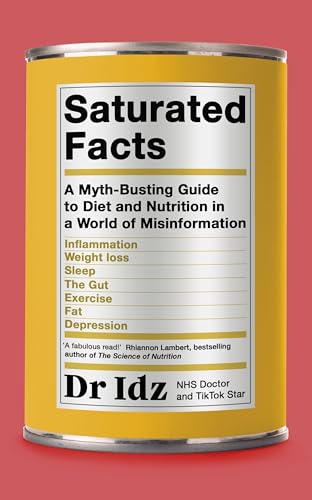
Are carbs the enemy? Am I getting enough protein? Should I worry about inflammation? Do calories count? And do any diets really work?
We are constantly bombarded with advice on how to live a ‘healthier’ life. From the benefits of intermittent fasting and the keto diet, to the growth of veganism and the dangers of inflammation, poor-quality, dubiously sourced information on how we can live and feel better is everywhere. But where should we turn for advice we can trust?
Dr Idrees Mughal (Dr Idz), an NHS doctor with a masters in nutritional research and a board certification in lifestyle medicine, has made it his mission to educate, inspire and empower the public when it comes to diet and lifestyle. His signature videos have attracted millions of followers online, and now he’s collected this wealth of information in his first book, Saturated Facts – your science-backed guide to living better.
Whether you’re looking to lose weight, sleep better, avoid disease or just have more energy as you go about your day, Saturated Facts is the comprehensive guide you need to make smarter decisions about your health.
My Review
This book arrived on publication day. I spent a couple of days reading and digesting it. There was a lot to think about. I’m interested in nutrition science, I’ve read a few other books on the subject, and I’ve even done a couple of level 2 nutrition courses. I like the science. The human body and how it processes food is fascinating and not generally as simple as people believe. It really is more complicated than individual nutrients and calories in-calories out.
I really liked the structure of this book, the references to specific studies and scientific consensus, and all the sources are listed at the back. There should always be sources! It made my brain happy to read this book. Dr Mughal makes the scientific papers legible to the non-specialist and lay reader (I did chemistry, biochemistry and geology, and I understand autism paper, everything else I need translating). I appreciate the effort. I also appreciate the author’s debunkings of myths.
A lot of the information wasn’t new to me, but the level of detail was, and I found that satisfying. The nutrition advice is sound, as far as I know and I generally eat quite well roughly following the advice, something I learnt years ago. I think this book would be really useful for people needing a clear explanation, backed up by named sources, before they engage in a change in diet.
I read a couple of statements in the book, also ostensibly supported by scientific sources, but which are actually a bit dodgy. In fact I found some of them rather upsetting and ignorant.
The first is a reference to Autistic people and faecal transplants, and how after a faecal transplant Autistic children showed ‘less autistic symptoms’. For a start that paper you referenced, Dr Idz, was from October 2005 and has already been debunked by better people than me. Common criticisms include: the children weren’t asked if it helped, their parents were asked for their subjective observations; the language used by the researchers was prejudicial and biased – comparing autistic children vs ‘healthy’ children; the researchers failed to consider the fact that autistic people often have gastric difficulties and limited diets due to sensory sensitivities so it’s hard for us to get balanced diets when we need our safe foods. If children are forced to eat food that upsets them either digestively or sensorily, they will have ‘more autistic symptoms’, because they’re in pain! Strangely enough, you’d probably be grumpy if you can’t eat something because it makes you want to vomit from the texture/taste/smell/sight (baked beans, mushy peas, avocado, I’m looking at you, or not actually because bleurgh) or because your belly hurts because you’re having a response to the food. Children don’t have the words, often, to specifically describe their pain or to work out the cause. This is especially true of those with other complex conditions or who struggle with verbal speech. Instead of giving us faecal transplants, try working out what’s causing the problems in the first place?
If you use a paper that’s so thoroughly wrong to make a point, why should I trust you’re other citations? I know about autism. I don’t know as much about nutrition, you could be bullshitting me and passing it off as scientific consensus. Also, the phrase ‘in mice’ is important in some of the cited papers about helping fat people be less fat.
On to the second one. Doctors and health care professionals generally engage in a lot of anti-fat bullying. I generally get nurses, for some reason, telling me I need to lose all the weight or I’ll get a horrible illness and die. Completely ignoring my genetics, my actual lifestyle, my medical conditions and neurotype. Doctors get funny when I need procedures that require anaesthetic (if you can mutilate healthy stomachs in the name of weight loss, you can do a fucking colposcopy under anaesthetic, stop being a dick about it). Doctor Mughal does in fact acknowledge the anti-fat biases of his colleagues but moves on extremely quickly and seems to push it off as a minor issue. On the subject of fatness he’s quite contradictory – it’s a disease that needs treatment, but also fat people are responsible for being fat, fat people are treated badly by doctors but doctors can’t help their biases.
And Dr Idz is no better than the rest of them on that count. He doesn’t question statements about fat people being more anxious (what do you think happens when people are bullied all their lives?) and doesn’t question the cause and effect of fatness and type-2 diabetes, even though genetics has been shown to be more of an influence than body size.
I’m fat so of course I must live on take aways and sit around all day. Who can afford to live on takeaways? Plus they upset my digestion. I probably have some sort of irritable bowel conditions (or as I call it ‘the anxiety shits’) and I have a hiatus hernia. Also, autistic food pickiness. I know what I can and can’t eat. But still, I like learning more about this stuff as a science-minded person. Don’t be too shocked, will you?
He also misunderstands the purpose of fat activism – it’s a movement for equality. Even if fat people lost that magical 10% of their starting weight, there would still be lots of fat people in the world, and we shouldn’t be excluded from participating in life, shouldn’t be denied healthcare and employment, and we shouldn’t be bullied because of ignorance and prejudices. That’s it. It’s not a difficult concept.
So, over all, watch it if you’re fat and kinda sensitive about stuff, because this book repeats a lot of the biased bollocks we already hear from HCPs, but when he sticks strictly to nutritional advice, Dr Idz really does a good job of explaining the science in an easily understandable way, with citations, mostly from the last decade, with a small number of exceptions (yes, I looked). I like citations, have I mentioned that.
I gave this book a 3/5 on GoodReads purely for the autism bollocks he repeated without question. I’d have got a 4 or 5 if he’d refrained from that and I hadn’t started questioning his sources.

 Published by: Icon Books UK

 Everything Is Better With Dragons