
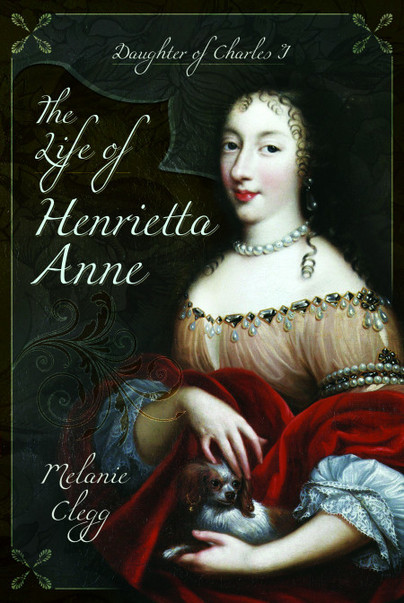
Published By: Pen & Sword
Publication Date: 25th September 2017
I.S.B.N.: 9781473893115
Format: Hardback
Price: £15.99
Blurb
Henrietta Anne Stuart, youngest child of Charles I and Henrietta Maria, was born in June 1644 in the besieged city of Exeter at the very height of the English Civil War. The hostilities had separated her parents and her mother was on the run from Parliamentary forces when she gave birth with only a few attendants on hand to give her support. Within just a few days she was on her way to the coast for a moonlit escape to her native France, leaving her infant daughter in the hands of trusted supporters. A few years later Henrietta Anne would herself be whisked, disguised as a boy, out of the country and reunited with her mother in France, where she remained for the rest of her life. Henrietta’s fortunes dramatically changed for the better when her brother Charles II was restored to the throne in 1660. After being snubbed by her cousin Louis XIV, she would eventually marry his younger brother Philippe, Duc d’Orléans and quickly become one of the luminaries of the French court, although there was a dark side to her rise to power and popularity when she became embroiled in love affairs with her brother in law Louis and her husband’s former lover, the dashing Comte de Guiche, giving rise to several scandals and rumours about the true parentage of her three children. However, Henrietta Anne was much more than just a mere court butterfly, she also possessed considerable intelligence, wit and political acumen, which led to her being entrusted in 1670 with the delicate negotiations for the Secret Treaty between her brother Charles II and cousin Louis XIV, which ensured England’s support of France in their war against the Dutch.
My Review
Henrietta Anne Stuart, born 16th June 1644 in Exeter, was the last child of Charles I Stuart and his French wife, Henrietta Marie Bourbon, daughter of Henri IV, during the height of the English Civil War. At the age of two she was taken to safety in France, where she joined her mother, who had escaped England just a week after Henrietta Anne was born. She only rarely visited England after her escape. Until the age of sixteen she lived as a poor cousin, dependant on the generosity of her aunt, Queen Mother, Anne of Austria and her cousin, King Louis XIV, in Paris, with her domineering mother. Sensibly, Henrietta Marie added ‘Anne’ to her toddler daughter’s name as soon as she arrived in Paris, to flatter their patroness. They lived in relative poverty, on the periphery of the French Court, waiting for news from England and trying to support the Stuart name, looked down on by richer, more fortunate cousins in France and Spain, with some help from their Dutch relatives in The Hague.
Devoted to her older brother, Charles, and all her siblings, Henrietta Anne was ecstatic when he was restored to the throne in 1660, but rarely saw him after. Their relationship was built and strengthened through extensive letters. Henrietta Anne advised and confided in her brother, working to bring about an alliance between England and France.
At the age of 16 she married Philippe, Duc d’Orleans, who had fallen dramatically in love with her, a match that only took place after Charles II was crowned, and she became one of the most eligible princesses in Europe. Moving from the periphery to the centre of the French court, Henrietta Anne became wrapped up in court intrigue and became a close adviser to Louis XIV. Her marriage went downhill after the first few months as Philippe proved to be a jealous and inconstant lover. He was egotistical and self-centred, blaming Henrietta Anne for his own faults and set-backs. His behaviour became emotionally abusive after her started a relationship with the Comte de Lorraine.
She died in 1670, leaving the French and English courts grief-stricken. Rumours spread that she had been poisoned by her husband or his male friends, although a post-mortem suggested she had died from a burst stomach ulcer. She was buried in magnificent state in Saint Denis six weeks after she died.
I didn’t know much about any of Charles I children, other than Charles II, until I picked up this book. I feel generally more informed about the period and the family now. It presents her life in a chronological order, and provides an insight into the social milieu in which she lived, as well as her character, using letters written by Madame and her contemporaries.
This book was well-written and easy to read, fairly comprehensive and should appeal to a wide, non-specialist, audience.
My sister has added it to her ‘To Steal from Rosie’ list.
4/5

 Everything Is Better With Dragons