
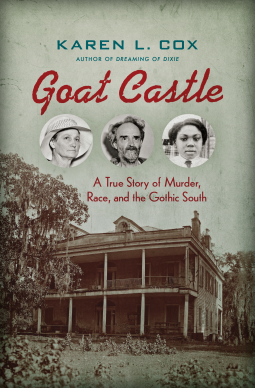
 Published By: University of North Carolina Press
Publication Date: 9th October 2017
I.S.B.N.: 978146963503
Price: $26.00
Format: Hardcover
Blurb
In 1932, the city of Natchez, Mississippi, reckoned with an unexpected influx of journalists and tourists as the lurid story of a local murder was splashed across headlines nationwide. Two eccentrics, Richard Dana and Octavia Dockery—known in the press as the “Wild Man” and the “Goat Woman”—enlisted an African American man named George Pearls to rob their reclusive neighbor, Jennie Merrill, at her estate. During the attempted robbery, Merrill was shot and killed. The crime drew national coverage when it came to light that Dana and Dockery, the alleged murderers, shared their huge, decaying antebellum mansion with their goats and other livestock, which prompted journalists to call the estate “Goat Castle.” Pearls was killed by an Arkansas policeman in an unrelated incident before he could face trial. However, as was all too typical in the Jim Crow South, the white community demanded “justice,” and an innocent black woman named Emily Burns was ultimately sent to prison for the murder of Merrill. Dana and Dockery not only avoided punishment but also lived to profit from the notoriety of the murder. In telling this strange, fascinating story, Karen Cox highlights the larger ideas that made the tale so irresistible to the popular press and provides a unique lens through which to view the transformation of the plantation South into the fallen, gothic South.
My Review
The murder of Jennie Merrill, at her Natchez, Mississippi home Glenburnie, in 1932 was something of a mystery, but right from the start her neighbours Dick Dana and Octavia Dockery were suspects in the robbery-murder. They enlisted the help of George Pearls, also known as ‘Pinkney’ Williams, in a conspiracy to rob the house of their 68-year-old neighbour. Emily Burns, with whom Pinkney Williams was boarding, was brought in to the conspiracy by Pearls/Williams when he asked her to join him for an evening walk.
After the murder, Dana and Dockery were arrested but after some time they were released on their own recognisance. Emily and ‘Pink’ weren’t so lucky. ‘Pink’ was shot dead by a police officer on his way back to Chicago and his wife. Emily was arrested, with her mother, and imprisoned for several months before she went on trial. Despite being outside and an unwilling accomplice, Emily is found guilty of murder although her sentence is reduced from hanging to life imprisonment.
Eight years later, she was released by the Governor of Mississippi, and spent the rest of her life as a seamstress. Dockery and Dana remained in their rotten mansion with their goats, pigs and chickens until they both died. Dana had inherited the mansion but hadn’t paid taxes and the house belonged to other people who regularly tried to evict the pair. Through Dockery’s tenacity, lies, and, acting skills, they managed to keep the house and land. After they died, the owners sold the land to developers. They, and their ‘Goat Castle’ are remembered while the victims – Jennie Merrill and Emily Burns – are forgotten.
There have been other books about the Merrill murder, but most focus on the infamous Goat Castle and the odd couple that lived their; this book brings in the darker side of Southern U.S. society during the post Civil War/pre-Civil Rights era. While the local Sheriff, Book Roberts, after finding Dana and Dockery’s fingerprints in blood in Merrill’s home, and knowing the history of conflict between Dockery and Merrill, was certain of their guilt and tried to have them convicted, local white society was not going to let that happen and decided to find a black scapegoat.
Since George Pearls/Lawrence Williams was dead, someone had to be punished. Emily Burns, a launderess, who had gone for a walk with a man she thought was a potential partner (she didn’t know he was married or that he was using an alias), and got dragged into a robbery/murder conspiracy, was that scapegoat. There was no justice for a black woman in Jim Crow Mississippi, she was threatened with a bullwhip and forced to make a confession after several months of intense interrogation. Her trial was a day and a half farce; the jury took thirty minutes to find her guilty. A white woman, found guilty of the same charge around the same time – accessory to murder – and sent to prison on the same day, was given a seven year sentence compared to Emily’s life sentence.
This is a really interesting case, but the racial aspects of it have previously been overlook; Cox brings these aspects back into the narrative, sensitively discussing the subject. Cox researched the case, using newspapers and the archives of historical associations, and spoke to Natchezeans, some of whom knew Emily Burns for first hand information, including the only known photograph of Emily Burns. The writing is easy to read and flows well as the author switches between each of the principle participants’ lives. There are a few photographs but a map of the area would have been helpful, for someone who is not a native of the area.
4/5

 Everything Is Better With Dragons