
 Published By: Pen & Sword
Publication Date: 5th September 2018
Format: Paperback
I.S.B.N.: 9781526736185
Price: £10.39 (normally £12.99)
This is one of the new books Pen & Sword have sent me to review (Thanks to Rosie Crofts, Digital Marketing, Pen & Sword). There will be a few coming up, as I have four more in this delivery, nine in a delivery due today, and two or three more on order. What can I say? I do enjoy their books. Next up will be Murder, Madness and Mayhem by Kathryn Burtinshaw and John Burt.
Blurb
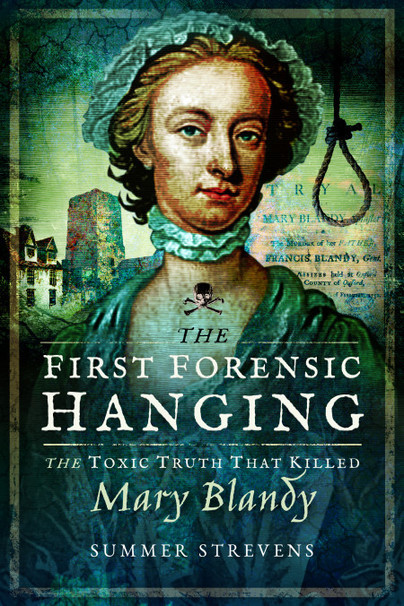
‘For the sake of decency, gentlemen, don’t hang me high.’ This was the last request of modest murderess Mary Blandy, who was hanged for poisoning her father in 1752. Concerned that the young men in the crowd who had thronged to see her execution might look up her skirts as she was ‘turned off’ by the hangman, this last nod to propriety might appear farcical in one who was about to meet her maker. Yet this was just another aspect of a case which attracted so much public attention in its day that some determined spectators even went to the lengths of climbing through the courtroom windows to get a glimpse of Mary while on trial. Indeed her case remained newsworthy for the best part of 1752, for months garnering endless scrutiny and mixed reaction in the popular press.
Opinions are certainly still divided on the matter of Mary’s ‘intention’ in the poisoning of her father, and the extent to which her coercive lover, Captain William Cranstoun, was responsible for this murder by proxy. Yet Mary Blandy’s trial was also notable in that it was the first time that detailed medical evidence had been presented in a court of law on a charge of murder by poisoning, and the first time that any court had accepted toxicological evidence in an arsenic poisoning case. The forensic legacy of the acceptance of Dr Anthony Addington’s application of chemistry to a criminal investigation is another compelling aspect of The First Forensic Hanging.
My Review
Excuse me if this makes no sense, my hands aren’t functioning at all today.
A short book (125 pages + 27 of bibliography and index) covering the life and death of Mary Blandy. Whether through ignorance and induced by her fiance William Cranstoun, or knowingly, Mary fed her father Francis arsenic in his tea and gruel, killing him painfully and slowly over three months in 1751. Several servants were also taken ill, two with long-term effects, as a result of eating or drinking poisoned leftovers. It was servants who helped bring about her arrest, however, saving the deadly gruel and a packet of mysterious powders thrown into the kitchen fire.
She was hanged for Francis’ murder after the jury decided she’d intended to kill him, although she vehemently claimed that until after the poison took effect she believed she had fed him a ‘love philtre’ sent by her fiance Captain William Cranstoun, to sweeten her father towards the Captain. Captain Cranstoun was impecunious and clearly after Mary Blandy’s rumoured £10,000 marriage portion, he was also already married and had a daughter.
It was the first case in which medical men were expert witnesses at a trial, and although Dr. Anthony Addington’s analysis wasn’t brilliant and certainly wouldn’t hold up today, it was the best they had at the time (no Marsh test for another 80 years) and the beginning of medical jurisprudence in Britain.
Strevens does a good job of bringing this case to life, using the many, many contemporary documents (pamphlets published during her imprisonment and for at least a year after her death, including one written by Mary, and another by Cranstoun) and exploring the consequences for medical jurisprudence and the social context of this murder, as well as imagining what would have happened had it taken place today.

 Everything Is Better With Dragons