
This is a long one, get comfy. I don’t talk about personal stuff much now, since my blog has evolved into a book blog from a general/mental health blog.
For the first time in 18 months, I weighed myself today. Last time I got weighed was at the start of 2020 when I was weighed at the start of a ‘get active’ programme with the local leisure centres, where I started swimming two to three times a week, and then a ‘weight management programme’ a few weeks later.
I will be talking about weight and BMI, so if that’s not a happy thing for you to think about, probably best not to read on.
I haven’t lost or gained any weight, but apparently I’m 6 centimetres shorter than I was in February last year…

I think the machine is broken. I’m 177cm tall.
Ignore the ‘female’ bit, it’s not relevant but I had to choose one.
The BMI calculation is wrong, too, because it used the wrong height. BMI is bullshit anyway. We all know that. Or we should do. If you don’t, here’s a list of podcasts to listen to:
Don’t know about the fat percentage. Those machines aren’t known for being incredibly accurate.
Being me, I looked up what the NHS says about BMI and weight.
https://www.nhs.uk/live-well/healthy-weight/bmi-calculator/

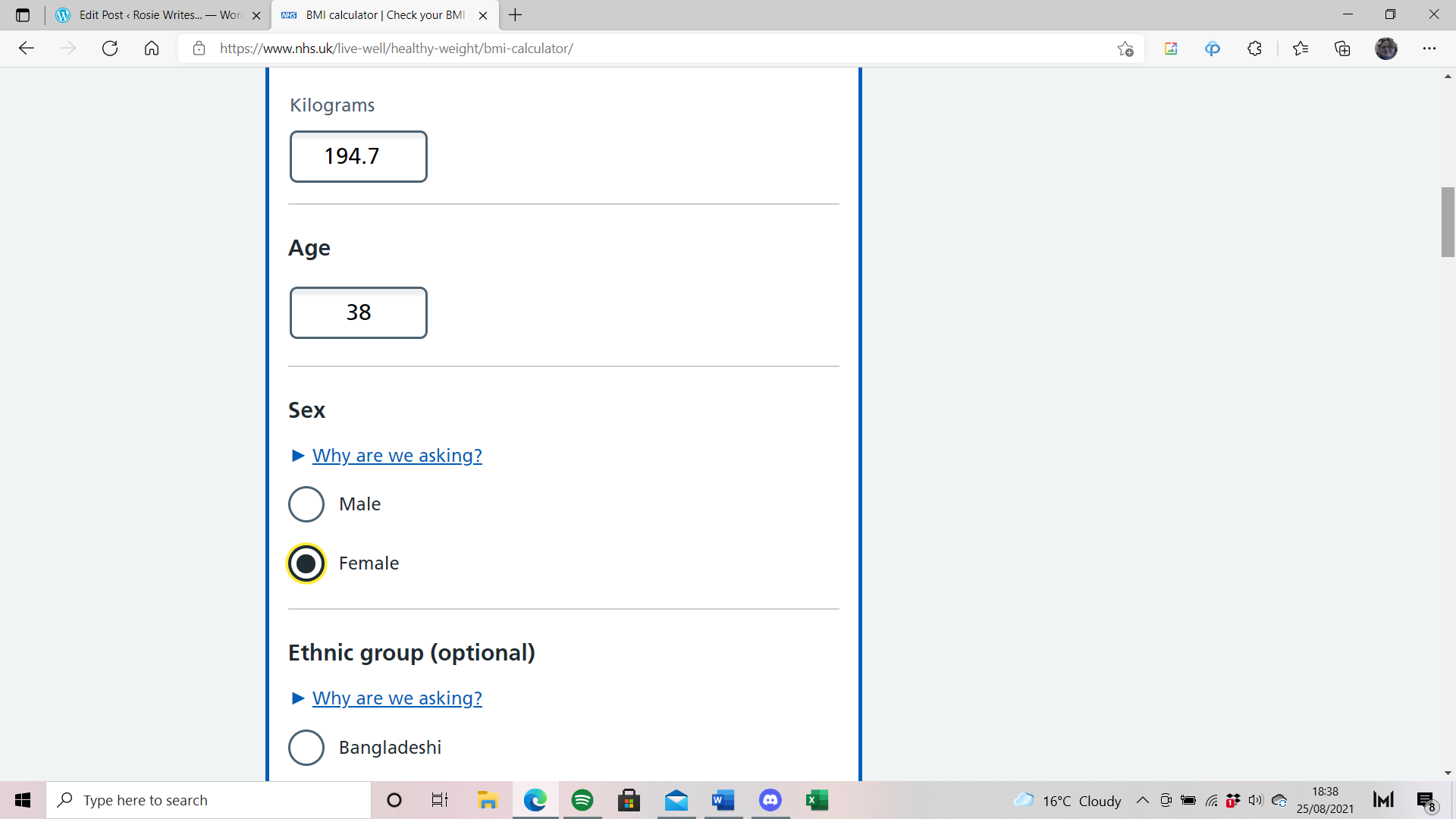

According to the NHS website I am Active. I do between 4 and 6 hours of exercise a week, mostly walking and swimming. I’d do more but I have to work and I don’t have the energy to go to the pool more than twice a week even if I didn’t have to work (paid and unpaid).
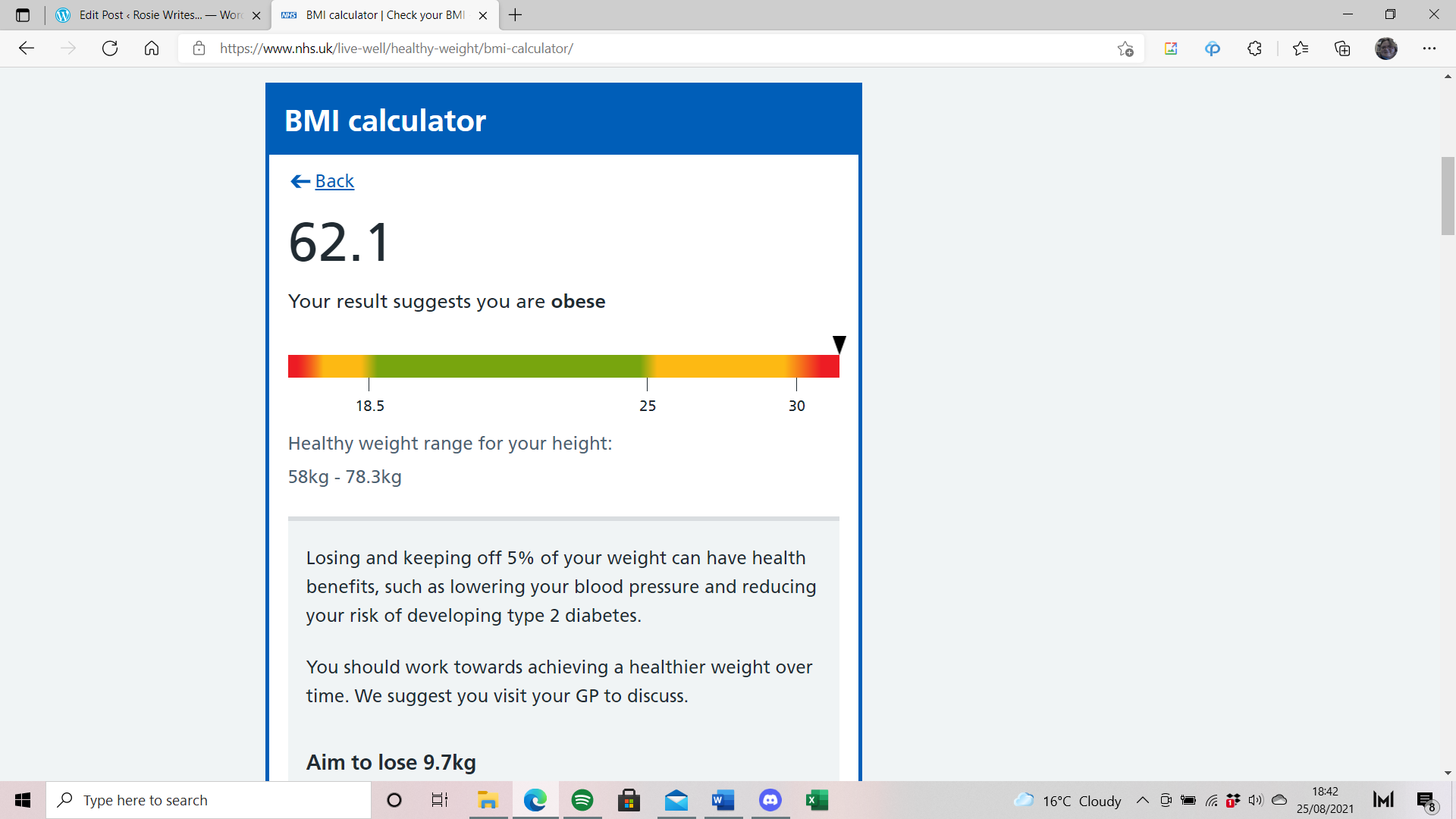
So here’s my NHS BMI result. I know, it’s really high.
Here’s the thing, BMI is a ratio of height to weight. It says nothing about health. Weight is mostly genetics. Health is mostly genetics. Environment, socio-economic status, childhood and family, trauma, etc. are greater determinants of health than what weight and fat.
It was never meant to be used for individuals, only ever populations as a whole. The original work, from 200 years ago, showed that populations show a bell shaped curve with height and weight. It was done on a small number of Belgian men. It was used in the US as a way to calculate insurance premiums.
The values for the different weight categories are entirely arbitrary. In the late 1980s the WHO shifted the categories AGAINST THE ADVICE OF THEIR SCIENTIFIC ADVISORS. Overnight millions of people went from being ‘normal’ to being ‘obese’. Why? Because money and fatphobia.
Even the NHS recognises that the BMI has limitations.
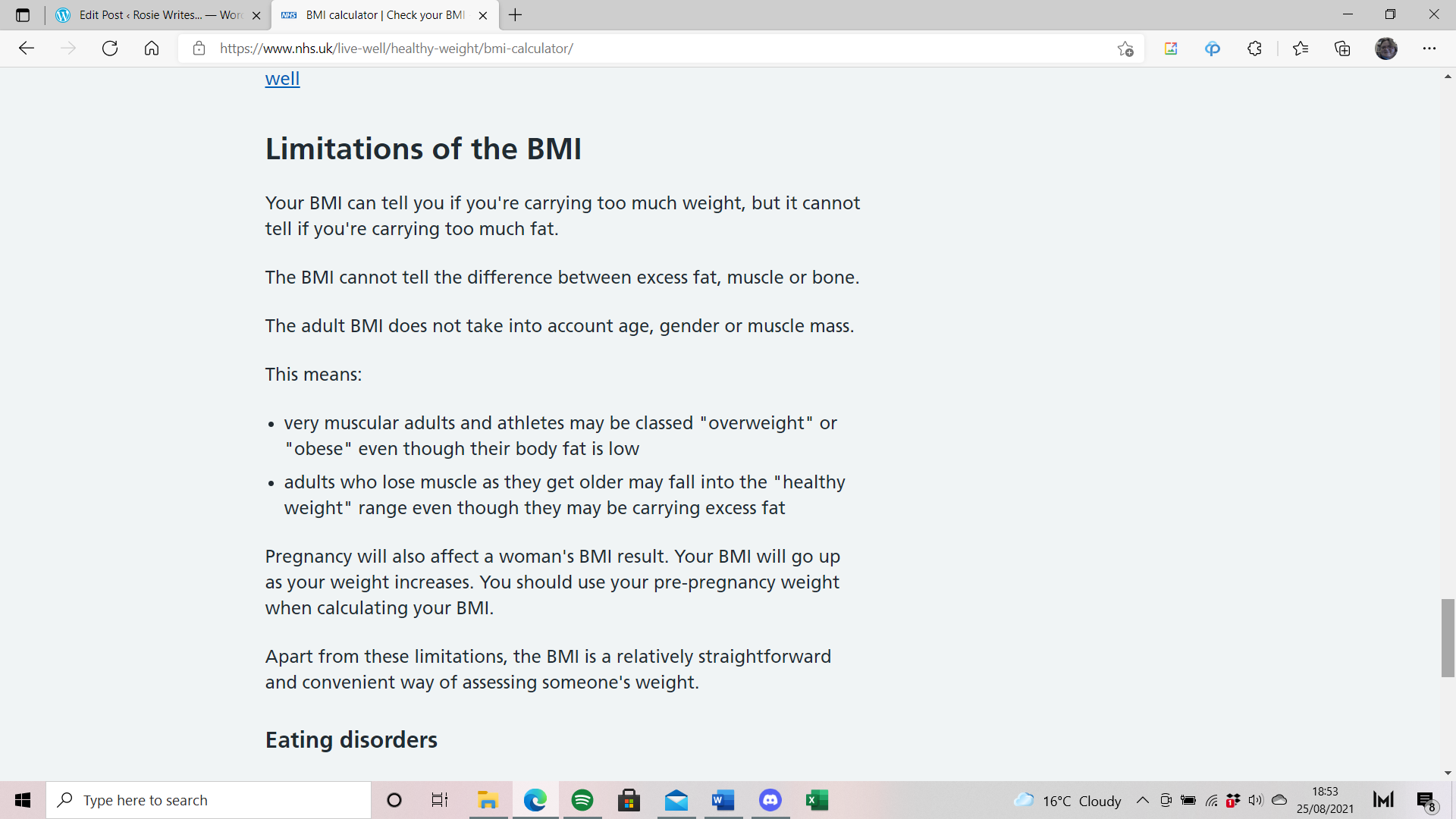
I have some questions:
If the adult BMI doesn’t take into account age, gender or muscle mass, why ask about age, gender and activity levels?
If ‘the BMI is a relatively straightforward and convenient way of assessing someone’s weight’, what are you assessing? You could just weigh someone. It doesn’t tell you anything other than the ratio of height to weight. It doesn’t tell you anything about a person’s health. If they suddenly start gaining or losing weight and they’re doing nothing different, that’s a cause for concern, whatever their starting weight. Not checking if you suddenly start losing/gaining weight can lead to a preventable death.
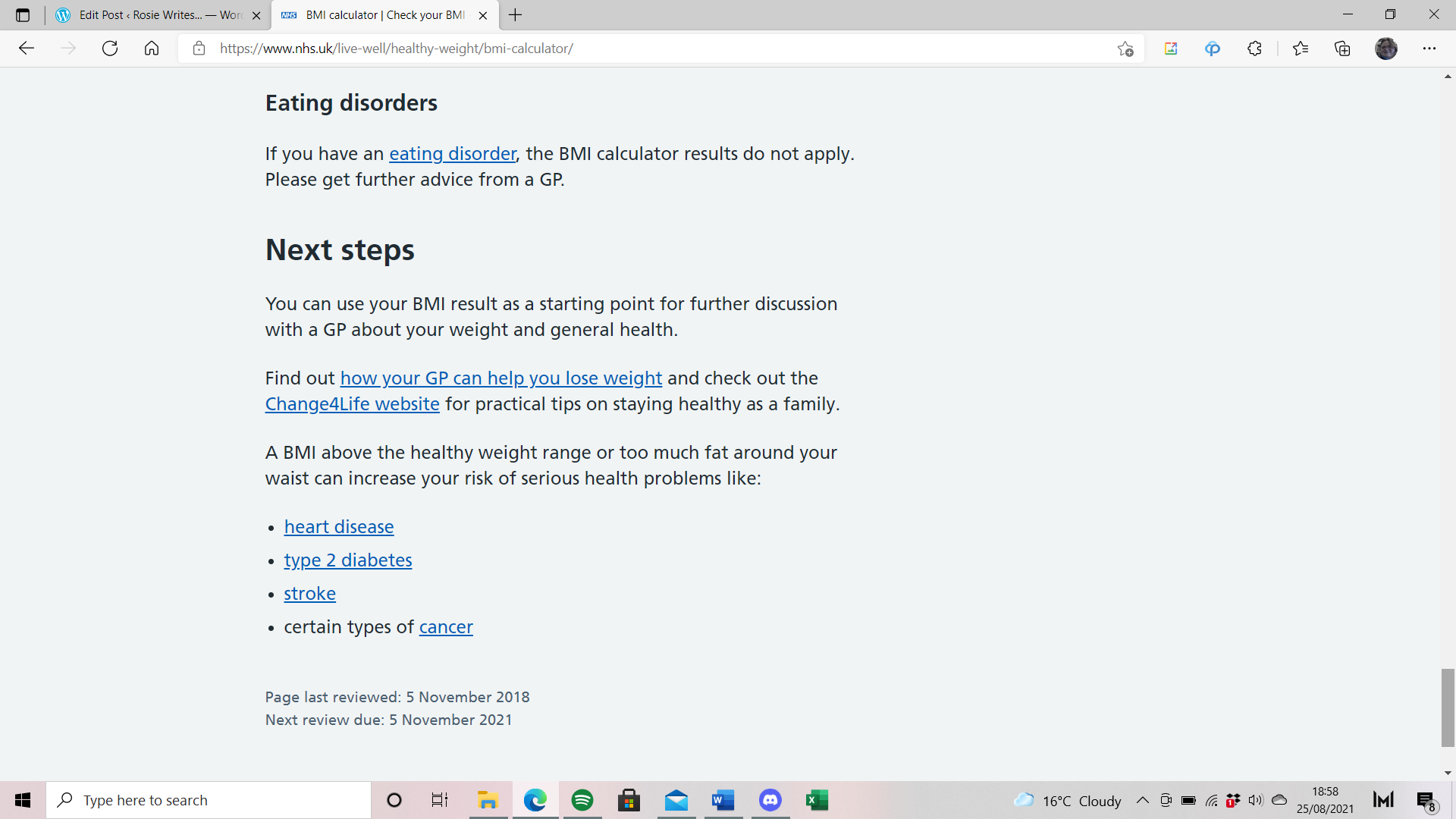
So, as soon as you get passed the ‘limitations’ section, it goes straight into ‘lose weight’. It also makes the same false correlation/causation with illness and weight. Sleep, stress and genetics are a greater risk factor for heart disease, etc. than weight. It doesn’t also help that fatphobia in medical professionals means many diseases are missed in fat people and for many people the trauma of fatphobia from health care professionals means people delay going to the doctors. Medical fatphobia kills.
Only about 5% of people who lose weight can keep it off long term. Weight loss is hard, and gets harder the more you try, because your body doesn’t know the difference between starvation and intentional weight loss. If you’re ‘mentally’ restricting, your body will act as though you are starving. Add in the guilt and shame, and it’s a recipe for mental health disaster.
At the same time I started going swimming regularly again, early in 2020, I was also ‘socially prescribed’ to an NHS weight management programme run by ABL Health. Two weeks ago I discharged myself from the programme. The reason I agreed to the programme in the first place was because I was told there would be psychological support before any weight and diet programme.
I have some psychological issues with food. I started putting on weight when I started school full time. I think I used food as a coping mechanism, firstly because I didn’t eat much of the food at school dinners, except the mashed potatoes or custard. My ability to eat mash was quite impressive as a 6 year old, and it made me ‘popular’ with other kids. I had no friends and didn’t know how to make friends, so for the time I was getting attention for eating mash in vast quantities I thought it was a good way to make friends.
It wasn’t. The same people who were fun when we were in the dining room were vile in the playground once I started gaining weight.
I was a tall, broad shouldered child. I turned into a tall, broad-shouldered, big boobed, wide-hipped adult after puberty. I could carry the weight, and I needed to because if I was my ‘ideal weight’, I’d look emaciated. My ‘ideal weight’ for my height is less than 10 stone. 10 stone! I’d need to lose 2/3rds of my body weight to reach that. It isn’t physically possible or healthy for me to try to do that.
Anyway, as I got older I used food to cope with my emotions and being overwhelmed by school and life in general. I also started going on diets and restricting from an early age. I think I was told when my great aunt niggled at me for being fat, and when I said I was on a diet, like mum, she turned around and said “Yes, a see-food-and-eat-it diet.” It took me years to understand what she meant by that, I thought it was something to do with sea food. Autistic processing. Anyway, it triggered the self-hate that lasted 25 years. It contributed to my mental health problems. It continues to contribute to my mental health problems.
So thanks for that, Auntie Rita, the school nurse who kept weighing me at secondary school and all the little bastards who thought and think it’s funny to bully me for being fat. If I’d given into my suicidal ideation, would that make you happy? Better dead than fat, hey?
I did Slimming World and Weight Watchers a few times, by prescription on occasion. I think in a decade I lost and gained the same two stone eight times. In those years I obsessed about food and exercise. I was also working full time in jobs that were not suitable, financially unstable, going to archery two to four times a week, looking after an allotment and walking four dogs daily. I was constantly exhausted and mentally distressed. Focusing on food and exercise helped me feel in control to a certain extent, but I was still getting bullied for being fat and not liking group exercise at work.
In 2014 I lost my job and was forced to move out on my own. The financial stress increased and my food was restricted due to poverty. That lasted for five years. In 2017 I became vitamin B12 and D deficient as well as anaemic. I went on supplements and tried to improve my diet, but it was hard with no money.
In 2019 I finally got awarded PIP and Support rate ESA. I finally had money for food! I was constantly hungry and would eat everything I could buy. So much chocolate and take-aways was eaten in 2019. Unsurprisingly, I put on weight. Or I think I did. My clothes got tighter and in December 2019 I had a well-woman appointment where the nurse told me off for putting on ‘so much weight’. I also got yelled at for my blood pressure. Which didn’t help my blood pressure.
I felt the pressure to ‘do something about it’ from health care professionals.
So, given my complex relationship with food, my history of dieting and weight cycling, restriction, binging and over-exercising until I injure myself then not exercising at all, I needed the psychological help. But the ABLHealth programme only gives you six sessions with a psychologist before the 1 year standard diet and exercise programme. It takes more than six weeks for me to trust a person enough to open up about these things.
I needed long-term help. I don’t qualify for eating disorder support, because I don’t have an eating disorder, although I have disordered eating, and because I have a high BMI. If you’re fat it’s really hard to get eating disorder support. The stuff that gets a person who is underweight, according to the BMI (even if they’re naturally small – I know a few people like this), sectioned and forced into eating disorder in-patient care, is actively encouraged by doctors and society in general in fat people.
I still need long-term help; the ABLHealth diet and exercise programme that followed the highly truncated psychological support triggered the disordered eating I’d learnt in years of dieting. I had to do food diaries. Food diaries mess with my mental health. I do two things: lie or severely restrict and obsessively exercise. None of that is healthy or comfortable for me.
I also did a couple of nutrition courses last year, which required food and exercise diaries. Those made me ill too. I told my ‘weight management advisor’ that I needed to find another way to do things because of the way it damages my mental health. She suggested a ‘portion plate’ and taking photos of what I’m eating so she could see and advise me. I tried her suggestions.
I got a bit obsessive about it, especially after I discovered the ‘Health’ app on my phone. It lasted a while until I crashed and binged because I had a minor confusion with a friend. If I hadn’t been focusing so much on food and exercise I’d have had the emotional energy to deal with my emotions. I also obsessively exercised. Two days a week I go swimming, and three days a week I did a walking exercise programme at home. When the pool was closed and I was scared to leave the house, I did the exercise programme every day. I injured myself doing that. So I had to stop. I felt awful for not exercising enough. MY mental health again tanked. I felt like a failure because I couldn’t exercise and I wasn’t losing any inches off my waist.
I was supposed to weigh myself weekly and report to the advisor, along with my SMART goals for diet and exercise. They worked on the assumption that programme participants didn’t know about food portions, sugar, food labels, exercise etc. You know, the stuff that anyone who’s ever been on a diet knows all about. They assumed I was ignorant and stupid. I don’t have scales in my house, because they trigger my restriction/over-exercising – binge/injure self cycles. To satisfy their need for data I had to measure my waist. I lost 8 to 10 cm over a year. I felt crap if I didn’t lose or gained any centimetres, like a failure.
Since the Well-Woman appointment where my blood pressure was made so much of, I had acquired a wrist blood pressure monitor and had been recording the results religiously. Adding the waist measurements to the spreadsheets was easy. I now have a complex Excel spreadsheet with blood pressure, WHO classifications, pulse, waist measurements, and more recently my waist to hip ratio. I sometimes get obsessive about doing my measurements. I try to keep it to once a week at most or I get really restrictive. My brain gets weird and I don’t like it.
About the same time I started going to the pool regularly and had the psychologist’s appointments, early last year, I started looking into HAES, anti-diet culture, fat activism, weight stigma and nutrition. Thus the two distance learning health and nutrition courses, and much, much reading/listening. It started in 2019, after reading The Fuck It Diet, by Caroline Dooner. I think I read it early in 2019 and hoped that the ‘psychological support’ aspect of ABL Health would be a continuation of some of the ideas in that book. I’m currently reading The Anti-Diet Revolution by Alexis Conason Psy.D that focuses on mindful and intuitive eating. That has been so much more helpful.
Given the amount of psychological distress the programme caused and the reading I’d done, I emailed to discharge myself from the weight management programme. This was my email. I’ve removed names.
Good evening #,
I’m sorry I missed your call on Monday, I was dissociating at the time from anxiety and exhaustion. It’s a right barrel of laughs when that happens and safest for me to stay in bed.
I have decided to discharge myself from ABL’s services. It has not been an easy decision and I don’t want you to think that you’re support has been less than stellar; I have come to this decision because in the last year weight management and health have become an ‘Autistic Special Interest’ of mine, and I have the scientific background to understand the data. Given my knowledge, I cannot remain on a programme that is not going to work and is unsupported by science.
I also won’t remain on a programme that helps to gatekeep healthcare for trans people. If a person is able to undergo bariatric surgery that involves mutilating healthy organs and has a 4% chance of death in the first year, then they can undergo gender confirmation surgery and putting a BMI maximum on the surgery is blatant gatekeeping, and immoral.
The ABL programme is based on flawed thinking that isn’t supported in the literature. Despite the consensus that labels healthy fat people as part of an ‘obesity paradox’, it is possible to be healthy and fat (about 32% based on current research). Healthy in that I have blood pressure below 130. Healthy in that I’m not diabetic. Healthy in that my waist to hip ratio is below 0.95. As suggested by Matthias Schulze1, an epidemiologist who studies risk factors for heart disease and diabetes at the German Institute of Human Nutrition and his team who put forward a new definition for so-called ‘Metabolically Healthy Obesity’. Body weight is up to 80% genetics, with environmental factors such as pollution and socio-economic status having a much greater role than day-to-day eating. It also uses a metric, the BMI scale, that is comprehensively unscientific, has no basis in reality where health is concerned and has actually been condemned by the All-Party Parliamentary Committee on women and Equality as being a major contributor to Eating Disorders. Sugar, contrary to the course documents, has not been shown to be statistically significant where the development of type-2 diabetes is concerned, in fact environmental stressors have a greater correlation. It is also extremely difficult to ‘exercise off’ ‘excess’ calories – the body uses a maximum of about 3000 to 3500 Kcals a day2, if you exercise excessively in order to lose weight all you do is force your body to shut down other functions. Extreme weight loss has been shown to damage the metabolism, which doesn’t recover to pre-weight loss levels even after several years and diets don’t work 95%3 of the time. I know I’m not going to be in the 5% that somehow manage to fight their biology and keep the weight off. Been there, done that, screwed up my relationship with food and exercise far too many times.
I needed help with my tendency to forget to eat for eight to twelve hours and then binge until I was ill. I haven’t found that help using ABL. I’ve had to work it out for myself, using resources I’ve found in the last year. I needed help repairing my unhealthy relationship with food, caused by years of dieting and weight-loss programmes. Writing food and exercise diaries triggers those disordered patterns, even photography, because documenting things throws me back into the same patterns and thoughts, I start intentionally restricting and then binging. I’m not going there again. I won’t. I have new information compare to March 2020 when I was referred ABL Health via social prescribing, that tells me the programme won’t work long term and I don’t want to waste your time or mine. I am going to look for a HAES and Mindful Eating programme if one is available in the area, or I’ll keep working on things alone.
Thank you, to you, # and # for your support in the last year, but clearly I am not the target audience for ABL. This is not on you. I know the programme is based on current, fatphobic, guidelines which place a heavy emphasis on BMI and aesthetics, and you are only following your training; I hope my feedback will be useful to you (as in yourself # as an individual coach, and ABL as an organisation) in developing in future.
I think I was polite and honest. I probably won’t make any impact on the way they deliver the programme. I got a stock email response a week after I sent it. It was carefully bland.
So, what have I learnt 18 months on?
I haven’t put on any weight, going swimming has helped my blood pressure, my waist has got smaller but my hips are what they are and won’t change, and I have a lot of work to do on my relationship with food and exercise. The ‘Active Forever’ programme with the leisure centre was a success. The weight management programme from ABL Health was a failure, a diet by another name, and diets don’t work. I’ve just done a fundraiser for Alzheimer’s Society, swimming 5 miles in 30 days. I did 6 miles and if you really want to help, here’s the link to donate:
https://www.justgiving.com/fundraising/SwimforDementia-RosemarieCawkwell
My next swimming goal is 40 lengths in an hour. Today I managed 37 lengths in an hour. I think I’m getting marginally faster although the faster I get the more uncoordinated I get. I swim breaststroke. If I try front crawl I half drown myself. Ah, the joys of being Autistic!
Final thoughts: have a listen to the podcasts, address your fatphobia and BMI is bullshit.
References (the short list)
- Obesity doesn’t always mean ill health. Here’s what scientists are learning | Science | AAAS (sciencemag.org)
- Burn, by Herman Pontzer
- The Diet-free Revolution, by Alexis Conason Psy.D


 Everything Is Better With Dragons
1 Comment