This morning I woke up to an email from my lettings agent. It was a section 21 eviction notice. I have until 7th July to find somewhere to live.
Now, some people might think this is normal, but I’ve lived here almost 9 years, paid my rent on time and in full every month, I’ve looked after the house, improved the garden, and alerted them immediately to any issues. It’s an old terrace built cheaply 1913, it has a lot of issues. And the landlord has agreed to all the smaller issues but put off the big stuff. Like the leaking roof and the damp. About 3 weeks ago, the lettings agent said that the agreed that he’d have the big work done but my rent would go up £100/month. I agreed. I could just afford that if I cut back on everything, including my once a year holiday – FantasyCon weekend. Then this…
Tomorrow the Renters Rights Act comes into force. Today was the last day he could issue a Section 21 notice and have it be valid. From tomorrow, section 21 evictions are scrapped, and the house has to be kept up to a certain condition.
My conclusion is that he’s seen the estimates to do the work to get the house up to standard, realised he would need to find a good reason to get evict after tomorrow, and decided to drop this on me when I have limited recourse.
I can’t afford to move. Even a reasonably cheap place would still need about £1300 for deposit and 1st month’s rent. And then there’s moving costs, probably £600 – £700 for removals and a house clearance once I’ve moved the stuff I’m keeping. Plus, I need a new bed, because it’s falling apart and new living room furniture, so add another £700 on to that. Anyone got a spare £2500 lying about they can lend me? Or donate?
I am disabled, most of my family are disabled or elderly. I have a lot of books. It took me a year to physically recover from moving in 2017, and two years to recover mentally. I’ve only really been stable for the last year or two. I’m starting to unravel a bit.
I’ve contacted the local council homelessness prevention team, checked the social housing website and contacted my social prescriber key worker. My sister has been for a visit. She found a contact for someone who does house clearances which she’ll phone next week and we cleared a kitchen cupboard that I can’t get to.
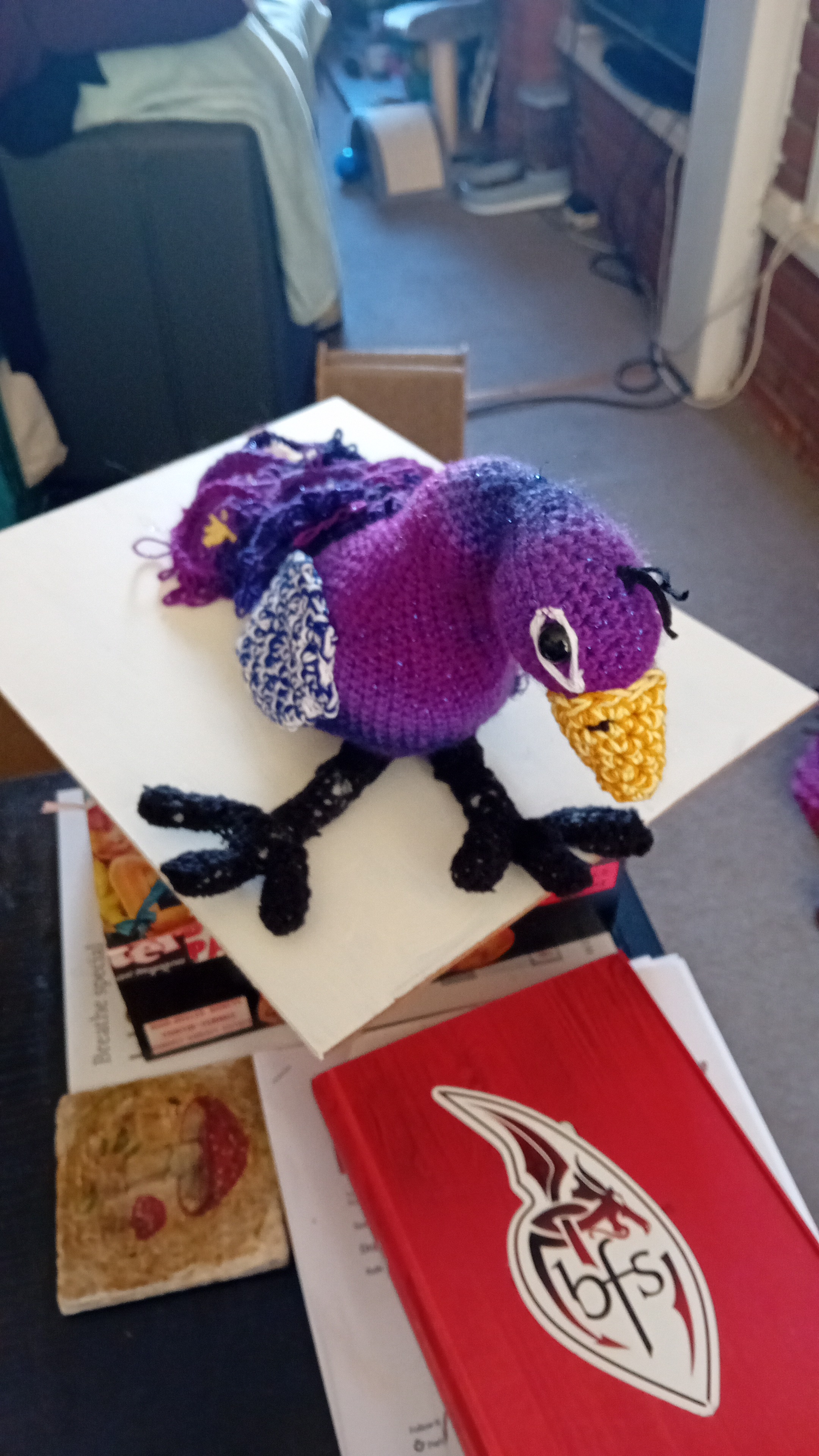
Doing practical things has helped but I’m still not coping well. My brain is not happy. All I can think about is how an I going to afford the deposit? How am I going to move all my books? Phoenix won’t like being moved; I’ll need to get her a crate for the move.
Any helpful suggestions or donations welcome. Thanks.
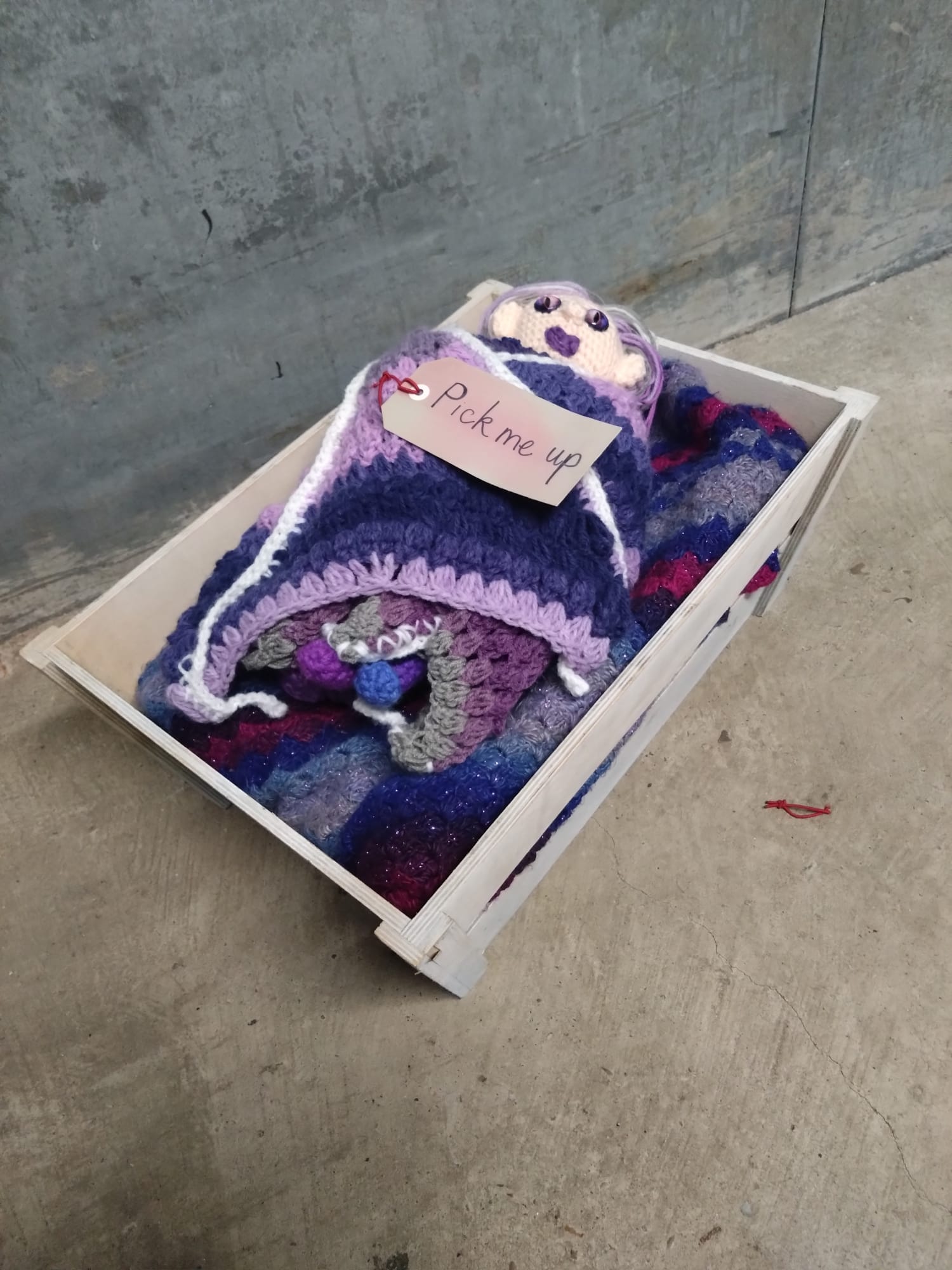
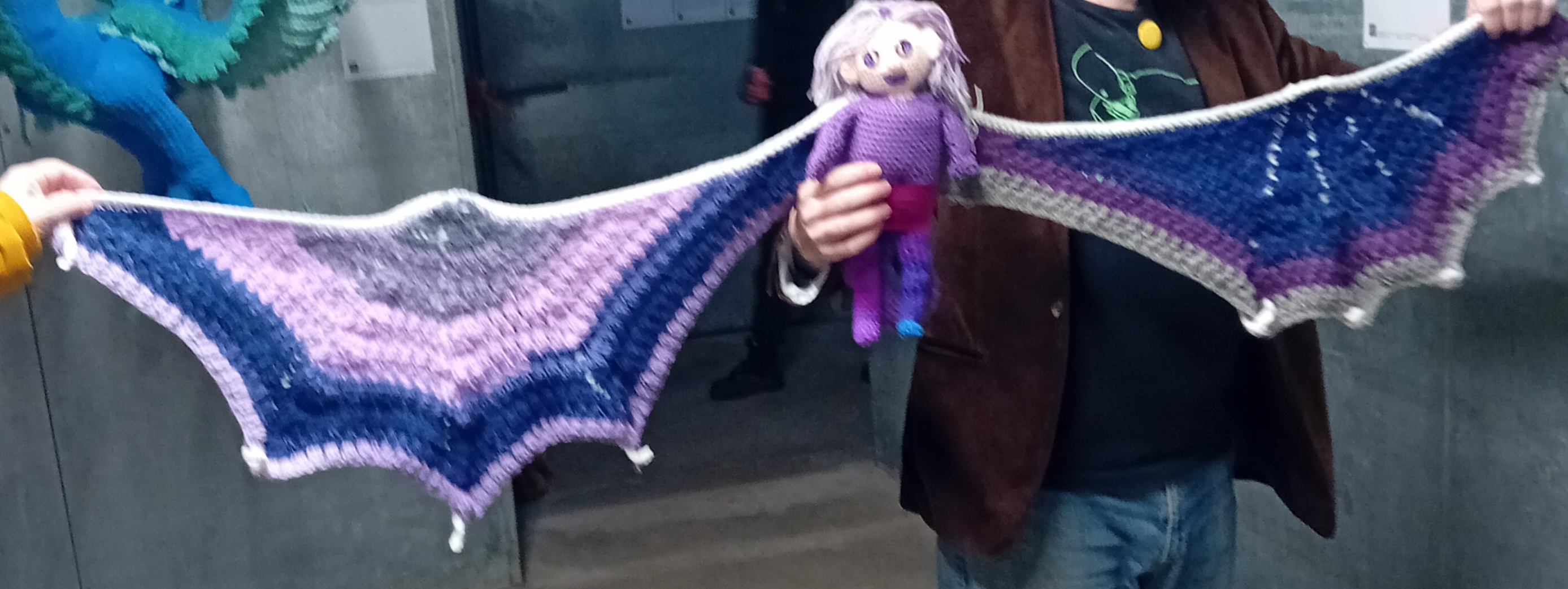
August was a busy month, with four blog tours and going to Autscape at the beginning of the month for work. I also needed to finish a crochet project for an exhibition at TT88 on 30th August, and a short story that I needed to finish and submit to Humber SFF by today.
I’ve also been reading books for the BFS Awards. I’m a judge for the Best Collection award. My fellow judges and I decided to have a deadline of 1st September, so I’ve been fitting them in around my tours. I also needed to read a book for a tour tomorrow.
The last week of August was very successful. I completed the crochet project, finished reading three books, and the short story.
I have other news, quite big news.
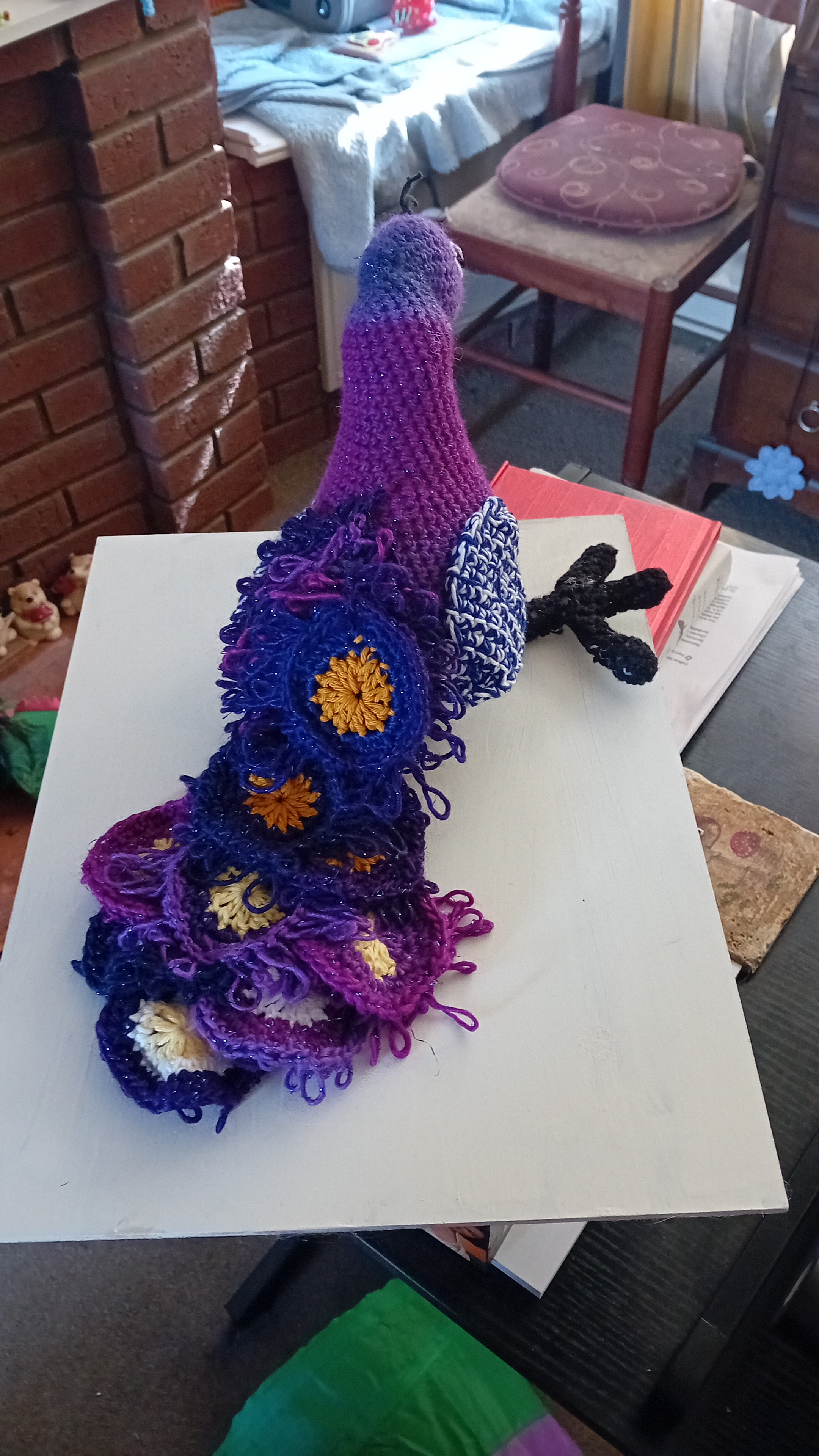
I work for an organisation that supports autistic adults, and have done for 5 years, but I’ve been involved with an arts organisation for several years as well. First the gallery, Turntable, hosted my Neurodivergent History project, and then my friend started Lucy’s Art Club, and it’s gone from there. I’m now a Director of a new organisation, Purple Peacock CIC, helping disadvantaged creatives in our region. At the end of the year I’m giving up my salaried job to take on self-employed work, both independently and with Purple Peacock CIC. I want to focus on my writing and creative work. I told my employer two weeks ago and it has been a weight lifted.
I feel like I’m able to access the creative part of me that was gradually locked up by my job taking all my focus.
I’ve also made contact with the editor at Spondylux Press about doing some proof reading and editing work for them. If you’re ND and want to find a publisher, I recommend Spondylux, I met the editor at Autscape and I will be reviewing two of the books I bought at a later date. Nema (the editor) is lovely.
In addition, I am going to build on the editing I’ve done with my current employer, for a couple of projects. I’ve edited short stories for authors and an anthology of art, poetry, memoir and short stories by Autistic authors. I have decided that I’m open for business self-employed as an editor and proof reader. See here for details.
Some of my projects with Purple Peacock CIC will be managing a reference library of poetry books we inherited, running a writing café, presenting writing and editing workshops for Lucy’s Art Club, and eventually, in several years, starting a small press for local disadvantaged authors.
There’s a novel I’m working on that’s only a few chapters in on the first draft. I’m planning to use up all of my annual leave in December, so I’ll have a whole, free month to write! Ahhh, it’ll be blissful!
I’ve got loads of crochet projects to do too, but they’re personal projects. However, if you want a monster crocheting, let me know and I’ll cost it for you.
I was going to write a review of Terry Pratchett: A Life With Footnotes, by Rob Wilkins, but I’m still crying slightly from the ending, and it’s too hot, and I had to go to Lidl for food and now I’m overwhelmed and tired, so no review today. I am even more convinced than ever that STP was neurodivergent even before his Alzheimer’s diagnosis.
There was a lady struggling with her shopping trolley trying to get home from Lidl, the wheels fell off. Loads of people passed her and didn’t stop to help. I helped her carry the loaded trolley to the river and waited while she phoned someone to come and help. It didn’t seem right to let her struggle. Her English wasn’t great, but then, this is Grimsby, most people here only speak passable English at the best of times, speaking it as a second language is quite impressive, to me at least. We managed to communicate enough to do what needed to be done.
The cat is shedding everywhere and I think I’m allergic. Well, I’m allergic to quite a lot of things, and the last lot of blood tests I had ruled out pet dander, but it could be pet hair, I suppose? I’m not giving up animals, so I’ll just stick with prescription strength antihistamines.
I’m going to read a book about Girl Guides and Girl Scouts this afternoon. I was in the Brownies and Guides, and a Young Leader. My Dad and Uncle we Scouts, my Grandad was a Scout leader. I’m still in touch with my Brownie Leader, who was also my Leader as a Young Leader. I have some stories to tell, and I’m sure if you asked, my Brownie and Guide Leaders probably have some embarrassing photos of me they’d share. My Guides were attached to our local Anglican Church, even when I stopped going to church I continued going to Guides, until the summer of 1999, when I left because I was doing my GCSEs and I slapped another Guide for calling me a ‘retard’ because I couldn’t find something.
She was a nasty little bitch.
We’d just got a new Guide leader and I hadn’t bonded well with her, so I left. A year later I was doing a historic churches fundraising walk and my former Brownie leader mentioned they’d been short staffed for a camp that summer. I asked her why she hadn’t rung me. After that I joined her Guides as a Young Leader. It was a different Guides group.
At the time, Immingham had 3 Guides groups, two attached to churches and one secular. My group was held in the church hall, and you could go from Rainbows to Guides there. I’d gone from the CofE group to the secular group. It served the less well-off girls who wanted to be Guides. You see, the local Anglicans and Methodists could be a bit up themselves and very hypocritical. Poor girls from the council estate weren’t really welcome there, and it was a trek for them to get to the church halls where those groups were held.
I’m told there’s only one Guide group left in Immingham now, and the Scouts long since shut up shop. The old church hall got sold off, as well, to the local private dentist, because the church couldn’t afford to keep it up. The old vicarage has also been sold as a private house too. We used to do a lot of outdoors stuff in the vicarage grounds, and if you believe my old Brownie leader, I was 3 when I saw a Brownies group at the summer fete and demanded to join. I had to wait until I was seven though. And I got one of the new uniforms. Which were made from incredibly uncomfortable fabric, but were much more practical that the brown dresses the other girls had to wear. I preferred trouser even then.
Yes, I know I said I wasn’t going to do weight loss or weight management programmes anymore, after the last one fucked my mental health over, but I did that one for 18 months. This has only been a 6-month programme., because I refuse to pay the full monthly price. I got some sort of deal through Hello Fresh.
Actually, that’s a good point; Hello Fresh leads people to the WW website if you choose one of their WW Personal Points meals. Clearly they have some sort of partnership and benefit from driving consumers from their respective websites to each other. It’s somewhat sick that they take advantage of people like that. I was just looking for something good in my discounted meals.
I decided to turn the experience into an experiment. I’m going to take things month-by-month and write a bit each month. There will be an explanation in the September 2022 section.
Since Twitter is blooming as a hellscape, I’ve decided to shift at least a little bit to Mastodon. I’m on the neurodifferent.me server for neurodivergent people. My handle is BetterDragons over there. I don’t know how useful it’ll be but there’s no harm in giving it a go.
Also, I’m writing this at 3.35am because Ezzie is poorly and I can’t sleep from worrying about her. She’s at the vets in less than twelve hours, but I’m still anxious. She’s currently resting against my leg and far too cold. She’s barely eaten for two weeks, has lost weight, and is struggling to walk. Her dodgy hips have been playing her up recently but something has changed because she’s struggling to walk, and she’s just finished a season, which is why she hasn’t eaten much for two weeks. Her seasons are sometimes upsetting for her, but it’s never been this bad before, and the combination of her hips and the season, and cold weather, seem to have really knocked her out.
Actually, it’s not that new. I’ve been working on it since mid-August and I thought I had to get it finished by the end of this month. Happily, since I was getting a bit burnt out on the project by the pressure, I have found out I have until 31st December to complete the project and submit the report.
In case you haven’t heard, Cambridge Autism Research Centre, lead by Prof. Simon Baron-Cohen, have launched a new research initiative. They want 10,000 autistic people to send them their genetic material. There has been a bit of fuss in the Autistic community because of the unsatisfactory answers given by Spectrum 10K when asked about data safety and the way some ‘Ambassadors’ have behaved, including naturalist Chris Packham calling anyone who disagrees with the research a science denier and conspiracy theorist, and ‘comedian’ Paula White calling a respected autistic autism researcher ‘brainless’.
I haven’t commented on any of the Twitter threads, but I’ve been reading them and taking in the information. The main issue is that there isn’t any guarantee about the security of the data, which may be sold to companies at a later date, and that some of the people and organisations involved, even tangentially, are known to want to ‘cure’ autism. Yes, we’re scared of eugenics.
This is a long one, get comfy. I don’t talk about personal stuff much now, since my blog has evolved into a book blog from a general/mental health blog.
For the first time in 18 months, I weighed myself today. Last time I got weighed was at the start of 2020 when I was weighed at the start of a ‘get active’ programme with the local leisure centres, where I started swimming two to three times a week, and then a ‘weight management programme’ a few weeks later.
I will be talking about weight and BMI, so if that’s not a happy thing for you to think about, probably best not to read on.
I haven’t lost or gained any weight, but apparently I’m 6 centimetres shorter than I was in February last year…
I’m a nice person and I like to help my support worker out so I put together a presentation for the Forum tonight. We covered the subject of Queer people. I have a bot of understanding of the subject since I am Queer and I read a lot. I had to do a bit of scrabbling around on the internet to find information I needed, so I’ve added the references at the bottom of this post, with a transcript of my presentation.
The slide show with transcript
Slide 1
Welcome to the LGBTQIA+ Forum. I’m going to talk about this important topic and why it’s important for us to be informed about Queer matters. Any interruptions, homophobia, transphobia or queerphobia etc. will result in me stopping this presentation. I refuse to tolerate bigotry of any kind. If you have questions either wait to ask them or write them in the chat.
Slide 2
About 17% of the population identify as non-heterosexual in some way. About 1% of the population are out as transgender and about 2% of the population are known to be intersex. I use ‘known’ and ‘out’ as qualifiers here, because, like neurodivergent people, at any one time many people are in denial, medically unidentified, unsure or in hiding so they don’t get included in the statistics.
LGBTQIA+ is a long list of letters, and I’m sure most of you know what most of them mean.
L – Lesbian
G – Gay
B – Bisexual
T – Transgender
Q – Queer
I – Intersex
A – Asexual
+ is for all the others not included in the ‘short’ initialism.
We will get to what these terms mean later, but there are others you might want to be aware of; you may come across them online or in reading.
Firstly, there’s the delightfully evocative ‘QUILTBAG’ – as you can see on the slide this initialism covers a much greater range of identities than LGBTQIA and includes more gender terms, such as genderqueer.
Secondly there’s GSM – Gender and Sexual Minorities – which is sometimes used in ‘official’ documents. It’s not that common and some people don’t like it.
Finally, at least for today, there’s LGBTTQQIAAP – that’s a mouthful! It’s an expansion of LGBTQIA+. There are longer expansions that include two spirit, aromantic, agender, genderfluid, it goes on. Because humans come in all shapes and sizes and with all sorts of attractions and genders. This label generally relates to a person’s gender or sexuality, but it can be so much more complicated than that.
We need to discuss some things before we start. Sexuality hasn’s always been seen as an identity. It came about during the late 19th century with the development of sexology and the pathologisation of sexuality that wasn’t strictly between men and women, missionary style, in a monogamous relationship. Anything else was deemed ‘abnormal’, whether it’s who you’re attracted to, how your gender is expressed or identified, what you’re into or the types of relationships you have. It’s in this context that these identities have been developed.
These identity labels have been useful in getting rights for gender and sexual minorities but they bring with them limiting expectations of behaviours and roles. However, we don’t have an awful lot of time to get deep into these things so I’m going to recommend the book Sexuality: A Graphic Guide, by Meg-John Barker and Jules Scheele.
Slide 3
Most people will be familiar with LGBT as an initialism; it’s the most commonly seen. Lesbian and Gay are terms that usually refer to people with exclusively homosexual attraction, that is attraction to their own sex or gender.
Gay men are attracted to men and lesbians are women who love women. ‘Gay’ is derived from the Old French word ‘gai’ meaning full of joy or mirth, in English it came to mean bright, cheerful, happy, carefree. The carefree meaning led it to be used for prostitutes (‘gay women’), brothels (‘gay houses’) and womanizers (‘gay men’) from about the 1600s; this is the first time it became associated with sex.
In the 1890s the word ‘gey cat’ (Scottish variant) was used to describe a vagrant who offered sexual services to women, or a young man who has just started living on the road and is in company of older men. Sexual submissiveness is implied, and it is this context and meaning that came to be used by the 1920s between homosexual men in the US to mean a homosexual man. It became commonly used after the 1950s and is an acceptable term used now. Since the 1990s it has been used as an insult to mean bad or ridiculous. Don’t.
Lesbian refers to Lesbos, a Greek island that was home to Sappho, a sixth century BCE poet. Sappho was so well known in her time and after that Homer referred to her as ‘The Poet’. Some of Sappho’s poetry is addressed to particular women and are strongly erotic or romantic, although whether they were meant to be autobiographical is in dispute. So, the association between Lesbos and women who love women was established. Sapphic is another word used in this context.
Lesbian and Gay are well known terms, they have been used for several decades and often used to refer to everyone who is not cis-gender and heterosexual. As part of the political fight to gain rights for non-heterosexual and cis-gender people, Gay and Lesbian people are often the only ones remembered and thought about.
It is a very binary approach to both sexuality and gender. I shouldn’t need to tell you that neither sex, sexuality nor gender are binary. Talking of, let us get on to the B – bisexual. This is a complex one. Originally, ‘bisexual’ was an adjective referring to “having the organs of both sexes in one being, hermaphroditic”, where it is attested to from 1824. The meaning “attracted to both sexes” is from 1914; the noun in this sense is attested from 1922. Modern definitions are given as “Attracted to more than one gender”, “Sexual or romantic attraction to ones own and other genders”.
Human sex isn’t binary. No really, I know you’ve been taught that there’s only male and female. Two well defined boxes that people can be neatly dropped into and is obvious from external features such as genitalia. Genetics and gonads – that is the reproductive organs you possess, are used to reinforce this. Except Intersex people – people with ambiguous genitalia and gonads – exist, and genetic studies show that there are many variations in genetics. It’s not just XX and XY. Even brain scans show that humans have a mosaic of ‘male’ and ‘female’ features – see The Gendered Brain, by Gina Rippon for details.
Gender is a complex idea that is made up of gender expression – that is how we express ourselves, gender roles – what society expects of us, and gender identity – how our internal sense of self manifests. It is this gender identity that is important here. A trans person doesn’t identify with the gender they were assigned at birth based on external features. So, a trans man is a man who was born with a vulva, was socialised as a girl but who identifies as not a girl/woman, but as a boy/man. A trans woman is a person born with a penis and socialised as a boy, but who’s internal sense of self is as a girl/woman.
That’s for a binary trans person.
A non-binary person is a person who doesn’t identify as either of the binary genders. This may be genderfluid, genderqueer, agender, bigender. This is not a new phenomenon – many cultures have more than two genders, however we live in a culture that for a couple of thousand years has resolutely refused to accept it and have exported this belief to cultures that previously had many genders.
Non-binary people can identify as trans or not. Some consider themselves trans because they don’t identify as their birth assigned gender, but as a gender outside the binary. Non-binary people who don’t identify as trans may do so because they identify as a gender that includes their assigned gender, for example a genderfluid person assigned female/girl at birth who sometimes identifies as a woman, but mostly agender.
Trans people simplify things by saying that they have ‘a fe/male brain in a fe/male body’ but that’s not really how it works. We just need to simplify things for people who have never had to understand that sex and gender are complicated. It only really works for binary trans people, not for non-binary people. Also, there is no such thing as male and female brains, there are only brains that are moulded and changed by life events. I once again direct you to Gina Rippon’s book on the subject. The sense of self identity is not found in some structure of the brain, it’s a cumulative thing that emerges. And that’s getting a bit philosophical, we’re not here to be philosophical tonight.
Some of these slides have the flags associated with different groups but not all of them, if you want to see more, have a look at:
Queer – this is an umbrella term; it is also used by people who are complicated in their identities. It originally meant something or someone strange. It only became an insult after it was used to describe Oscar Wilde’s relationships, and by extension all non-heterosexual sex acts and relationships. It has been reclaimed.
Asexual and aromantic – Asexual people generally don’t feel sexual attraction although they may feel romantic or aesthetic attraction. They may also identify as demi-sexual or grey-sexual – that is under certain circumstances they may feel sexual attraction.
Aromantic people don’t or rarely feel romantic attraction, although they may feel sexual attraction.
Rather than treating attraction as an all-in-one package, Asexual communities commonly differentiate typesof attraction, such as romantic, sexual, aesthetic, sensual, etc. Many aces may report that their experiences with one type of attraction may be different than with another.
Because of this, some asexuals have also begin to use multiple orientation labels to differentiate these patterns, especially with regards to sexual vs. romantic attraction. Thus, someone who was not sexually attracted to anyone, but who was romantically attracted to all genders, might consider themselves a “panromantic asexual”, where “panromantic” is their romantic orientation, and asexual is their sexual orientation.
Slide 6
Intersex people, as I said earlier, are people with what is medically known as ‘disorders of Sex Development’ and are about 2% of the population, although there could be more intersex people who just don’t know they’re intersex. Intersex refers to people who can’t be put easily in to the ‘male’/’female’ boxes. They are included in the initialism that is mostly about gender and sexuality because they are a minority that don’t fit the neat categories we expect. The existence of intersex people shows just how complicated foetal development is and that sex is a continuum rather than distinct groups.
There is also a cross-over of intersex and trans communities, in that 40% of intersex people identify as trans.
Slide 7
We are looking at gender and sexuality from a strictly European perspective, influenced heavily by Greek and Roman attitudes and Christianity. That went to the rest of the world when Europeans started their great imperial projects in the 16th century. So, on the slide is a quick rundown. If you want to know more, there are books, go look it up. I’m running out of time so, let’s move on to the next slide.
Slide 8
Why is it important to have a basic understanding of these things?
Well, approximately 30% of the autistic population identify as something other than cis-gender and heterosexual, so there’s a good chance you’ll meet a Queer person if you spend enough time with Autistic people. In fact, purely by being here, you definitely have.
Hi. I’m Queer – pansexual, non-binary, agender, genderfluid, and I’m polyamorous. If you’ve got a problem with that, you can go to hell. *big grin*
Not having a basic understanding of the different varieties of human can make you look an absolute tit, which, I suppose, is better than being thought a bigot. My efforts this evening are made to prevent that, that is unless you want people to think you’re a bigot. A bit of reading will expand your awareness and understanding. I still have so much to learn, I don’t have all the answers, I don’t experience every possible combo of genders, attractions, and sexualities, but I’m willing to try to understand and share information.
There is another important point I want to make; the same people who pathologized neurodivergent people pathologized queer people, the same people who invented conversion therapy for homosexual men and transgender people worked on ABA – a therapy used to make autistic people act less autistic for the convenience of their non-autistic parents and teachers, that is used a lot in the US and is used in special schools in this country, although they give it a different name to make people think it’s not the same old torture. We have too much in common as marginalised communities and a lot of overlap in demographics.