
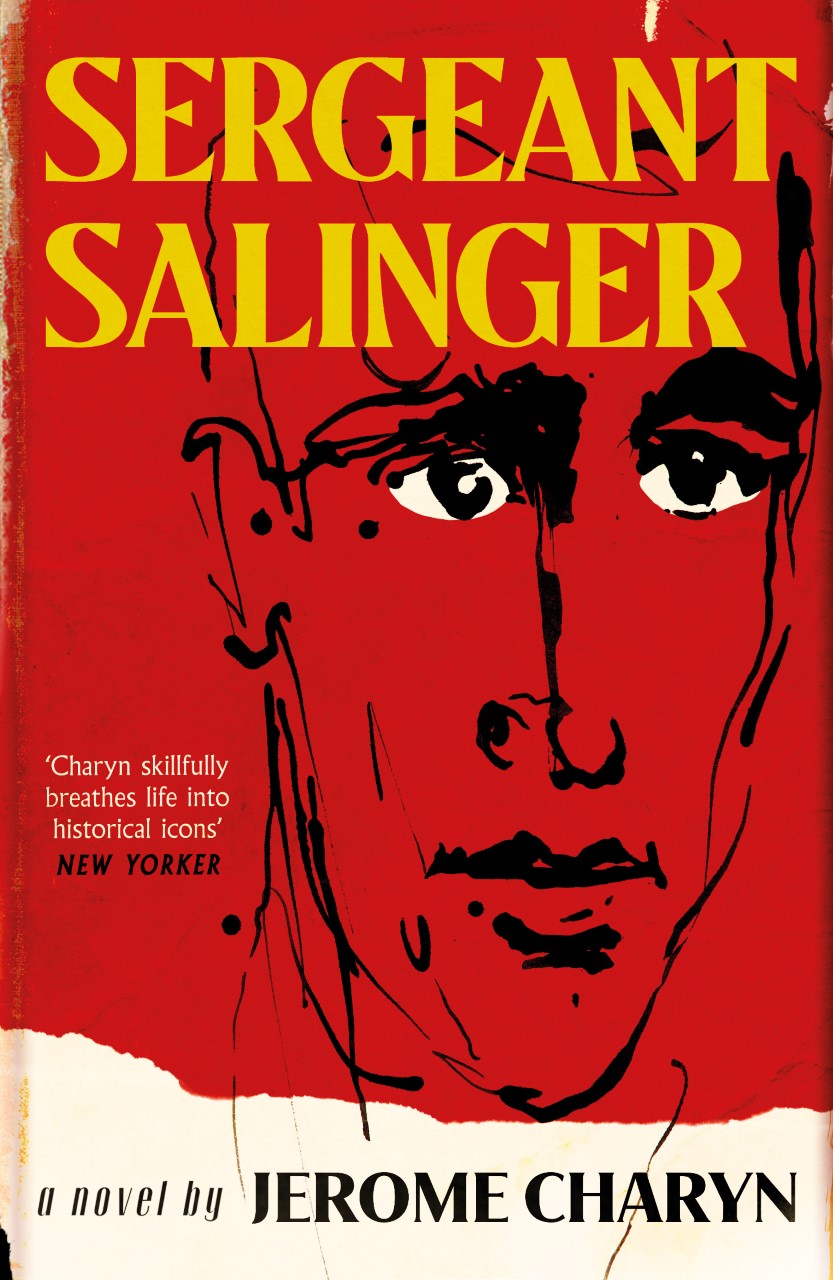
Grounded in biographical fact and reimagined as only Charyn could, Sergeant Salinger is an astonishing portrait of a devastated young man on his way to becoming the mythical figure behind a novel that has marked generations.
2021 marks the 70th anniversary of the first publication of The Catcher in the Rye.
J.D. Salinger, mysterious author of The Catcher in the Rye, is remembered today as a reclusive misanthrope. Jerome Charyn’s Salinger is a young American WWII draftee assigned to the Counter Intelligence Corps, a band of secret soldiers who trained with the British. A rifleman and an interrogator, he witnessed all the horrors of the war – from the landing on D-Day to the relentless hand-to-hand combat in the hedgerows of Normandy, to the Battle of the Bulge, and finally to the first Allied entry into a Bavarian death camp, where corpses were piled like cordwood. After the war, interned in a Nuremberg psychiatric clinic, Salinger became enchanted with a suspected Nazi informant. They married, but not long after he brought her home to New York, the marriage collapsed. Maladjusted to
civilian life, he lived like a ‘spook,’ with invisible stripes on his shoulder, the ghosts of the murdered inside his head, and stories to tell.
My Review
Thanks to Anne of Random Things Tours and to No Exit Press for organising this tour and sending me a copy of this book.
How do I describe this novel? It covers J.D. Salinger’s life between 1942 and 1947, during which he goes from a love-struck young writer to a traumatised ex-soldier who carried his great novel around Devon and then across France, Luxembourg and Germany to Nuremberg, chasing spies, traitors and Nazis. He collects a dog, a wife and many, many scars and haunting experiences along the way.
It’s currently Friday evening as I’m writing this, and this review is up on Monday. I was panicking about getting this book read, because I have a new work schedule, and have had various family plans this week, including going swimming and then to Pizza Hut with my sister today. I’d barely read 50 pages, if that, when I put the book in my pocket this morning, on the off chance I’d get some reading time. I didn’t until I was on the bus home. Other than breaks when it got a bit overwhelming, I haven’t stopped reading, I’ve been listening to music and reading for five hours!
I’m overwhelmed by this book. The descriptions of horrible events, seen through the eyes of Sonny Salinger as he copes with his duties in Counter Intelligence, from counting the dead on Slapton Sands in Devon to walking through a concentration camp and discovering an abused 12 year old girl, via the terrible winter of 1944, among the forests of the Ardennes, were deeply moving, and painful. Sonny dissociates repeatedly, an experience vividly described, in order to survive, and his experience of mental illness is too close to reality for me to easily brush away.
The writing was sublime, perfection. I was utterly entranced. The best words in the best order.
Even the conceit of writing voluptuous as ‘voluptu-u-u-u-ous’ made sense in the context. I did find it a bit disturbing, especially when applied to a 15 year old school girl, but dirty old men are dirty old men and that’s the context in which it is first used. Sonny isn’t being a dirty old man, but it is questionable that a 23 year old is seeing a 16 year old, even in Manhattan in 1942. The book hints at the disgusting behaviour people got away with in the night clubs of the time – school girl debutantes being used to attract customers to bars run by gangsters and inhabited by bitchy gossip columnists and authors who should know better.
Talking of authors who should know better, Ernest Hemingway makes several appearances in the book, first in that dodgy night club where we first meet Sonny before he is called up, then in Paris, where he’s presiding over the newly liberated Ritz with his band of partisans, and then in Nuremberg at Krankenhaus 41, when Sonny’s grip on reality is weak. Hemingway is Papa, the old man of American literature, unable even to write dispatches to newspapers any more, and Sonny is the broken short story writer who’s been tapping out a novel in foxholes and bunkers but can’t write anything. The relationship changes across time and environments, and was interesting. Sonny goes from being star struck by Hemingway to seeing him as a comrade of sorts.
I don’t actually know if any of the events are true or if they ever met each other. I’ve never read anything by Hemingway or Salinger; terrible I know. I probably should, but I have so many new books on my TBR pile and I got bored of the ‘you must read this to be considered cultured’ books a few years ago. I got almost all the literary references without needing to.
The characterisation of the Salinger family and how they shaped Sonny, the complex relationships and conflicts in the family, and the much easier relationships sonny has with his comrades in the CIC and infantry as they engage in conflict present an interesting contrast. The family is supposed to be peaceful, but that just suppressed the conflicts and causes petty spiteful behaviour. In the army, the conflict is acceptable, everything is on the outside, expressed, as long as you follow orders and do your job. It’s only when Sonny brings home is German wife Sylvia, who doesn’t adhere to the code of middle-class ‘mustn’t stand out’ politeness, that the conflict is brought to the surface. Her directness helps Sonny, but she still needs to leave or the politeness with stifle her the way it stifled the young Sonny. Doris, Sonny’s older sister, is a bitch, but she learnt it from her mother, and instead of using it to stifle and control, she uses it to set people free, especially her baby brother.
The descriptions of the landscapes of Devon, then Normandy, the Ardennes, Luxembourg and Germany were immersive, yet they were evoked with so little work. There are no lush descriptions, but bold strokes that bring them to life. The antagonism between the British, especially civilians, and US troops is well attested, but the way Charyn describes incidents suggests he was on the receiving end of it at some point, and his way of writing Sonny’s internal thoughts and actions they produced, suggests he knows it was their arrogance and obvious wealth in a war-impoverished country that provoked a lot of the problems.
I haven’t read anything by this author before (I’m very uncultured!), but I was incredibly impressed by this novel. It is clearly the work of a skilled and experienced writer, who has taken a little known periods in a literary legend’s life and spun a totally engaging tale that explains the later events of J.D. Salinger’s life.
Highly recommended.
ABOUT THE AUTHOR

Jerome Charyn is the author of more than fifty works of fiction and
nonfiction. Among other honors, he has received the Rosenthal Family
Foundation Award for Fiction from the American Academy of Arts and
Letters and his novels have been selected as finalists for the Firecracker
Award and PEN/Faulkner Award for Fiction. Charyn lives in New York.
For more information about the author visit jeromecharyn.com

 Everything Is Better With Dragons
Hugest thanks for the blog tour support xx