Title Details
ISBN: 9781922616180 | Murdoch Books
Paperback | Embargo 5th January 2023
RRP £14.99
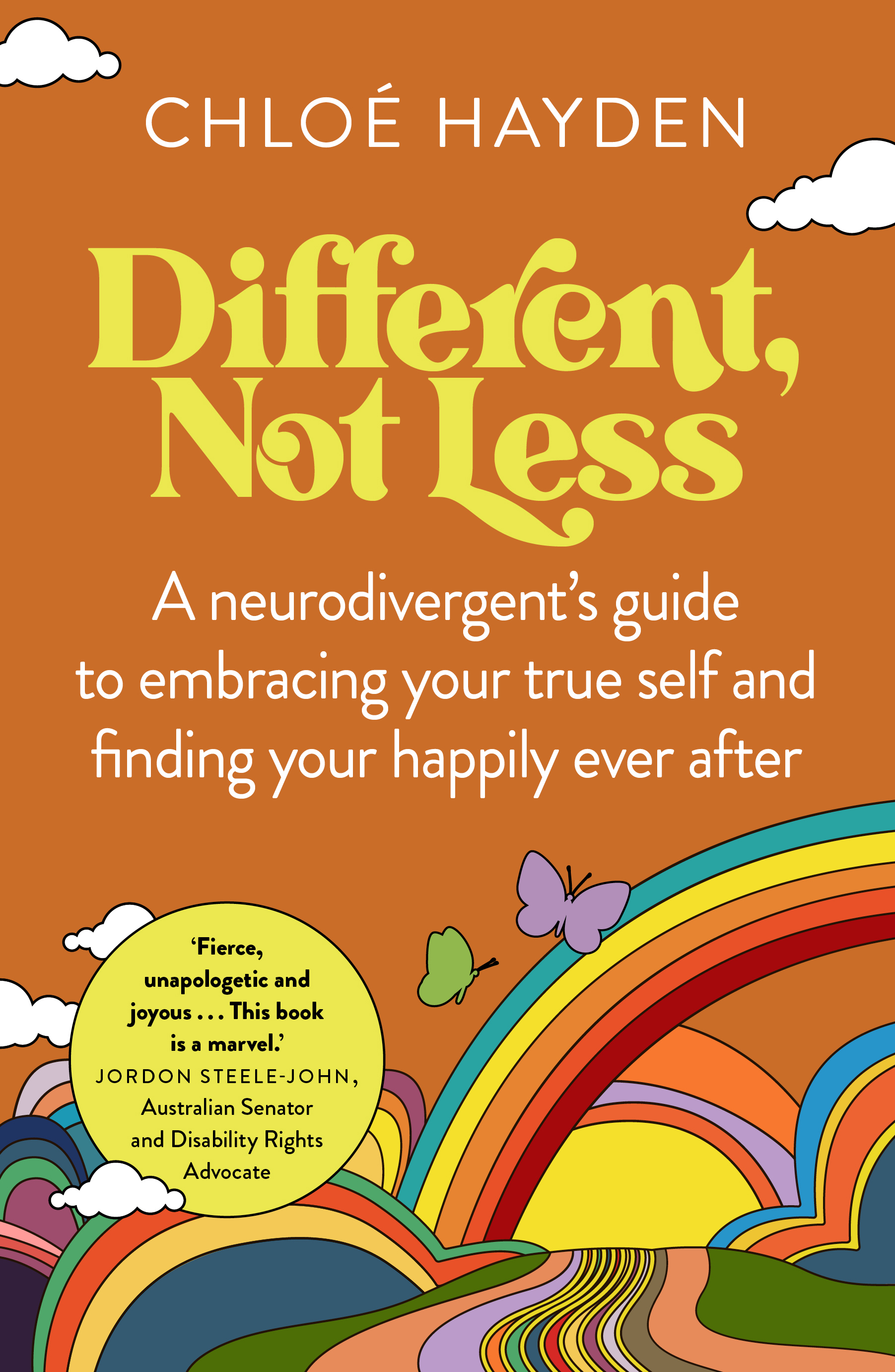
An empowering guide to celebrating and supporting neurodivergence from Netflix’s Heartbreak High star and disability advocate, Chloé Hayden.
Growing up, Chloé Hayden felt like she’d crash-landed on an alien planet where nothing made sense. Eye contact? Small talk? And why are you people so touch oriented? None of it made sense.
Chloé desperately wished to be part of the fairy tales she so dearly loved. A world in which the lead is considered a hero because of their differences, rather than excluded and pushed aside for them.
She moved between 10 schools in 8 years, struggling to become a person she believed society would accept. After years of being ‘weird, quirky, Chloé’ she was eventually diagnosed with autism and ADHD. It was only after a life-changing group of allies showed her that different did not mean less that she learned to celebrate her true voice and find her happily ever after.
Different, Not Less is a moving, at times funny story of how it feels to be
neurodivergent as well as a practical guide, with insights on how autism and ADHD present differently in females, advice for living with meltdowns and shutdowns, tips for finding supportive relationships, communities and workplaces and much more.
Whether you’re neurodivergent or supporting those who are, Different, Not Less will inspire you to create a more inclusive world where everyone feels like they belong.
My Review
Thanks to the publisher and Anne for organising this blog tour. I missed out on the physical copies, so Anne sent me an e-book that I said I’d have a bash at reading. As it happens, this book was available on Audible in December so I downloaded it and listened to the audiobook instead of reading it. Chloe Hayden narrated her book.
Hayden applies her love of Disney to present her memoir and advice to young neurodivergent people. She is AuADHD and was diagnosed as a teenager. She spent all her teen years trying to fit in. Been there, done that. It was crap. I gave up eventually and hid in my books. Books were better than people. I can see why she found Disney and fairy-tales as her map to the world.
She also covers mental health, bad and good, eating disorders, and abuse. It’s painful to read, but, like childhood bullying, I can relate so hard! Again, been there, done that. I probably have disordered eating rather than a diagnosable eating disorder, but I understand the urges and impulses to restrict, to punish, to try to fit in or hide, as a defence mechanism in a world trying to force us into a tiny box that doesn’t fit.
The author includes and comments on the current diagnostic criteria for Autism and ADHD; her commentary is critical of the frankly ridiculous criteria, and she talks about the aspects of being Autistic and ADHD that aren’t in the criteria, and the differences between men and women in expressing those traits. Personally, I don’t think there is a ‘male’ or ‘female’ profile of Autism and ADHD, I think it’s individual variation and social conditioning, plus researcher expectations. I know ADHD women who have ‘typically male presentation’, and Autistic men who have ‘typically female traits’. When you know a large number of neurodivergent people, you realise they’re all individuals.
The advice to parents is great. She’s right – parent’s, it not about you!
The notes, resources and index are quite comprehensive, as you would expect from an Autistic person with a special interest.
This book is a memoir with advice and information for neurodivergent people, and their ‘side-kicks’. Generally, I enjoyed this book; Chloe Hayden is a really good writer and a fluent narrator. She is also about half my age so there are things I can relate to because I remember being there, and other things that were not so relatable. But that’s understandable, because Autistic and/or ADHD people are not a monolith. We come from every socio-economic demographic, every continent, every ethnicity and every religion/belief system, so we’re not going to relate to everything.
Obviously, not everything is perfect about this book, but those disagreements are personal preference, not about the quality of the book.
Firstly, I have a bone to pick with the author:
“What’s unusual here is that this book was written
by a neurodivergent disabled person—not by
someone who has studied these topics from a
distance, but by someone who lives them.”
This is not true. I do this stuff for a living, I read books about autistic people and their stories, and write about it. Allow me to list books by autistic people about being autistic:
- Autism in Adults, by Luke Beardon – Dr Beardon has also written books about Autistic children and coping with anxiety – highly recommended
- Loud Hands, by Julia Bascom – This is a relatively early one
- All the Weight of our Dreams, edited by Lydia X. Z. Brown et al
- Letters to my Weird Sisters, by Joanne Limburg
- Secret Life of a Black Aspie – A Memoir by Anand Prahlad
- Ten Steps to Nanette, by Hannah Gadsby
- Neuroqueer, by Nick Walker
- I Overcame My Autism and All I Got Was This Lousy Anxiety Disorder, by Sarah Kurchek
- Odd Girl Out, by Laura Bates
- Untypical: How the world isn’t built for autistic people and what we should all do about it, by Pete Wharmby
- Stim: An Autistic Anthology, edited by Lizzie Huxley-Jones
- Spectrums: Autistic Transgender People in Their Own Words, by Maxfield Sparrow
- The Autistic Trans Guide to Life, by Yenn Purkis (Anything by Wenn Purkis is great!)
- The Reason I Jump, by Naoki Higashida
Autistic people have been writing books about being Autistic since at least Donna Williams wrote ‘Nobody Nowhere’ in 1992 and Temple Grandin inflicted her ablest crap (repeatedly) on the world. There are so many books available if you want to hear about being autistic from autistic people.
Secondly, I don’t like Disney! No, really, it’s cisheteronormative dross that reinforces unhealthy and unrealistic body standards, tells girls they only need to be pretty and reinforces toxic masculinity in boys, and it always misappropriates other people’s cultures and misrepresents them. I get it, some people love Disney stories. I know a couple of Autistic people who adore Disney and don’t get my lack of interest at all. They’re both adults too, different genders. Anyway, my actual bone is that Disney stories are not really good for exploring concepts around neurodiversity. Fairy-tales, or stories in general, can be really useful, but the overuse of inappropriate Disney references was irritating.
Thirdly, Judy Singer didn’t coin ‘neurodiversity’; it was floating around the Autistic internet in the 1990s, all she did was publish it in an academic setting – her Bachelors dissertation – in 1998. Harvey Bloom published an article in a popular magazine in 1997. She’s been dining out on that ever since. She didn’t conceive of a social model of disability based on neurological diversity either, that had also been around in the Autistic internet and disability justice communities generally, and has since evolved from Judy Singer’s published understanding of it.
About the Author

Chloé Hayden is an award-winning actor and disability advocate, motivational speaker and social media influencer. Whose story of being ‘different, not less’ has attracted a worldwide following. She is currently appearing in Heartbreak High, the Netflix remake of the
iconic Australian series.

 Everything Is Better With Dragons
Thanks for the blog tour support x