
Price £16.99
ISBN-13 9780715654866
Description
The role of resident vet in the British Overseas Territories encompasses the
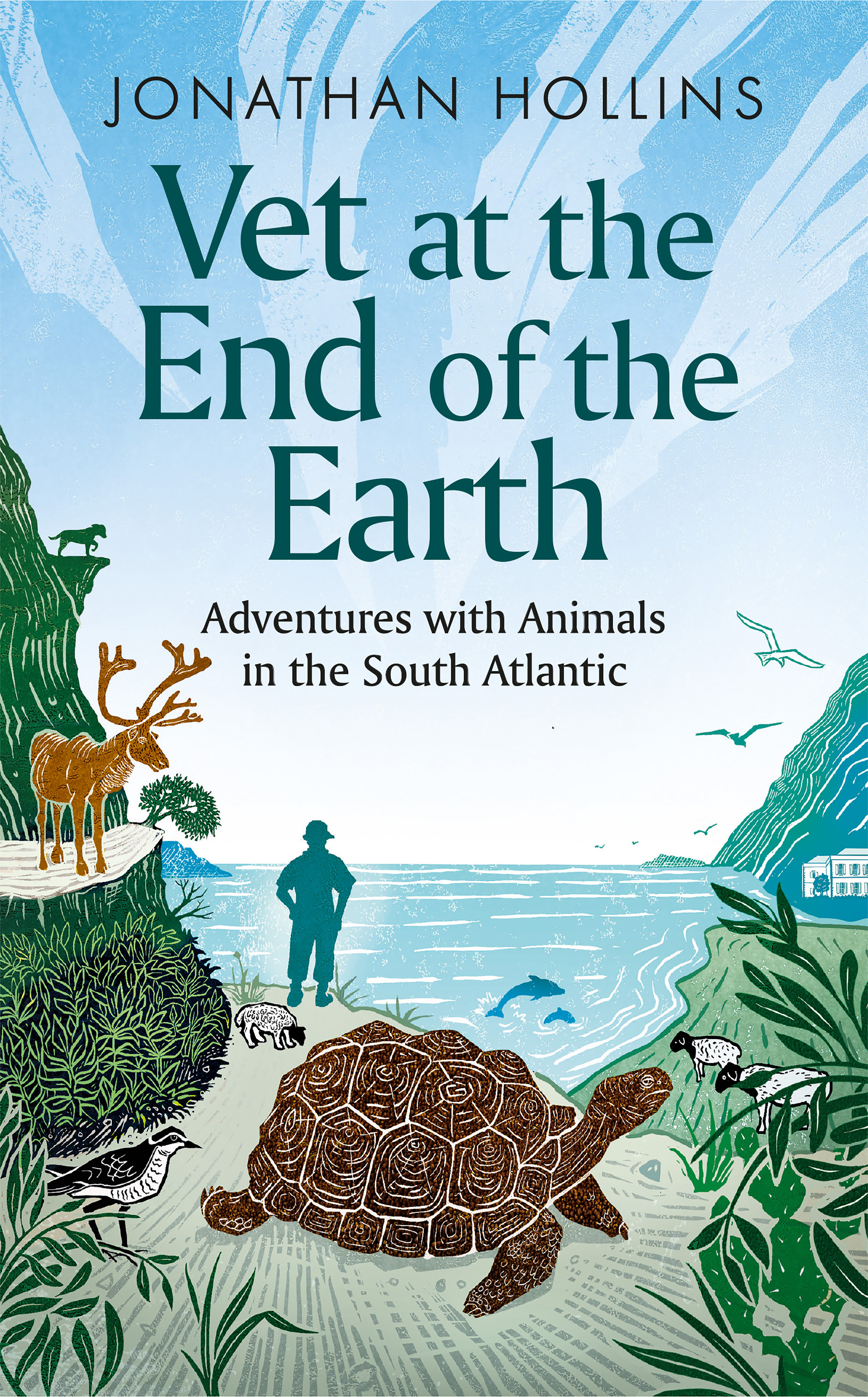
complexities of caring for the world’s oldest known land animal – a 190 year-old giant tortoise – and MoD mascots at the Falklands airbase; pursuing mystery creatures and invasive microorganisms; relocating herds of reindeer; and rescuing animals in extraordinarily rugged landscapes, from subtropical cloud forests to volcanic cliff faces.
Witty, warm and beautifully crafted, Jonathan Hollins’s tales of island vetting are not only full of wonderful creatures – they are also steeped in the unique local history, cultures and peoples of the islands, far removed from the hustle of modern life. These tales of island vetting are perfect for animal lovers, adventurers and armchair travellers alike.
My Review
Thanks to Anne for organising this tour and to the publisher for sending me a copy of this book.
Joe Hollins has had an interesting life as a vet. By far the most interesting is his time as a vet in British Overseas Territories, mainly the Falklands Islands, St Helena and Tristan de Cunha islands. He has wormed all the dogs and a few cats on West Falkland, herded reindeer from one end to the other, crayfished in Tristan De Cunha, where he also measured rat tails, and climbed to the top of the Hill (a 2000 meter volcano) to swim in a heart shaped crater lake. On St Helena he ministers to the cattle, sheep, chickens, ducks, dogs, cats, and Jonathan the Seychelles Giant Tortoise. He has now retired officially, but it sounds like he doesn’t get much rest, between clearing the grounds of an overgrown former coffee plantation he’s bought on St. Helena and covering until a new official vet arrives.
Clearly Jonathan is sharing the more entertaining and/or gross aspects of his experiences is to be expected. He also writes with a deep love of both the animals in his care and the humans that are attached to them.
I was very moved by his writing about the Tristanians, their culture and traditions; it’s utterly fascinating – a small population with seven main family names, all descended from a variety of soldiers who decided to stay when the British Army left in the early nineteenth century, two shipwrecked Italian families, and people shipped in from St Helena – who had a mix of British, African and Indonesian ancestry – when they needed more people. The original articles or agreement was that everyone held everything equally and no one was more important than anyone else. They still try to maintain these rules, under the guidance of the Island Council. For all the hardships of life, the Tristanians seem to have a lot of fun.
After an eruption from their Hill in 1961, they were evacuated to the UK for a couple of years then returned with all the modern (at the time) conveniences. They farm, fish, salvage wrecks and generally keep themselves to themselves. Which isn’t hard because the Tristan De Cunha islands are the remotest inhabited islands in the world. Only one of the four islands has people on it, in the Village, and the other three are left to nature. They can only be reached by ship and landing on Tristan De Cunha sounds like an adventure in itself. I learnt so much about them from reading this book; I don’t think I’ve ever learnt anything about them except hearing the name.
One of the last stories Jonathan tells, from New Year 2020 is the search for Rosie, a missing dog, on St Helena (eventually found on a really awkward ledge on the wrong side of a very high ridge). It brought tears to my eyes, thinking about that poor baby scared by fireworks haring off into the wilds only to get lost and unable to get home. It didn’t help that her human was away in the UK having a triple heart by-pass. The thought of that poor man getting home to find his beloved dog lost and probably dead somewhere in the hills of St Helena was really upsetting. Luckily, she was found by Jonathan and his friends, rescued by the fire service and after treatment for dehydration, and reunited with her humans. They all received a commendation from the Governor of St Helena.
It was interesting to read a bit about the history of St Helena. Of course I know that Napoleon Bonaparte was exiled there in 1816, after the Waterloo campaign and that he died there of stomach cancer a few years later, but I didn’t know that it was the place rescued enslaved Africans were taken for processing and return to their homes after the British decided to actual abolish the slave trade and hunt down slavers from the 1840s onwards. Tens of thousands of Africans were rescued, but approximately 8000 died by the time they arrived at or during their time on St Helena. Many died before the Royal Navy arrived.
The living landed in the bay next to Jamestown, and when the airport was being built, they first had to build a road from that bay to the one where the airport would be, and in doing so, found the graves of freed Africans. There is now a memorial to the 8000, and the bones have been reburied in caskets made by local school children, who then took part in the reburial and memorial service, as a way of connecting with and remembering their collateral ancestors.
It’s a painful yet somehow inspiring story. Despite the efforts of many, and the lauding of the 1807 bill than made it illegal to traffic humans on British ships, abolition didn’t really happen until 1839 and then as if to make up for 250 years of abhorrent behaviour by British people (main slave towns were Bristol, Liverpool and Glasgow – no one gets out of this without blame), the Royal Navy suddenly becomes a ‘saviour’ and start attacking anyone carrying enslaved people across the ‘middle passage’. Then what? Taken to an island 1000 miles from home, with no way to communicate where they were from and probably some serious health problems as a result of their enslavement and transportation, how many of the Africans actually made it back to their homes and families? Someone give the Navy a ‘You Tried’ star.
This book is mainly a memoir, but it also encompasses natural history, the geography and history of the BOTs, human stories and communicates a love of animals and places that is inspiring and moving. Highly recommended.

Author biography
Originally from the south of England, Jonathan Hollins MRCVS trained at
Emmanuel College, Cambridge, and has been a working vet for four decades.
Since the mid-2000s, he has spent long periods as a senior vet in the British Overseas Territories of the South Atlantic and has a home on St Helena. He has written for the UK national press and presented documentary features for BBC Radio 3 and Radio 4.

 Everything Is Better With Dragons
Thanks for the blog tour support x