
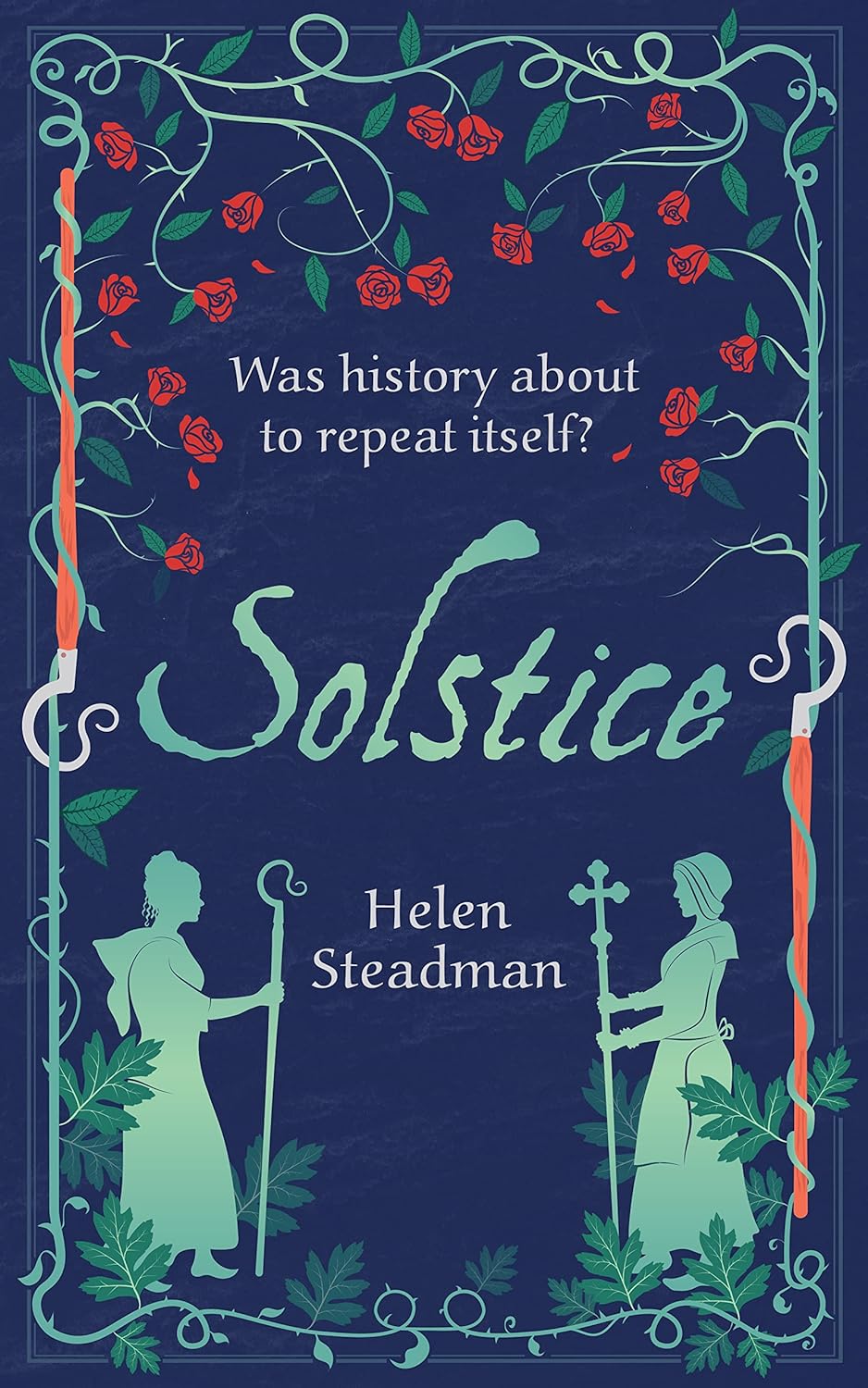

My Review
Thanks to Anne for organising this tour and to the publisher for my copy of this book.
Patience Leaton, 20ish, I think, and lean to emaciation, is the daughter of a Vicar. Her family (father Hector, brother Earnest) have been forced from their parish in Ely for reasons hinted at by Patience, to the Durham dales parish of Mutton Clog, a sheep farming village of farmers. The previous vicar has died at a fortunate time for the disgraced Leaton family and they’ve been given the meagre living. Used to a richer life in the town of Ely, and with a puritan conviction, Patience disdains the people of Mutton Clog before they even meet. The Leatons have secrets, and Patience has an urge to find witches.
Young Rose Driver is 16 and a skilled shepherdess on her family farm. The farm is prosperous but life is blighted by her bullying father and widowed grandmother. Her step-mother, May, is her mother June’s best friend. Marriage to Rose’s Widower Da, Andrew Driver, was an escape from an abusive father, and she took her sister Tilly with her.
Rose and Patience meet the day after the Leaton’s arrive in Mutton Clog. Rose also meets Earnest. He seems sweet, intelligent, and very handsome. He charms Rose while Patience looks on id disgust, immediately blaming Rose for Earnest’s behaviour. Patience decides Rose is a witch and goes about finding evidence to prove it.
One day, the pious, hypocritical, zealous Patience sees Rose at her work with the lambing ewes, and believes her to have engaged in a satanic ritual. From then on, everything bad that happens is Rose attempting to kill her. Rose meanwhile has sheep to care for. Earnest comes to visit her at the shepherding shed, and presses his suit, although Rose fights him off.
Things go down hill from there, involving a midsummer millpond, a death at the wool fair, and another at sea, imprisonment at Durham, and a death by hanging. Finally, there’s birth and life returning. Just as it should be.
I must admit that while I first started reading this book 3rd November, thinking it would be a quick read, but then I realised Patience was a bitch out to ruin Rose and that Rose was going to suffer unnecessarily. I put the book down to concentrate on another book I’m reviewing this week, The Lost Supper, because I struggle with stories that involve the unjust punishment of a good character by someone acting from malice. Today, 12th November, I decided to deal with that by looking at the last chapter. It helped, because I knew that I could get through the nasty stuff because I knew Rose would come out of things fairly well, although she loses a lot of people along the way. So I dived in. Took me three hours, maybe, to get through the book in the end, and it wasn’t as upsetting as I though it would be.
Through the novel we discover the lies Patience is telling people, and herself, to hide her family secrets, and I realised she was probably seriously mentally ill, at a time when there was only two possible ways to view mental illness – either madness or witchcraft. Patience is a ‘respectable girl’ so she can’t be mad (poor people or those not considered respectable could be mad, but they were probably curse), and she’s a god-fearing, diligent, vicar’s daughter, so she can’t be a witch.
Even I can tell she’s probably got some sort of religious mania, possibly anorexic, and with some delusions. There’s nothing inherently wrong with having any of these mental illnesses, and with treatment people can live a normal life and none of them usually cause murderous behaviour. Her neighbours and victims put it all down to her being a spoilt miss with too much time on her hands and not enough reading material to keep her mind educated and active. The magistrate in Durham thinks she’s a plain girl jealous of a pretty girl. I get the feeling, if she was in the North American colonies, she’d have murdered dozens. We learn that she has already killed one woman, and as the book goes on, it looks like her mania might actually be the reason her family is forced from Ely. Then we find out something else. Everyone else is always to blame, for Patience. It’s never her fault, her actions cause terrible consequences, but she always pushes it on to her victims.
It’s also interesting that we learn Patience is probably bisexual and is in conflict with herself for being attracted to anyone. She sees sexuality as a sin; her mother is dead to Patience because she is ‘promiscuous’, her brother is cursed with their mother’s promiscuity and needs to be guarded, her attraction to Tilly and Tom is their fault for being wanton (Tilly lifts her skirt up to cross a river, and Tom works shirtless in the graveyard on a hot day). It doesn’t occur to her that her parents’ marriage was loveless, and her mother almost dies giving birth to the twins. It doesn’t occur to her that Earnest is a creep who uses his position as a curate to seduce young women and then blames them for his own actions. It doesn’t occur to Patience that sex is a part of life and some people really enjoy it, and some people don’t, and social conventions will constrain people’s actions, and her religious convictions are constraining her thinking.
Earnest got a better death than he deserved after seducing Rose (and Tilly), blaming her for his actions, and then trying to force her to abort their child. His actions encourage Patience in her campaign against Rose. His behaviour is hypocritical and it seems his father knows how bad he is and is desperate to send him to sea, while Patience believes he’s just young and easily led, not the pillar of religious rectitude that she is. They’re twins; he was born first by a few minutes.
Rose is a steady farmer, daughter and granddaughter of farmers, daughter and granddaughter of herbalists, murdered as ‘witches’. She’s the backbone of her household, and continues to be so after her father dies, until she’s forced to live with the Leatons, who abuse her. Her time in Durham North Gate Gaol is wretched, and so evocatively described. People died before they even got their day on court in gaols, because they had to wait for the quarterly assizes.
Rose’s experiences as a child, which we only learn about when Rose learns about them, and later in court, are foreshadowed in childhood games and fears of going to church. The family she has in Mutton Clog are mostly not blood relatives, but they treat her as their child and grandchild, because that’s the right thing to do. We learn that Rose’s Da is a much worse man than we know from his actions in life, but he helped save Rose from a monster. The psychological damage she received as a child explains many things and it’s actually a fairly reasonable explanation. I don’t know enough about the sort of trauma seeing a violent murder as a young child would cause to be able to say it’s a realistic depiction, but it seems reasonable.
I love the way the community of Mutton Cleg come together to help Rose in gaol and in court; it’s clear no-one understands why Patience is targeting Rose, but they are there to get the truth out. That they will suffer for witnessing to the truth of events from the past and the present occurs to some of them. I haven’t read any of the other books, but the events of this book suggest they are good. I should probably get the first two in the series and The Running Wolf, which is set in 1687, when the baby born at the end of Solstice is an adult.
I’m assuming this book is set sometime in the 1650s or 1660s, during the puritan period. People in neighbouring dales are still having Midsummer Bonfires, and many of them stopped during the Civil Wars of the 1640s (yes, British, not English, because the civil wars engulfed all four countries/both main islands of the archipelago). Mutton Clog is rural enough that it might not have been involved. The church still has stained glass windows and the manse is comfortably furnished, which is very much not puritan practice.
I love the way Rose and the villagers are bemused by the plainness of the Leaton’s clothes and food. Hector Leaton seems to be fairly balanced, in that he’s comfortable with the changes in his housing and, when Tilly joins the household, his meals. He resists a lot of Patience’s stranger ideas and only weakens when he’s grieving; she is consciously manipulative of him. Even after his estranged wife returns and he’s grieving, he’s able to recognise that he was partly responsible for his wife leaving and that he needs to make amends. His actions speak when Patience refuses to record his words.
Tom Verger is an absolute hero in this novel. The history that develops through the novel shows that he was a hero in the earlier novels too. He is stoic and loving, and stands up to bullies for his community.
I really enjoyed this novel; it explores the psychological and cultural environment of the 1650s to explain the witch-obsessions. It draws on real events and realistically describes the lives of rural farmers in Northern England. Finally, it brings the Widdershins series to a satisfying conclusion, with hope and new life.

Helen Steadman’s first novel, Widdershins and its sequel, Sunwise were inspired by the 1650 Newcastle witch trials. Her third novel, The Running Wolf is about a group of master swordmakers who defected from Germany to England in 1687. Helen’s fourth novel, God of Fire, is a Greek myth retelling as seen through the eyes of Hephaestus, perhaps the least well known of all the Olympians.
Helen is particularly interested in revealing hidden histories and she is a thorough researcher who goes to great lengths in pursuit of historical accuracy. To get under the skin of the cunning women in Widdershins and Sunwise, Helen trained in herbalism and learned how to identify, grow and harvest plants and then made herbal medicines from bark, seeds, flowers and berries.
The Running Wolf is the story of a group of master swordmakers who left Solingen, Germany and moved to Shotley Bridge, England in 1687. As well as carrying out in-depth archive research and visiting forges in Solingen to bring her story to life, Helen also undertook blacksmith training, which culminated in making her own sword.


 Everything Is Better With Dragons
Thanks for the blog tour support x