
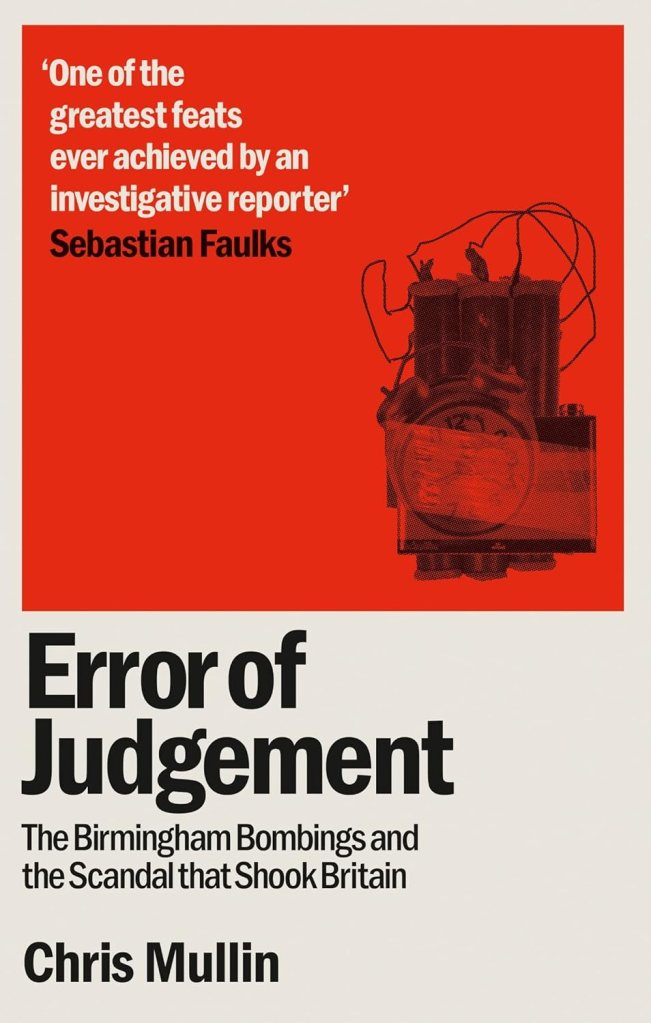
£10.99 in Paperback.
Description
Error of Judgment lit a fire under the political and legal establishment when it was first published, shattering the prosecution case against six Irishmen wrongly convicted of with the Birmingham bombings and going on to change the course of British legal history. It also resulted in significant reforms to the legal system and the quashing of many other wrongful
convictions.
Now 50 years on from the bombings and with a new preface and several new chapters covering the aftermath of the case, this new edition of Error of Judgement tells the complete story of one of Britain’s most significant miscarriages of justice.
On the evening of 21st November 1974, bombs planted by the IRA in two crowded Birmingham pubs exploded, killing 21 people and injuring at least 170. Within a day of the explosion, six men – Paddy Hill, Gerry Hunter, Richard McIlkenny, Billy Power, Johnny Walker and Hughie Callaghan – were arrested and charged. All were found guilty.
Methodically, with total clarity and a tone that is both gripping and impassioned, investigative journalist Mullin unpicked every detail of the case, revealing gaping holes in the prosecution case and an establishment determined to close ranks. Error of Judgement is a graphic illustration of what can go wrong when our police and criminal justice system is under pressure to get results and how difficult it is to persuade those responsible to own up once mistakes become obvious.
My Review
Thanks to Anne, of Random Things Tours for organising this blog tour and to Octopus Books for my copy of this book.
This is a chunky book, and just the introduction tells the reader an awful lot about the process of producing it, which took several years due to lack of funding for research, and the response from authority figures and journalists when it was first published. I have tried to read as much as I can in the time available (I have a lot on at the moment and will update as I go), and I have been mesmerised by the quality of the writing and storytelling in the chapters I have read so far. The description of the bombings, the immediate aftermath and the injuries to the victims makes for searing reading.
Update: Just in time, I have finished reading this book and with 24 hours to go, I can now complete the review.
Mullin takes the reader through the chronology of events, from the background and events leading up to the Birmingham pub bombings in 1974, including the reasons for the planned trip to Belfast, the detention and violent interrogation of the six men, the arrests, trials and media circus that surrounded it, and then Mullin’s investigation. He has updated the original manuscript to bring readers up to date, following the appeals and then release of the Birmingham Six, the lacklustre investigations by police and government, and finally what happened to the six afterwards. We also learn about Mullin’s interviews with West Midlands IRA members and the real bombers, two of whom are still alive and living in Ireland.
The Lancashire and West Midlands Police officers involved in the case engaged in systematic abuse of suspects, falsified their own documentation and confessions, and then lied under oath, repeatedly and many continue to do so. The Judiciary and Home Office covered up for the police and protected themselves even as the evidence for police violence and lies became overwhelming because it was more important for them to seem above reproach than to be honest and just. The scientist who’s initial test indicated traces of nitro glycerine would never admit he was wrong, despite evidence that he was, and his papers mysteriously disappeared.
There was a massive miscarriage of justice in this case, and in many others at the time, and were it not for investigative journalists and determined supporters of those convicted, many innocent people would have died in prison.
Mullin clearly and comprehensively explains the events he writes about, and gives the reader both the testimony of the Birmingham Six, their families, and those of the real bombers and IRA members in the West Midlands in the 1970s, but also the official record of events as concocted by the police and judiciary. He doesn’t shy away from the violent details of the abuse the men suffered from the police and prison officers, nor from conflicts he had with Grenada Television, who’s funding helped him have to time to investigate and write the original version of Error of Judgement. The TV programme and book helped bring about the original Appeal, which was unsuccessful. The Appeals Judged didn’t want the system upsetting and chose to believe the original evidence and ignore new evidence.
The book also exposes the terribly bad efforts of the duty solicitors assigned to the men when they were finally (after several days) arrested. The men tried to bring the assaults they suffered to the attention of their solicitors but were ignored, they didn’t record the injuries until after another round of beatings on arrival at their prison, assaults by police, prison officers and other prisoners. The prison doctor missed multiple injuries, and prison officers intimidated the men when their solicitors finally brought independent doctors to examine them. The also failed to call on independent forensic scientists to question the tests done, and didn’t point out obvious inconsistencies between the evidence of the bombs and the claims in the confessions.
Their appeals solicitor and QC did a much better job and sought out new evidence that, at the final appeal, made a farse of the Crown’s claims. It helped that Devon and Cornwall Police were engaged to investigate and did a very thorough job of looking at the confessions and police notebooks, and that multiple scientists presented evidence about the inefficacy of the tests applied, thus knocking away the main pillars of the original prosecution arguments.
Despite evidence that the police and prison officers attacked the men, and later evidence that may others suffered the same abuse, no one was ever punished for their perjury and abuses. It only strengthened the conviction of many people that coppers could get away with anything. It did nothing to improve trust in the police or the judicial system. Mullin provides clear evidence that the fairy tale that the men and many others were really guilty and got off on a technicality spread quickly, as the whole system fought to protect itself from criticism or any attempt at self-reflection and improvement. Maggie Thatcher (of hated memory, may she burn forever) promoted this and the tale soon became a ‘self-evident truth’, while the focus of official reviews and enquiries turned to ways the law could make it easier for the police to avoid accountability rather than how to tighten safety nets.
I found the discussion of the men’s backgrounds interesting. They were all from a similar area in Belfast, none were IRA members, although they raised funds for the families of interned people and attended, occasionally, Sian Fein and Irish community events. They were thoroughly embedded in the Birmingham Irish community and this was used against them in the prosecution. They were working men, badly educated and making their lives in the industrial heart of England to escape poverty in Northern Ireland. They were all married with children. Five of the men were going to Belfast for the funeral of a mutual acquaintance, a man who was an IRA man, and died attempting to plant a bomb. Most of them had been to school with the man or knew his extended family. One of the men was going to visit an elderly aunt who’d had a stroke and the funeral was a good enough excuse to go too. One of the men was just at the station to see them off and was at another pub when the bombs went off.
Three other men were tried at the same time as the Birmingham Six, accused of planning to blow things up, but not actually accused of being part of the pub bombs. Those men actually were IRA men involved to greater or lesser extents in the crime, but they were never convicted, and it seems odd that the two cases were tried together. The defence for the Birmingham Six tried unsuccessfully to have the trials severed because it made no sense to try six men for the bombing, and three completely different men for planning to bomb places.
One of these men was referred to in the original version of this book as X and admitted to making the bombs. He is named by Mullin in the final chapter, he gave evidence to Mullin as part of his original investigation and then later after the book originally came out and triggered the first appeal. He died in the late 1990s. Mullin also names the leader of the Birmingham IRA at the time of the bombings and another man involved in building the bombs and organising the bombings. The only man Mullin hasn’t named was a teenager at the time of the bombings and was devastated that his actions killed 21 people.
All of the IRA men maintained that they never meant to kill anyone, but the phone message wasn’t passed along quickly enough and the buildings weren’t cleared as they should have been. I’m not sure I believe that entirely, given that X admitted he was late calling in the warning because he couldn’t find a working phone, and his record of the time the first bomb exploded was 21 minutes after it actually happened, and a couple of them admitted that they wanted the British to feel what it was like in Belfast and understand why the Republicans in Northern Ireland might be angry. Given that the RUC and British Army were technically committing war crimes and breaching human rights laws at the time, I can see why they might feel that way.
Don’t agree with them, obviously. Killing people is generally not the best way to go about things, trying to talk things through and find a solution is better, thus the mostly successful Good Friday Agreement achieving more than 30 years of bombing and shooting each other. Once again, mythology isn’t an excuse for murder. It doesn’t matter if your mythology is religious or political, it’s all bollocks. Sit down, act like adults and work it out.
But back to the book.
Excellent writing, strong narrative drive, clearly explains events and the arguments, as well as giving an insight into the atmosphere in Birmingham and around the case, the culture of the times in both the Midlands Irish community and the police. Very readable, highly recommended.

 Everything Is Better With Dragons
Thanks for the blog tour support x