
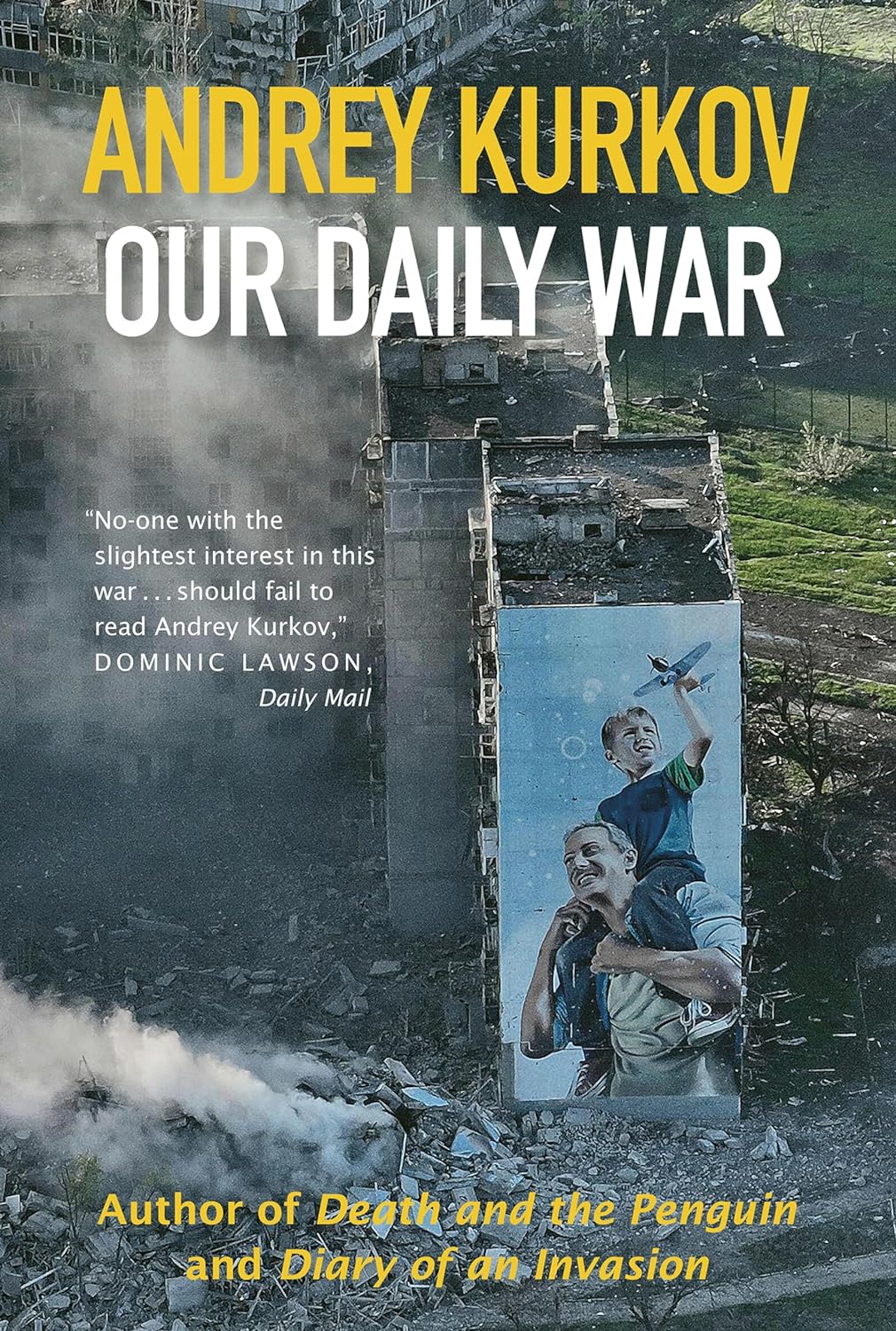
HARDBACK ORIGINAL | £ 20.00 | OPEN BORDERS PRESS
Blurb
Ten years on from the annexation of Crimea, two years on from Russia’s all-out invasion of Ukraine, the Ukrainian people continue to fight back. In the second volume of his war diaries, Andrey Kurkov gives a fresh perspective on a people for whom resistance and solidarity have become a matter of survival.
Our Daily War is a chronological record of the heterogeneous mix that comprises Ukrainian life and thought in the teeth of Russian aggression, from the constant stress of air raids, the deportation of citizens from the occupied regions and the whispers of governmental corruption to Christmas celebrations, crowdfunding and the recipe for a “trench candle”.
Kurkov’s human’s-eye view on the war in Ukraine is by turn bitingly satirical, tragic, humorous and heartfelt. It is also, in the manner of Pepys, an invaluable insight into the history, politics and culture of Ukraine.
Our Daily War is the ideal primer for anyone who would like to know what life is like in that country today.
My Review
Thanks to Anne for organising this blog tour and to the team at Orenda for sending me a copy of this book.
Reading this book opened my eyes to modern Ukrainian history, culture and social attitudes. I knew about some events from 1918 to about 1950 – the big stuff – the fight for independence after the fall of the Russian Empire and the Civil War, the Bolshevik take-over of Ukraine and destruction of the fledgling state, including the functioning anarchist region, the invasion by the USSR and Germany during WW2, the Holodomor. I only had a vague understanding of the events surrounding the Russian invasion of Crimea in 2014, and the gap between Holodomor and Crimean invasion is rather large. I didn’t know they’d only been a free country for 30 years, the 1990s don’t seem as close as all that, although I remember the slow fall of the USSR. I’ve met maybe one Ukrainian, that I know of, in 2009 while I was working at a fish factory. He was an ethnic Russian, and seemed to think everyone in Ukraine was Russian, so maybe he was from one of the border areas? I did used to know someone on Facebook, who was Ukrainian, living in Kharkiv I think, who hated her government, and thought NATO had ships in the Black Sea. She got a lot of her news from Russian channels. Given the state of Kharkiv right now, I do hope she and her child are safe.
I’ve been steadily reading through this book since it arrived and finished it just in time. This is a substantial book, and each essay/speech/diary entry is thoughtful, intelligently written and infused with wry humour and a deep love for Ukraine and her people. The descriptions of life in Ukraine since early 2022 are evocative and powerful.
If you hadn’t realised before, after reading this book you’d be absolutely certain: Russia needs to be stopped. This war is about Putin’s ego and his fantasies of being a Tsar, and nothing to do with the internal political struggles of Ukraine. The man is a fucking nutter, and his people believe his lies. POWs are brutalised while Russian soldiers think Ukrainians will do the same to them so kill themselves before being captured. Russians who have been captured say they’re told they’ll have their eyes gouged out, be raped, or have their mouths filled with polyurethane foam. Some of them are professional criminals set loose on Ukraine, not soldiers. And that doesn’t even begin to cover the mercenary armies being employed by Russia. It’s disturbing and disgusting.
Kurkov manages to so some traveling, as an internally displaced person, and as a refugee, as well as in a professional capacity. He’s also ethnically Russian in a state where Russia is the enemy, and yet, he has only ever had minor spats with people about his use of Russian as his first language or of writing in Russian. There are many languages and cultural groups in Ukraine, and most people seem to get along, if Kurkov is reporting his experiences honestly. He repeatedly mentions the displaced Tatars and Cossacks, forced to leave the occupied territories, their use of their own languages and customs, as a normal part of Ukrainian life and culture. Considering the turbulent history of the region, you’d expect more antipathy, but perhaps past events have helped mould Ukraine into a tolerant country because the worst things, caused by intolerance, have already happened? I enjoyed learning about Ukrainian cultural traditions and attempts to keep things going as normal, as well as the arguments about who and what should be remembered from the past, during difficult modern events.
Kurkov is very definite about the importance of culture in helping people to survive the war and to thrive afterwards, acknowledging the trauma of the entire population, whether they’re living in occupied territories, facing forced Russification (as their parents, grandparents and ancestors going back 300 years have), living in Kyiv being bombed frequently, not-sleeping through blackouts and hearing funeral music all the time, those living in the west of Ukraine, far from the frontline, who have some semblance of a normal life, or those in exile as refugees. Children are struggling, with schools that have been destroyed, learning in online school when there’s electricity, or in bomb shelters, constant stress from the air raids, and loss of homes and family members. This whole generation is going to need some serious therapy.
Author Biography

Andrey Kurkov was born near Leningrad in 1961 and graduated from Kyiv Pedagogical Academy of Foreign Languages in 1983. After working as a prison guard in Odesa and as a journalist, he self-published his texts and found renown as a novelist. His novel Death and the Penguin, his first in English translation, became an international bestseller, translated into more than 43 languages, and has been in print since its publication in 2001. Since the beginning of the Russian invasion, the author has published unrivalled reports from his war-torn country in newspapers and magazines all over the world. He has been a regular presence on radio and television, including BBC Radio 4’s “Letter from Ukraine”, and travelled worldwide to lecture on the perilous state of his country. He has, in the process, become a crucial voice for the people of Ukraine. His Diary of an Invasion was published in 2022.


 Everything Is Better With Dragons
Thanks for the blog tour support x