
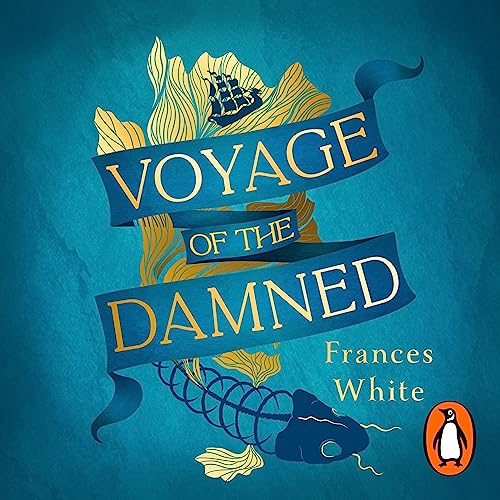
First published January 18, 2024
Book description
For a thousand years, Concordia has maintained peace between its provinces. To mark this incredible feat, the emperor’s ship embarks upon a twelve-day voyage to the sacred Goddess’s Mountain.
Aboard are the heirs of the twelve provinces of Concordia, each graced with a unique and secret magical ability known as a Blessing.
Except one: Ganymedes Piscero – class clown, slacker, and all-round disappointment.
When a beloved heir is murdered, everyone is a suspect. Stuck at sea and surrounded by powerful people without a Blessing to protect him, odds of survival are slim.
But as the bodies pile higher, Ganymedes must become the hero he was not born to be. Can he unmask the killer and their blessing before this bloody crusade reaches the shores of Concordia?
Or will the empire as he knows it fall?
My Review
I have two hardback special editions of this book and chose it as my audiobook from Amazon Music now that they are giving people one book a month, although you don’t get to keep it. Once you finish the audiobook, you swap it for another one. Now I’ve finished Voyage of the Damned, I’ve got Service Model by Adrian Tchaikovsky. I’m definitely getting this book when it comes out in paperback because it’s fun.
Dee, the narrator, is the ‘Blessed’ of the least important province of Concordia. His best friend is marrying the sister of one of the few other decent Blessed. There’s a small child running around the ship disappearing when she gets scared. And everyone else hates each other. Mostly the upper provinces disdain the lower provinces. The lower provinces accept their lesser position, except Ermine, who want their freedom.
The unity of Concordia is a sham. Wealth funnels upwards from the farming, fishing, and fighting states to the ruling and policing states. To the Dragon. The emperor is aging, going mad, and will die soon. Before that, his heir and her eleven ‘Blessed’ companions, Duxes of their provinces, must visit the mountain of the Goddess, protected by the monks of Bunnerfly province.
To get there, the twelve must travel by ship, and celebrate a feast for each province. No one trusts anyone. Dee gets his heart broken, and then upsets them all. Except Grasshopper, who thinks her new friend is marvellous.
At that point, people start dying. Dee gets his heart ripped out.
Dee decides, with the assistance of Grasshopper, and Wyatt, from Bear Province, who had previously hated him, to investigate the murders. It’s a mystery that their lives depend on him solving.
I enjoyed Dee’s narration (and the narrator, Nathan Foad, is a really good narrator); he’s a funny character who goes on both a physical journey, and a personal one. It was quite delightful to listen to Nathan Foad’s energetic narration and to the different accents given to each character.
I don’t want to spoiler the mystery. I have to say, I did not guess the murderer, or the twist discovery. It is very clever, and I enjoyed finding out what was going on, as one would with an Agatha Christie novel, when the murderer, thinking themself so clever, admits to everything, and their motives. There’s the climactic chase and fight, before the future arrives in the final chapter. Very satisfying.
The world building is not as fleshed out as I would expect from an adult fantasy; this book reminds me more of a fantasy for teenagers. Certainly, I found overlaps in the tone with the tone I associate with Tamora Pierce’s Tortall books. I found this quite comforting. Although the worldbuilding in those books gets fleshed out over a dozen or more books.
I found the world allegorical, and not at all subtle. The wealthy live above the poor, draining them of any potential wealth. The lives and labour of the poor are considered unworthy compared to the wealthy. People who fight the wealthy are thrown beyond the Bandage, where ‘monsters’ live. Except the monster are humans too, monsterising the ‘other’ to force unity on the state. There’s the official language and beliefs of Concordia, supressing the individual languages and beliefs of the individual provinces.
These are things we see in imperial states, especially those which have contiguous provinces or in more spread out colonial states. For instance, in the British Empire, English was the official language, overriding local languages. Even now, it remains an official languages within some colonies, along with indigenous languages. Victorian British laws and traditions were introduced, and still remain in some places. Unfortunately. Monstering the ‘other’ is a tradition of empires and most states. We definitely do it still. Just look at the news and see how Palestinians are talked about, despite being murdered en masse.
The characters of Dee and Grasshopper are very well fleshed out. Dee has quite a clear view of himself. He is a mess of fears and guilt, and knows it. His development as a person over the twelve days is quite abrupt. He starts out hating himself and wanting to cause trouble, and discovers his inner strength and self-worth through exploring the mystery. The others are less clear, although that develops over the novel as Dee himself gets to know people he had previously avoided.
The world is queer-normative. No one remarks on the relationships of anyone, except of the Shield and his love for the recently dead Tortoise ‘Blessed’, but only because the Shield isn’t meant to love anyone except their Emperor or Empress. There’s even an asexual character, although they’re presented as a strange, spy with a traumatic past. Because that doesn’t feed into pre-existing prejudices about asexual people…
The disability representation is quite fun. Elephant is a bolshy woman in a wheelchair who is competent and capable of looking after herself; she is sexually active and doesn’t hide it, except when she wants to for political purposes. She softens as she gets to know Dee, and especially Grasshopper. She likes children because they are less likely to hate people. She’s probably one of my favourite characters.
I’m not sure about the fat representation. Dee is chubby, he talks about his thighs, and one of the other characters call him a ‘baby seal’. I think he’s a probably what’s called a ‘small fat’. He also talks about ‘eating his feelings’, wanting to eat all the different foods of the empire, and ‘eating his weight in cheese’. Look, I get it, we should be happy that we have a fat main character, one who has a love life, but he’s a stereotypical fat person – lazy, gluttonous, ‘the funny one’, dismissed by people around them, and mentally ill (Dee has suicidal ideation and acts on it). It’s quite insulting. The assumption that a fat person is lazy, binges on sweets, only eats unhealthy food, has unhealthy coping mechanisms which is why they’re fat, and is mentally ill, doesn’t need any help to spread. People already believe these things about fat people, and it results in bullying, medical neglect, illness and death.
A fat main character with a solid sense of self-worth and mentally well, with a healthy relationship with food, would be nice for a change. Anyone want to give it a go?
Over all, I enjoyed this book and gave it five stars on GoodReads; that was my immediate response on finishing the book. Writing this review brought up things I must have been ruminating on while listening to the book. If you want a fun fantasy read/listen with a hint of golden age mystery, a dash of danger, and love, but nothing too heavy, I’ve got to say this is quite a good book.

 Everything Is Better With Dragons
1 Comment