Review: ‘From Codpiece to Three Piece: The History of Fashion’

History Today

Kindle Edition

July 2013

UlinkaRublack, Patrick Little, Christina Walkley, Lois Banner, Quentin Bell, Carol Dyhouse, Stella Mary Pearce  and Eileen Ribeiro

£2.05 from Amazon.co.uk


This small e-book contains eight articles spanning 60 years of scholarship and publishing. They focus on fashion, not just what clothes were worn when, but attitudes to clothing, and the things they indicate about the wearer, and also how people viewed the clothing worn by their ancestors, and how it was depicted in art.

Ranging from the changing attitudes to the wearing of fur to how fourteenth century artists depicted classical subjects to the question of precisely how dull Cromwell’s clothes were, this is a fascinating collection of articles. There is nothing new here; in fact I recognised three of the articles as I’ve read History Today regularly for the past eight years. The older articles were interesting, though; sixty years is a long time in academia and the attitudes of the writers to their subject’s is as interesting as the subjects themselves.

I’ve never bought one of these collections before (although it would be more precise to say my oldest friend bought me it since I used the gift card she gave me for my birthday – thanks Fi!) but I think it’s well worth the price. They are great resources, containing the best articles History Today has published on a particular subject. I would have liked a new, original article to go with the collection though; I think it would have made a nice touch.

Review: ‘Bright Young Things; Life in the Roaring Twenties.’ By Alison Maloney

2012

Virgin Books


review - byt


Described in the blurb as a ‘sweeping look at the changing world of the Jazz Age, as life below stairs vanished forever, loose morals ran riot, and new inventions made it seem anything was possible’, this book gives an entertaining glimpse in to the lives of the Bright Young People, the wealthy young Mayfair set who ran riot in London in the Nineteen Twenties. Presented in a gossipy tone, with first-hand accounts from those who were part of the group of friends dubbed the ‘Bright Young People’ by the popular press, and the generation of ‘Bright Young Things’ they led and inspired. The central cast of aristocrats and artists loom large in a playful narrative of all night dancing, freak parties, treasure hunts through London, immodest fashions and heavy drinking. The more staid members of their age group and class, the debs, and the attitudes of their parents to the antics of the hedonistic set are also covered.

The focus is primarily on London; however there is some reference to the United States and Paris. As Jazz was a large part of the lifestyle of the Bright Young Things, this isn’t surprising. The spread of this form of music from the southern United States across the Atlantic to London and the on into Europe is fascinating, although the author doesn’t go in to a great deal of detail.

Also covered in the book are references to changing sexual attitudes, and the growth of consumer ‘labour –saving’ goods as more people had access to electricity and servants became rarer.


While this book is subtitled ‘Life in the Roaring Twenties’ it doesn’t really give much of an insight in to life for those who weren’t wealthy and educated, and living in London. Bare mention is given to the lives and aspirations of working and lower middle class people, who presumably had ambitions and needs as well. It’s very gossipy in nature, relying on published diaries, letters and autobiographies/biographies for much of the detail. The ‘flapper’, her dress, attitudes and occupations are a recurring feature of the book.

I didn’t feel that the author really put meat on the bones of the subject, although the origin of certain terms originating in, or associated with, the decade are explained and there is a decent bibliography at the back. I’d say this was quite a good book for GCSE students wanting a bit more information about the Twenties, and those wanting an overview of the decade. At the very least it’ll get people started and then they can move on to more detailed studies of the decade.


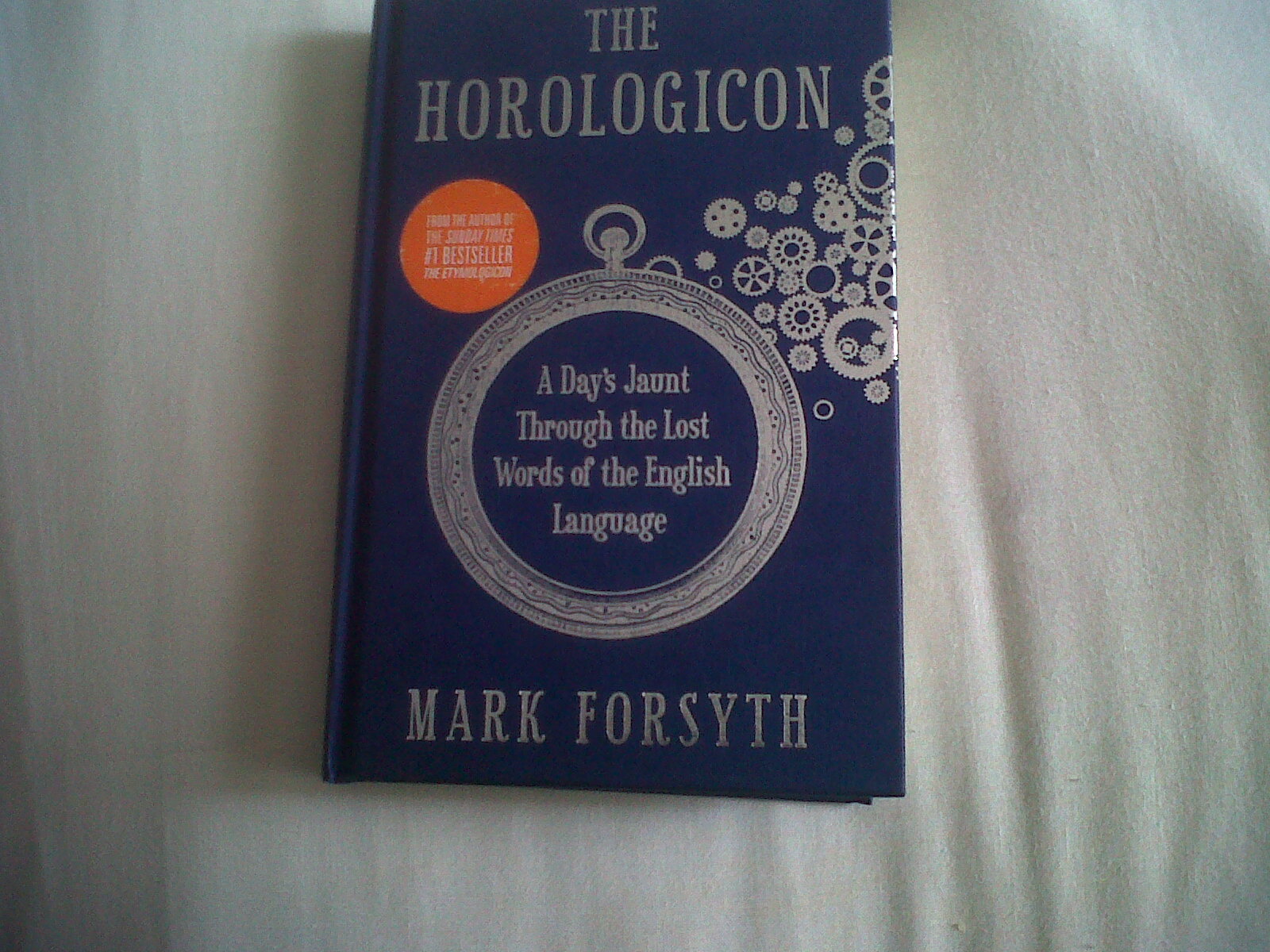
Review: ‘The Horologicon: A day’s jaunt throught the lost words of the English language’ by Mark Forsyth

The Horologicon: A day’s jaunt through the lost words of the English Language

Mark Forsyth

Icon Books

2012

I’ve just finished reading this book. The author doesn’t recommend reading it straight through, instead treating it as a reference work to be consulted at the appropriate hour of the day, unless one wishes to go mad. I used to read dictionaries for fun (don’t ask) so, really, it’s quite probable that I am already mad. That being the case, I’ve spent the past couple of morning’s making my way through this witty volume.

I laughed like a drain all the way through. Mark Forsyth is a clever writer; his talent for finding and using obscure words is truly remarkable. No longer will I suffer from utcare; I shall rise from my bed and take up this little volume. And when Bulls’s Noon comes I shall probably still be looking through it.

I really must get his first book, The Etymologicon; if it’s as good as The Horologicon I am certain of a good read.

I heartily recommend this book if you’re interested in the lost words of the English language, ever feel tongue-tied, in need of new ways to insult your boss without getting the sack, or just want a new word to say that you, or somebody else, are drunk.

Mark Forsyth blogs at

http://inkyfool.blogspot.com

And his Twitter is @inkyfool

Bye for now,

Rose

Review: Happily Ever After: Celebrating Jane Austen’s Pride and Prejudice by Susannah Fullerton

Review: Happily Ever After: Celebrating Jane Austen’s Pride and Prejudice

Susannah Fullerton

Frances Lincoln Limited Publishers

2013


While I was in the British Library on Monday I saw a few books about Jane Austen and Pride and Prejudice, and being a little bit of a Janeite I couldn’t resist buying this book for the train journey home. It is a fairly substantial hardback of 225 pages illustrated with drawings and photographs from the various editions of the book and film/tv adaptations that have been made. It took me a bit longer than the train journey to read, but certainly made the time pass agreeably.

The contents cover everything from the writing of Pride and Prejudice to the characters and various adaptations in books and films, and the ‘selling’ of Pride and Prejudice. Who knew you could get skateboards with quotes on them?

It is fairly obvious that the book was published to coincide with the 200th anniversary of the publication of Pride and Prejudice. The writer is clearly enamoured of her subject and holds definite opinions about it. It is enjoyable to read, and covers many interesting topics. The book is informative and would probably have been useful to my younger self when I was studying Pride and Prejudice for my GCSE English Literature. I particularly found the discussion of translating P&P interesting. The fine irony of Jane Austen, her wicked wit, cannot be easy to translate, although anyone who gives it a go deserves a medal for trying.

However, there is a slight feeling of snobbery and prejudice against anyone who dares to adapt the original (personally I like ‘Pride and Prejudice and Zombies’ – it’s funny) and the authoress also becomes repetitive at times. We all know P&P is a great book; you don’t need to tell us a dozen times a chapter.

Borrow it from the library if you’re studying Pride and Prejudice, only buy this book if you really can’t resist.

As ever, that’s just my opinion. Happy reading,

Rose