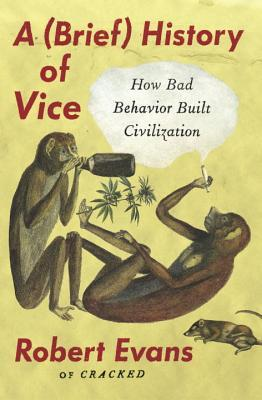
Format: 260 pages, Paperback Published: August 9, 2016 by Plume ISBN: 9780147517609 (ISBN10: 0147517605) Language: English
Description
From a former editor at the popular humour site Cracked.com and one of the writers of the bestselling You Might Be a Zombie and The De-Textbook, a rollicking look at vice throughout history, complete with instructions for re-creating debauchery at home.
Part history lesson, part how-to guide, A Brief History of Vice includes interviews with experts and original experimentation to bring readers a history of some of humanity’s most prominent vices, along with explanations for how each of them helped humans rise to the top of the food chain. Evans connects the dots between coffee and its Islamic origins, the drug ephedra and Mormons, music and Stonehenge, and much more. Chapters also include step-by-step guides for re-creating prehistoric debauchery in your modern life based on Evans’s first-hand fieldwork. Readers won’t just learn about the beer that destroyed South America’s first empire; they’ll learn how to make it.
My Review
I really enjoy Robert Evans’ podcast ‘Behind The Bastards’ and thought I’d give this book a read, just for amusement. Apparently he spent the money he was paid for this book on living in a ridiculously big house for a year and almost became homeless. Dafty.
Doing daft things for education and entertainment seems to be Evans’ motivation for a lot of things in life, although he is also a decent conflict zone reporter. This book was written while he was still at Cracked.com, and before he started his podcast. It is a mixture of science, history, anthropology and self-experimentation with a variety of historical intoxicants, from Sumerian early beer, hallucinogens from ancient Greece, nose pipes from Mesoamerica, and the ways tobacco has been used for healing, including as a purgative. I’m surprised only one person ended up in hospital.
The book was entertainingly written and honest about the effects of the various substances tried. I’m not sure the thesis, that ‘bad behaviour’ made civilisation, is substantiated, but it’s an interesting trip through the ancient world, from a very different perspective.
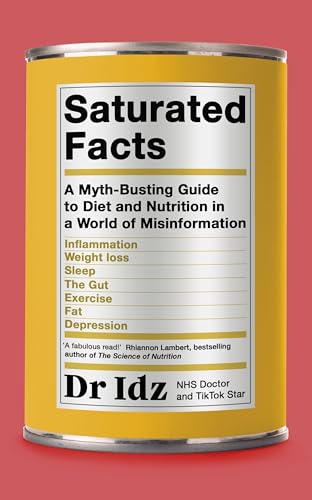
Publisher : Penguin Life (14 Mar. 2024) Language : English Paperback : 272 pages ISBN-10 : 0241588227 ISBN-13 : 978-0241588222
Are carbs the enemy? Am I getting enough protein? Should I worry about inflammation? Do calories count? And do any diets really work?
We are constantly bombarded with advice on how to live a ‘healthier’ life. From the benefits of intermittent fasting and the keto diet, to the growth of veganism and the dangers of inflammation, poor-quality, dubiously sourced information on how we can live and feel better is everywhere. But where should we turn for advice we can trust?
Dr Idrees Mughal (Dr Idz), an NHS doctor with a masters in nutritional research and a board certification in lifestyle medicine, has made it his mission to educate, inspire and empower the public when it comes to diet and lifestyle. His signature videos have attracted millions of followers online, and now he’s collected this wealth of information in his first book, Saturated Facts – your science-backed guide to living better.
Whether you’re looking to lose weight, sleep better, avoid disease or just have more energy as you go about your day, Saturated Facts is the comprehensive guide you need to make smarter decisions about your health.
My Review
This book arrived on publication day. I spent a couple of days reading and digesting it. There was a lot to think about. I’m interested in nutrition science, I’ve read a few other books on the subject, and I’ve even done a couple of level 2 nutrition courses. I like the science. The human body and how it processes food is fascinating and not generally as simple as people believe. It really is more complicated than individual nutrients and calories in-calories out.
I really liked the structure of this book, the references to specific studies and scientific consensus, and all the sources are listed at the back. There should always be sources! It made my brain happy to read this book. Dr Mughal makes the scientific papers legible to the non-specialist and lay reader (I did chemistry, biochemistry and geology, and I understand autism paper, everything else I need translating). I appreciate the effort. I also appreciate the author’s debunkings of myths.
A lot of the information wasn’t new to me, but the level of detail was, and I found that satisfying. The nutrition advice is sound, as far as I know and I generally eat quite well roughly following the advice, something I learnt years ago. I think this book would be really useful for people needing a clear explanation, backed up by named sources, before they engage in a change in diet.
I read a couple of statements in the book, also ostensibly supported by scientific sources, but which are actually a bit dodgy. In fact I found some of them rather upsetting and ignorant.
The first is a reference to Autistic people and faecal transplants, and how after a faecal transplant Autistic children showed ‘less autistic symptoms’. For a start that paper you referenced, Dr Idz, was from October 2005 and has already been debunked by better people than me. Common criticisms include: the children weren’t asked if it helped, their parents were asked for their subjective observations; the language used by the researchers was prejudicial and biased – comparing autistic children vs ‘healthy’ children; the researchers failed to consider the fact that autistic people often have gastric difficulties and limited diets due to sensory sensitivities so it’s hard for us to get balanced diets when we need our safe foods. If children are forced to eat food that upsets them either digestively or sensorily, they will have ‘more autistic symptoms’, because they’re in pain! Strangely enough, you’d probably be grumpy if you can’t eat something because it makes you want to vomit from the texture/taste/smell/sight (baked beans, mushy peas, avocado, I’m looking at you, or not actually because bleurgh) or because your belly hurts because you’re having a response to the food. Children don’t have the words, often, to specifically describe their pain or to work out the cause. This is especially true of those with other complex conditions or who struggle with verbal speech. Instead of giving us faecal transplants, try working out what’s causing the problems in the first place?
If you use a paper that’s so thoroughly wrong to make a point, why should I trust you’re other citations? I know about autism. I don’t know as much about nutrition, you could be bullshitting me and passing it off as scientific consensus. Also, the phrase ‘in mice’ is important in some of the cited papers about helping fat people be less fat.
On to the second one. Doctors and health care professionals generally engage in a lot of anti-fat bullying. I generally get nurses, for some reason, telling me I need to lose all the weight or I’ll get a horrible illness and die. Completely ignoring my genetics, my actual lifestyle, my medical conditions and neurotype. Doctors get funny when I need procedures that require anaesthetic (if you can mutilate healthy stomachs in the name of weight loss, you can do a fucking colposcopy under anaesthetic, stop being a dick about it). Doctor Mughal does in fact acknowledge the anti-fat biases of his colleagues but moves on extremely quickly and seems to push it off as a minor issue. On the subject of fatness he’s quite contradictory – it’s a disease that needs treatment, but also fat people are responsible for being fat, fat people are treated badly by doctors but doctors can’t help their biases.
And Dr Idz is no better than the rest of them on that count. He doesn’t question statements about fat people being more anxious (what do you think happens when people are bullied all their lives?) and doesn’t question the cause and effect of fatness and type-2 diabetes, even though genetics has been shown to be more of an influence than body size.
I’m fat so of course I must live on take aways and sit around all day. Who can afford to live on takeaways? Plus they upset my digestion. I probably have some sort of irritable bowel conditions (or as I call it ‘the anxiety shits’) and I have a hiatus hernia. Also, autistic food pickiness. I know what I can and can’t eat. But still, I like learning more about this stuff as a science-minded person. Don’t be too shocked, will you?
He also misunderstands the purpose of fat activism – it’s a movement for equality. Even if fat people lost that magical 10% of their starting weight, there would still be lots of fat people in the world, and we shouldn’t be excluded from participating in life, shouldn’t be denied healthcare and employment, and we shouldn’t be bullied because of ignorance and prejudices. That’s it. It’s not a difficult concept.
So, over all, watch it if you’re fat and kinda sensitive about stuff, because this book repeats a lot of the biased bollocks we already hear from HCPs, but when he sticks strictly to nutritional advice, Dr Idz really does a good job of explaining the science in an easily understandable way, with citations, mostly from the last decade, with a small number of exceptions (yes, I looked). I like citations, have I mentioned that.
I gave this book a 3/5 on GoodReads purely for the autism bollocks he repeated without question. I’d have got a 4 or 5 if he’d refrained from that and I hadn’t started questioning his sources.
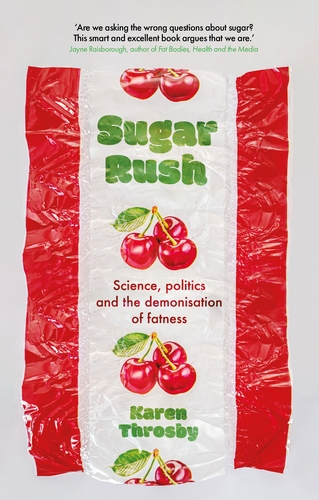
Format: Paperback ISBN: 978-1-5261-5155-1 Pages: 304 Price: £19.99 Published Date: June 2023 Published by Manchester University Press
DESCRIPTION
In the second decade of the twenty-first century, the crusade against sugar rose to prominence as an urgent societal problem about which something needed to be done. Sugar was transformed into the common enemy in a revived ‘war on obesity’ levelled at ‘unhealthy’ foods and the people who enjoy them. Are the evils of sugar based on purely scientific fact, or are other forces at play?
Sugar rush explores the social life of sugar in its rise to infamy. The book reveals how competing understandings of the ‘problem’ of sugar are smoothed over through appeals to science and the demonization of fatness, with politics and popular culture preying on our anxieties about what we eat. Drawing on journalism, government policy, public health campaigns, self-help books, autobiographies and documentaries, the book argues that this rush to blame sugar is a phenomenon of its time, finding fertile ground in the era of austerity and its attendant inequalities.
Inviting readers to resist the comforting certainties of the attack on sugar, Sugar Rush shows how this actually represents a politics of despair, entrenching rather than disrupting the inequality-riddled status quo.
My Review
Throsby uses a variety of sources from 2016 to 2019 to interrogate the focus on sugar are ‘the’ bad nutrient. She links this to pre-existing food hysterias, and austerity, with its focus on punishing the poor, the fat, the abject Other.
The structure of this book is that of an academic textbook, with an introduction, sources used, and chapter conclusions, while the writing is more like that one would find in a popular science book, easy to read and understand. The tone is one of enquiry and interest, rather than anger or scoffing at the writers of the source materials. The arguments and conclusions are supported strongly and are convincing, at least to this reader.
I highly recommend this to fat activists, disability rights activists, anyone interested in social equity, and dietitians. Really considering buying a copy to give my dietitian…
Format: 224 pages, Paperback Published: November 30, 2023 by Pluto Press ISBN: 9780745348667 (ISBN10: 0745348661) Language: English
Blurb
Neurodiversity is on the rise. Awareness and diagnoses have exploded in recent years, but we are still missing a wider understanding of how we got here and why. Beyond simplistic narratives of normativity and difference, this groundbreaking book exposes the very myth of the ‘normal’ brain as a product of intensified capitalism.
Exploring the rich histories of the neurodiversity and disability movements, Robert Chapman shows how the rise of capitalism created an ‘empire of normality’ that transformed our understanding of the body into that of a productivity machine. Neurodivergent liberation is possible – but only by challenging the deepest logics of capitalism. Empire of Normality is an essential guide to understanding the systems that shape our bodies, minds and deepest selves – and how we can undo them.
Robert Chapman is a neurodivergent philosopher who has taught at King’s College London and Bristol University. They are currently Assistant Professor in Critical Neurodiversity Studies at Durham University. They blog at Psychology Today and at Critical Neurodiversity .
My Review
Robert Chapman works with a couple of neurodivergent academics (Hi Louise and Anna 1 )I know, so I heard about this book months before it was published and pre-ordered it as soon as I could. There was a problem with the publisher’s computer system and my pre-order was lost so I had to re-order it. I did end up getting a discount because of that though, so I’m not complaining. I also ordered a few other books from Pluto Press, which I will get around to reading and reviewing. Eventually.
This book was an absolute joy to read. Chapman explores the history of neurodivergent people and the disability and neurodiversity rights movements. They explicate and critique anti-psychiatry, Freudianism and other areas of psychiatry, and confirming what I’ve said for years, capitalism is to blame for everything!
No, seriously, think about it.
Why do we have to be machines that happily work set shifts every day doing repetitive uncreative tasks? Capitalism.
Why do we have to fight for any form of social support? Capitalism.
Why are so many more people struggling with their mental health? Capitalism.
We live in a society where everything has a price and if you can’t produce you are a drain on society. The Tories have placed the blame and burden of austerity firmly on disabled people. Neolibralism, that monster set loose by Thatcher on our social and educational systems, pushes things further than ever before, and now we have fascism rearing its ugly head again. This is not hyperbole and if you think it is, you haven’t been listening to disability rights and neurodivergent rights activists, anyone who gives a damn about civil society or social equity.
I tried to say similar things to Chapman in my booklet about neurodivergent history, and couldn’t quite express myself the way I wanted to or get the message I wanted across. Part of that was lack of theoretical background (I am not a philosopher) and part was the funding source. Can’t write a socialist history or a manifesto for neurodivergent equality when you’re getting government funding and working for a non-partisan charity.
Yes, I liked this book because it agrees with my personal politics2, but that’s not the only reason. Chapman writes clearly, fluently, and makes convincing arguments for their position. They explain and explore history, making connections between different areas that might not be clear, although their examples show that other people have made those same connections in the past. By putting the neurodivergent experience in the context of capitalism, viewing the changing place of neurodivergent people through a Marxist lens, we can see the connections between the way capitalism has narrowed our lives and shaped the paradigm through which we are viewed by society, the medical and political system, and how they choose to treat us.
I have already recommended this book to several people and will be asking for a copy for our Little Neurodivergent Library at work.
Insert mad waving here. They’re all a part of the Medical Humanities Department at the University of Durham, my alma mater, not that Durham would admit that I ever went there. ↩︎
Burn it down, pull it out by the roots, start all over again with an equitable society from the beginning. ↩︎
By Amanda J Thomas Imprint: Pen & Sword History Pages: 280 ISBN: 9781473875678 Published: 23rd June 2020
Blurb
The Nonconformist Revolution explores the evolution of dissenting thought and how Nonconformity shaped the transformation of England from a rural to an urban, industrialised society.
The foundations for the Industrial Revolution were in place from the late Middle Ages when the early development of manufacturing processes and changes in the structure of rural communities began to provide opportunities for economic and social advancement. Successive waves of Huguenot migrants and the influence of Northern European religious ideology also played an important role in this process. The Civil Wars would provide a catalyst for the dissemination of new ideas and help shape the emergence of a new English Protestantism and divergent dissident sects. The persecution which followed strengthened the Nonconformist cause, and for the early Quakers it intensified their unity and resilience, qualities which would prove to be invaluable for business.
In the years following the Restoration, Nonconformist ideas fuelled enlightened thought creating an environment for enterprise but also a desire for more radical change. Reformers seized on the plight of a working poor alienated by innovation and frustrated by false promises. The vision which was at first the spark for innovation would ignite revolution.
My Review
I received this book in 2020 from the publisher in return for an honest review. It has taken me a long time to read it. I have been reading in in bursts, a chapter or two at a time around other reviewing commitments and work.
This review is all over the place. I have just finished the book. It took me 3.5 years to read the first ten chapters (140 pages) and less than a day to read the last five (68 pages); I’m a bit confuddled.
The book covers developments from the 1300s to the 1800s, in dissenting religious groups and industrial development, and makes the argument that without the unconventional thinking and organisational support Nonconformists and ‘heretics’ provided to each other, England would not have become the driver of Industrial revolution that it was in the early 18th to late 19th century that it was. The focus is on England, the interactions between England and Continental ideas and people, England and the North American colonies, England and France (because, 1066 and all that). It doesn’t look at technology developed in any of the colonies (usually derived from indigenous or enslaved peoples’ knowledge).
There are some interesting ideas in this book:
The author points out the complex family networks of the Midlands and northern Nonconformist families who supported each others’ business ventures and encouraged/funded new developments in ironworks, among other things. The relationships were longstanding and lucrative for many of the families. The connections went from the Tyne to the Severn, through Liverpool, Manchester, Sheffield, Birmingham and Bristol.
The literacy encouraged by Protestant beliefs – that people should be able to read the Bible in their own language – encouraged education in these families and that enabled people to question social structures and norms, as well as make scientific breakthroughs.
Every group looks back to a golden age of freedom and liberty – the Peasant’s Revolt (which was more of a middling sorts revolt with villainage cannon fodder) looked back to a pre-Norman England, the Nonconformists of the 18th century valourised the Puritanism of the Republic. They never were golden ages, there were always tyrants and inequality and war.
The author doesn’t mention much about the slave trade, although some of the Nonconformist families made their money from making guns and cannons, supporting the East India Company and the slave trade. At least one person mentioned, from the 1700s, was disowned by his Quaker congregation for inheriting a gun company and supporting the slave trade. It is safe to say that without the triangular trade a lot of people wouldn’t have had the funds to support the new products produced by Wedgwood, or fund the research of Priestley and the Lunar society (amongst others). The focus of the book is so narrow that the author can’t bring these considerations into the text. I don’t know if that is a good or bad thing. She does mention the above, but briefly, with no exploration. A wider exploration of the developing empire might have added context.
The final two chapter focus heavily on Thomas Paine, his adventures in North America and France, who he knew and what he wrote. Amanda J. Thomas explores the possible developments of his radical thought from his Quaker upbringing to his return to North America in 1800 after imprisonment in France. The author connects his activities to the rise and fall of radical organisations, especially those in Sheffield, demanding governmental reform. As we all should know, the government of the time, and for decades afterwards, was very opposed to any reform, cracking down heavily, violently against anything that would put the high church gentry and the aristocracy out of control. And yet, people kept dissenting…
There were times when the book felt disjointed, as though it were a collection of essays arranged chronologically, and at other times several chapters would naturally follow from each other. This may be an artifact of the development of the book?
The writing is decent and the story is really interesting. What I think slowed me down was all the family trees (tangled shrubs in some cases) that the author felt the need to write out and share with us in the main text. I don’t think it was always necessary to getting the ideas across clearly and could possibly have be left to an appendix, along with the visual representations of the family trees.
The book has a good bibliography and indexing, notes are clearly identified and information sourced. The author has relied heavily on some sources more than others, usually those about specific families or individuals, which gives a possibly partial impression of events, but also provides interesting nuggets of information about individuals and the social and cultural dynamics of their times. I did not know that Joseph Priestley knew Thomas Paine and Thomas Jefferson, for example, or that Benjamin Johnson was a member of the Royal Society at the same time. I knew Erasmus Darwin and Wedgwood knew each other, because of the weird family dynamics of Charles Darwin and his cousin-wife. In-bred the lot of them -the Wedgwoods, Darwins and Galtons.
So, final thoughts. Interesting ideas and social history that tries to illuminate the development of the co-occurring scientific, religious and political though that brought about the 18th and 19th century Industrial Revolution in England, and makes some attempt to put it into the wider North Atlantic context. Quite well written and extensively researched. Excellent bibliography. Could do with some editing.
Also, I noted some references that make it into Discworld.
In the follow up to his Sunday Times bestseller, The Hidden Life of Trees, Peter Wohlleben compares tree planting to battery farming
‘In clear, vivid prose with impeccable reasoning, Peter Wohlleben makes a compelling case that almost everything we do in modern forestry management may be dead wrong. What should we do instead? Let the wisdom of the trees quell our human arrogance, heal the forest and restore our sweet, green world’ Sy Montgomery, author of How to be a Good Creature and The Soul of an Octopus
TREES CAN SURVIVE without humans, but we can’t live without trees. Even if human-caused climate change devastates our planet, trees will return—as they do, always and everywhere, even after ice ages, catastrophic fires, destructive storms, and deforestation. It would just be nice if we were around to see them flourish.
The Power of Trees is forester Peter Wohlleben’s follow-up to The Hidden Life of Trees, a Sunday Times bestseller that sold millions of copies worldwide. In his latest book, he is dismissive of token gestures in terms of tree planting. Just as he compared forest trees to ‘families’ and urban trees to ‘street urchins’ in his first book, in The Power of Trees he uses equally powerful metaphors to compare tree planting to battery farming (‘Switching to fast-growing species and breeding trees for desired traits brought results like those achieved by factory farming: individuals ready for harvest at a young age, all with a relatively uniform carcass weight.’). However, he also joyfully describes trees determination to survive, describing seedlings breaking through the earth where you least expect them, as ‘stalwart tree children’.
This latest work is as fascinating and eye-opening as it is trenchant in its critique: on the one hand, Wohlleben describes astonishing discoveries about how trees pass knowledge down to succeeding generations and their ability to survive climate change; on the other, he is unsparing in his criticism of those who wield economic and political power—who plant trees exclusively for the sake of logging and virtue signaling—even as they ruthlessly exploit nature. The Power of Trees is a love letter to the forest and a passionate argument for protecting nature’s boundless diversity, not only for the sake of trees, but also for us.
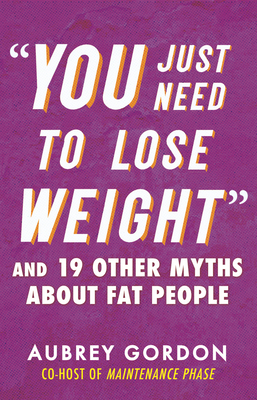
The co-host of the Maintenance Phase podcast and creator of Your Fat Friend equips you with the facts to debunk common anti-fat myths and with tools to take action for fat justice
The pushback that shows up in conversations about fat justice takes exceedingly predicable form. Losing weight is easy—calories in, calories out. Fat people are unhealthy. We’re in the midst of an obesity epidemic. Fat acceptance “glorifies obesity.” The BMI is an objective measure of size and health. Yet, these myths are as readily debunked as they are pervasive.
In “You Just Need to Lose Weight,” Aubrey Gordon equips readers with the facts and figures to reframe myths about fatness in order to dismantle the anti-fat bias ingrained in how we think about and treat fat people. Bringing her dozen years of community organizing and training to bear, Gordon shares the rhetorical approaches she and other organizers employ to not only counter these pernicious myths, but to dismantle the anti-fat bias that so often underpin them.
As conversations about fat acceptance and fat justice continue to grow, “You Just Need to Lose Weight” will be essential to ensure that those conversations are informed, effective, and grounded in both research and history.
Maintaining its appealing style and presentation, the Yearbook of Astronomy 2023 contains comprehensive jargon-free monthly sky notes and an authoritative set of sky charts to enable backyard astronomers and sky gazers everywhere to plan their viewing of the year’s eclipses, comets, meteor showers and minor planets as well as detailing the phases of the Moon and visibility and locations of the planets throughout the year. To supplement all this is a variety of entertaining and informative articles, a feature for which the Yearbook of Astronomy is known. Presenting the reader with information on a wide range of topics, the articles for the 2023 edition include, among others, The Incomparable Sir Patrick Moore; Shining a Light on Jupiter’s Atmosphere; A Brief History of the End of the Universe; The Closing of Historic Observatories; The Ability to Believe: Bizarre Worlds of Astronomical Antireality; Optical SETI at Harvard; The Future of Spaceflight; and Male Family Mentors for Women in Astronomy: Caroline and William Herschel.
This iconic publication made its first appearance way back in 1962, shortly after the dawning of the Space Age. Now into its seventh decade of production, the Yearbook continues to be essential reading for anyone lured and fascinated by the magic of astronomy and who has a desire to extend their knowledge of the Universe and the wonders it plays host to. The Yearbook of Astronomy is indeed an inspiration to amateur and professional astronomers alike, and warrants a place on the bookshelf of all stargazers and watchers of the Universe.
My Review
This book is a comprehensive yearbook covering the skies of both northern and southern hemispheres, with monthly notes and a wide selection of articles. It’s a slickly produced, full-colour, yearbook that will appeal to astronomy enthusiasts.
I found it fascinating, although my knowledge of astronomy is not as extensive as I would like it to be. I think I have learnt something from reading this book.
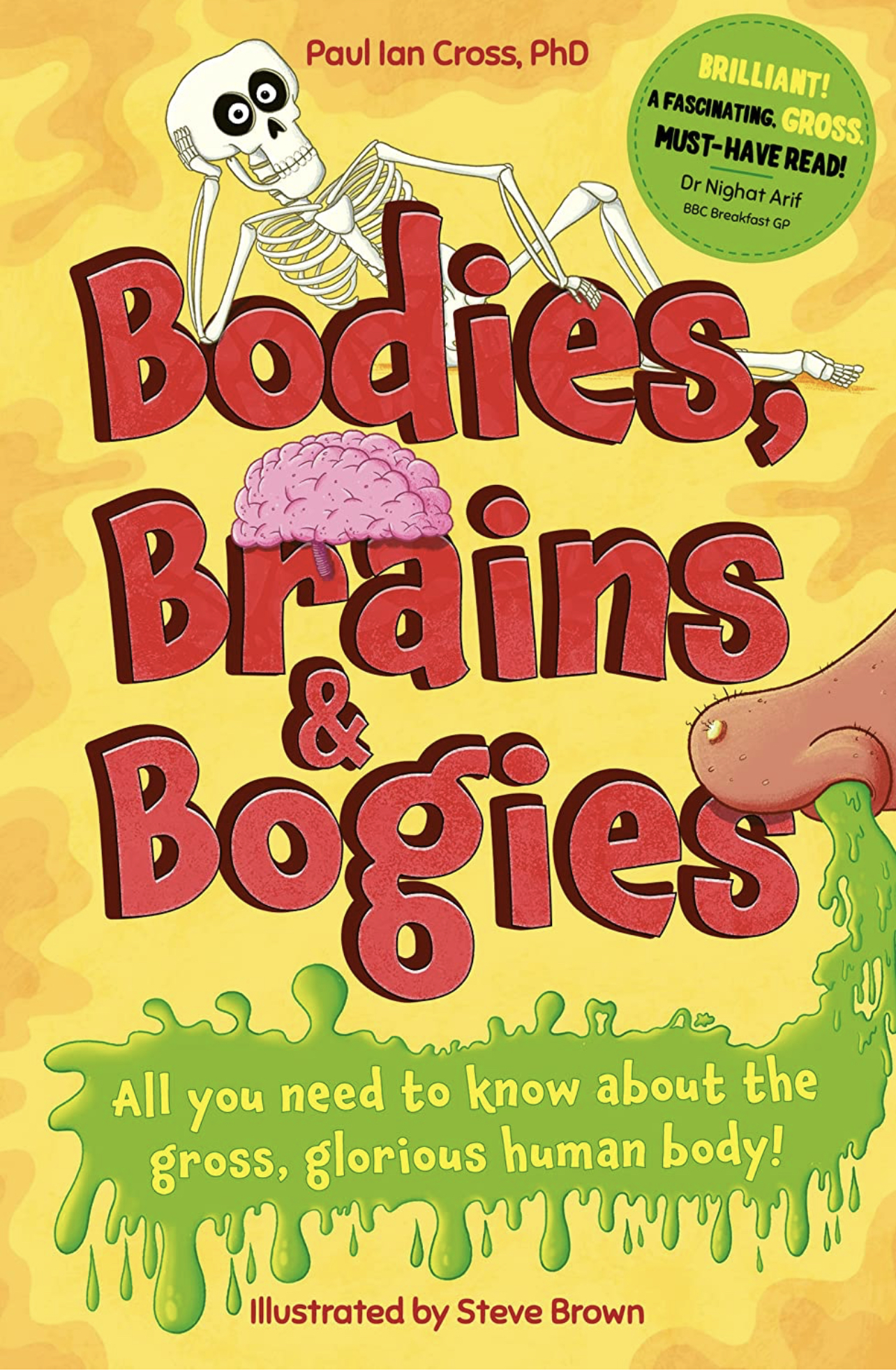
This fantastic title from Paul Ian Cross, the writer of How to Vanquish a Virus, takes the reader on a whirlwind tour of everything that’s disgusting, unusual and amazing about the human body. Find out everything about poo, pus and bogies, while learning a whole lot about how our bodies work hard in hundreds of fascinating ways to keep us alive.
With tons of hilarious and informative illustrations, it includes lashings of Paul Ian Cross’s trademark laugh-out-loud humour, in-depth knowledge and infectious optimism. It’s the perfect funny, accessible way to discover everything you’ve ever wanted to know about the human body, but were too grossed-out to ask!
Paperback, 419 pages Published November 14th 2017 by W&N (first published September 8th 2016) ISBN: 1780229070 (ISBN13: 9781780229072)
Blurb
This is a story about you. It is the history of who you are and how you came to be. It is unique to you, as it is to each of the 100 billion modern humans who have ever drawn breath. But it is also our collective story, because in every one of our genomes we each carry the history of our species births, deaths, disease, war, famine, migration, and a lot of sex.
Since scientists first read the human genome in 2001, it has been subject to all sorts of claims, counterclaims, and myths. In fact, as Adam Rutherford explains, our genomes should be read not as instruction manuals, but as epic poems. DNA determines far less than we have been led to believe about us as individuals, but vastly more about us as a species.
In this captivating journey through the expanding landscape of genetics, Adam Rutherford reveals what our genes now tell us about history, and what history tells us about our genes. From Neanderthals to murder, from redheads to race, dead kings to plague, evolution to epigenetics, this is a demystifying and illuminating new portrait of who we are and how we came to be.
My Review
This is another one of my random books I bought because it looked interesting. I like biology, history and all that connected stuff. Yes, it really is all connected; it makes no sense to teach them as separate subjects, they all overlap. But that’s not really important right now…
Adam Rutherford writes amusingly of genomics, history and archaeology, as he explains how modern humans came to be the only hominids left and where we are now. It’s basic stuff that people really should know, but unfortunately they don’t and that causes a lot of problems in society.
Seriously, how can anyone believe in ‘race’ these days when genomics can show that it doesn’t exist in a scientific sense? I understand it is a social classification that has real effect in the world, race is a social construct that is used to unite people and divide them, to build a social identity and to deny social advantages, but that doesn’t make it any less illogical.
I actually found his discussion of his PhD research fascinating. Eyes are really odd, but clearly not ‘designed’. Like much of the body, it’s really daft and clearly made up of changes over time. Eyes break so easily, they’re so often a mess from the start too. How anyone can believe they were created perfectly by some god is again, beyond me. Octopuses managed to do it better, for crying out loud!
Human evolution is fascinating! No really, I love it. I found the way Rutherford described the multiple times different human species mixed and shared genes really informative.
The book is fairly introductory and includes a glossary and further reading, so it’s a good place to start if you’re interested.
Problems: Adam Rutherford shouldn’t talk about Autism, because he clearly knows nothing; he still refers to us as having Autism Spectrum Disorder. We are not disordered!
His grasp of human sex and gender is limited. He often refers to ‘the two sexes’ and ‘male is XY, female is XX’, completely ignoring the fact that sex is more complicated than that, and he dismisses intersex people in a footnote as negligible disorders. Way back in 2016 I reviewed a book on the subject that clearly explains how much variety there is in human sex and gender. He also uses ‘male’ and ‘women’, rather than ‘male’ and ‘female’, or ‘men’ and ‘women’; it’s confusing and I’m not sure why he does it. In context, it doesn’t make sense. If you’re talking about sex or presumed sex (because someone’s external genitalia may be one thing but their chromosomes and hormones could be different) use male, female or intersex; if you’re talking about gender, use gender labels – men, women, non-binary, agender etc.
Definitely one to read and share with all your embarrassing relatives.






 Everything Is Better With Dragons