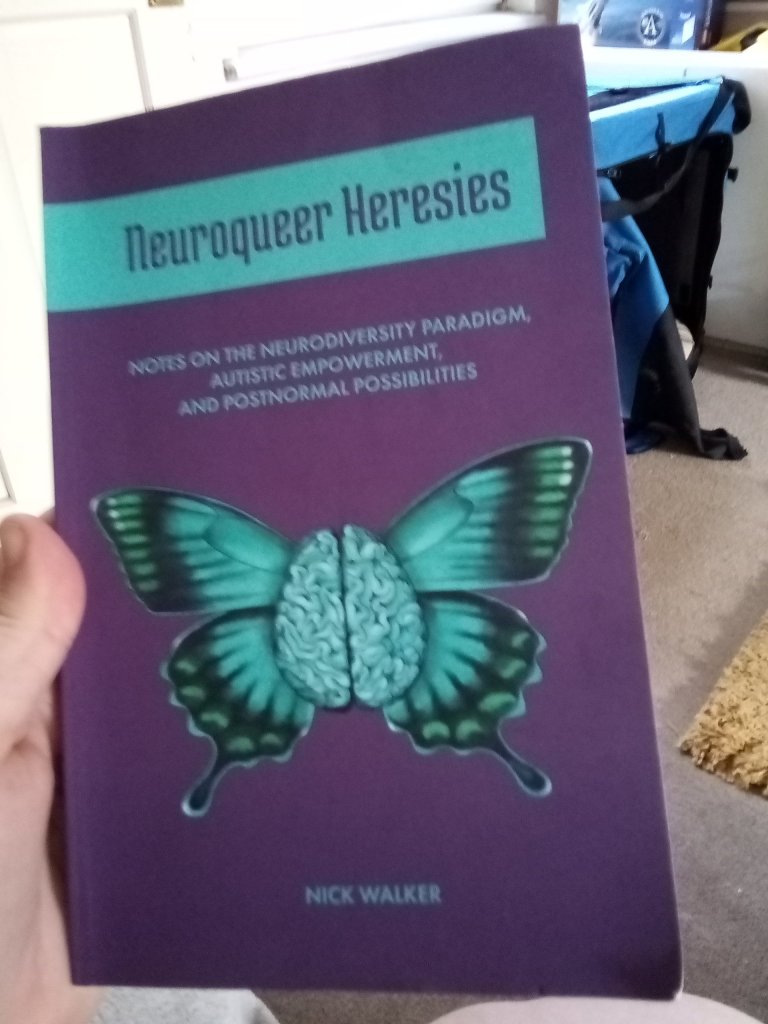
I’ve come across Nick Walker’s work before, seen neurocosmopolitan and Neuroqueer referenced by other writers, and used Walker’s list of definitions in my own work, particularly the heritage project I’m working on – many people are unfamiliar with neurodiversity, the concept, paradigm and movement, and the vocabulary tha to has developed around it – but I hadn’t done more than skim until someone suggested we read some of her work for a Narratives of Neurodiversity Network Salon. Since I like to support small presses, I bought a copy of Walker’s book.
I’m very glad I did. I’ve spent a decent amount of time reading and cogitating in the contents. I am slightly annoyed to find that the ideas I thought I had that were original have actually been thought before, and articulated more elegantly than I could have done.
Although the stars and constellations metaphor is still mine and mine alone. So far as I know.
Nick Walker has been part of the neurodiversity movement for the last couple of decades, and knows people who were there at the beginning when autistic people started meeting and building culture online. She coined a lot of the words, or knows the people who did, and gives difinative histories and meanings for the words. This book also goes on to explain concepts like neurocosmopolitan and Neuroqueer in ways that people can understand. With examples.
I’m donating a new, un-Rosie-marked copy of this book to the little autistic library I’m building at my work. I think it’ll be helpful in giving people a different way of looking at their diagnosis and understanding of themselves through the neurodiversity paradigm rather than the pathology paradigm.
The Red Tigress, Ana Mikhailov, has returned to Cyrilia, but the country she once called home has fallen under a dark rule. Across the land, the Empress Morganya is tightening her grip on Affinites and non-Affinites alike.
Ana dealt a blow to the Empress when she and her allies turned back Morganya’s troops, but she couldn’t stop Morganya from gaining possession of a dangerous new weapon with the power to steal Affinities. Ana’s forces are scattered, and her alliance with the rebel group, the Red Cloaks, is becoming more frayed by the day.
What’s worse, she’s lost her Affinity to blood and without it, Ana barely knows who she is anymore – or if she has the strength to defeat Morganya.
Morganya’s reign of terror is close to crushing the nation Ana was born to rule. And now Ana will finally face the sinister empress, but will she survive? Will anyone? And will her Empire welcome her back to the throne, or turn her out to survive on her own.
The Affinites and Non-Affinites of Cyrilia will determine Ana’s future, if Morganya doesn’t kill her first.
Paperback, 406 pages Published May 16th 2019 by Gollancz (first published November 13th 2018)
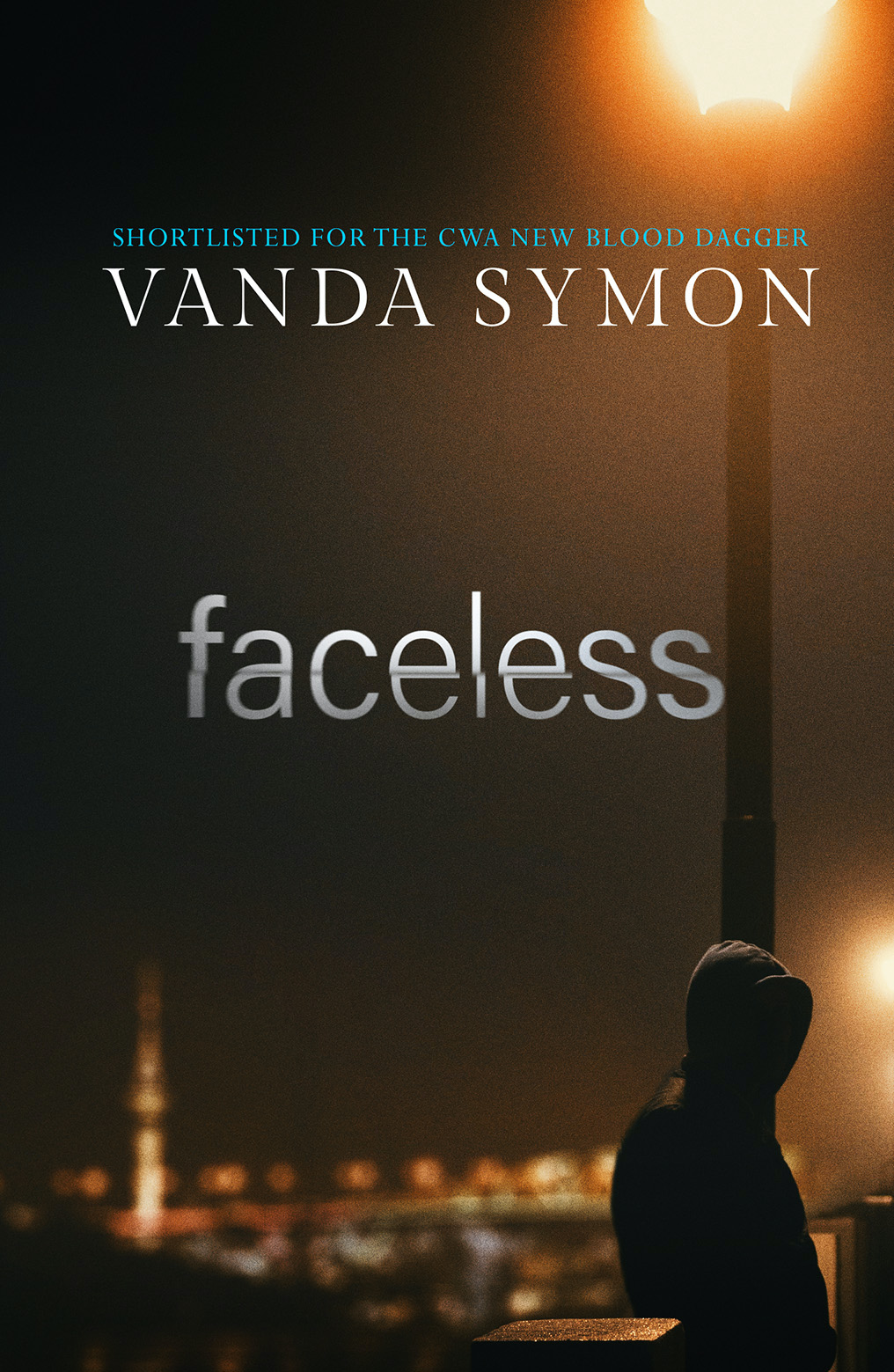
The Faceless Man, wanted for multiple counts of murder, fraud, and crimes against humanity, has been unmasked and is on the run.Peter Grant, Detective Constable and apprentice wizard, now plays a key role in an unprecedented joint operation to bring Chorley to justice.
But even as the unwieldy might of the Metropolitan Police bears down on its foe, Peter uncovers clues that Chorley, far from being finished, is executing the final stages of a long term plan. A plan that has its roots in London’s two thousand bloody years of history, and could literally bring the city to its knees.
To save his beloved city Peter’s going to need help from his former best friend and colleague–Lesley May–who brutally betrayed him and everything he thought she believed in. And, far worse, he might even have to come to terms with the malevolent supernatural killer and agent of chaos known as Mr Punch.
My Review
I thought I’d read this one, but after finishing the audiobook of False Value I was checking the TBR pile and found it, so clearly I hadn’t. It wasn’t in my Audible library either (it is now) so I hadn’t listened to it instead. Why am I getting Lies Sleeping and False Value read, I hear you cry? Well, the latest Peter Grant novel, Amongst Our Weapons is published this month. It arrived in my Audible library today and I’m waiting for my special edition from Goldsboro Books to be delivered. It isn’t available until 14th April, but I’ll probably have listened to the audiobook by then. It’ll be nice and pristine on my bookshelf.
So what happens in Lies Sleeping? Peter et al. are hunting the Faceless Man. Still. He, Martin Chorley, has a cunning plan to ‘make it all better’, by killing Punch, the spirit of riot we first meet in Rivers of London. There’s an ancient sword, goat sacrifices and attacks on archaeological sites. To find out what all the fuss is about, Peter has to meet old gods, some dead Romans and try not to die, too much.
And Beverley is pregnant.
I enjoyed this book. I always enjoy the Peter Grant books; there are a lot of geeky in-jokes and references to Discworld, why wouldn’t I enjoy them? There are cynical comments about policing in London and the state of the country. I like Peter and the gang, and find the plots gripping.
I’ve been struggling a bit with my mental health because of that heritage project I wrote about a few weeks back, all the horror is taking a toll on my brain, so I’ve been resting, and today, after three quite busy days all I’ve had the energy to do is curl up on the chair with this book and get lost in Peter’s adventures. I find the predictable characters (predictable because I’m familiar with the characters and worldbuilding, not because they’re badly written) soothing. Like Discworld, Peter Grant’s version of London, built by Ben Aaronovitch on the real thing but with a fantasy twist, is a safe retreat. I know there will be explosions, Peter will get into trouble, Molly will feed everyone, Beverley and her sisters will do something entertaining, some major disaster will happen, or be averted by the skin of someone’s teeth, there will be satirical comments about policing and the Government, and references that only fantasy geeks will get. It’s easy to read, get lost for 400 pages and then come back with a more relaxed frame of mind.
I like this book, but you probably should read the other 6 first, or nothing will make sense.
A drowned man. A missing teenager. A deadly secret.
When Emmy Leach discovers the body of a drug addict, wrapped in a tent and submerged in the icy waters of a Cumbrian tarn, she causes more than one problem for investigating officer DCI Jude Satterthwaite. Not only does the discovery revive his first, unsolved, case, but the case reveals Emmy’s complicated past and opens old wounds on the personal front, regarding Jude’s relationship with his colleague and former partner, Ashleigh O’Halloran.
As Jude and his team unpick an old story, it becomes increasingly clear that Emmy is in danger. What secrets are she and her controlling, coercive husband hiding, from the police and from each other? What connection does the dead man have with a recently-busted network of drug dealers? And, as the net closes in on the killer, can Jude and Ashleigh solve a murder — and prevent another?
A traditional British detective novel set in Cumbria.
Pub date: 17 MARCH 2022 ISBN 13: 978-1-914585-06-7 EPUB: 978-1-914585-07-4 Price: £8.99
Blurb
Mired in grief after tragic recent events, State prosecutor Chastity Riley escapes to Scotland, lured to the birthplace of her great-great-grandfather by a mysterious letter suggesting she has inherited a house.
In Glasgow, she meets Tom, the ex-lover of Chastity’s great aunt, who holds the keys to her own family secrets – painful stories of unexpected cruelty and loss that she’s never dared to confront.
In Hamburg, Stepanovic and Calabretta investigate a major arson attack, while a group of property investors kicks off an explosion of violence that threatens everyone.
As events in these two countries collide, Chastity prepares to face the inevitable, battling the ghosts of her past and the lost souls that could be her future and, perhaps, finally finding redemption for them all.
Nail-bitingly tense and breathtakingly emotive, River Clyde is both an electrifying thriller and a poignant, powerful story of damage and hope, and one woman’s fight for survival.
Worn down by a job he hates, and a stressful family life, middle-aged, middle-class Bradley picks up a teenage escort and commits an unspeakable crime. Now she’s tied up in his warehouse, and he doesn’t know what to do.
Max is homeless, eating from rubbish bins, sleeping rough and barely existing – known for cadging a cigarette from anyone passing, and occasionally even the footpath. Nobody really sees Max, but he has one friend, and she’s gone missing.
In order to find her, Max is going to have to call on some people from his past, and reopen wounds that have remained unhealed for a very long time – and the clock is ticking –
The Land of Twydell & the Dragon Egg, is the second book in the Tales of Avalon Series.
What happened during Merlin’s trip to Twydell? Who, or what, did he meet? The Land of Twydell and the Dragon Egg, describes the wizard’s extraordinary adventures in Avalon’s neighbouring country and the people and creatures he meets there.
As he flies across the countryside on his broomstick he is puzzled to see a long line of people leaving the capital of Dalton and heading towards the outlying villages. Entire families are leaving the capital. They look ragged and downcast and appear to be taking their possessions with them. As he approaches Dalton, Merlin is shocked to see billowing smoke and that large parts of the city have been destroyed by fire.
The wizard learns that the devastation has been caused by a pair of dragons which have lived near the city for many years without any problem. King Frederrick is bewildered as to why the dragons should suddenly seek to attack the Twydellers for no apparent reason.
Merlin agrees to help the Twydellers and sets off on an unexpected adventure which brings him in contact with dragons and other strange creatures. He also renews his friendship with an old friend and is delighted to meet new ones.
If you like stories about magical beings then you will enjoy reading The Land of Twydell & The Dragon Egg.
Hardcover, 288 pages Published June 24th 2021 by HarperCollins ISBN: 0008430187 (ISBN13: 9780008430184)
Blurb
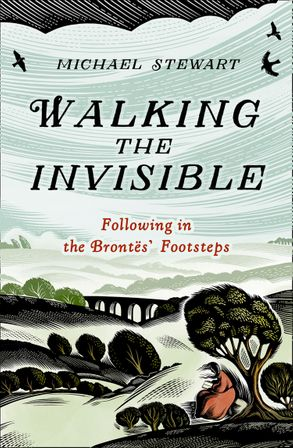
Michael Stewart has been captivated by the Brontes since he was a child, and has travelled all over the north of England in search of their lives and landscapes. Now, he’d like to invite you into the world as they would have seen it.
Following in the footsteps of the Brontes across meadow and moor, through village and town, award-winning writer Michael Stewart takes a series of inspirational walks through the lives and landscapes of the Bronte family, investigating the geographical and social features that shaped their work.
This is a literary study of both the social and natural history that has inspired writers and walkers, and the writings of a family that have touched readers for generations. Finally we get to understand the ‘wild, windy moors’ that Kate Bush sang about in ‘Wuthering Heights’, see the imposing halls that may have inspired Thornfield Hall in Jane Eyre, and learn about Bramwell’s affair with a real life Mrs Robinson while treading the same landscapes. As well as describing in vivid detail the natural beauty of the moors and their surroundings, Walking the Invisible also encompasses the history of the north and the changing lives of those that have lived there.
Paperback, 312 pages Published 2021 by Hammeron Press ISBN13: 9781910849309
Blurb
Charlotte Cooper, a fat activist with more than 30 years experience, lifts the lid on a previously unexplored social movement and offers a fresh perspective on one of the major problems of our times. In her expansive, intelligent grassroots study she: – Reveals details of fat activist methods and approaches – Features extensive accounts of fat activist historical roots going back over four decades – Explores controversies and tensions in the movement – Shows that fat activism is an undeniably feminist and queer phenomenon Fat Activism: A Radical Social Movement is a rare instance of fat people speaking about their lives and politics on their own terms. The book is the result of Charlotte’s community-based doctoral research.
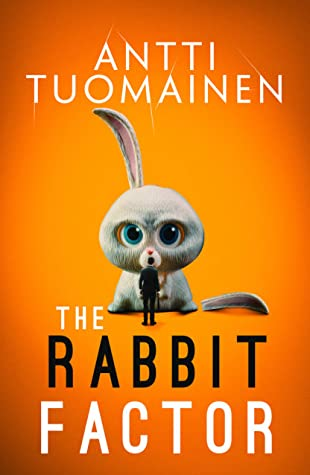
Hardcover, 300 pages Published October 28th 2021 by Orenda Books (first published August 19th 2020) Original Title: Jäniskerroin ISBN:191319387X (ISBN13: 9781913193874)
An insurance mathematician’s carefully ordered life is turned on its head when he unexpectedly loses his job and inherits an adventure park … with a whole host of problems. A quirky, tense and warmly funny thriller from award-winning Finnish author Antti Tuomainen.
What makes life perfect? Insurance mathematician Henri Koskinen knows the answer because he calculates everything down to the very last decimal.
And then, for the first time, Henri is faced with the incalculable. After suddenly losing his job, Henri inherits an adventure park from his brother – its peculiar employees and troubling financial problems included. The worst of the financial issues appear to originate from big loans taken from criminal quarters … and some dangerous men are very keen to get their money back.
But what Henri really can’t compute is love. In the adventure park, Henri crosses paths with Laura, an artist with a chequered past, and a joie de vivre and erratic lifestyle that bewilders him. As the criminals go to extreme lengths to collect their debts and as Henri’s relationship with Laura deepens, he finds himself faced with situations and emotions that simply cannot be pinned down on his spreadsheets…
Warmly funny, rich with quirky characters and absurd situations, The Rabbit Factor is a triumph of a dark thriller, its tension matched only by its ability to make us rejoice in the beauty and random nature of life.





 Everything Is Better With Dragons