


Steamgyptianpunk
I have a thing for licorice.

I have a deliciously exotic post for you for Steampunkapalooza. Today, April 12, is national licorice day. Those amazing ancient Egyptians were the first to discover the wonders of licorice. Generous amounts of licorice were found in King Tut’s tomb and the use of licorice in an ancient beverage is recorded in Egyptian hieroglyphics. The Victorians loved licorice. It’s a perfect candy for a tea party. You can place a stick of it in your tea to stir it. Also a crystal dish filled with colorful Licorice Allsorts, a favorite English candy since 1899, will liven up your tea table. Of course licorice was just one of many ancient Egyptian influences on Victorian culture.
The Victorians loved costumes and Cleopatra influenced costumes were quite fashionable, used in the theater and to wear to balls. Of course actual Ancient Egyptian clothing and the Victorian idea of it were two different things. Pictured here…
View original post 763 more words
Redecoration
It’s officially spring so I’ve given the blog a bit of a spruce up for the season. I got a bit bored of the way I had it before.
Review: Ernie Beckett’s Traditional Fish Restaurant, Cleethorpes
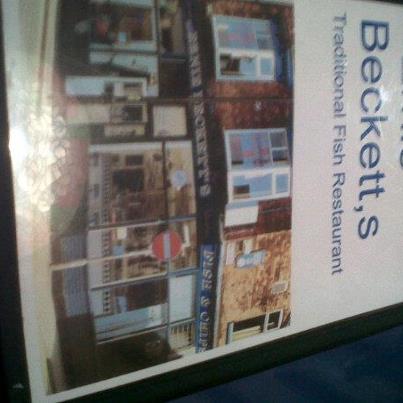
This afternoon I went out for my tea; I tried a fish restaurant I’ve never been too before. I’ve heard about Beckett’s from quite a few people so I thought I’d give it a try. When I arrived I found that the restaurant was full and there was a party of three already waiting. Beckett’s appears to be popular, both with locals and visitors, although it is early in the season. While I was waiting I perused the take-away menu. It was fairly priced. Having a quick look at the already cooked fish, they appeared to be generous portions. We were waiting about fifteen minutes for a table but when tables became available the staff quickly cleared away the debris and took orders.
The Food


Beckett’s serve basic fish and chip shop food, traditional stuff, nothing exotic.
We ordered three large fish, chips and mushy peas (one without the mushy peas), tea and bread and butter. £8.50 each.
The fish a beautifully cooked and very good quality; the batter a was light and crispy. The chips were just right. They were generously proportioned, although I wouldn’t have minded another slice of bread and butter. The tea pot was large and we got several cups each, and there was plenty of milk.
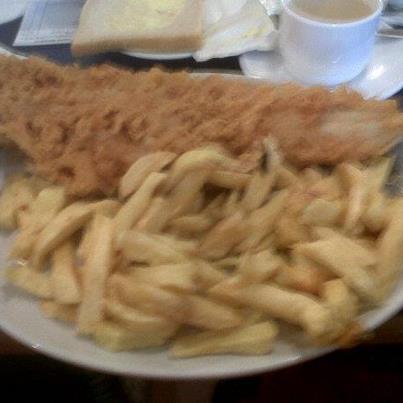
My fish and chips – so big I couldn’t get it all in the picture!
The Staff
Friendly, polite and efficient. The fish cook, James, especially made conversation with customers.
The Restaurant
It is a cafe really. It is small and the tables just about accommodate four people. The doors to the seating area are narrow. They do not take cards, cheques or fifty pound notes. On a nice day it’s probably quicker if you get your meal to take away and find a bench on the seafront. But on a chilly April afternoon it’s quite a pleasant place to sit down and eat.
Overall
It was nice. I’d definitely go there again.
Rose
I’ve been working on a few things…
While I was travelling to Nottingham last month I started writing a short story from a prompt I found on Tumblr – which has some great writing blogs by the way, go and look. I finished it a few days ago. The only problem I had was that the idea I went with wasn’t the only idea I had; there were three I wanted to do something with. Consequently I wrote another short story and started a third which I need to get around to finishing.
I got distracted by a picture prompt from another Tumblr blog and started writing a short story for that. Then I found some ‘opening paragraph prompts’ I wrote on the train home from Nottingham in December, in another notebook. So I started writing another short story. Yeah, it’s got a little out of hand now. So, I was thinking, since I’m writing shed loads of short stories right now why don’t I do something with them?
That’s my current project, take two written prompts and two picture prompts and write three short stories for each of them. It’s going to be an interesting exercise for my creativity.
I suppose it’s a good job I have a few new notebooks about the place, because I’m using them up rapidly at the minute. I find I’m more likely to finish a story if I hand write it than if I type it straight away on my laptop. I think it’s probably psychological. It also allows me to do a first edit as I’m typing up.
There’s all sorts of things in my notebooks. I rarely let other people see them though. Not that anyone can decipher my handwriting; when I’m in full scribble mode my writing is terrible.
I’ll stop rambling now, and get some writing done,
Bye,
Rose

See, I told you my writing was scrawl, although that’s actually not too bad…
Review: ‘Who Needs Mr Darcy?’
Jean Burnett
2012
Sphere (Little Brown Book Group)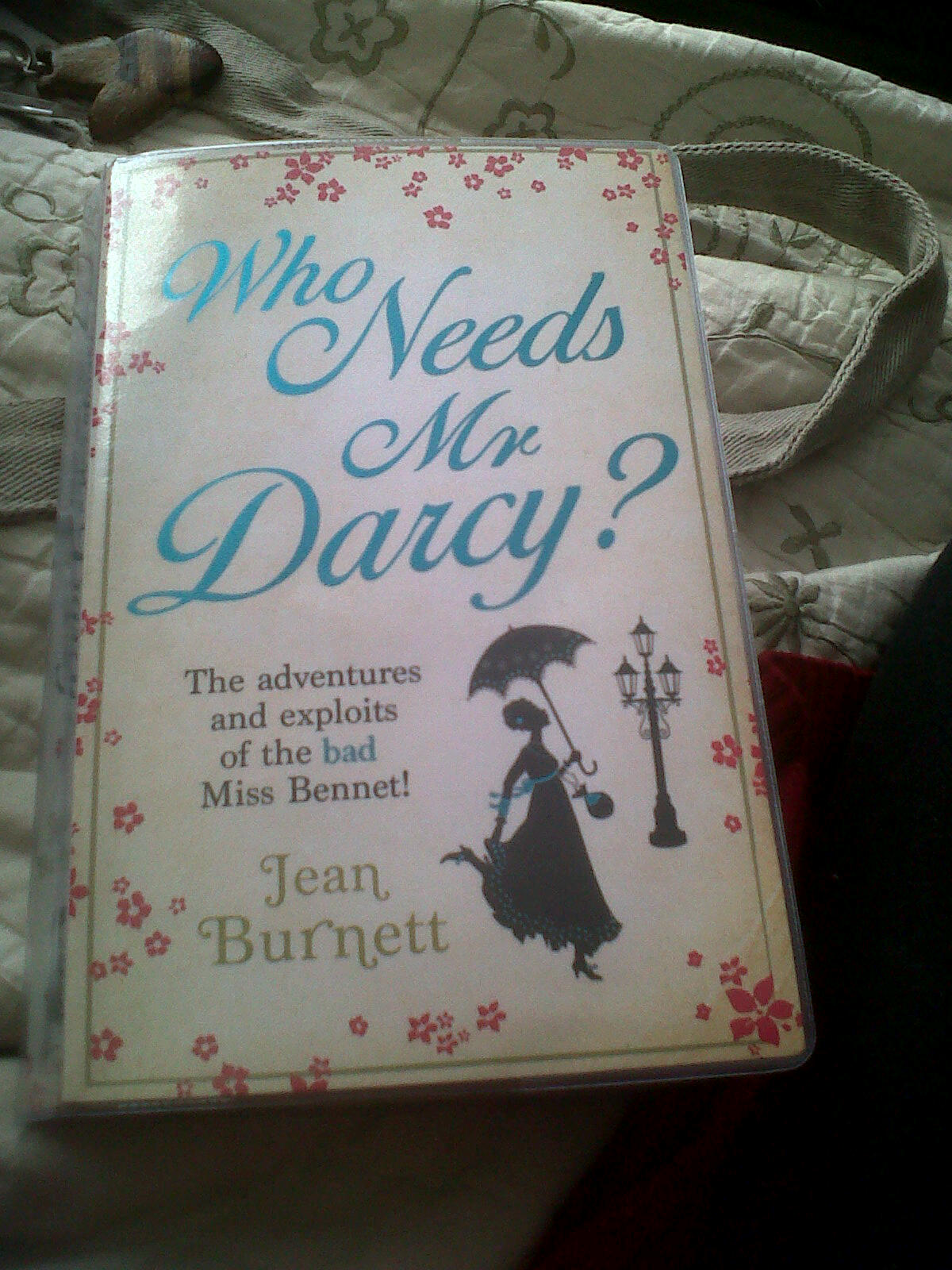
Opening at Pemberley in September 1815 and concluding aboard a ship to Brazil in 1818, this novel follows ‘The adventures and exploits of the bad Miss Bennet’. Lydia Wickham, married three years and widowed at Waterloo, when her husband had the decency to die in battle (although not as heroically as Lydia was telling people), is at a loose end. Currently in residence at Pemberley, living as a dependant of her humourless brother-in-law Darcy and her sister Lizzy, Lydia dreams of escape, of London, Paris and Lord Byron, of making her fortune by marriage to a rich man and dancing among the fashionable world at Almack’s. She has become her husband’s mirror image. Darcy wants rid of her, and Lydia is eager to be got rid of, provided she can have an allowance from her relatives and the freedom to do whatever she wants.
By subterfuge Lydia gets her way and travels to London to stay with the impecunious and immoral Selena and Miles Caruthers, friends from her days as an army wife. On the way she is robbed by a handsome highwayman, in London she plays with marked cards and becomes involved with a banker. Travelling to Brighton she meets the Prince Regent, becomes involved in a murder and robbery, and is kidnapped by her highwayman
Eventually Lydia finds her way to the no longer fashionable Bath, as her banker is arrested and she acquires a new admirer. Plans are made for Paris, but first she must go to Pemberley. Here a letter arrives from Longbourne; Kitty, who Lydia has kept informed of all her adventures, has had an attack of conscience and drops Lydia in it up to her neck. Sent away to be a companion to a rich, elderly widow (it was that or the asylum, suitable husbands not being forthcoming) in Bath, Lydia despairs.
Until she hatches a plan and her employer is persuaded to end her retired life and go to the Continent. Lydia is ecstatic and finally gets to see Paris and Venice. But her past catches up with her and she is forced to work for the British Government in a delicate matter.
This Lydia is has learnt no restraint, no humility or respectability. She is as immodest, reckless and ignorant as would be expected from the youngest Bennet girl. She blames all her misfortunes on others and takes no responsibility for her actions. She sees her family as interfering, disapproving and spiteful.
She is not an endearing character at all, and the plot has too much gothic extravagance about it to be very enjoyable, and yet I raced through this novel. More could have been made of the royal intrigue, financial scandal and international politics, which are the main drivers of the plot and which effect Lydia’s fate the most, but the story, like it’s narrator is rather shallow. Leaving Lydia and her criminal beau aboard ship and bound for Brazil clearly leaves the way open for a sequel should the author choose to pen one.
I think this would have been a fun book, in the mould of Regency romances, if the main character had been an original rather than a pale attempt at writing Lydia Bennet. Jean Burnett simply does not write Lydia Bennet as well as Jane Austen drew her two hundred years ago. The character is a flat caricature. It’s enjoyable enough I suppose but I wouldn’t go out and buy it. That’s what the library is for.
And that is all I have to say on the subject.
Bye,
Rose
In none writing related news…well, actually…
I have a job interview next week.
If I get the job I’ll probably be working twelve hour shifts, which means I’ll have less time for writing, but more money to do the things I like to write about. It’ll work out somehow. I’m not going to stop writing just because I finally get a decent lab job.
That’s it, that’s all I was going to say.
Hang on, no it’s not.
I was reading ‘The shifting price of prey’ by Suzanne McLeod, but I couldn’t get into it, despite enjoying the earlier books in the ‘Spellcrackers.com’ series. It’s going back to the library. I might take it out again in the future.
Books I’m looking forward to reading this year include:
The Science of Discworld IV by Terry Pratchett, Jack Cohen and Ian Stewart
Published 11th April 2013
The Long War by Terry Pratchett and Stephen Baxter
Published 20th June 2013
Albums I am looking forward to hearing this year:
Fall Out Boy
‘Save Rock and Roll’
15th April 2013
Sacred Mother Tongue
‘Out Of The Darkness’
15th April 2013
HIM
‘Tears on Tape’
29th April 2013
30 Seconds to Mars
‘Love, Lust, Faith + Dreams’
21st May 2013
I intend to review them all.
And now I must go, I’ve got a computer booked at the library in ten minutes.
Bye Bye
Rose
Review: The Magical Castle, Cleethorpes
If any of you follow my Twitter (no? don’t worry about it, I’m not very interesting) you’ll know I went to a child’s birthday party last Wednesday (27/03/13). It wasn’t any old party though; as a treat for the child in question it was held at ‘The Magical Castle’ in Cleethorpes, Lincolnshire.
The Magical Castle is an indoor play centre. It’s like a giant climbing frame with ball pits, slides, zip lines, a climbing wall and bouncy castle, for children and those of us adults who occasionally act like children. They do parties, if you book. It’s quite popular but I’ve never been before.
The ‘Castle’ structure is extensive with separate areas for very young children and a ‘party room’ that has been made to look like a circus tent and room for at least thirty guests. There is also a café for those who don’t fancy chasing around after their kids. It’s £1.40 for a tea or coffee, £1.30 for a scone or teacake. They also do wraps, naked potatoes, and chips for fairly reasonable prices.
The staff I met and spoke to were very friendly and helpful. They wanted the birthday boy to have a good time, and provided a treasure hunt for the party as well as the food. The party food was actually quite nice. Basic and it wouldn’t have fed the 10 children it was supposed to be for, except possibly the cocktail sausages, of which there were plenty. There was a choice of three types of sandwiches, chips and pizza slices, fruit and veg sticks, and cocktail sausages and sausage rolls, followed by jelly and ice-cream. The ice-cream was good quality, as was rest of the food provided and the fruit squash.
As a place to take the children if you happen to be in Cleethorpes and it’s raining it’s not bad. The admission fee varies between school holidays, weekends and bank holidays, and weekdays (it’s slightly cheaper) and by age of child; one free adult per child, £1.00 for each extra adult. As a place for a children’s party I would recommend it (from £8.95 a child). But book early if you want it on a Saturday, make sure you have more than ten children coming and take you own cake. They don’t provide the cake. The party bags are quite good as well. I put mine in the play box I keep for any visiting monsters. It had a colouring books, crayons, puzzle, stickers etc although the pink ‘princess’ theme was a bit much even if it does fit with the décor of the attraction.
For more information their website is:
http://www.magicalcastle.co.uk/
I shall be off now,
Rose
Restaurant Review: The Barge, Grimsby
29th March 2013
I’m sat on The Barge
Bored
Waiting for my food
I can’t drink because I’m on my
Scooter
And my head feels funny
Because I’m
Waiting for my food
It’s always worth the
Wait
Though because the food
At The Barge
Is the best in
Grimsby
So I’ll sit here
People watching and writing
Waiting for my food
Yes, while waiting I composed a poem about The Barge. I had little else to do except write and wait for my meal. I’ve eaten at this particular place a few times and never been disappointed.
The Barge is a popular place to eat and drink in Grimsby, especially for those who enjoy their music heavy (the most ‘pop’ music I’ve ever heard on their jukebox was Bon Jovi, and that’s only during the day. After 5pm it gets heavier and louder). Today it is particularly busy, their ‘2 jumbo fish, chips and peas for £14.99’ offer might have something to do with that. Despite its popularity The Barge is never packed during the day.
I ordered the ‘Barge Gourmet Burger’ for £7.95 and the special ‘Crème Egg Cheesecake with Vanilla Ice-cream’ for £2.00 (£2.95 if I hadn’t bought a main course as well), as well as a large Diet Pepsi (£1.95). The staff are friendly and polite, and although it took about 20 minutes for the food to arrive, they brought my cutlery and any sauce I requested immediately.
The burgers were just cooked, only just for my taste, but succulent and full-flavoured, the cheese generous, I could have done with a bit more bacon, although it was just right in terms of how well it was cooked. Any longer and it would have been too crispy. The onion rings, fresh, home-made onion rings, were perfect. They actually tasted of onion for a start; they were hot, but not scolding, crispy and golden. The chips were also home-made, chunky and golden. There didn’t appear to be a lot at first sight but the size of them made up for that. The salad and coleslaw was no mere accompaniment either but an integral part of the meal. The coleslaw was fresh, and also home-made, large slices of cabbage, onion and carrot well covered by mayonnaise. It was lovely.
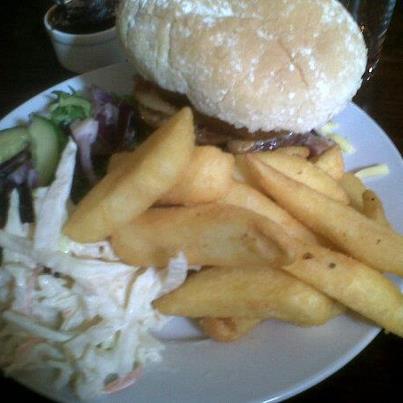
I wasn’t sure I’d have room for a pudding after the main course but I thought I’d give it a try. And I was well rewarded. The base was thick and the cheesecake topping creamy. The ice-cream was excellent quality.
All in all, though it is a little expensive, if you happen to be in Grimsby for any reason and want a decent meal, ignore McDonalds and take a walk to the Freshney. You can’t miss The Barge, it’s a bloody great big barge concreted into the dock.
Bye for now
Rose
Review: The City’s Son: Book 1 of the Skyscraper Throne
Tom Pollock
Jo Fletcher Books (Quercus)
2012
I picked this up in the library about two weeks ago and it’s taken me a while to get through it. I think it’s meant to be a YA fantasy, but I had trouble deciding who the target audience were. The main characters were certainly adolescent, but it could as easily be read by adults.
Set in contemporary London the story follows the adventures of teenage graffiti artist Beth Bradley and her best friend and poet of the streets Pen (Parva Khan) as they get drawn into the war between the Urchin Prince, Filius Viae, and Reach, the Crane King.
Switching between the viewpoints of Beth and Filius the story tells of the midnight encounter with a railwraith by Beth and her involvement with Filius, as Pen is fighting her own battles. Betraying her only friend after one particular night of artistic revenge on a bullying teacher, Pen loses Beth to the hidden London. Beth’s father goes in search of her and Pen comes along to help. Unfortunately they are ambushed by Reach’s minion ‘The Wire Mistress’ who takes Pen as her avatar.
Meanwhile Beth and Filius are trying to build an army while waiting for his Mother, the Goddess of the Streets to return and help them; an army of statues, and lamp people, and one homeless Russian. Plus a person made of rubbish.
In fighting the war many battles are won and lost, lives lost and choices made. Sometimes you have to make a deal, and pay the price in the end. But the price of victory might not be worth paying. Beth has to decide as she becomes Filia Viae to Filius’s Filius Viae.
Although it took me a while to read this, I enjoyed it and will probably read the next one. The book feels allegorical; do we allow skyscrapers and things of glass and steel to destroy the life found in old city streets, is it progress or the killing of a place to change it? Renewal or ripping away of life? These are clearly pressing matters to think on and a balance or compromise has to be found, as Beth does. We have decisions to make, will we choose right, strike the right bargains and are we willing to pay the price for our choices?
Bye, for now
Rose
 Everything Is Better With Dragons