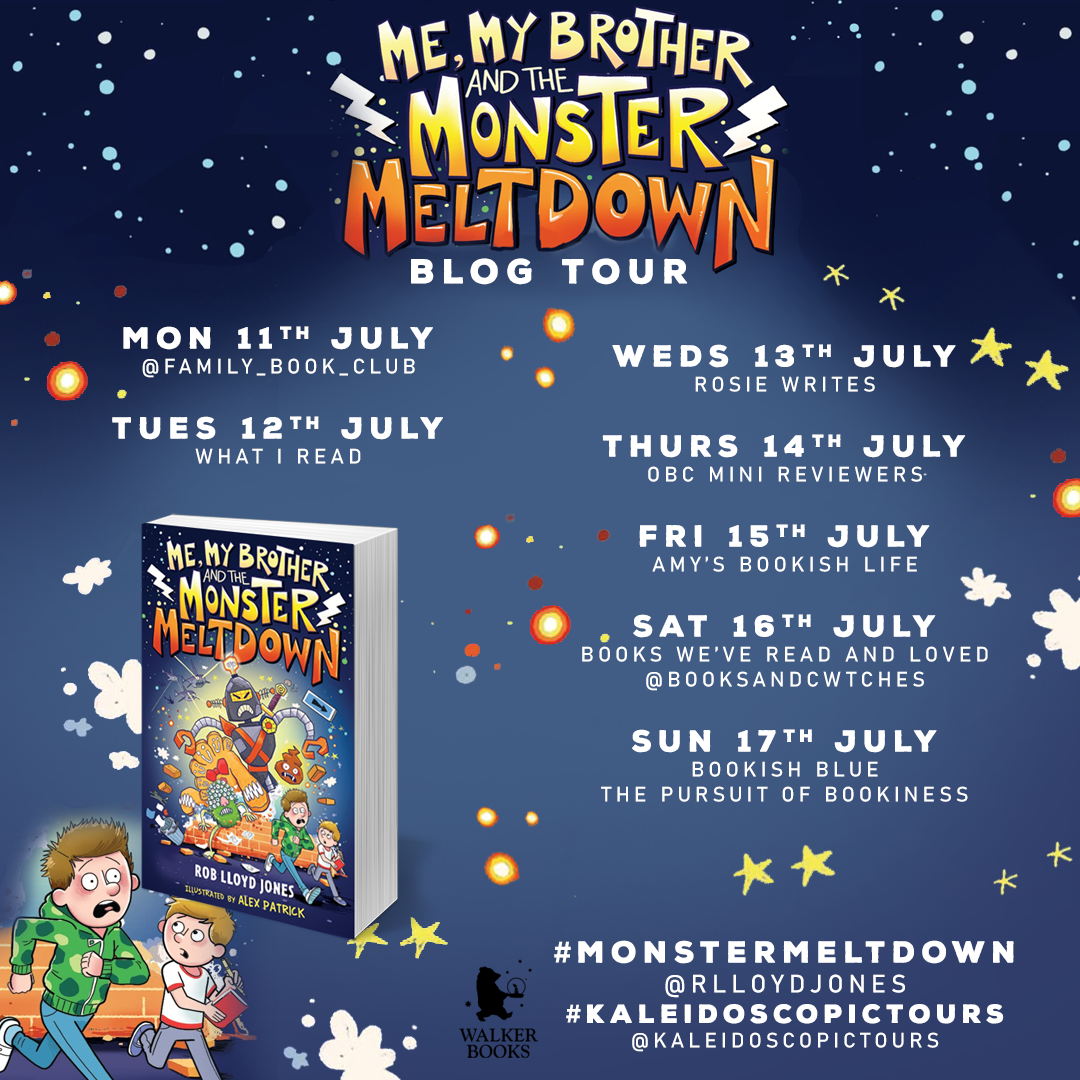
Information about the Book Title: Me, My Brother and the Monster Meltdown Author: Rob Lloyd Jones Illustrator: Alex Patrick Publisher:Walker Books Release Date: 7th July 2022 Genre: MG
All the adults are freaking out. Giant monsters are smashing up supermarkets across the country. The army can’t stop them and the prime minister is hiding in panic. A colossal six-headed gingerbread man, a massive emoji poo, a gigantic bouncing bum… Top scientists have no idea where they come from – or why they seem to hate supermarkets so much. But nine-year-old Otis has an idea. The creatures are exactly the same as drawings by his five-year-old brother, Jago: what if Jago brought his crazy creations to life with a magic pen? But their parents won’t listen, so it’s up to Otis and his pals to sort this monster mess out!
My Review
Thanks to Bee at Kaleidoscopic Tours for organising this tour, and the author and publisher for sending me a copy of this book. I was a little worried it wouldn’t arrive on time but it did on Thursday. I think I read it Thursday evening.
Monsters are attacking Rottingdean, and all the adults are going a bit mad. It’s up to Otis, Jago and their friends to find out where the monsters are coming from and stop them. Their adventures are hilarious as they dodge monsters, soldiers and their Dad, who keeps running into walls. They outwit the adults, defeat the monsters and get covered in chocolate.
At 157 pages with illustrations and a couple of paragraphs a page, it’s not a long read, but for a young child it would be a good starter book, once they’ve moved beyond picture books. Six to nine year olds will love this book. They will also learn about the damage our government has done to libraries. The book was written during lockdown to help Lloyd Jones’ sons cope with the pandemic through humour. The illustrations of the increasingly frantic prime minister in his bunker were particularly pointed.
The group of friends are a balanced group, characters who bounce off each others’ silliness and manage to work well together to solve a problem. I liked the depiction of the people at the care home having lives beyond their status as old people waiting for their family to visit or to die of boredom in their care home. I giggled quite a lot reading the book.
The illustrations are really good, very humorous. It’s a familiar style in books for the age group.
I would definitely recommend this book, especially for kids struggling to cope with the pandemic and lockdowns of the last couple of years.
Author Information
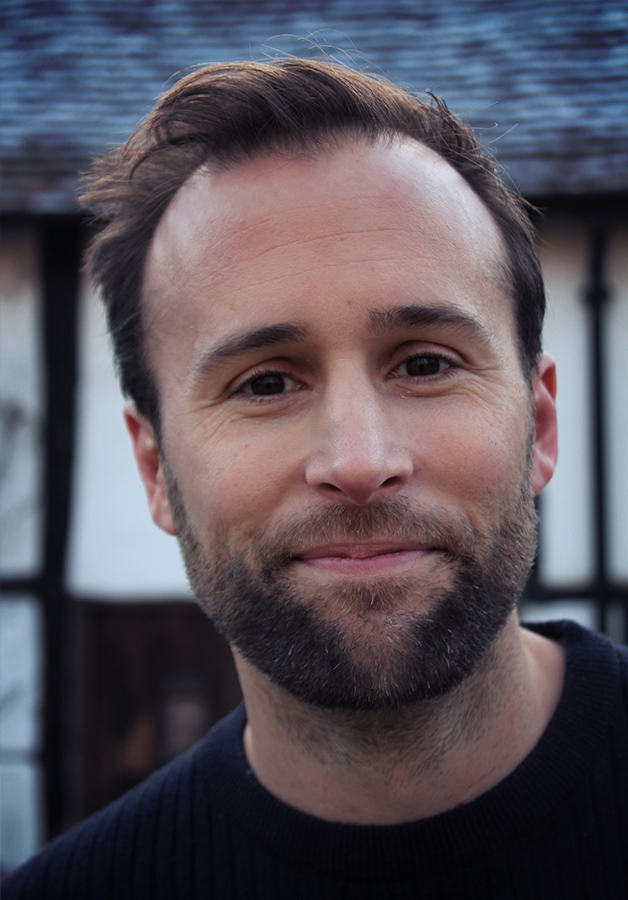
Rob Lloyd Jones is the author of the highly acclaimed middle-grade novels Wild Boy and Wild Boy and the Black Terror, as well as the Jake Atlas adventure series.
Created with his sons, Otis (9) and Jago (5), during home-schooling, Me, My Brother and the Monster Meltdown is his first funny fiction for younger readers. In Rob’s words, “it celebrates the power of children’s imaginations and their strength in adversity and adventure…and a monster apocalypse.”
Rob lives in East Sussex with his wife, and monster-mad Otis and Jago.
Paperback, 480 pages Published July 7th 2022 by Head of Zeus (first published October 5th 2021) ISBN13: 9781788543248 Edition Language: English Series: Burningblade & Silvereye #2
Blurb
Standing on opposite sides of a looming civil war, two siblings discover that not even ties of blood will keep them from splitting the world in two.
Four hundred years ago, a cataclysmic war cracked the world open and exterminated the Elder races. Amid the ashes, their human inheritor, the Dawn Republic, stands guard over lands littered with eldritch relics and cursed by plaguespawn outbreaks. But a new conflict is looming and brother and sister Maya and Gyre have found themselves on opposite sides.
At the age of five, Maya was taken by the Twilight Order and trained to be a centarch, wielding forbidden arcana to enforce the Dawn Republic’s rule. On that day, her brother, Gyre, swore to destroy the Order that stole his sister… whatever the cost.
Twelve years later, brother and sister are two very different people: she is Burningblade, the Twilight Order’s brightest prodigy; he is Silvereye, thief, bandit, revolutionary.
For centuries, the Dawn Republic has ruled over the land unopposed. No more.
Deep below the Gap, Gyre Silvereye discovered a city, hidden far from human eyes. There, the ghouls have dwelt for four hundred years in hibernation, awaiting the moment to wreak their vengeance on the Dawn Republic.
With their help, Gyre can finally see a way to overthrow the all-powerful Twilight Order. But the ghouls do not give their trust easily, and Gyre will need to secure the alliance of the human rebels to the south if they are to even stand a chance. And uniting the two won’t be simple.
His sister Maya still fights for the Order. But after recent events, she is no longer certain where her loyalties lie. Chasing the origins of a mysterious artefact to a long-lost library, she just might find the truth – whether she is ready for it or not.
My Review
I have two editions of this book, and the first one in the series. I have Goldsboro Books special editions in hardback, and paperbacks. The paperback from Head of Zeus arrived on Thursday, because I had it on pre-order. I have two copies of the first book in the Burningblade & Silvereye series too,Ashes of the Sun, which I reviewed in March 2021. I also have both as audiobooks. I couldn’t get on with the audiobook narration for this one, or I’d have reviewed it before now. It’s very unfortunate, since I quite liked the audiobook of Ashes of the Sun and was looking forward to listening to this one too.
Gyre Silvereye and Maya Burningblade are siblings on opposite sides of the social order. As a Centarch, Maya represents the ruling Order, heirs to the mysterious Chosen, while Gyre is a rebel, a thief and determined to bring the Order down, with the help of the ‘ghouls’, a sentient species who are almost extinct and hated by humanity.
The ghouls are a rather large, humanoid species, with hair and fangs, who use dhak, a form of magic. They live in the hidden Refuge, an ancient ghoul city that is now almost empty after 99% of the ghouls died because of the plague that also wiped out the Chosen. Ghouls use constructs to do all the heavy lifting, and have weapons that Gyre can use in his rebellion. He ropes Elariel, a ghoul who worked for Naumoriel (villain in the first book), into helping him. He offers the ruling parliament of the ghouls a way to get revenge on the Chosen and the Order by supporting his rebellion with weapons and tools. Elariel undergoes a terrible operation as punishment which makes her look human to help with the mission.
Kit is now happily running around in multiple construct bodies, lamenting only her inability to fuck, although she does discover how much she enjoys voyeurism and fighting in multiple places at once. The three leave Refuge for Deepfire, where they collect three large wagons and a lot of alchemical equipment, and Sarah, an alchemist formerly of the Order who joined the rebels in Deepfire. They travel through the Splintered Kingdoms to Khirkhaz, a mountainous and forested region where a Commune led by the ousted Apphia, Baron Kotzed, fights to retake the area from the Republic and return to her family’s tower.
Meanwhile, Maya, her partner Beq, and their scout, Varo, go looking for an Archive in the mountains in the north west, beyond Deepfire and near the coast. Many Centarchs had attempted to clear the place of plaguespawn to reach the Archive, but had failed. Maya and her small team find a village, a mystery and information about the Thing and Maya’s deiat. Beq gets over-excited by the possibilities of the archive. They return to the Forge, where they are sent out on a secret mission that involves them going to the capital of the Republic, Skyreach to break into Kyriliarch Prodominus’ private warehouse. There, they discover a great secret and more information about betrayal in the Order.
The two groups meet in Khirkhaz during the fight to defend Apphia’s claim from the Republic. They go off on a mission of their own that could destroy or save the world…
The world and its history is explored further as the two groups travel across the continent by different means, and we learn more about the Chosen and the ghouls. It becomes increasingly obvious that humans have been lied to for centuries and that the Order is fractured. Who can anyone trust? The tension lies between what the reader knows from following Gyre and his group, and what Maya believes to be true based on what she is told and what she finds in her adventures. They are both driven by idealism, which doesn’t do well in the real world. Gyre finds his Khirkhaz Commune is really a collection of argumentative, disunited factions from different backgrounds, only nominally led by Apphia. Maya discovers that she’s been lied to repeatedly, although we don’t really see how it changes things for her, other than her internal confusion about who to trust. Hopefully, it’ll become clearer in the third book.
The relationship between Gyre and Maya is fraught before they meet up in battle, but it becomes more so as they realise they need to work together. Gyre is deeply affected by his sister’s actions in the last chapters, but still helps her. I’ll be interested to see the fall out in the next book. I have a feeling that Gyre and company might be arrested and Maya is placed in an even more compromised position, or the Corruptor will overcome the Order. Pretty sure Tanax and Basal are corrupted. I hope the ghouls are able to save themselves though and humanity gets its collective head out of its collective arse. The Order and Republic are clearly positioned as compromised and controlling in these books, while Gyre and the rebels as ‘heroes’, but it’s more complicated. No one group is evil or good. They’re humans; venal, greedy and selfish in some cases, deceived and deceptive, selfless, determined to improve the world, and generous. The technology has limits even if magic is involved and people get exhausted, no one can fight forever, weapons and tools break and ammunition or fuel runs out. Like in the real world.
There is a development of Maya and Beq’s relationship carries through their chapters, as they support each other and realise how important they are to each other. I like their relationship; they’re young and inexperienced, and trying to work out what they are to each other. It’s sweet. Thankfully, the author manages not to make their sexuality a big deal, it’s just a background fact that both are girls and they are in a relationship. It’s the development of their relationship that’s important, not the fact it exists.
Beq is a marvellous character, geeky, intelligent and brave, who doesn’t have much confidence in herself, but can do anything she sets her mind to. I also enjoyed the little scene where she’s reading while waiting for Maya to finish her visit Jaedia in the hospital, and doesn’t notice Maya come out of the room because the book is so engrossing. Been there, done that. Haven’t we all? She also struggles with jokes and is very literal. She’s practical and loves Maya deeply although she doesn’t seem to have many other relationships or friends.
Kit, having died and then returned as the controlling intellect in a construct army, is a lot more fun that in the first book. Death seems to have allowed her to put aside her angst and enjoy life. The abilities she has as a construct allow her to be in so many places at once, which helps her and Gyre to escape from various traps, fight battles and rescue each other. The image of chicken sized mechanical spiders carrying smoking ceramic bombs attacking Maya and Legionaries made me giggle but at the same time are very practical. They would be useful.
This is a world where both magic and technology mix to allow aircraft, long distance almost instantaneous travel, but humans still live in squalor in cities, hide behind high walls in the countryside, and the magic and tech developed by two species though to be extinct is limited to a certain class or group. It’s a blending of science fiction and fantasy that works well. I enjoyed Elariel’s questioning of the social rules and distinctions, because things are very different on ghoul society, where helping anyone in pain is an obligation, all the work is done by constructs, and decisions are made by a representative group. Her complaints about clothes are funny, and true. They are uncomfortable.
Details like Elariel being in pain because she isn’t used to walking in shoes or the difficulties of getting wagons along forest paths bring a touch of reality to this book. The descriptions of the environments people travel through and the different societies of the continent seem to have been well thought out. The writing is fluid and gripping, it’s punchy and fast paced at times while also having slower, more reflective sections. I stayed up rather later to finish the book and can’t wait for the next in the series. I know it’ll be out next year and the title ‘Emperor of Ruin’ which sounds promising.
Because I’m a bit obsessive, and I have Ashes of the Sun in the Orbit paperback edition (US publisher), and Blood of the Chosen in the Head of Zeus edition (UK publisher). I’ve just bought the opposites so I have both books in both editions. I’ll get the Goldsboro Books special hardback of the third book and the two different paperbacks. They have different covers, I’m not just being pedantic about having matching publisher’s editions. I am however aware that most people don’t do this,
Now to my criticisms. There aren’t many. Elariel’s appearance, especially the comments about her attractiveness get a bit repetitive and aren’t really adding to the plot. Other people’s reactions and her utter cluelessness get the message across adequately. The ability of the ghoul swords to cut through unmetal armour where it’s thin is mentioned in every fight, which is just unnecessary, the reader won’t forget that these swords are pretty amazing even if they do have limits. I knew we were heading into the final fight when Maya and Gyre meet up to go to the Purifier and that they would be betrayed, because the same thing happened in Ashes of the Sun. It’s a little formulaic, even though it works.
Generally, I was impressed by this solid sequel, even with the minor irritants. I recommend it to fans of science fiction and fantasy.
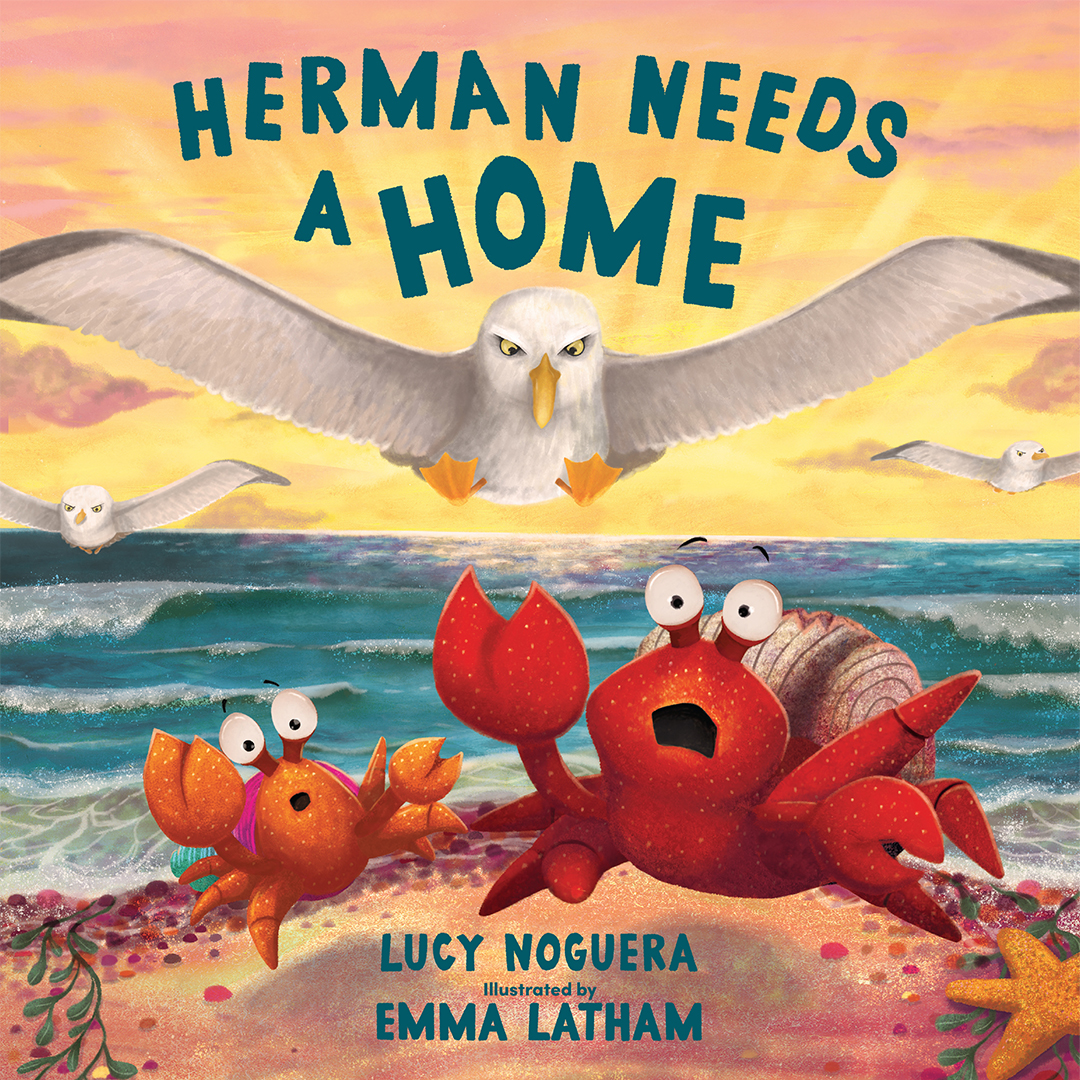
When Herman the hermit crab gets too big for his shell, he can’t find a new one that feels just right. With his sister, Hiro, he travels up and down the beach in search of a shell he can call home.
They don’t find a shell, but they do find something else – a pile of rubbish left behind on the sand. But can Herman make a home out of any of it?
My Review
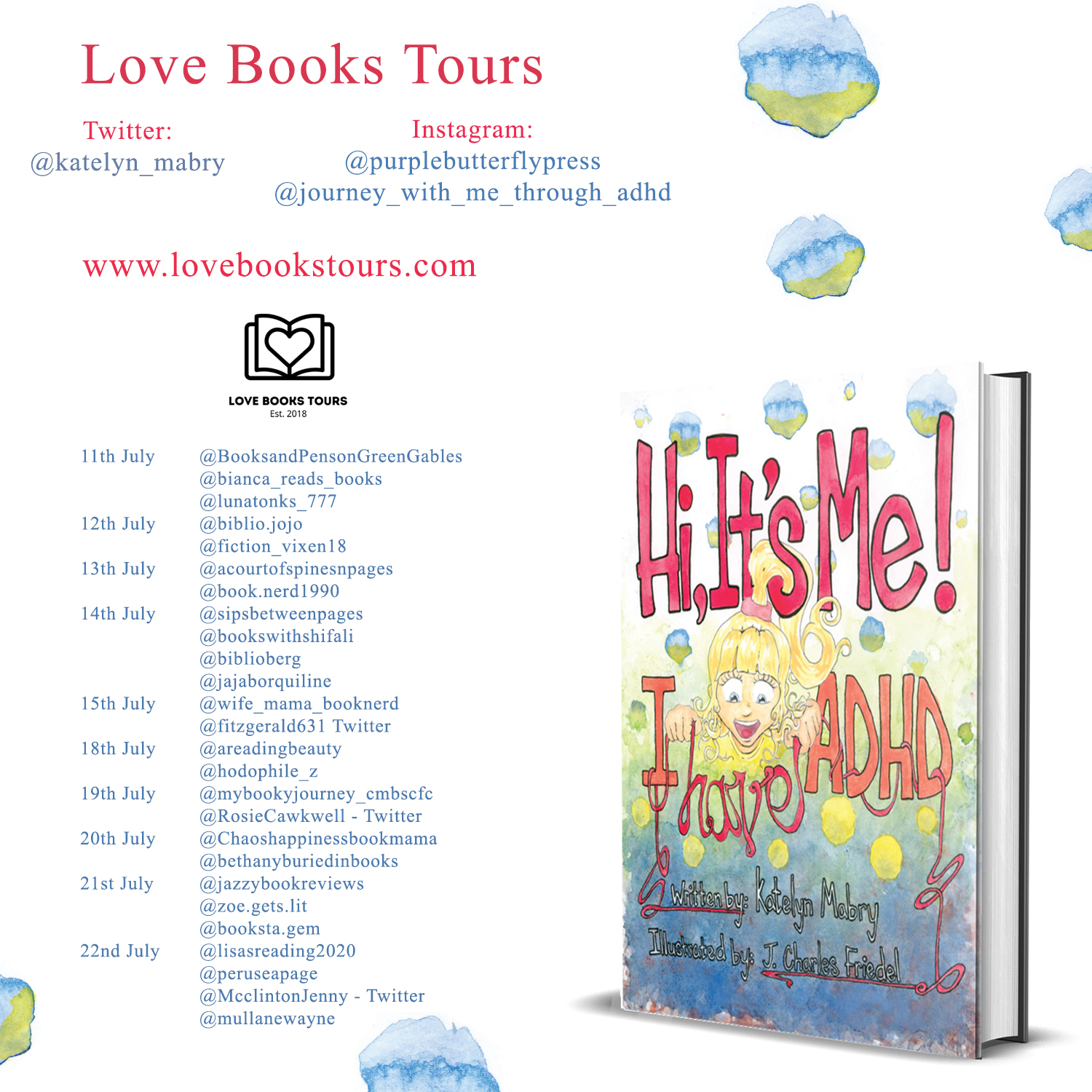
Thanks to the author for sending me a copy of this book and to Love Books Tours for organising this tour. I received a lovely parcel from Lucy Noguera.
Herman and his sister Hiro need new shells, so their family line up and swap shells. Unfortunately, Herman is bigger than any of the others and needs to find a new shell. Hiro and Herman go for a walk on the beach to fins a new shell. Instead they find a large pile of rubbish. Nothing fits right, of course but as night falls, Herman hides in a broken tennis ball. The next day he goes on an unexpected trip.
I reviewed another book by Lucy Noguera last year, SWOP the satsuma sized secret, and really enjoyed it. That came in a lovely parcel, too. This book is for younger children and is beautifully illustrated by Emma Latham. As with SWOP, there is a lesson for young readers. In this case, it’s about the damage rubbish can cause to sealife and ends with a page about how to look after the coast by clearing up rubbish.
The illustrations are lovely, bright and colourful. The paper is high quality, dense and solid, so it’ll last a good long time. The writing is fun and bouncy, and I suggest it’ll be good reading for both parents and children.
I generally send these books to my cousin’s kids, and I’m looking forward to hearing what they think of this one. I think they’ll love it.
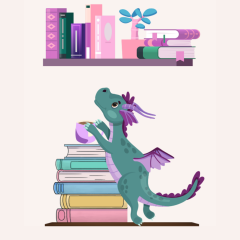
Evening all, it’s late but I thought I’d share a decision I made. I’ve decided to change the name of the blog from Rosie Writes… to Everything Is Better With Dragons.
There are reasons. Firstly, I named this blog 9 years ago when I didn’t know what the blog was going to be about, other than me writing. The blog has evolved into a book blog, so the more general name isn’t appropriate anymore. There is also another book blog called ‘Rosie Reads’. In fact, there are about half a dozen with a similar name. It can be quite confusing, so I’ve decided to move away from such a common name.
Secondly, I don’t particularly resonate with the name ‘Rosie’ anymore. It’s associated with a different me, not the me I am now. I’d prefer people to use Rosemarie to address me now.
Thirdly, my business cards have a dragon on with ‘Everything is better with dragons’ around the dragon, so it makes more sense to have the name on the blog too.
Forth, the podcast has the same name and logo, and I like things to all line up. There are Tumblr blogs and a Facebook page with similar names but not quite the same. And probably no one has gone with this colour scheme, pink and green. I actually have a dragon I made in those colours.
Paperback, 351 pages Published October 3rd 2017 by Akashic Books
Blurb
Odd-mannered, obsessive, withdrawn, Aster has little to offer folks in the way of rebuttal when they call her ogre and freak. She’s used to the names; she only wishes there was more truth to them. If she were truly a monster, as they accuse, she’d be powerful enough to tear down the walls around her until nothing remained of her world, save for stories told around the cookfire.
Aster lives in the low-deck slums of the HSS Matilda, a space vessel organized much like the antebellum South. For generations, the Matilda has ferried the last of humanity to a mythical Promised Land. On its way, the ship’s leaders have imposed harsh moral restrictions and deep indignities on dark-skinned sharecroppers like Aster, who they consider to be less than human.
When the autopsy of Matilda‘s sovereign reveals a surprising link between his death and her mother’s suicide some quarter-century before, Aster retraces her mother’s footsteps. Embroiled in a grudge with a brutal overseer and sowing the seeds of civil war, Aster learns there may be a way off the ship if she’s willing to fight for it.
My Review
I’ve reviewed this book on my podcast Everything Is Better With Dragons, episode 2 which will be available soon, but I’m sharing a written review for those who don’t listen to podcasts.
I liked this book.
Aster is clearly Autistic, like Rivers Solomon, and later in the book we learn Aster is probably non-binary too. A bit of intersectional representation! Aster also comes from the lower decks of the arc ship she’s travelling in. The society of the HSS Matilda is highly stratified by skin colour, the darker you are the lower down the ship you live and the worse your living conditions are. Aster, unlike many of her deck mates, has a lot of mobility between decks due to her position as assistant to the Surgeon General, Theo. Aster has a complex relationship with Theo, neither really know what they are to each other beyond their professional relationship, and both struggle to express what they feel for each other.
Complex relationships are a theme in this novel.
Theo has a complex relationship with his uncle, Lieutenant, who eventually becomes Sovereign. Theo is frightened of his uncle and aware that his uncle is highly conflicted about his feelings for Theo.
Lieutenant has a complex relationship with morality. He is attracted to his feminine nephew, appalled by his attraction and also by the ‘pollution’ of the family bloodline represented by Theo’s skin colour. He’s also jealous of Theo’s relationship with Aster. He assumes it’s sexual, although it doesn’t get that far. He can’t punish Theo directly, because they are equals as Commander of the Guard and Surgeon General, but he can hurt Aster. After his ascension to Sovereign, he takes his sadistic hate out on everyone on Q deck, where Aster lives. He claims that his authority comes from a deity, and that as a ‘pure’ human he is better than lower deck residents.
The society in the book is heavily based on the Antebellum South of the U.S., so incredibly unequal, racist and screwed up. Aster and her friend Giselle are irritants in the society they are forced to tolerate. Aster because she is able to code switch in both gender and language, doesn’t get the point of a lot of the social conventions and has the ability to move about. Giselle because she’s bat shit crazy and is happy to cause mayhem and be a Devil. It is her ability to withstand abuse and trauma, and react in unexpected ways that prevent the Guards or any authority from keeping her down.
Another complex relationship, that between Aster and Giselle, defines and triggers major events in the novel. They love and hate each other, but they also need each other. Aster couldn’t interpret her mother’s notes without Giselle, who sees the world from an entirely different angle, possibly upside down and inside out. Giselle is paranoid, and has delusions of persecution; she is convinced someone is trying to poison her for much of the book. She gets into all sorts of places because she wants to hide from her persecutors.
Aster has complex relationships with maternal figures in her life, firstly her absent mother and secondly Q-deck leader, Aint Melusine. Lune, Aster’s mother, left a riddle for her child to unravel, which becomes Aster’s driving interest, along with botany, astronomy and chemistry. It is Aster’s need to answer the question of Lune and where she went that gives Aster the resilience to survive persecution by Lieutenant and to save HSS Matilda from pointless wandering.
Ainy Melusine replaced the mother Aster never knew. She is not particularly maternal despite being a Nanny on the upper decks, and teacher to the children of Q deck, but she does her best for Aster who she recognises as an unusual child from an early age and helps her to gain an education beyond that normal for a low deck child. Melusine is also Theo’s mother, which complicates her relationship with both Theo and Aster, as she can’t tell either of them. Theo’s father was a previous Sovereign, and the relationship between him and Melusine was clandestine and considered immoral on the upper decks.
These complicated relationships and characters travel through space on a large arc ship that has been travelling at near light speed for 350 years, although on Earth a thousand years has passed. They are powered by Baby, a miniature star, who provides power for the drive and provides light for the crops on a complicated layering system of fields. The ship is clearly and vividly described as is the society that has evolved in different decks and over the ship as a whole. The contrast between the metal and decay of the lower decks with the lush extravagance of the upper decks provides a visual narrative about the people of the Matilda. Despite the harshness of their lives, the lower deckers are inventive, loving and preserve their own food, languages and storytelling cultures against all odds.
The narrative is broken up with stories that Melusine has told Aster in the past. These stories are colourful and clearly draw on Black American and African stories. Melusine or Aster reflect on the stories and what they mean to them, which brings them seamlessly into the narrative.
The narrative is mostly told from Aster’s perspective but occasionally Theo, Melusine and Giselle have chapters. I found this a really interesting structure and have used a similar structure in my novels. I enjoyed the direct plotline with past events being pulled in as memories that fit into the story seamlessly. There’s no skipping between past and future. It’s a lot less confusing that way, at least for me.
The writing and the language used is particularly effective for showing the different cultures and social structure with its minute gradations based on minor differences in skin tone. The language has impact, especially during traumatic events. Some things are heavily implied and some are outright stated, depending on the needs of the narrative. I have the audiobook as well as the paperback and listening to the story had a strong impact on me.
I really enjoyed this novel. I read the last 100 pages in an afternoon, so engrossed by the action and events, I had to know what happened next, and I’d love to see a sequel.
A collection of stories featuring favourite characters from Visions of Zarua and ‘Silent Sea Chronicles’, plus a glimpse into the new series, ‘Starlight Prophecy’.
The Guardian
With an assassin picking off wizards one-by-one, Kalesh visits Cassima, a former student, hoping to persuade her to re-join the Royal Wizards and use their protection to keep her family safe.
Kalesh’s newest charge, Paddren, has strange visions which link to a past event known only to a select few. The knowledge hidden in Paddren’s visions is invaluable so Kalesh must guard the boy at any cost.
Can Kalesh keep his students off the assassin’s radar long enough for his order to stop the killer?
Garrick the Protector
Fifteen-year-old Garrick is helping at his uncle’s farm when his cousin’s illegal use of magic threatens the family’s safety.
Mara is in immediate danger from the Assembly who deem all magic as a threat. The only safe place for her is the Turrak Mountains where exiled mystics have found sanctuary alongside the island’s Sentinel.
Can Garrick get Mara to safety before the Assembly catch up with them?
War Wounds
Conscripted to fight off raiders, Calder finds the months of bloody battle unleash a sixth sense buried inside him.
Finally released from duty, he travels home and encounters a mysterious woman who insists his life is destined to serve a higher purpose. Calder rejects her claims, wanting only to return to a simple existence with his wife.
But can Calder pick up his old life when the powers within him have been stirred? And why does he feel such misgivings about his return?
All three stories give readers a tantalising glimpse into the fantasy worlds created by Suzanne Rogerson.




 Everything Is Better With Dragons