Yuletide wishes

  • Happy Hogswatch,
  • Glad Yuletide,
  • Joyous Solstice,
  • Merry Christmas,
  • Happy Hanukkah,

Sorry if I’ve missed anyone.


I’m not massively into the festive season, mainly because I find it loud, bright and busy, and people are massively hypocritical. The fuss is massively overstimulating for me and makes we tired, grumpy and generally not well. I find hiding in my house with the lights low and no sounds except possible low nature sounds or classical music in the background to be the only way to cope. I’m already finding it hard to focus if there is too much going on.

There’s the expectation of being around people and I can’t really cope with it. I like visiting people but I need to be able to escape when I want. Going to spend 25th with people has a lot of expectation that I’ll be there for a certain amount of time and because I can’t drive I need the other people to get me there and back, so I feel reliant on people. I don’t like being reliant, I don’t like feelings of expectation, I don’t like not being able to escape when I want to.

I do like giving gifts but I struggle to know what to give people. It’s easier if people just give me a list of the things they need. I don’t like buying people things that’ll get put on the shelf and forgotten. I’d prefer them to actually want and need what I give them. There are a lot of books being given this year.

The hypocrisy of people spending two weeks pretending to care about less fortunate people when they spend the other 50 weeks of the year being selfish and only caring about their immediate family gets right on my tits. Don’t do stuff just because it’s Christmas and New Year or because you want people to think you’re so wonderful (charity gifts for example); help people because you actually care and want to help people.

Also, if you don’t want to spend shed loads of money on gifts, don’t just to keep up with the neighbours (or the in-laws). Actually, if you don’t want to do the whole traditional roast dinner/Christmas day thing, don’t. It’s not compulsory. If it’s the only day you’re getting off for a month and you want to spend the day in your jammies eating chocolate, do that. If you want to go on an adventure, go on an adventure (a friend has the week to herself for the first time in almost 30 years, and is going to the West Country with friends – because she can and she wants to). Don’t let other people’s expectations and demands stop you dong what you want to do, if doing that makes you happy.

Right, I’m getting off my soap box now and getting dressed. I’m going to see my bestie, exchange gifts and eat mince pies.

Autistics and the arts

I have a new book, called Naming Adult Autism: Culture, Science, Identity by James McGrath, (book review coming at some point) who is a Senior Lecturer at Leeds Beckett University. In the opening chapter he makes the very good point that, despite the efforts of Simon Baron-Cohen and his AQ test (2001) to make it so, a lot of autistic people aren’t particularly interested in STEM subjects and really like the arts.

I’ve just done the AQ test to help with some research at Canterbury Christ Church University and it was striking how obvious the bias against the arts – including reading fiction and appreciation of theatre – is in that test. If you enjoy fiction it counts against you. McGrath wrote an article on the subject – to which Baron-Cohen responded with what can only be described as a mealy mouthed Tweeted attempt at making his highly reductive ‘hyper-systematizing’ hypothesis relevant. It’s obvious from listening to actually autistic people that he’s way off the mark and I don’t understand how he is considered an expert.

Almost every autistic person I have interacted with either in person of online is highly creative, and many love fiction. Whether it’s making YouTube videos or writing, Auties are artists or appreciate fiction.

Here’s a list I can think of from memory:

  • Making videos about Thomas the Tank Engine,
  • creating and appreciating video games
  • gardening and garden design
  • writing,
  • drawing,
  • cat-inspired images and turning them into jewellery or domestic art,
  • photography,
  • creating videos about autistic life and experience,
  • appreciating films,
  • crafting – tactile textile crafts seem really popular,
  • poetry,
  • drama and theatre

I don’t understand why the ‘researchers’ who are pathologising us with reductive criteria are allowed to define what it means to be autistic.

Why aren’t clinicians who work closely with auties saying ‘hang n a minute, that’s not my experience says’? Since ‘researchers’ won’t listen to us, why aren’t the people they WILL listen to supporting us?

Why are our voices being ignored?


Right, rant over, I’m going to shower, at some point, read a crime novel and go to craft club to finish work on a crocheted Moomin I’m making for my sister. Armed with my headphones and sunglasses, of course.#

Ooh, in case anyone needs them, Boots do sunglasses that block peripheral sunlight and fit over ordinary glasses for £25. Been a right life-saver for me, no more squinting and eye pain from too much sunlight.

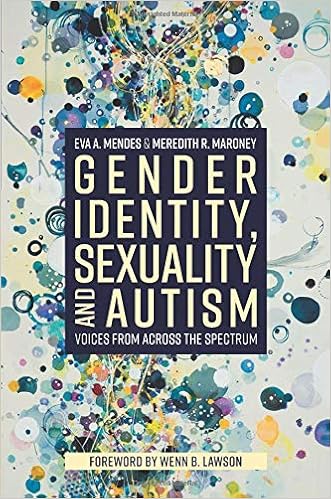
Unexpected Review: ‘Gender Identity, Sexuality and Autism’, by Eva A Mendes and Meredith R Maroney


Jessica Kingsley Publishers
21st January 2019
£13.99
978-1785927546

Blurb

Bringing together a collection of narratives from those who are on the autism spectrum whilst also identifying as lesbian, gay, bisexual, transgender, queer, intersex and/or asexual (LGBTQIA), this book explores the intersection of the two spectrums as well as the diverse experiences that come with it. By providing knowledge and advice based on in-depth research and personal accounts, the narratives will be immensely valuable to teenagers, adults, partners and families. The authors round these stories with a discussion of themes across narratives, and implications for the issues discussed.

In the final chapter, the authors reflect on commonly asked questions from a clinical perspective, bringing in relevant research, as well as sharing best-practice tips and considerations that may be helpful for LGBTQIA and ASD teenagers and adults. These may also be used by family members and clinicians when counselling teenagers and adults on the dual spectrum. With each chapter structured around LGBTQIA and autism spectrum identities, Gender Identity, Sexuality and Autism highlights the fluidity of gender identity, sexual orientation and neurodiversity and provides a space for people to share their individual experiences.

Continue reading “Unexpected Review: ‘Gender Identity, Sexuality and Autism’, by Eva A Mendes and Meredith R Maroney”

Wearing a human suit

This comes from a text conversation I had with my sister on Friday. We were supposed to be going out.

H: I’m on my way

Me: Okay. I’m awake, just making myself human.

H: I thought you were a dragon. What are you making yourself human?

Me: People get scared if I turn up all dragon-y, so I’m putting a human suit on. It’s a bit of a tight fit, constraining even.

That’s what it feels like to mask, to be less than my authentic self, I’m wearing a tight, restrictive ‘human suit’, forcing me to act in limited ways that make me uncomfortable at least and hurt at worst. When I’m stressed or anxious and I’m forced to not pace or chatter by other people saying “Stop that.” etc. I’m hurting. I get that people are uncomfortable with me not acting like a ‘normal’ person, but they aren’t in pain because of it, I am.

Just another fun thing about being autistic in a majority non-autistic world.

Book Review: ‘Spectrum Women’, edited by Barb Cook and Dr. Michelle Garnett

38884913

Publication Date: August 21st 2018 
Publisher: Jessica Kingsley Publishers
ISBN: 9781785924347
Format: Paperback
Price: £13.16 (amazon.co.uk)

Blurb

Barb Cook and 14 other autistic women describe life from a female autistic perspective, and present empowering, helpful and supportive insights from their personal experience for fellow autistic women. Michelle Garnett’s comments validate and expand the experiences described from a clinician’s perspective, and provide extensive recommendations.

Autistic advocates including Liane Holliday Willey, Anita Lesko, Jeanette Purkis, Artemisia and Samantha Craft offer their personal guidance on significant issues that particularly affect women, as well as those that are more general to autism. Contributors cover issues including growing up, identity, diversity, parenting, independence and self-care amongst many others. With great contributions from exceptional women, this is a truly well-rounded collection of knowledge and sage advice for any woman with autism.

My Review

I think I’m slightly in love with this book. I treat myself to it in August, a few days after publication and read it swiftly. I’ve been keeping it to myself ever since (except to review on Good Reads) because I’m selfish and it is fantastic! I keep meaning to lend it to my sisters to try to help them understand, but it’s not leaving my house, sorry. It’s too insightful and useful.

This book is a gripping insight into being a woman on the spectrum, as well as excellent advice for women on the spectrum. I found some of the chapters more helpful than others, from a personal point of view, but I think it’ll be useful to any woman or girl on the spectrum, to understand themself and some direction in the world around them.

If you’re an autistic woman, or parenting an autistic girl, go and read this book!

My First Rejection

To be fair, this is the only publisher I’ve submitted to.

I heard back from Sara at Inspired Quill yesterday evening, although I only read it this morning. Unfortunately, they aren’t accepting Hidden Fire this time round but the advice she gave was really useful. I’m going to go back and look at both Hidden Fire and Fire Betrayed again, with her feedback in mind.

I was chuffed with this:

wonderful authorial voice that flows well and is a pleasure to read. Your characters are interesting, and it’s obvious that you know every detail about the world you’ve created.

… I like the way you don’t end every sentence with ‘said’ or ‘she shook her head’ (or similar!)…

I’m just sorry that currently, Inspired Quill doesn’t have the resources to offer you a contract and work with you.


The feedback boils down to:

  • Dialogue can be hard to follow when there are groups – non-verbal cues
  • More telling than showing – non-verbal cues
  • Episodic (good because keeps readers engaged) but needs a unifying arc running through.

The autistic writer has a problem with non-verbal cues and tone of voice. Now there’s a surprise! (This is a humorous comment, not a criticism of the feedback).

I can work with this. It’s not a problem.

I published Hidden Fire and Fire Betrayed a year ago, and I’ve learnt a lot since, especially during my dissertation writing. My supervisor, although a bit harsh at times, pushed me to write better, and his advice coincides with what Sara has written, to a certain extent.

Yes, it hurts my ego a bit and I’ll be shying away from doing anything for a while, but, I know how I react. Give me a couple of weeks and I’ll start work on them all again.


Completely random thought re: criticism and autistic people:

People say auties are rubbish with criticism, but I think it’s just a case of us needed longer to process and reflect so our automatic response is ‘nope, not happening, not doing it’, because, I at least feel like, when people criticise they expect immediate change and improvement and it’s just not possible, so ‘shut down and refuse’ is the go to response. Given time and no pestering, it’s possible to integrate the criticism into my worldview and work on it, but I need enough processing time (about two weeks). I don’t know if that’s how other auties feel, but that’s how it works for me. Maybe, instead of just listing ‘doesn’t respond well to criticism’, people should ask about how we feel and approach criticism, how we process and integrate it, instead?

I am almost definitely not a great loss to science

I was having one of my ‘can’t turn brain off’ nights last night. I had a few thoughts, like autistics are about 1% of the population, add the other neurodivergents and that probably comes to 5 – 10% of the human population. Maybe there was a evolutionary advantage to having a small number of people in a group that thought and processed the world differently.

And then I got up this morning, did my usual Twitter, Facebook and WordPress gander and realised, it’s all been thought before and articulated better, by people much more intelligent than I am.

So I think I’ll go back to writing stories.

Ignore the pacing, tapping and twitching, I’m just stimming.

This week I’m going to write about stimming. The calendar asks the questions what is stimming and how is it related to masking.

Stimming is autie slang for those things we do to self-sooth when anxious, among other things.

I have a variety of stims. I flap my arms, like a confused penguin, usually when I’m in the chemists and waiting for my medication. It works particularly well when I’m wearing my waterproof jacket, because it makes a rustling sound that I like. I rub my hands on my thighs especially when I’m wearing jeans. The texture and movement is soothing. Texture seems to be important for me, rough textures work well. I also like physical actions, like throwing a ball at the wall and catching it. Crafting is possibly a stim too. It’s a socially acceptable stim to crochet or sew in public.

Why do I stim? Because I get anxious and I need to send the energy somewhere, I suppose.

What has stimming to do with masking?

If I can redirect the anxiety to an activity I can hold up until I get home. It helps me maintain the facade of calm and attention, except when I can’t and then I stim because I need to. That’s when the mask drops in public and I get funny looks. That’s not fun. Especially as I think some of my behaviours that might have been stimming as a teenager were the reason some people bullied me at school. It was twenty years ago but the worry is still there that someone will attack me for doing what I need to do to be comfortable.

So that’s my take on stimming and masking.


Anyway, I’ve discovered this evening that Monday evening after 8 pm is a good time to go shopping. There was only two other people in the shop when I went to get my food shopping. It was great. No queue at the tills, no children getting too close, hardly any staff getting in the way with containers. It was great. Plus I had an audio book on my tablet, with the volume quite high. I’m going to end up deafening myself.

Pass my Mask, I need to leave the house

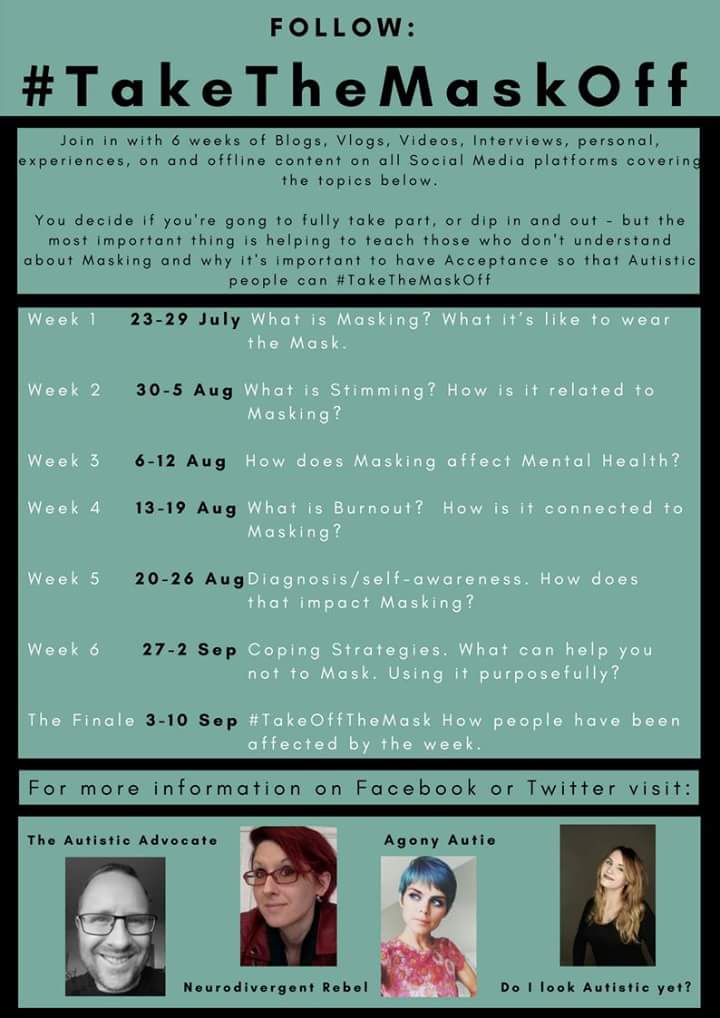
So, the delightful ladies and gent on this poster are doing a thing under the tag TakeTheMaskOff. I recommend following them on social media, they’re very interesting people.

Anyway, I thought I’d contribute in my own small way, with a blog post. I don’t know whether I’ll be doing one every week, it depends on what else I’ve got on.


Continue reading “Pass my Mask, I need to leave the house”