Review: ‘From Codpiece to Three Piece: The History of Fashion’

History Today

Kindle Edition

July 2013

UlinkaRublack, Patrick Little, Christina Walkley, Lois Banner, Quentin Bell, Carol Dyhouse, Stella Mary Pearce  and Eileen Ribeiro

£2.05 from Amazon.co.uk


This small e-book contains eight articles spanning 60 years of scholarship and publishing. They focus on fashion, not just what clothes were worn when, but attitudes to clothing, and the things they indicate about the wearer, and also how people viewed the clothing worn by their ancestors, and how it was depicted in art.

Ranging from the changing attitudes to the wearing of fur to how fourteenth century artists depicted classical subjects to the question of precisely how dull Cromwell’s clothes were, this is a fascinating collection of articles. There is nothing new here; in fact I recognised three of the articles as I’ve read History Today regularly for the past eight years. The older articles were interesting, though; sixty years is a long time in academia and the attitudes of the writers to their subject’s is as interesting as the subjects themselves.

I’ve never bought one of these collections before (although it would be more precise to say my oldest friend bought me it since I used the gift card she gave me for my birthday – thanks Fi!) but I think it’s well worth the price. They are great resources, containing the best articles History Today has published on a particular subject. I would have liked a new, original article to go with the collection though; I think it would have made a nice touch.

Review: ‘Bright Young Things; Life in the Roaring Twenties.’ By Alison Maloney

2012

Virgin Books


review - byt


Described in the blurb as a ‘sweeping look at the changing world of the Jazz Age, as life below stairs vanished forever, loose morals ran riot, and new inventions made it seem anything was possible’, this book gives an entertaining glimpse in to the lives of the Bright Young People, the wealthy young Mayfair set who ran riot in London in the Nineteen Twenties. Presented in a gossipy tone, with first-hand accounts from those who were part of the group of friends dubbed the ‘Bright Young People’ by the popular press, and the generation of ‘Bright Young Things’ they led and inspired. The central cast of aristocrats and artists loom large in a playful narrative of all night dancing, freak parties, treasure hunts through London, immodest fashions and heavy drinking. The more staid members of their age group and class, the debs, and the attitudes of their parents to the antics of the hedonistic set are also covered.

The focus is primarily on London; however there is some reference to the United States and Paris. As Jazz was a large part of the lifestyle of the Bright Young Things, this isn’t surprising. The spread of this form of music from the southern United States across the Atlantic to London and the on into Europe is fascinating, although the author doesn’t go in to a great deal of detail.

Also covered in the book are references to changing sexual attitudes, and the growth of consumer ‘labour –saving’ goods as more people had access to electricity and servants became rarer.


While this book is subtitled ‘Life in the Roaring Twenties’ it doesn’t really give much of an insight in to life for those who weren’t wealthy and educated, and living in London. Bare mention is given to the lives and aspirations of working and lower middle class people, who presumably had ambitions and needs as well. It’s very gossipy in nature, relying on published diaries, letters and autobiographies/biographies for much of the detail. The ‘flapper’, her dress, attitudes and occupations are a recurring feature of the book.

I didn’t feel that the author really put meat on the bones of the subject, although the origin of certain terms originating in, or associated with, the decade are explained and there is a decent bibliography at the back. I’d say this was quite a good book for GCSE students wanting a bit more information about the Twenties, and those wanting an overview of the decade. At the very least it’ll get people started and then they can move on to more detailed studies of the decade.


Review: ‘The Devil’s Ribbon’ A Hatton and Roumande Mystery by D.E. Meredith

image

2011
Allison and Busby

In July 1858 a cholera epidemic once again threatens an overheated London. Professor Hatton of St. Barts Hospital and his chief diener Albert Roumande spend their days cutting up cadavers in an effort to learn as much ad they can about the disease. At the same time they are also working in the new science of forensics and as London’s leading experts are called in to help when an Irish MP is murdered a few days before the anniversary of Drogheda, a green ribbon found in the dead man’s mouth.

A series of other murders follow. The victims all seemed to have known each other in Donegal, during the Potato Famine. What happened there and who would want revenge? As Hatton, and Inspector Grey of Scotland Yard, about whom Hatton has grave doubts, investigate they are interrupted by an explosion in a packed shopping arcade. The Inspector, and the widow of the first victim are seriously injured. Hatton has more questions than answers. Is the explosion connected to the murders or is one a cover tor the other? What has Donegal to do with it? Why does all the opium and fly papers keep disappearing? And is the mortuary budget really getting cut?

Using their new method of fingerprinting the Professor and his diener discover the murderers. Using torture Inspector Grey finds the bombers.

I do like a good murder mystery, and this is an excellent example. The characters are engaging even if the set up hasn’t been original since Conan Doyle wrote his Sherlock Holmes stories (skilled amateur investigators/useless professional policeman). The plot is strong, and conclusion unexpected and imaginative. Full of period detail which immerses the reader in the scenario without being overwhelming or too descriptive, and which adds to the plot. The premise, of an early forensic pathologist working in a world that doesn’t understand what he does, is interesting.

This is the second book in the series. I haven’t read the first but I probably will try to at done point. It isn’t necessary though as it is perfectly possible to read the novel as a stand alone story. Previous cases are hinted at throughout, drunken/drugged confessions about their pasts develop the characters, although some of the repeat characters need fleshing out a bit. How did they all end up in London? What secrets, because they all have secrets, do they hide, and why? Presumably we will find out in future novels although somethings can be guessed at.

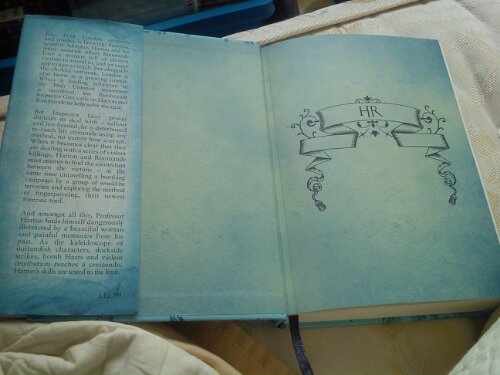
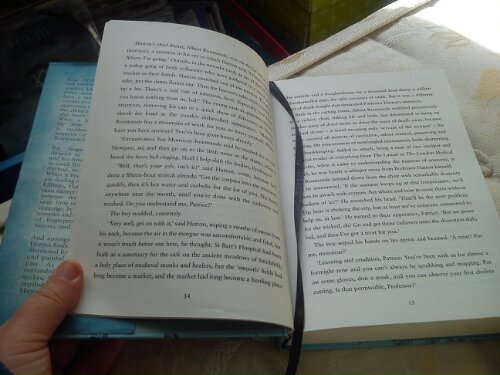
I really did like this book; the audio book is available soon. It is a beautifully bound and presented article.

image

image

image

I might be easily pleased but I like a well presented hardback book.

I noticed a small number of typos but nothing that took away from the story significantly.

Definitely a must read if you like historical mysteries.

****

Rose

Fanfic: a whole world in a PDF document

What a lovely day, I’m sweltering; I hope all my lovely readers are well and enjoying the weekend?

Ladies and gentlemen, I have a question for you all.

Who reads fan fiction (or fanfic, or just plain fic)?

Hands up if you have or do.

Next question,

Hands up if you’ve ever written fanfic?

And the most important question of all,

Why?

Swear down I’m not judging, I’m just interested. Want to know why? Simple really, I was having a read through Twitter and someone from one of the bands I follow mentioned they were the subject of fanfic. I was torn between laughing, tweeting them to say serves them right for reading fic about themselves (but that might have seemed negative towards fanfic writers) and explaining the warnings and categories used in fan fiction writing.

Here we have a fine example of how my brain works.

This, and the fact that Ellie and I spent an evening at Download explaining to Mark-the-tent-lodger  the concept of fic, and associated abbreviations (do you know your OTP from your BROTP, NC-17 from dub-con?), led me to wonder just how widespread the phenomena is?

I first came across the concept of fanfic about two years ago, before that I didn’t know it existed. Now I know that several of my friends not only read, but also write fanfic. There’s a whole community of writers out there who mainly or only write fan fiction. It’s a fascinating world.

I’m told it’s origins lie in the mists of time, when Star Trek first appeared. Since then this creature has spread into literature, music and films, as well as a huge variety of television shows. Some concern real people and some fictional characters; however all treat them as stock characters in a story. Some even cross over e.g. the other day I read a fic in which the characters of the BBC Sherlock met NBC’s Hannibal. They can be ‘canon’, that is, fit into the existing storyline, or AU, in which anyone can be anywhere, anywhen or anything, provided they stay essentially true to the character.

Fan fiction has it’s own dedicated websites and online forums and groups. Fanfiction.net was the first I ever looked at, when I was reading ‘True Blood/Southern Vampire Mysteries’ fics. There’s an excellent series called ‘Oh no! Vampire Bill!’ that’s basically 1001 different ways to kill the most irritating character in the TV programme/books. Kept me entertained for days. Then I was directed to certain groups on Live Journal which specialise in real-person fics. The problem with both fanfic.net and live journal is that there is very little editing, although some groups have formatting rules. Also, it isn’t that easy to search at times.

Recently a new website, archiveofourown.org has become the place to find all your fanfic. Specifically designed to provide an easily searchable standard format for new stories, and an archive for older work, it is now becoming quite popular. Fairly regularly one finds links to both the writers’ Live Journal or other website, and AO3 posting of a fic. The tagging system can be awkward at times, but if you have an idea of what you’re looking for it is possible to find fics accurately, as there is a comprehensive search system, and the fics can usually he downloaded in a variety of formats. As well as that, series and chapters are linked together so it’s fairly easy to check for updates.

I don’t know about anyone else but I read fanfic because it’s fun, and a good story is a good story. I’ve read some right stinkers, some that need a bit of work, and some that need professional publishing. Now. Fanfics based on literature and films/television allow fans to immerse themselves in the universe of the originals in a creative way.

I suppose the real difficultly, for me at least, comes when real people are being written about. Yes, it’s fun making up stories about people you admire or inspire you, but how far can it be taken? Personally I feel that if we acknowledge the fics aren’t real, and that the people in them are ‘stock characters’ then it’s acceptable. Fics allow fans to explore fantasies, put their heroes in unreal situations and see what happens. So long as it remains a story and nobody thinks it’s real every thing is fine.

And if you’re daft enough to look for fanfic about yourself, you have been warned; run away quickly for you are heading into dangerous waters.

Generally speaking writers will tag their fics with a variety of codes, which are confusing if you’ve never seen them, but once understand become a second language. They will also tag any possible triggers, since fics quite often deal with mental illness, abuse, self-harm, suicide etc.

Fanfic readers also talk in code. I can’t decide whether the purpose is to unite fans or hide our guilty pleasure. For instance, when asked who you’re OTP is, you are being asked which romantic couple you like the most. The phrase ‘I ship it’ means ‘I love that…’, and abbreviations for romantic pairings can be entertaining.

So, that’s fanfic, I’d be interested to hear other people’s opinions on the subject.

And yes, occasionally I write fic, but I’m not telling you what about or where to find them. That’s between me and my co-conspiritors.

Good evening,

Rose
Review: Knot in Time (Tales of Uncertainty Book 1) by Alan Tucker

2012

Dare Heisenberg (adopted great-nephew of the great Heisenberg of Uncertainty Principle fame) is a drop-out living on the streets of Denver. A disappointment to his adopted-parents, his teachers and just about everyone he ever met, including himself, Dare doesn’t really see much of a future for himself. That is until one night he meets a blob named Bob. Bob has an offer for Dare that changes his existence. Dare can go on as he is or join the Keepers, who regulate time and space.

Naturally he accepts.

Dare is sent on his first mission, which goes horribly wrong and sets off a chain of events which results in Dare ending up on (and above) Mars with giant hamster aliens and an indestructible spider-creature. Oh, yes and four anti-matter bombs. Dare and his new friend Lauri must race against time to prevent the destruction of a species.

I was sent this e-book to review at the request of www.everythingbooksandauthors.com (thanks Toni); it’s been a while since I read much science fiction but I used to enjoy it so I thought I’d give this book a go.

Overall I’d say I enjoyed the novel, especially the final third, when it felt like the author had really got in to his storytelling stride, describing the scenes and action well. I grew to sympathise with Dare, a character whose self-centredness irritated until he started to develop.

The only significant negative point I could make is that the pacing is a little uneven.  The first hundred pages were slow, but once the action started it sped up. The change in pace came at a point that, when I read it, felt disjointed; as though this were two separate stories that had been put together but the join wasn’t smooth. It also felt a little rushed towards the ending, with an element of deus ex machina. I also found some of the early descriptions of Dare’s family background and education repetitive and laboured.

These are minor quibbles and this is an enjoyable sci-fi novel, with an interesting premise; the author clearly has some understanding of current theories in physics. In addition, I especially liked the pahsahni (giant hamster aliens) and their back-story. It is a good introduction to Sci-Fi suitable for YA audience.

I’m hoping to do write a few more reviews for www.everythingbooksandauthors.com, Toni the Admin is really nice, she gets back to you quickly and doesn’t preasurise readers/reviewers. I’ve got a great long list of books I’m reveiwing at the minute, so expect a few more over the next week or so!

Rose