
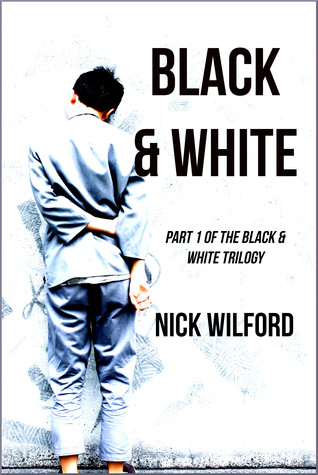
Publication Date: 18th September 2018
Published by: Superstar Peanut Publishing
I.S.B.N.: 9781370304622
Format: e-book
Blurb
What is the price paid for the creation of a perfect society?
In Whitopolis, a gleamingly white city of the future where illness has been eradicated, shock waves run through the populace when a bedraggled, dirt-stricken boy materialises in the main street. Led by government propaganda, most citizens shun him as a demon, except for Wellesbury Noon – a high school student the same age as the boy.
Upon befriending the boy, Wellesbury feels a connection that he can’t explain – as well as discovering that his new friend comes from a land that is stricken by disease and only has two weeks to live. Why do he and a girl named Ezmerelda Dontible appear to be the only ones who want to help?
As they dig deeper, everything they know is turned on its head – and a race to save one boy becomes a struggle to redeem humanity.
My Review
An e-book of this novel was sent to me by the author in return for an honest review.
I, a 34 year old, am probably not the target audience for this novel; I still enjoyed it, it’s probably more my nephew’s sort of thing though. He likes dystopian novels with teenage main characters.
Interesting world concept: a perfect land, mirrored by a land of death and mud, one with no government and the other with an over-mighty, restrictive dictatorship. Guess which is which?
Harmonia is ‘perfect’; clean, organised, hygienic. No sickness, no pain, death at a ripe old age of 110 when you’re vapourised into nothingness, gone forever. Controlled, bland, sanitised, synthesised food, no animals or plants, no colour.
Loretania is muddy, people die young from a disease that makes them cough and vomit their lives away, they subsist on rat roasted over an open fire, human mess runs through the streets and the dead are remembered with a monument of bones.
Sympathetic main characters: three children, sixteen year old. Ezmeralda Dontible is a government official’s bored daughter, Wellesbury Noon is a promising ‘gravball’ player who can’t help feeling things aren’t quite right, and a dying Loretanian, desperate for help, whose name I can’t remember. This particular character, whilst a catalyst for the plot, is unmemorable and is barely in the book. He’s the poor unfortunate that the others need to save when he failed to save himself.
A new character, George, arrives late into the plot, a scientist, the Chief Scientist of Harmonia, in fact. An old man who engineered the birth of all three characters (I think, the explanation was a bit confusing), who decides to help them overthrow the government and rescue the Loretanians from disease and death. There was no foreshadowing, he just turned up to rescue Ezmeralda when she gets the disease killing the Loretanians and Wellesbury. His motivations aren’t alluded to and it all sort of gets piled on at the end.
The novel had a decent plot; it interesting enough for me to not put it down for a few hours. I actually read the book over an evening.
It just felt a little…hollow, not fleshed out enough. There wasn’t enough description of Whitopolis for me to imagine it. All I got was bland, white everything. There was no sound or texture. Was that deliberate? The characters describe feeling muffled by the atmosphere of Harmonia, while in Loretania they feel alive, full. The descriptions of Loretania are certainly more fleshed out. I’m unsure whether the lack of description in one and the opposite in the other was a plot device or not. And the ending felt…off. Predictable. The kids, with the help of a sympathetic adult, save the day.
The grammar and spelling were certainly excellent, no errors typically found in indie books (including my own!) here.
Despite some plot and character issues, I liked this novel, it was entertaining and certainly fits the market for teenage dystopian novels that seem to be going through a popular phase (although that might have passed already).
3/5

 Everything Is Better With Dragons