
I’m a nice person and I like to help my support worker out so I put together a presentation for the Forum tonight. We covered the subject of Queer people. I have a bot of understanding of the subject since I am Queer and I read a lot. I had to do a bit of scrabbling around on the internet to find information I needed, so I’ve added the references at the bottom of this post, with a transcript of my presentation.
The slide show with transcript
Slide 1

Welcome to the LGBTQIA+ Forum. I’m going to talk about this important topic and why it’s important for us to be informed about Queer matters. Any interruptions, homophobia, transphobia or queerphobia etc. will result in me stopping this presentation. I refuse to tolerate bigotry of any kind. If you have questions either wait to ask them or write them in the chat.
Slide 2
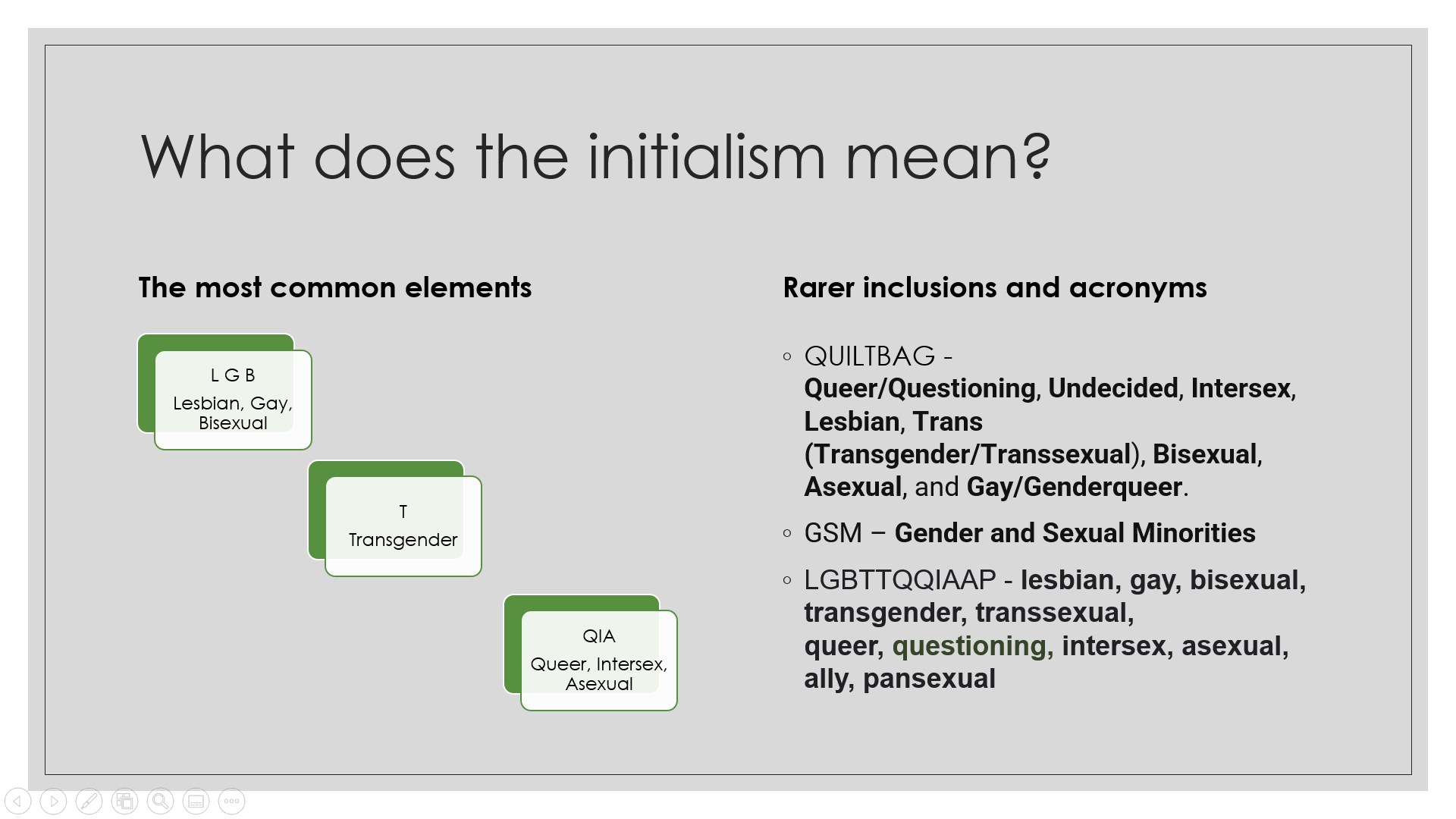
About 17% of the population identify as non-heterosexual in some way. About 1% of the population are out as transgender and about 2% of the population are known to be intersex. I use ‘known’ and ‘out’ as qualifiers here, because, like neurodivergent people, at any one time many people are in denial, medically unidentified, unsure or in hiding so they don’t get included in the statistics.
LGBTQIA+ is a long list of letters, and I’m sure most of you know what most of them mean.
L – Lesbian
G – Gay
B – Bisexual
T – Transgender
Q – Queer
I – Intersex
A – Asexual
+ is for all the others not included in the ‘short’ initialism.
We will get to what these terms mean later, but there are others you might want to be aware of; you may come across them online or in reading.
Firstly, there’s the delightfully evocative ‘QUILTBAG’ – as you can see on the slide this initialism covers a much greater range of identities than LGBTQIA and includes more gender terms, such as genderqueer.
Secondly there’s GSM – Gender and Sexual Minorities – which is sometimes used in ‘official’ documents. It’s not that common and some people don’t like it.
Finally, at least for today, there’s LGBTTQQIAAP – that’s a mouthful! It’s an expansion of LGBTQIA+. There are longer expansions that include two spirit, aromantic, agender, genderfluid, it goes on. Because humans come in all shapes and sizes and with all sorts of attractions and genders. This label generally relates to a person’s gender or sexuality, but it can be so much more complicated than that.
We need to discuss some things before we start. Sexuality hasn’s always been seen as an identity. It came about during the late 19th century with the development of sexology and the pathologisation of sexuality that wasn’t strictly between men and women, missionary style, in a monogamous relationship. Anything else was deemed ‘abnormal’, whether it’s who you’re attracted to, how your gender is expressed or identified, what you’re into or the types of relationships you have. It’s in this context that these identities have been developed.
These identity labels have been useful in getting rights for gender and sexual minorities but they bring with them limiting expectations of behaviours and roles. However, we don’t have an awful lot of time to get deep into these things so I’m going to recommend the book Sexuality: A Graphic Guide, by Meg-John Barker and Jules Scheele.
Slide 3
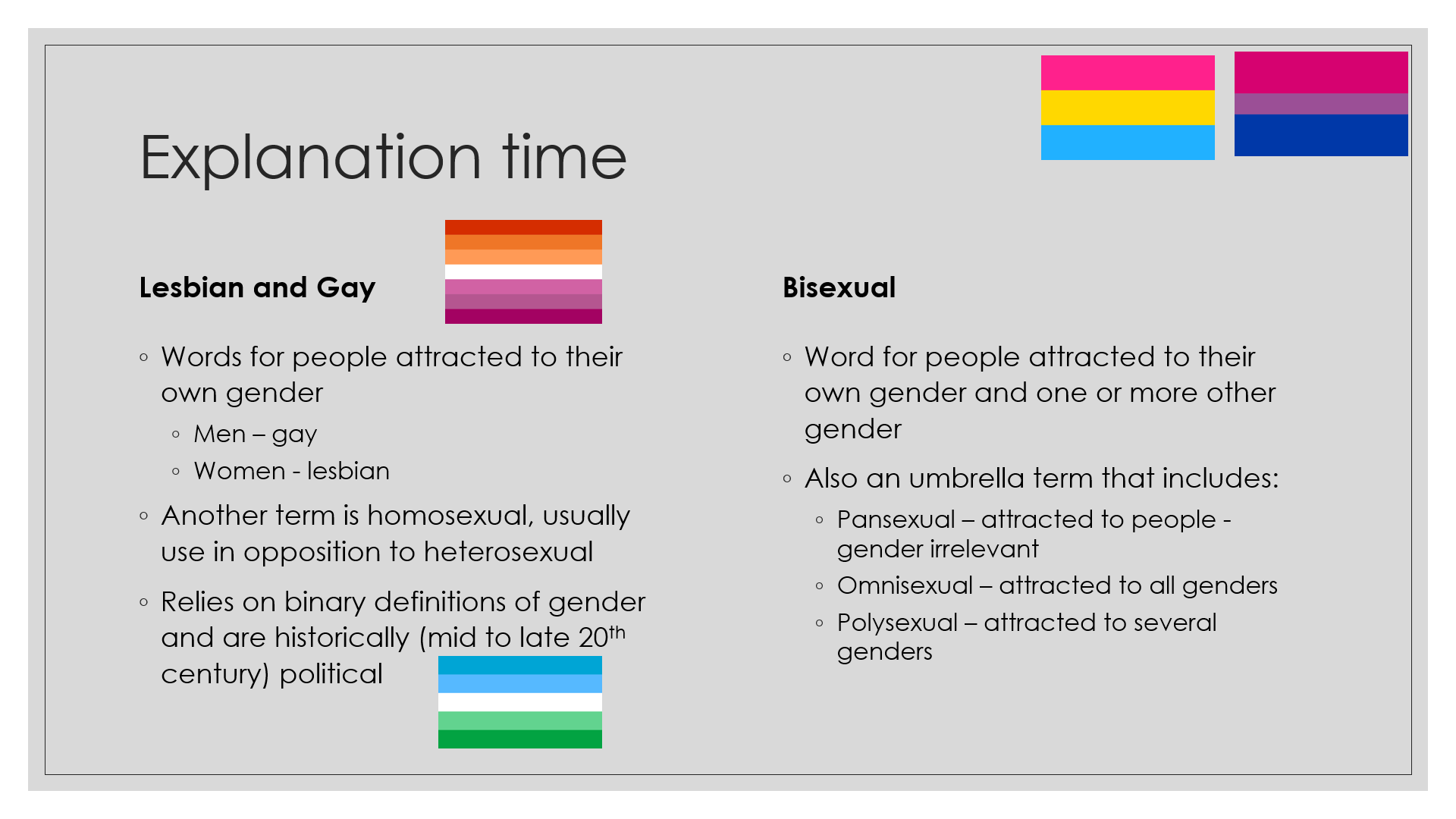
Most people will be familiar with LGBT as an initialism; it’s the most commonly seen. Lesbian and Gay are terms that usually refer to people with exclusively homosexual attraction, that is attraction to their own sex or gender.
Gay men are attracted to men and lesbians are women who love women. ‘Gay’ is derived from the Old French word ‘gai’ meaning full of joy or mirth, in English it came to mean bright, cheerful, happy, carefree. The carefree meaning led it to be used for prostitutes (‘gay women’), brothels (‘gay houses’) and womanizers (‘gay men’) from about the 1600s; this is the first time it became associated with sex.
In the 1890s the word ‘gey cat’ (Scottish variant) was used to describe a vagrant who offered sexual services to women, or a young man who has just started living on the road and is in company of older men. Sexual submissiveness is implied, and it is this context and meaning that came to be used by the 1920s between homosexual men in the US to mean a homosexual man. It became commonly used after the 1950s and is an acceptable term used now. Since the 1990s it has been used as an insult to mean bad or ridiculous. Don’t.
Lesbian refers to Lesbos, a Greek island that was home to Sappho, a sixth century BCE poet. Sappho was so well known in her time and after that Homer referred to her as ‘The Poet’. Some of Sappho’s poetry is addressed to particular women and are strongly erotic or romantic, although whether they were meant to be autobiographical is in dispute. So, the association between Lesbos and women who love women was established. Sapphic is another word used in this context.
Sappho | LGBT Info | Fandom (wikia.org)
Lesbian and Gay are well known terms, they have been used for several decades and often used to refer to everyone who is not cis-gender and heterosexual. As part of the political fight to gain rights for non-heterosexual and cis-gender people, Gay and Lesbian people are often the only ones remembered and thought about.
It is a very binary approach to both sexuality and gender. I shouldn’t need to tell you that neither sex, sexuality nor gender are binary. Talking of, let us get on to the B – bisexual. This is a complex one. Originally, ‘bisexual’ was an adjective referring to “having the organs of both sexes in one being, hermaphroditic”, where it is attested to from 1824. The meaning “attracted to both sexes” is from 1914; the noun in this sense is attested from 1922. Modern definitions are given as “Attracted to more than one gender”, “Sexual or romantic attraction to ones own and other genders”.
https://www.etymonline.com/word/bisexual
Slide 4

On to T – Transgender.
Right, we need to talk about sex and gender.
Human sex isn’t binary. No really, I know you’ve been taught that there’s only male and female. Two well defined boxes that people can be neatly dropped into and is obvious from external features such as genitalia. Genetics and gonads – that is the reproductive organs you possess, are used to reinforce this. Except Intersex people – people with ambiguous genitalia and gonads – exist, and genetic studies show that there are many variations in genetics. It’s not just XX and XY. Even brain scans show that humans have a mosaic of ‘male’ and ‘female’ features – see The Gendered Brain, by Gina Rippon for details.
Gender is a complex idea that is made up of gender expression – that is how we express ourselves, gender roles – what society expects of us, and gender identity – how our internal sense of self manifests. It is this gender identity that is important here. A trans person doesn’t identify with the gender they were assigned at birth based on external features. So, a trans man is a man who was born with a vulva, was socialised as a girl but who identifies as not a girl/woman, but as a boy/man. A trans woman is a person born with a penis and socialised as a boy, but who’s internal sense of self is as a girl/woman.
That’s for a binary trans person.
A non-binary person is a person who doesn’t identify as either of the binary genders. This may be genderfluid, genderqueer, agender, bigender. This is not a new phenomenon – many cultures have more than two genders, however we live in a culture that for a couple of thousand years has resolutely refused to accept it and have exported this belief to cultures that previously had many genders.
Non-binary people can identify as trans or not. Some consider themselves trans because they don’t identify as their birth assigned gender, but as a gender outside the binary. Non-binary people who don’t identify as trans may do so because they identify as a gender that includes their assigned gender, for example a genderfluid person assigned female/girl at birth who sometimes identifies as a woman, but mostly agender.
Trans people simplify things by saying that they have ‘a fe/male brain in a fe/male body’ but that’s not really how it works. We just need to simplify things for people who have never had to understand that sex and gender are complicated. It only really works for binary trans people, not for non-binary people. Also, there is no such thing as male and female brains, there are only brains that are moulded and changed by life events. I once again direct you to Gina Rippon’s book on the subject. The sense of self identity is not found in some structure of the brain, it’s a cumulative thing that emerges. And that’s getting a bit philosophical, we’re not here to be philosophical tonight.
Some of these slides have the flags associated with different groups but not all of them, if you want to see more, have a look at:
The Complete Guide to Queer Pride Flags
Slide 5

Queer – this is an umbrella term; it is also used by people who are complicated in their identities. It originally meant something or someone strange. It only became an insult after it was used to describe Oscar Wilde’s relationships, and by extension all non-heterosexual sex acts and relationships. It has been reclaimed.
Asexual and aromantic – Asexual people generally don’t feel sexual attraction although they may feel romantic or aesthetic attraction. They may also identify as demi-sexual or grey-sexual – that is under certain circumstances they may feel sexual attraction.
Aromantic people don’t or rarely feel romantic attraction, although they may feel sexual attraction.
Differentiation of attraction is often found in Asexual communities to explain how they experience attractions. To quote an asexual blogger who knows more about this than I do: Differentiating Attraction/Orientations (Or, the “Split Attraction Model” by any other name is so much sweeter.) – NEXT STEP: CAKE (wordpress.com)
Rather than treating attraction as an all-in-one package, Asexual communities commonly differentiate types of attraction, such as romantic, sexual, aesthetic, sensual, etc. Many aces may report that their experiences with one type of attraction may be different than with another.
Because of this, some asexuals have also begin to use multiple orientation labels to differentiate these patterns, especially with regards to sexual vs. romantic attraction. Thus, someone who was not sexually attracted to anyone, but who was romantically attracted to all genders, might consider themselves a “panromantic asexual”, where “panromantic” is their romantic orientation, and asexual is their sexual orientation.
Slide 6

Intersex people, as I said earlier, are people with what is medically known as ‘disorders of Sex Development’ and are about 2% of the population, although there could be more intersex people who just don’t know they’re intersex. Intersex refers to people who can’t be put easily in to the ‘male’/’female’ boxes. They are included in the initialism that is mostly about gender and sexuality because they are a minority that don’t fit the neat categories we expect. The existence of intersex people shows just how complicated foetal development is and that sex is a continuum rather than distinct groups.
There is also a cross-over of intersex and trans communities, in that 40% of intersex people identify as trans.
Slide 7

We are looking at gender and sexuality from a strictly European perspective, influenced heavily by Greek and Roman attitudes and Christianity. That went to the rest of the world when Europeans started their great imperial projects in the 16th century. So, on the slide is a quick rundown. If you want to know more, there are books, go look it up. I’m running out of time so, let’s move on to the next slide.
Slide 8
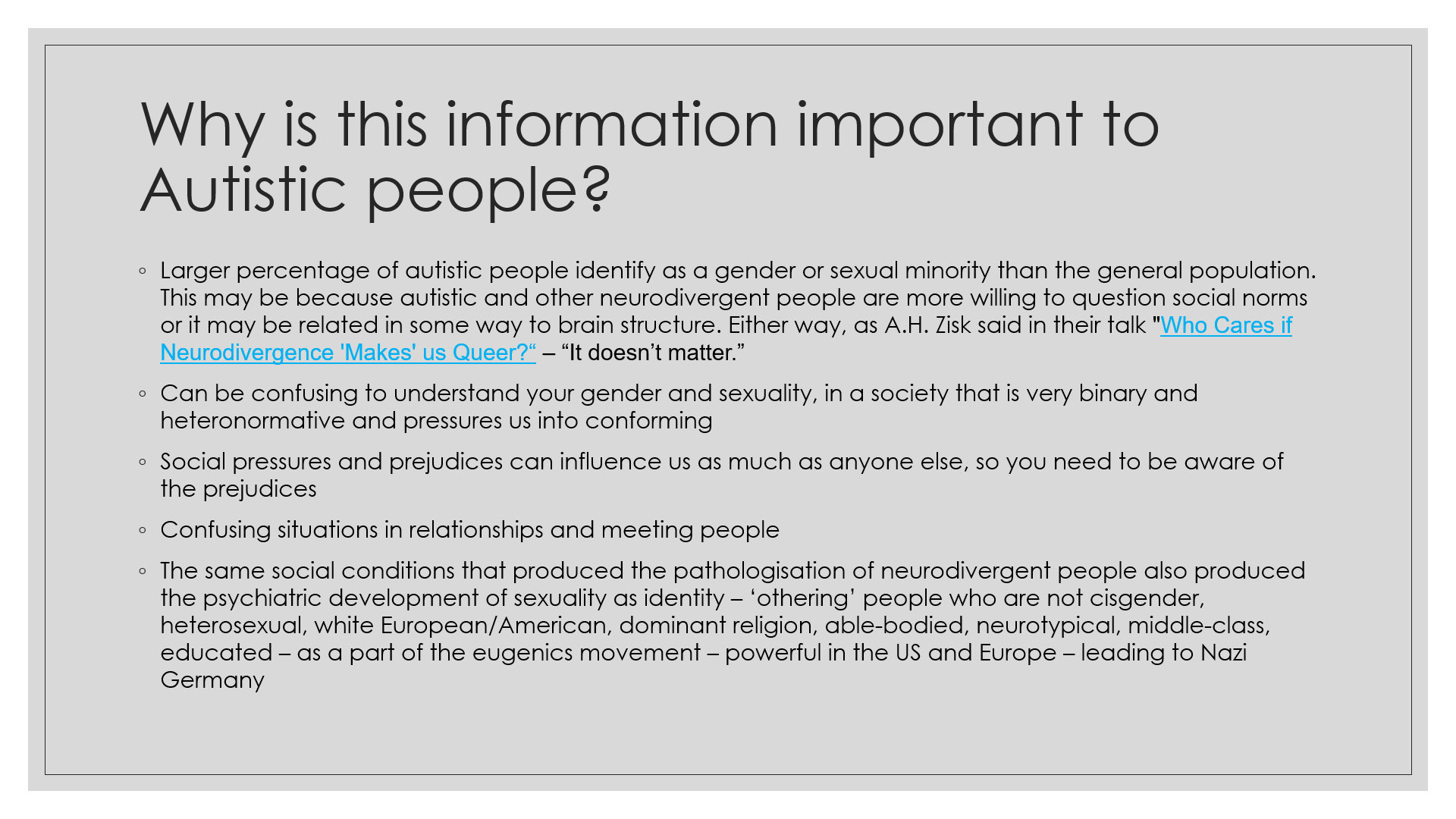
Why is it important to have a basic understanding of these things?
Well, approximately 30% of the autistic population identify as something other than cis-gender and heterosexual, so there’s a good chance you’ll meet a Queer person if you spend enough time with Autistic people. In fact, purely by being here, you definitely have.
Hi. I’m Queer – pansexual, non-binary, agender, genderfluid, and I’m polyamorous. If you’ve got a problem with that, you can go to hell. *big grin*
Not having a basic understanding of the different varieties of human can make you look an absolute tit, which, I suppose, is better than being thought a bigot. My efforts this evening are made to prevent that, that is unless you want people to think you’re a bigot. A bit of reading will expand your awareness and understanding. I still have so much to learn, I don’t have all the answers, I don’t experience every possible combo of genders, attractions, and sexualities, but I’m willing to try to understand and share information.
There is another important point I want to make; the same people who pathologized neurodivergent people pathologized queer people, the same people who invented conversion therapy for homosexual men and transgender people worked on ABA – a therapy used to make autistic people act less autistic for the convenience of their non-autistic parents and teachers, that is used a lot in the US and is used in special schools in this country, although they give it a different name to make people think it’s not the same old torture. We have too much in common as marginalised communities and a lot of overlap in demographics.
Slide 9

Here are the videos I linked in the slide.




 Everything Is Better With Dragons