P U B L I C AT I O N DATE: 18th JANUARY 2024 PA PE RB AC K O R I G I N A L | £9.99 | ORE N DA B OO KS
It started with a lie…
Married couple Karin and Kai are looking for a pleasant escape from their busy lives, and reluctantly accept an offer to stay in a luxurious holiday home in the Norwegian fjords.
Instead of finding a relaxing retreat, however, their trip becomes a reminder of everything lacking in their own lives, and in a less-than-friendly meeting with their new neighbours, Karin tells a little white lie…
Against the backdrop of the glistening water and within the claustrophobic walls of the ultra-modern house, Karin’s insecurities blossom, and her lie grows ever bigger, entangling her and her husband in a nightmare spiral of deceits with absolutely no means of escape…
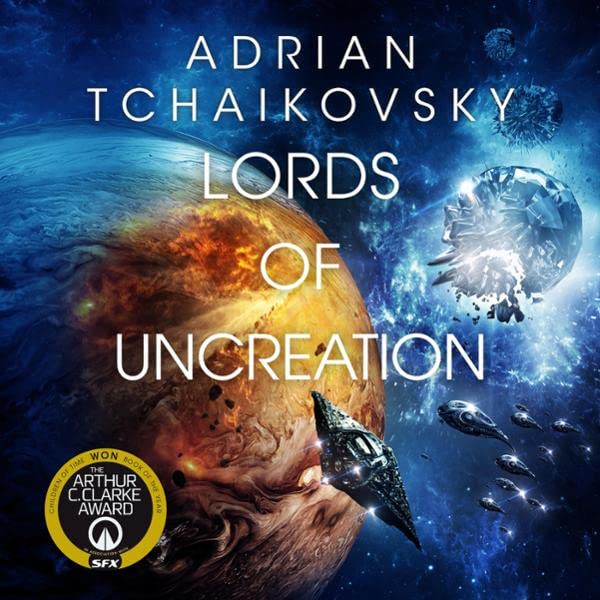
The Final Architecture, Book 3 By: Adrian Tchaikovsky Narrated by: Sophie Aldred Series: The Final Architecture, Book 3 Length: 20 hrs and 49 mins Unabridged Audiobook Release date: 27-04-23 Language: English Publisher: Tor
Summary
From Adrian Tchaikovsky, author of Children of Time and winner of the Arthur C. Clarke Award, Lords of Uncreation is the final high-octane instalment in the Final Architecture space opera trilogy.
He’s found a way to end their war, but will humanity survive to see it?
Idris Telemmier has uncovered a secret that changes everything – the Architects’ greatest weakness. A shadowy Cartel scrambles to turn his discovery into a weapon against these alien destroyers of worlds. But between them and victory stands self-interest. The galaxy’s great powers would rather pursue their own agendas than stand together against this shared terror.
Human and inhuman interests wrestle to control Idris’ discovery, as the galaxy erupts into a mutually destructive and self-defeating war. The other great obstacle to striking against their alien threat is Idris himself. He knows that the Architects, despite their power, are merely tools of a higher intelligence.
Deep within unspace, where time moves differently, and reality isn’t quite what it seems, their masters are the true threat. Masters who are just becoming aware of humanity’s daring – and taking steps to exterminate this annoyance forever.
My Review
I’ve read or listened to quite a few of Adrian Tchaikovsky’s books in the last few years. I’m reading one currently, and I’ve just finished listening to this book. I’ve met Adrian a couple of times at FantasyCon; he’s from Lincolnshire and got his honorary Doctorate in January 2019, at the same ceremony I received my Masters at Lincoln. He’s a bit of a weirdo, but not a bad one. His son is autistic (some people I know who grew up with Mr Tchaikovsky have speculated that he’s ADHD but I don’t know), and he tries to include neurodivergent characters in his more recent books. I particularly enjoyed the crows in Children of Memory, who are ADHD and Autistic. I’m considering getting paperback copies to add to the Little Neurodivergent Library at work.
In the The Final Architecture books, the ‘ints’ are neurodivergent – most have deliberately damaged brains that allows them to process the world in a way entirely differently to the majority of the population. Some are naturals – like the first ‘int’, Saint Zavienne, and some of the Partheni new class who have the ‘right’ genetics for sensitivity to unspace travel, but most have an acquire brain injury that makes the neurodivergent. They are significantly disabled by their brains, and Idris is one of the most disabled. He’s also the oldest, one of the original class, almost a hundred years old; never aging, never sleeping, always anxious, always highly stimulated. His obsession with finding the Masters, the ones driving the Architects to destroy sentient life in the universe, pushes him close to death, multiple times. Usually he only survives because of some piece of tech or emergency procedures taken by his friends and occasionally his enemies.
I found Idris to be a bit of a wet blanket, but he admits to being a weak, ‘little’, man. He’s small and physically weak from his early years of deprivation, his long life of hard labour fighting the Architects and travelling in the unreal. He has a strong spirit and his frustration with people who won’t listen and who won’t consider the implications of their actions resonates. He is opposed to genocide, which is a perfectly reasonable position to hold, and he seeks the first cause. I can agree with that position. I don’t think we’ll find an intergalactic species desperate to recreate the conditions of their original universe at the centre of our problems however.
Idris is the driver of the mission, but the driver of the plot is Olli, who along with Kitt the Hanni are the remaining crew of the Vulture God, while everyone else is on the Eye buggering about in unspace. Olli, being a suspicious bint, doesn’t trust anyone, particularly the ‘parthos’ – the women of the Partheny. And she’s right to be suspicious, as she uncovers a breakaway group plotting a coup, and helping the arc-ship building cabal. A pointless war breaks out between Hu and the Partheny. Olli and Kitt take the ship, and an Ogdru (an aquatic species that can navigate unspace) called Junior out of it and try to save everyone.
Eventually, they end up saving the universe. Olli gains various items from the Hegemony, after she becomes heir to ‘The Razor and The Scythe’, as Unspeakable, head of a crime syndicate, and by the end of the novel, head of her own nation. Olli is my favourite character, and I really want a novel about her adventures as Unspeakable. Her attitude of ‘fuck it’, her willingness to try whatever she needs to do to survive and to help her friends survive, and her magic legs from the Hegemony, make her an engaging, fun character.
The story is complicated and has several parts. First the mission on the Eye, then the war, then the rescue, and finally back to the mission. The narrative uses multiple voices to tell the story – a limited 3rd person omniscience – and there is some overlap between the chapters as the same events are told by different characters and then taken forward. Since events happen across hundreds of thousands of kilometres of space, this is quite helpful. I enjoyed seeing events from multiple perspectives.
The narrator, Sophie Aldred, is very good. She gives each character their own personality. She has really good pacing and inflection, although some of her pronunciations are wrong. I enjoyed listening to this audiobook. I found myself looking forward to getting back to it while also finding ways to stretch it out because I didn’t want the story to end.
If you’ve enjoyed Adrian Tchaikovsky’s other books, you’ll probably enjoy this one. The man publishes two or three books a year, so you’ll probably always have something to read/listen to. He’s really good at space opera with relatable human (and nom-human) characters.
PUBLICTION DATE: 18th JANUARY 2024 PAPERBACK ORIGINAL | £9.99 | ORENDA BOOKS
They’re the housemates from Hell…
When her disastrous Australian love affair ends, Lou O’Dowd heads to Edinburgh for a fresh start, moving in with her cousin, and preparing for the only job she can find … working at a halfway house for very high-risk offenders.
Two killers, a celebrity paedophile and a paranoid coke dealer – all out on parole and all sharing their outwardly elegant Edinburgh townhouse with rookie night-worker Lou…
And instead of finding some meaning and purpose to her life, she finds herself trapped in a terrifying game of cat and mouse where she stands to lose everything – including her life.
Slick, darkly funny and nerve-janglingly tense, Halfway House is both a breath-taking thriller and an unapologetic reminder never to corner a desperate woman…
Format: 392 pages, Hardcover Published: December 15, 2023 by Harper Voyager ISBN: 9780008596965 Goldsboro Books Exclusive Edition
Two elven sisters become imprisoned in the hidden world of the fae where danger, and love, lies in wait. Faebound is the first book in an enchanting new trilogy from the internationally bestselling author of The Final Strife.
A thousand years ago, the world held three fae, elves, and humans. But now the fae and humans exist only in myth and legend, survived by the elves who are trapped in an endless war over the remaining lands.
Yeeran is a colonel in the elven army and has known nothing but a life of violence and hardship. Her sister, Lettle, is a diviner whose magic promises a different future for her and her sister, but the prophecies have yet come to pass.
When a fatal mistake leads to Yeeran’s exile from the Elven Lands, Lettle, fearful for her sister’s life, follows her into the uncharted territory beyond their borders. In the wilderness the sisters encounter the largest obeah they have ever seen. Part leopard, part stag, the obeah’s magic is harnessed to make weapons for the elven war. It is during this hunt that they are confronted with the a group of fae who take them captive. Imprisoned in a new land, they must navigate the politics of the fae court all while planning their escape.
Now Yeeran and Lettle are fighting a different kind of between their loyalty to their elven homeland and the intoxicating world of the fae, between what duty decrees is right, and what their hearts tell them they need.
My Review
Alright, one last review for the day and then I’m off to bed. I’ve just read about 300 hundred of the 395 pages this evening. I read the rest last month. I’ve been busy. Now I have to wait for the next one! And it promises to be so good!
I don’t normally like romantic fantasy, even though it seems to be a really popular genre at the moment. I prefer fantasy with a romantic sub-sub-sub plot. Fantasy that could stand without the romantic elements. There should be more that just lust and romantic love moving the plot forward. Nor should sex be substituted for actual character development.
But.
I like this one. The characters are fun, there’s battles, murder, prophesy, finding and losing family, betrayal, talking animals…all the fun stuff. The plot does rely a bit on the enemies to lovers trope, but that’s a romantasy staple and in the context it actually works. El-Arifi doesn’t use sex as a substitute for character development, although there is some in there. On the beach, of all places.
The main characters are Yeeran and Lettle, a colonel in the Waning army and a Seer. They are sisters in their late thirties and twenties, respectively. That makes a nice change. Main characters that aren’t children. They’ve had a hard life. Yeeran chose to join the army and fight in the Forever War, while Lettle was too young to leave, and had to stay with their father. After poisoning him as dementia took control, Lettle seeks solace in an old temple, and meets her mentor, a Seer, who takes her to their capital and trains her in divination. Yeeran rises to become the youngest general in the Waning army, while Lettle becomes a powerful diviner, although divination, the gift to elves from the moon god is increasingly ignored and disparaged.
Then Yeeran makes a battlefield mistake that costs hundreds of lives. Sent into exile, Yeeran seeks out a way to win back favour with her chieftain/lover. Lettle, and Yeeran’s Captain, Rayan, follow her into exile, through the neighbouring Crescent and meet up as Yeeran is hunting an obeah.
Then things turn nasty. Because the obeah is faebound to a fae prince, who will die when the obeah does, and a fae princess witnesses the death. There is a nasty fight and Yeeran is condemned to death. But first the three elves must be marched through the wasteland to the underground home/prison of the fae.
Just when it looks like everyone is going to die, Yeeran bonds with an obeah herself. This changes everything. The fae won’t kill an obeah, and killing Yeeran would kill an obeah. This gives Yeeran, Lettle and Rayan a few months respite to find a way to escape. Something is happening outside the fae lands, and inside there is dissension in the ranks. The arrival of three elves changes the balance and they will all learn something about themselves and the world.
I’ll admit, my favourite character is Pila, the obeah bonded to Yeeran. She’s a sarcastic bint and I love her. The elves and fae are okay, I suppose, but I want more obeah adventures! I’m joking, although Pila is my favourite, I like the way the characters are developing and the push-pull of duty and attraction. Lettle sees most things more clearly than her sister, but Yeeran is too bound up in her training to accept that Lettle might be right. The tension between the two sister, and the tension between Yeeran and Furi, drive the story forward. These tensions represent the tension between two elvish worldviews and the competing elvish and fae worldviews, that need to be reconciled for them the move forward.
Furi is furious most of the time, be as the reader gets to know her through Yeeran’s eyes, we discover that the anger is a cover for grief, pain and fear. She’s trapped in Mosima, trapped in her duty to people and family, her future is determined for her by a curse, and she has no way out. She turns this outward towards elves in general and Yeeran in particular. Yet, it’s the arrival of Yeeran, Lettle, and Rayan that will eventually free her.
Also, it’s very, very queer. As in the societies are queer normative. And I love to see it.
That’s the big reveal at the end. Which I’m not going to spoil. You all need to go out and get this book. The standard edition will be published in a week or so, and I think I have a copy on order with Waterstones. (Look, we all know I’m a completist, I can’t help myself. I just found out there’s a FairyLoot exclusive edition and I can’t get it! It’s very frustrating!)
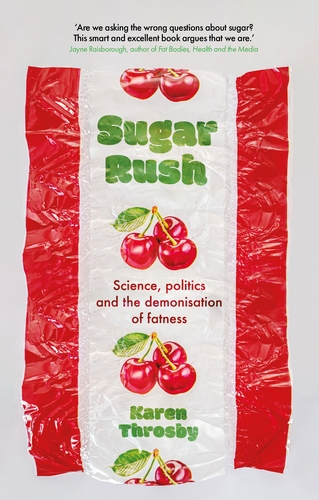
Format: Paperback ISBN: 978-1-5261-5155-1 Pages: 304 Price: £19.99 Published Date: June 2023 Published by Manchester University Press
DESCRIPTION
In the second decade of the twenty-first century, the crusade against sugar rose to prominence as an urgent societal problem about which something needed to be done. Sugar was transformed into the common enemy in a revived ‘war on obesity’ levelled at ‘unhealthy’ foods and the people who enjoy them. Are the evils of sugar based on purely scientific fact, or are other forces at play?
Sugar rush explores the social life of sugar in its rise to infamy. The book reveals how competing understandings of the ‘problem’ of sugar are smoothed over through appeals to science and the demonization of fatness, with politics and popular culture preying on our anxieties about what we eat. Drawing on journalism, government policy, public health campaigns, self-help books, autobiographies and documentaries, the book argues that this rush to blame sugar is a phenomenon of its time, finding fertile ground in the era of austerity and its attendant inequalities.
Inviting readers to resist the comforting certainties of the attack on sugar, Sugar Rush shows how this actually represents a politics of despair, entrenching rather than disrupting the inequality-riddled status quo.
My Review
Throsby uses a variety of sources from 2016 to 2019 to interrogate the focus on sugar are ‘the’ bad nutrient. She links this to pre-existing food hysterias, and austerity, with its focus on punishing the poor, the fat, the abject Other.
The structure of this book is that of an academic textbook, with an introduction, sources used, and chapter conclusions, while the writing is more like that one would find in a popular science book, easy to read and understand. The tone is one of enquiry and interest, rather than anger or scoffing at the writers of the source materials. The arguments and conclusions are supported strongly and are convincing, at least to this reader.
I highly recommend this to fat activists, disability rights activists, anyone interested in social equity, and dietitians. Really considering buying a copy to give my dietitian…
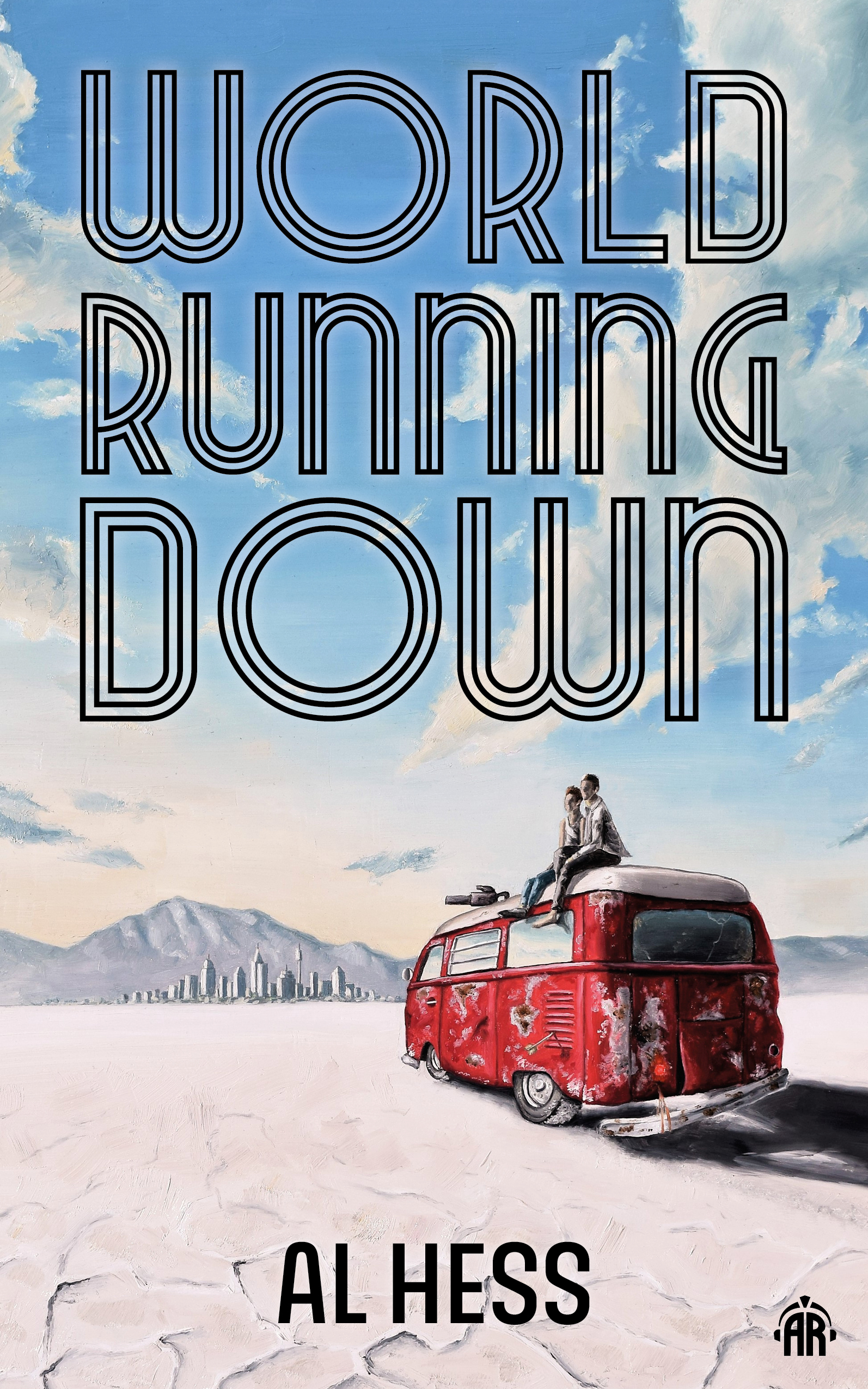
Valentine Weis is a salvager in the future wastelands of Utah. Wrestling with body dysphoria, he dreams of earning enough money to afford citizenship in Salt Lake City – a utopia where the testosterone and surgery he needs to transition is free, the food is plentiful, and folk are much less likely to be shot full of arrows by salt pirates. But earning that kind of money is a pipe dream, until he meets the exceptionally handsome Osric.
Once a powerful AI in Salt Lake City, Osric has been forced into an android body against his will and sent into the wasteland to offer Valentine a job on behalf of his new employer – an escort service seeking to retrieve their stolen androids. The reward is a visa into the city, and a chance at the life Valentine’s always dreamed of. But as they attempt to recover the “merchandise”, they encounter a problem: the android ladies are becoming self-aware, and have no interest in returning to their old lives.
The prize is tempting, but carrying out the job would go against everything Valentine stands for, and would threaten the fragile found family that’s kept him alive so far. He’ll need to decide whether to risk his own dream in order to give the AI a chance to live theirs.
World Running Down is Al Hess’s first traditionally published novel; he is also an incredible artist. Check out his instagram! He also has a website.
Content warnings (from Al Hess’ website):profanity; alcohol use; M/M open door sex and sexual elements; brief violence; brief misgendering and transphobia; body dysphoria; abduction; classism; risk of forced sex trafficking; toxic friendship/codependency; a fictional denomination of Mormonism and discussion of religion
Rep: trans, gay, lesbian, non-binary, and (briefly mentioned) polyamorous rep; M/M romance ADHD main character (some people have claimed Valentine for Team Autistic as well, and I am totally okay with that!)
My Review
I picked this book up from the Angry Robot Books stall at FantasyCon, and got a very cool art card with it, drawings of Valentine and Osric. Al Hess did the drawings and the cover of his book. I want the rest of the postcards Al drew for the characters but I don’t think they’re available anymore. I think I’m part of the Angry Robot blog tour for Al Hess’ next book, Key Lime Sky, later in the year. I’m looking forward to that. I’ve also signed up for Hess’ newsletter, so I’ve got the ebook for a pre-curser to World Running Down to read.
The plot: Valentine Weiss is a scavenger in a future Utah, where the cities are a haven of free healthcare, transport and education, where there is food in abundance and stable housing. Outside of the heavily guarded cities are small settlements and encampments living on marginalised land, home to marginalised people – the religious conservatives, the social conservatives, the Queer and the poor. To get in to Salt Lake City, with the medical care he needs – testosterone and surgery – he needs a visa and to pass a citizenship test. But that requires money.
With his friend, Ace, or Audrey, who is hoping to get a visa so she can join her distant family in the city, he takes on various jobs out in the dangerous salt flats and mountains. The pair run fuel runs for small settlements, fight off salt pirates, and search for anyway to make money. One a job to drop off fuel, they find a messenger waiting for them.
This is Osric, an AI Steward forced into an android body. Osric doesn’t understand his body, or what it needs – food, water, sleep, going to the toilet. He’s overwhelmed by all the sensations, and irritated by clothes. So he spends a lot of time taking his clothes off, and only putting them on when he really has to.
Valentine is very attracted to Osric, first physically, and then, getting to know him, to his kindness, intelligence and empathy. Valentine feels so much empathy for his new friend, he’s overwhelmed by care for him, and for everyone else. He helps Osric with basic human tasks and then listens to his message. A job, as yet unknown, for a wealthy person in Salt Lake, with the reward of clothes and a visa.
The clothes are important. Valentine feels more himself in a suit. It helps him cope with his dysphoria. Ace loves the dresses. The trio head to Salt Lake, where an interaction with another Steward at the reception centre helps Osric understand more about how he ended up in an android body, and to set in motion events that would change society, although they don’t know it. The job turns out to be a retrieval of goods – eight female androids stolen by a former brothel manager. Osric, we discover, has been embodied to be the new manager, while Valentine and Audrey are need to recover the androids.
The trio go back out on the road after some contretemps in the brothel, and soon find the androids in a camp of Mormon salt pirates. An awl used as a weapon brings about the discovery that the androids are gaining sentience, and they really don’t want to go back to the brothel.
This brings Audrey and Valentine into conflict. He won’t force sentient beings into being escorts if they don’t want to, but she is desperate for the visa that will get her to her family. Osric needs to go back whether he wants to or not. His body is owned by the brothel, and he wants to return to the collective of the Stewards. What will they do?
Hess is an autistic, trans writer, and I can tell. Not that I’m judging, I really appreciate the representation. Osric is right; clothes are itchy and uncomfortable! I often don’t wear clothes if I can avoid it.
Not being a dread pirate, I can’t tell you how accurate his portrayal of the internal experience of ADHD is, or the struggles with dyscalculia the Valentine clearly has. I do have a lot of AuADHD and ADHD colleagues, friends and relatives, so I can recognise the external manifestations. I also get the frustrations with the world and with people who don’t get it, or won’t take the time to understand.
I identified strongly with both Valentine and Osric, and their struggles with embodiment and identity. It brought up some stuff, okay, I’m working on it. Can I be an android, please? There’s a lot of emotional angst and conflict while the pair work out what they feel and what they want to do. It hurt. I loved it.
Al Hess writes ‘cosy sci-fi’ and I like it. The story are domestic and emotionally charged, placed in a future world that is both better and worse. In the cities, life is materially great, if you don’t think about what’s outside. Life outside if the cities is brutal, but there is love and community, even if it’s hard to get food and medical care. It’s morally complex and questions the utopian ideals of some sci fi.
It’s cosy, gay and neurodivergent adventure in the desert and I really enjoyed this book and I’m looking forward to reading more by Hess. I have already ordered a copy for someone and recommended it be added to the fiction section of the Little Neurodivergent Library at work.
Format: 392 pages, Paperback Published: January 1, 2014 by Heron Books ISBN: 9781848664791 (ISBN10: 1848664796) Language: English
Alice Roberts takes you on the most incredible journey, revealing your path from a single cell to a complex embryo to a living, breathing, thinking person. It’s a story that connects us with our distant ancestors and an extraordinary, unlikely chain of events that shaped human development and left a mark on all of us. Alice Roberts uses the latest research to uncover the evolutionary history hidden in all of us, from the secrets found only in our embryos and genes – including why as embroyos we have what look like gills – to those visible in your anatomy. This is a tale of discovery, exploring why and how we have developed as we have. This is your story, told as never before.
My Review
The book takes the foetal development from before ovum and sperm meet to birth, and going from head to toe, to discuss both foetal development and evolution. The author is uniquely place to write this sort of book, having spent years as both a scientist and a science communicator. I enjoyed Alice Roberts’ documentaries that I’ve seen, and this book from ten years ago holds up well, although the science continues to move on.
I found this book really interesting. I have some background in biology, but not a huge amount, I only did a year of university chemistry, mostly biochemistry and molecular biology. I suspect if you didn’t manage to pass GCSE biology and don’t watch documentaries, you might struggle with this book, but for the reasonably educated, it’s a good book. It’s a foundation at least, for university study. It’s not a textbook however, it is written with a general audience on mind. If you enjoy Dr Roberts’ documentary series’ you’ll be fine with this book.
I giggled at the occasional digs at creationists, because they deserve it for their wilful ignorance. If you’re sensitive about that, you probably need a slightly less advanced book before you get to this one. And you need to escape whatever cult you’re in that’s stopping you from getting an education…
Format: 224 pages, Paperback Published: November 30, 2023 by Pluto Press ISBN: 9780745348667 (ISBN10: 0745348661) Language: English
Blurb
Neurodiversity is on the rise. Awareness and diagnoses have exploded in recent years, but we are still missing a wider understanding of how we got here and why. Beyond simplistic narratives of normativity and difference, this groundbreaking book exposes the very myth of the ‘normal’ brain as a product of intensified capitalism.
Exploring the rich histories of the neurodiversity and disability movements, Robert Chapman shows how the rise of capitalism created an ‘empire of normality’ that transformed our understanding of the body into that of a productivity machine. Neurodivergent liberation is possible – but only by challenging the deepest logics of capitalism. Empire of Normality is an essential guide to understanding the systems that shape our bodies, minds and deepest selves – and how we can undo them.
Robert Chapman is a neurodivergent philosopher who has taught at King’s College London and Bristol University. They are currently Assistant Professor in Critical Neurodiversity Studies at Durham University. They blog at Psychology Today and at Critical Neurodiversity .
My Review
Robert Chapman works with a couple of neurodivergent academics (Hi Louise and Anna 1 )I know, so I heard about this book months before it was published and pre-ordered it as soon as I could. There was a problem with the publisher’s computer system and my pre-order was lost so I had to re-order it. I did end up getting a discount because of that though, so I’m not complaining. I also ordered a few other books from Pluto Press, which I will get around to reading and reviewing. Eventually.
This book was an absolute joy to read. Chapman explores the history of neurodivergent people and the disability and neurodiversity rights movements. They explicate and critique anti-psychiatry, Freudianism and other areas of psychiatry, and confirming what I’ve said for years, capitalism is to blame for everything!
No, seriously, think about it.
Why do we have to be machines that happily work set shifts every day doing repetitive uncreative tasks? Capitalism.
Why do we have to fight for any form of social support? Capitalism.
Why are so many more people struggling with their mental health? Capitalism.
We live in a society where everything has a price and if you can’t produce you are a drain on society. The Tories have placed the blame and burden of austerity firmly on disabled people. Neolibralism, that monster set loose by Thatcher on our social and educational systems, pushes things further than ever before, and now we have fascism rearing its ugly head again. This is not hyperbole and if you think it is, you haven’t been listening to disability rights and neurodivergent rights activists, anyone who gives a damn about civil society or social equity.
I tried to say similar things to Chapman in my booklet about neurodivergent history, and couldn’t quite express myself the way I wanted to or get the message I wanted across. Part of that was lack of theoretical background (I am not a philosopher) and part was the funding source. Can’t write a socialist history or a manifesto for neurodivergent equality when you’re getting government funding and working for a non-partisan charity.
Yes, I liked this book because it agrees with my personal politics2, but that’s not the only reason. Chapman writes clearly, fluently, and makes convincing arguments for their position. They explain and explore history, making connections between different areas that might not be clear, although their examples show that other people have made those same connections in the past. By putting the neurodivergent experience in the context of capitalism, viewing the changing place of neurodivergent people through a Marxist lens, we can see the connections between the way capitalism has narrowed our lives and shaped the paradigm through which we are viewed by society, the medical and political system, and how they choose to treat us.
I have already recommended this book to several people and will be asking for a copy for our Little Neurodivergent Library at work.
Insert mad waving here. They’re all a part of the Medical Humanities Department at the University of Durham, my alma mater, not that Durham would admit that I ever went there. ↩︎
Burn it down, pull it out by the roots, start all over again with an equitable society from the beginning. ↩︎





 Everything Is Better With Dragons