
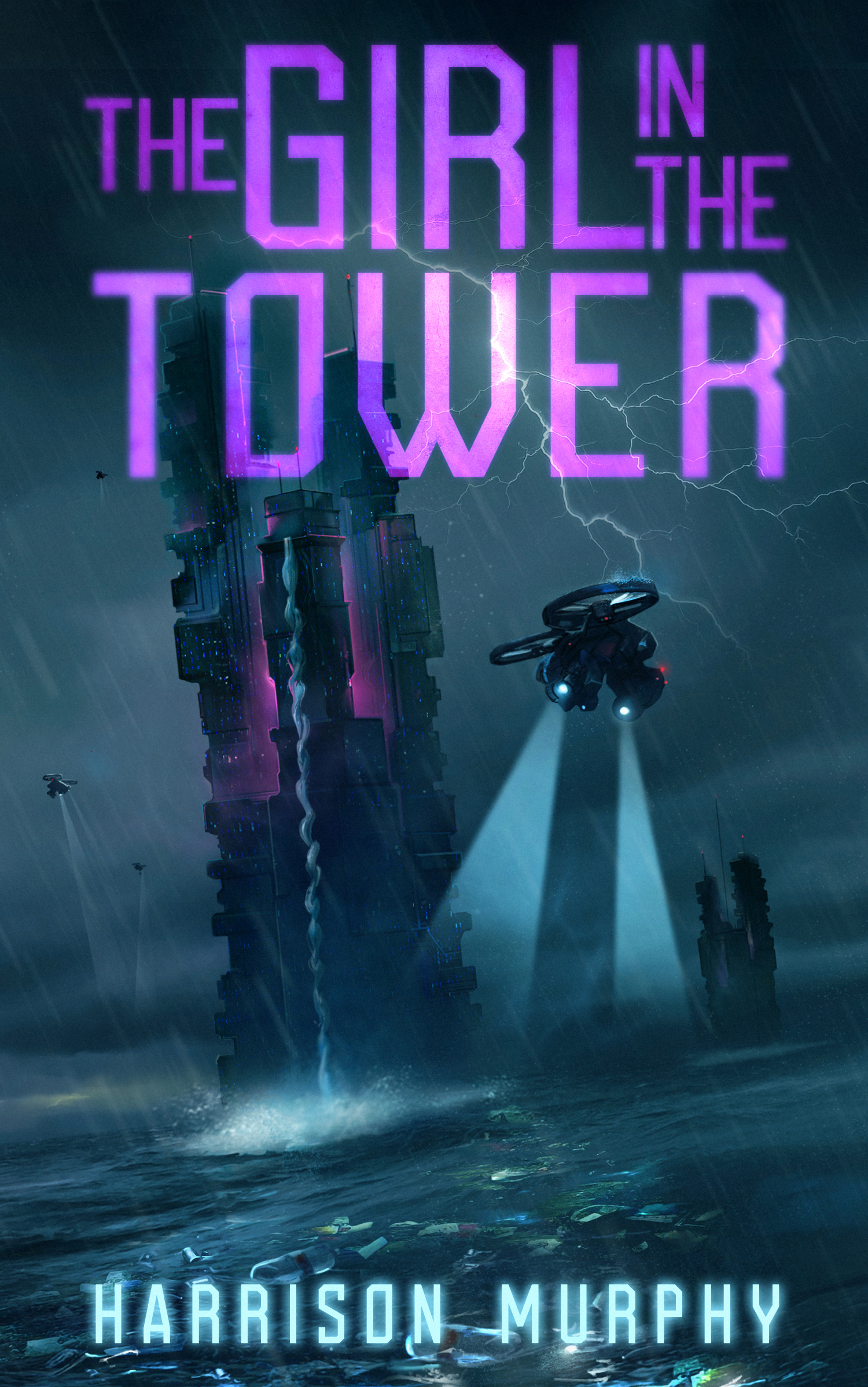
Blurb:
When the past lies buried beneath the waves, and the present hides behind a veneer, what power do we have over the future?
As high-flying energy magnate, Parsley Ringland, prepares for maternity leave, tragedy strikes. She passes out after a health complication and wakes up elsewhere. In the tower that sustained the life she had once known.
As she fights to protect herself and her unborn child, Parsley begins to fear for humanity itself. She is faced with an impossible dilemma. Does she keep the world in comforting darkness? Or expose a cruel truth that might destroy it?
Is it better to endure a terrible truth than to lounge inside a lie?
My Review
Thanks to Anne of Random Things Tours for organising this tour and to the author for sending me a copy.
The premise – it’s 2101, most of humanity is dead and other than a few struggling people on a couple of islands, most of the survivors are plugged into a simulation of 2001. Instead of oil they use a salt water solution called sil to power cars and aircraft, homes and cities, everything we use oil for. The simulation, or Dwello, was developed by three teenagers and one of them was a fascist, so all the people in the world are light skinned, and all religious belief systems have been eradicated. In contrast, society is run along socialist and green principles, there’s little competition and a lot of cooperation.
One, Parsley, is CEO of Basil, a major British Sil organisation. After returning from maternity leave, she has suddenly changed. Why? This is where the background story comes in, layered like a palimpsest. In the Real, Parsley has been disconnected so that she can give birth after complications. She discovers she’s not a white blond, but a dark skinned woman with a shaved head, and her family is living on a tiny island, almost starving. After giving birth, she and Dejana head out to find her family. Discovering the truth shocks Parsley.
She, Dejana, another woman who was disconnected due to pregnancy problems, and one of the Elders (the original teenagers) Severin, decide to bring down the Dwello by overwhelming the servers that keep it functioning. To this end, Parsley starts introducing concepts from the real 2001, like consumerism and capitalism, single-use plastics, littering, and terrorism.
I don’t know how I feel about this book. It’s an intriguing concept, but I found the execution confusing and disjointed. It’s quite visual and the timeline moves around a lot. I think it would work really well as a film but as a novel it struggles. I did enjoy it at points and was really immersed and loving the characters, and then at other times it was a slog and the characters would become caricatures.
It took a lot of getting into. The prologue seemed like a total non sequitur, until the epilogue. I was confused by the jump from the prologue, to Lou and then Parsley. I can see it working as a film, though. If I think of it as a script for an adaptation, I can picture the scene layouts and the plot makes sense, with scenes cutting in and out from Dwello to Real, and the visual contrast between sanitised 2001 and dark, gritty, wet and windy 2101. Seriously, someone could make a good dystopian blockbuster from this story.
It’s a good plot, there’s a lot there, and the characters of Lou, Parsley, and Dejana are strongly developed and full. They go through emotional growth and development, they face trauma and have fairly realistic responses to situations. They all have a purpose in the story. Dejana is the guide, Parsley is the main character and instrument of change, while Lou brings the reader information from the ground level and is the future, along with her daughter Abigail.
On the other hand, there are language problems that an editor should have picked up. Murphy uses phrases, such as Coltan describing 2016 as being ‘too woke’, that will date very quickly. The phrasing ‘stay woke’ has been around for about a century, but in a specific community and with a specific meaning. It has lost that specificity, and I honestly can’t see it having the same meaning or currency as it does now. Although now it just means ‘anything a conservative person doesn’t like’ rather than ‘being aware of the difficulties of being a Black person in the US’. There were some spelling and grammar errors, such as waived instead of waved, that occurred enough for me to notice but not enough for it to be a problem.
I’m going to be honest, I gave this 3.5 stars on GoodReads, but I don’t want you to think I disliked it. If I thought this was unreadable, I’d have emailed Anne and asked for content instead of a review. Taste is individual, just because something doesn’t work for me in its current form, that doesn’t mean it won’t work for you, especially if you like films like The Matrix.
Author bio:

Harrison Murphy is a writer from Motherwell, Scotland. He specialises in downbeat, and often provocative, speculative fiction with elements of sci-fi and fantasy thrown into the mix. The Girl in The Tower – a cli-fi Rapunzel story – is his most recent novel. His fourth novel, IV, is an exploration of the afterlife, as well the limited agency we have in affecting this life. He also wrote the Chrysalis trilogy, set in a world where we can design our own minds.

 Everything Is Better With Dragons