George Goodwin
Publication Date: 16th February 2016
Edition: Hardcover
ISBN: 9780300220247
Price: $32.50

Continue reading “Review: ‘Benjamin Franklin in London’ by George Goodwin”

Everything Is Better With Dragons
Book blogger, Autistic, Probably a Dragon
George Goodwin
Publication Date: 16th February 2016
Edition: Hardcover
ISBN: 9780300220247
Price: $32.50
Continue reading “Review: ‘Benjamin Franklin in London’ by George Goodwin”
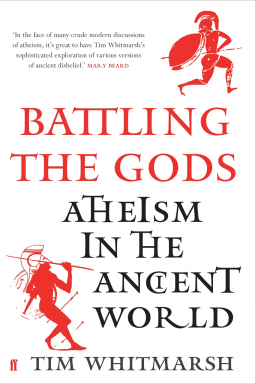
Continue reading “Review: ‘Battling the Gods: Atheism in the Ancient World’ by Tim Whitmarsh”

Blurb
Witches Protection Program is filled with adventure & suspense Michael Phillip Cash creates a tongue-in-cheek alternate reality where witches cast spells and wreak havoc in modern day New York City.
Michael Phillip Cash is an award winning and best selling author of horror, paranormal, and science fiction novels. Michael currently resides on Long Island with his wife and children.
My Review
Firstly, the plot; it has a great deal of potential and could be extended from this novella in to a full novel or even a series. I was disappointed with certain aspects – such as the explanation for Bernadette’s great conspiracy, and the reason Wes lost his original position. They just weren’t ambitious enough. If that was all I wouldn’t be too bothered but the insistent and weakly developed romantic plot irritated me.
Secondly the writing: not bad, although tension would drop in all the wrong places.
Characters: All the men are heroes of one sort or another, and all the women are horrible (either physically or psychologically) or weak. Returning to Bernadette, all her actions are predicated on the assumption that the romantic rejection by her sister’s husband would make her hate all men and want to lock them up in internment camps. Or Scarlett, who’s jealousy of Morgan should somehow drive her mad with power lust. It all tickled at something, and then I realised what it was. Straw-feminist arguments advanced by misogynists include ‘feminists hate men’, ‘women hate each other’, and ‘women compete for male attention’; I’m sure the author isn’t a misogynist, but his book read like an MRA fantasy, complete with the handsome white man coming in to save the day and get the, equally white, younger, pretty girl.
I really hope that is the ‘tongue-in-cheek’ aspect of the book.
Overall, I was underwhelmed by this book, although the idea itself has a lot of potential.
2/5
The Most Anticipated Science Fiction and Fantasy Books of 2016 – http://wp.me/p4llEQ-19d

Blood Oil
Tyrants, Violence, and the Rules That Run the World
Leif Wenar
Publisher: Oxford University Press
ISBN: 9780190262921
Publication Date: 1st January 2016
Good morning and happy new year.
It’s that time of year again when people make all sorts of resolutions to change their behaviour, usually in some superficial way, for the coming year. As usual, I am refusing to play along. It’s still winter(and will be for another few months), I’m in hibernation mode, so instead of making resolutions I’m reflecting on the past year and considering what I’ve learnt.
This year has been a struggle with my mental health conditions and with financial instability. I think I’ve come to the new year slightly stronger than I was a year ago. I can deal with household crises if I have a bit of back up when I have to deal with companies (thanks Elaine and Dad), and I can make my money stretch to cover the odd treat as well as the bills. I’m still struggling with social interaction. Parties and crowds overwhelm me, too much noise feels like it’s worming it’s way in to my head. I have coping strategies now though and I can apply them. I just have to remember to. I’m remembering to eat regularly and take my medication, most of the time, and I try to not go too many days without leaving the house.
I’ve learnt that there are certain things I need to do to maintain my mental health, boundaries I need to maintain and thoughts I have to question. Just because my mind is telling me my friends are ignoring me and that I’ve been abandoned, (In have massive problems with feeling abandoned by people and always have – there is nothing rational about this) that doesn’t make it real. Just because my brain is telling me I’m an inconvenience to everyone, that doesn’t make it true. I need to express how I feel rather than bottling it up and then exploding with irrational rage. Saying ‘you hurt me when you do/say/etc. this’ is not more trouble than it’s worth. People aren’t going to stop loving me because I’m being honest (and most of them are used to my randomness anyway).
I’ve learnt that I can survive pretty much anything, because I have gone through a lot in the last few years and yet, despite coming close on occasion, I am still alive. I have a job and friends, a supportive family and my meds. This year will be better than last, I’m determined that it will.
Happy New Year
Rose
xXx
Hello,
I’ve been quiet, haven’t I? I haven’t forgotten you, and I’m busy working my way through a variety of books so I can review them for you, but I have been very ill. This cold isn’t giving up easily and I’ve had to spend three days in bed. I’ve also had a household appliance crisis. My fridge freezer died on Christmas Day; the funeral is this afternoon, just as soon as the replacement gets delivered. I’ve been using the freezer as a refrigerator, my kitchen is colder than the fridge. I’m getting quite worried about the cheese.Continue reading “Happy New Year’s Eve”
To all my readers, Seasons Greetings, whatever you celebrate.
I’ve only been away overnight but it’s nice to be home, snuggling with my doggies. I had a lovely couple of days in Harrogate with my friends. Continue reading “Home at last”
I’ve got the house decorated.

My cardboard Yule tree, bought from The woodland Trust five or six years ago.

Ezzie approves of the decoration and the new electric fire
[Alter pictures to come next week]
I usually wait until the 21st; I had planned to go shopping this afternoon but my stomach problems are giving me trouble so I stayed home and decorated. I’m also busy this weekend, and not free until Wednesday, so today is a good a day as any.
 Everything Is Better With Dragons