Book Blitz: A Painter in Penang, by Clare Flynn @clarefly @lovebooksgroup #lovebookstours

Sixteen-year-old Jasmine Barrington hates everything about living in Kenya and longs to return to the island of Penang in British colonial Malaya where she was born. Expulsion from her Nairobi convent school offers a welcome escape – the chance to stay with her parents’ friends, Mary and Reggie Hyde-Underwood on their Penang rubber estate.

But this is 1948 and communist insurgents are embarking on a reign of terror in what becomes the Malayan Emergency. Jasmine unearths a shocking secret as her own life is put in danger. Throughout the turmoil, her one constant is her passion for painting.

From the international best-selling and award-winning author of The Pearl of Penang, this is a dramatic coming of age story, set against the backdrop of a tropical paradise torn apart by civil war.

Buy Link  https://amzn.to/3iyTFYD

Author Bio

Historical novelist Clare Flynn is a former global marketing director and business owner. She now lives in Eastbourne on the south coast of England and most of her time these days is spent writing her novels – when she’s not gazing out of her windows at the sea.

Clare is the author of eleven novels and a short story collection. Her books deal with displacement – her characters are wrenched away from their comfortable existences and forced to face new challenges – often in outposts of an empire which largely disappeared after WW2.

Her latest novel, Prisoner From Penang, was published on 17th April 2020. It is set in South East Asia during the Japanese occupation in World War Two.

Clare’s novels often feature places she knows well and she does extensive research to build the period and geographic flavour of her books. A Greater World – 1920s Australia; Kurinji Flowers – pre-Independence India; Letters from a Patchwork Quilt – nineteenth century industrial England and the USA; The Green Ribbons – the turn of the nineteenth and twentieth century in rural England, The Chalky Sea – World War II England (and Canada) and its sequels The Alien Corn and The Frozen River – post WW2 Canada. She has also published a collection of short stories – both historical and contemporary, A Fine Pair of Shoes and Other Stories.

Fluent in Italian, she loves spending time in Italy. In her spare time she likes to quilt, paint and travel as often and as widely as possible. She is an active member of the Historical Novel Society, the Romantic Novelists Association, The Society of Authors, NINC and the Alliance of Independent Authors.

Get a free copy of Clare’s exclusive short story collection, A Fine Pair of Shoes, at www.clareflynn.co.uk.

Cover Reveal: Running Wolf by Helen Steadman

When a Prussian smuggler is imprisoned in Morpeth Gaol in the winter of 1703, why does Queen Anne’s powerful right-hand man, The Earl of Nottingham, take such a keen interest?

At the end of the turbulent 17th century, the ties that bind men are fraying, turning neighbour against neighbour, friend against friend and brother against brother. Beneath a seething layer of religious intolerance, community suspicion and political intrigue, The Running Wolf takes us deep into the heart of rebel country in the run-up to the 1715 Jacobite uprising.

Hermann Mohll is a master sword maker from Solingen in Prussia who risks his life by breaking his guild oaths and settling in England. While trying to save his family and neighbours from poverty, he is caught smuggling swords and finds himself in Morpeth Gaol facing charges of High Treason.

Determined to hold his tongue and his nerve, Mohll finds himself at the mercy of the corrupt keeper, Robert Tipstaff. The keeper fancies he can persuade the truth out of Mohll and make him face the ultimate justice: hanging, drawing and quartering. But in this tangled web of secrets and lies, just who is telling the truth?

Continue reading “Cover Reveal: Running Wolf by Helen Steadman”

Review: In Black and White, by Alexandra Wilson

Alexandra Wilson was a teenager when her dear family friend Ayo was stabbed on his way home from football. Ayo’s death changed Alexandra. His death compelled her to enter the legal profession to search for answers.
As a junior criminal and family law barrister she finds herself navigating a world and a set of rules designed by a privileged few. A world in which barristers sigh with relief at the retirement of a racist judge: ‘I’ve got a black kid today and he would have had no hope.’

In her debut book In Black and White, Alexandra beautifully re-creates the tense court room scenes, the heart-breaking meetings with teenage clients and the moments of frustration and triumph that make up a young barrister’s life.

Alexandra speaks with raw honesty about her experience as a mixed-race woman from a non-traditional background in a profession that is sorely lacking in diverse representation. A justice system in which a disproportionately large number of black and mixed-race people are charged, convicted and sent to prison.

She shows us how it feels to defend someone who hates the colour of your skin or someone you suspect is guilty, and the heart-breaking youth justice cases she has worked on. We see what it’s like for the teenagers coerced into county line drug deals and the damage that can be caused when we criminalise teenagers.

Her account of what she has witnessed as a young mixed-race barrister is in equal parts shocking, compelling, confounding and powerful. Alexandra’s story is unique in a profession still dominated by a section of society with little first-hand experience of the devastating impact of violent crime.

Endeavour • 13th August 2020
£16.99 • Hardback

Continue reading “Review: In Black and White, by Alexandra Wilson”

Review: The Story of Babushka, by Catherine Flores

Synopsis:

A beautifully illustrated book, with a magnificent story that children and tweens will love.

Babushka wants to find out the meaning of life so she sends her bodies out of the forest and into the world to search for answers. 

Continue reading “Review: The Story of Babushka, by Catherine Flores”

Trying to process why I write autistic characters and what I would like to know

I have occasionally joked that I learnt to be human by reading fantasy. What I mean by this is that fantasy explores so many different possible situations, so many different characters, that I was able to learn about human behaviour and psychology. I sometimes even learnt the appropriate responses to situations and why typical people do things that seem nonsensical to me.

Actually, most of the stuff they do is still nonsensical but I try to be tolerant. I’m probably more tolerant of the typical need to make small talk than most people are of my need to not make small talk, for example.

I write autistic main characters most of the time, it is sometimes deliberate, sometimes not. For me it helps to have a character that is trying to navigate a situation and to put myself in their place. I struggle to visualise things so I have to embody that situation instead. I can’t know how the character will react until I put myself there. I can usually work out how the other characters will react though, based on past experiences or reading, e.g. MC gets into an argument because the other person is in the wrong, other person either admits or gets defensive, MC will get upset and other characters will chide them for bringing up something that people don’t want to talk about. Creates conflict.

Or the end of the world is coming, Autistic MC has a sensible, logical plan, everyone else is panicking, how would they react? Baring in mind, my sisters and I regularly plan out what we’d do in even of a zombie apocalypse, and I have seriously considered preparing a go bag and clearing out the cupboard under the stairs to use as an emergency shelter, this is something I can ’embody’ fairly easily.

I have written accidentally autistic characters, who react and process their lives in an unconsciously autistic way and I have also written deliberately autistic characters. The difference is, when it’s deliberate there’s a purpose behind. In my Lucie Burns stories (especially my unfinished Dissertation piece) the purpose was to show a realistic autistic woman as a police officers, in opposition to the less than realistic and sometimes actively harmful depictions of autistic women in books and film/TV.

I’m currently working on a story for my writing group about a forensic psychologist who is autistic and helping to investigate a series of child murders (I go through phases of loving crime fiction and wanting to write crime all the time); I don’t have a defined purpose in this story, I just want to show an autistic person in a situation people might think unlikely – I don’t think people realise we make decent psychologists, teachers, social workers, etc. because they’re ‘people’ jobs and we don’t like people/have no empathy/all that nonsense. Also, I wanted to. I sounded like fun when I first planned the story out. I might even have my two autistic investigators meet in a future story, just for the hell of it. I expect their colleagues would all be ‘oh you’ll like (character), she’s autistic too’ and they don’t hit it off at all. Because we’re all human and different.

I do think representation is important, especially Own Voices representation, because for too long other people, typical people looking from the outside in, have defined us, defined our narrative and told the world they’re the experts. No, we are.

Anyway, I read a bit of fiction written by other autistic writers who also have autistic main characters, and I find it helpful, because other writer present other perspectives. I want to know if it’s deliberate, or their default character writing, I want to know their purpose, and reasoning. Is it hard to write about the difficult parts of being autistic, is it hard to write typical characters. I find my typical characters can be a bit flat, while my autistic characters tend to be more rounded. I actively have to try not to make older male typical characters bigoted boorish drunks, for example. Can’t imagine why…

I want to know about the writing process. I write almost a script first then have to go back and fill in the details, like body language and descriptions. Writing is an active process. I might get flashes of a scene in my brain but then I have to embody it to move beyond that. How do other autistic people work, especially if they have aphantasia?

I never know what my characters look like beyond an outline, and I actively have to pin things down as I write the story. I have face recognition problems if I haven’t seen people often or if I have haven’t seen them in a long time – especially with children. Do other writers have this problem, or do they know write from the start what their characters look like and will do?

How do they cope with characters of different backgrounds? I actively stick to white AFAB main characters, because I can’t begin to know what it’s like to be anything other than that. I have a limited ‘pool’ of friends and where I’m from isn’t diverse, so except for my BFF who is half-Egyptian and who has talked about what that means, and obviously I’ve observed, since we’ve been friends for 25 years, I don’t have much reference material. I don’t think it would be right for me to write a character from a different background if I couldn’t get a really detailed understanding of what it’s like to be someone who isn’t a white, working class AFAB person. I have an intellectual understanding of people’s experiences with discrimination and different cultural backgrounds but not the visceral understanding. I need to visceral understanding to embody a character. Is that just me, am I limited in my ability to ‘put myself in others’ shoes’ or is it a common thing?

Do autistic people, as readers and writers, use fiction to form their identity, as part of autistic culture or as a human in general? How does fiction help with this identity formation?

There’s so many questions, and I don’t know how to get the answers. I want to do a PhD on autistic writers and their autistic characters, but I don’t know how to phrase what I want to study, I don’t know where to start with applying for PhDs, either. It’s such a niche area, who would I even talk to?

Luckily, a new ‘neurodiversity and literature’ list serv has been started so I can ask them. If I get my courage up to ask all these academics with scary qualifications and careers.
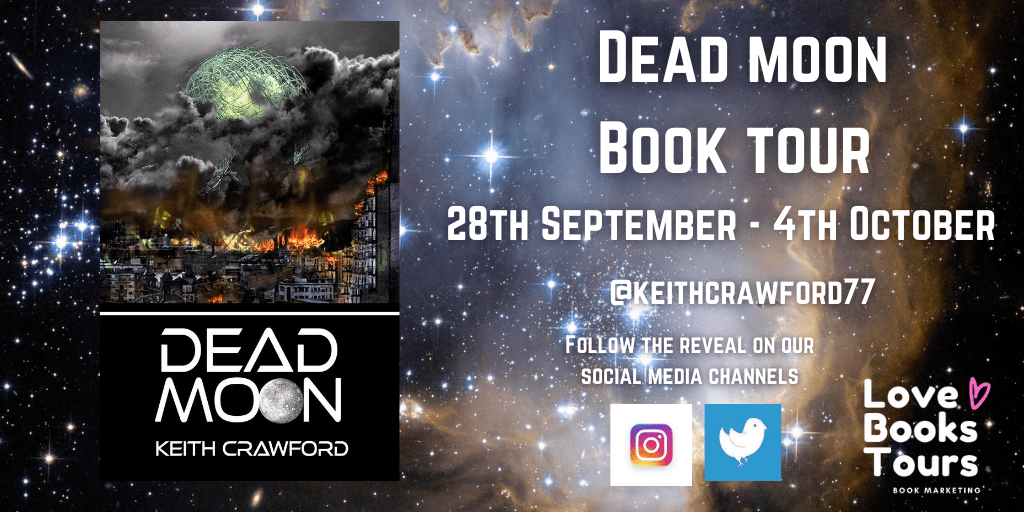
Review: Dead Moon by Keith Crawford


Humanity will be extinguished in less than seven days.

Wing Commander Jude Styles is a Starfighter Pilot trying to get pregnant before the world ends. Her wingman, Hamid Ashkami, just wants to block the spam

messages he is receiving from someone claiming to be his dead ex-husband.

Instead, they are locked in a media tour, shown off as the heroes that stopped the alien invasion by destroying the massive mothership known as the “Dead Moon”, persuading the masses that all will be fine if they keep calm and carry on.

Trapped telling the same lies, driven over the edge by post-traumatic stress and the constant flow of alcohol, it is only a matter of time before Jude and Hamid break down – and the fragments of the Dead Moon have already begun to fall from the sky.

Yes, I’m first on the tour. Thanks for that Kelly. And thanks to the author for a copy of this book.

Continue reading “Review: Dead Moon by Keith Crawford”

Audiobook Review: Heaven’s River, by Dennis E. Taylor, narrated by Ray Porter

Heaven's River: Bobiverse, Book 4

Civil war looms in the Bobiverse in this brand-new, epic-length adventure by Audible number-one best seller Dennis E. Taylor.

More than a hundred years ago, Bender set out for the stars and was never heard from again. There has been no trace of him despite numerous searches by his clone-mates. Now Bob is determined to organize an expedition to learn Bender’s fate – whatever the cost. 

But nothing is ever simple in the Bobiverse. Bob’s descendants are out to the 24th generation now, and replicative drift has produced individuals who can barely be considered Bobs anymore. Some of them oppose Bob’s plan; others have plans of their own. The out-of-control moots are the least of the Bobiverse’s problems.

Undaunted, Bob and his allies follow Bender’s trail. But what they discover out in deep space is so unexpected and so complex that it could either save the universe – or pose an existential threat the likes of which the Bobiverse has never faced.

Listening Length16 hours and 57 minutes
AuthorDennis E. Taylor
NarratorRay Porter
Audible.co.uk Release Date24 September 2020
PublisherAudible Originals
Program TypeAudiobook
VersionOriginal recording
LanguageEnglish
ASINB088C4N9R8

My Review

I have been looking forward to this book ever since I heard that it was being released. I have listened to the first three books multiple times and really wanted to know what happened next.

Set some decades after Bob left Earth, he’s looking for Bender. A trail leads him to a star system with a missing planet and a large structure floating in space. Bender’s ship is there but Bender’s cube is missing. Bob gets together a team to infiltrate the structure and find Bender. The team is Bob, Bill, Garfield and Bridget, with Will as back-up and a group of Bobs lead by Hugh of the Skippys and Gandalf of the Gamers.

The Skippys and the Gamers are just two of the groups that the Bobiverse has developed. The Skippys want to develop a true A.I. and the Gamers just want to go on DnD campaigns, but they’re all really good with computers. Another group, Starfleet, have different interests – they want the Bobs to cease contact with all biological beings – humans and Pav at the moment but any other species they come across.

When the Bobs find the Quinlans living in the construct – Heaven’s River – Starfleet demand that the Bobs keep out of it. The humans are up in arms about something or other, because they always are, and Will is getting sick of it. Bob decides Starfleet can get knotted, and the Bobiverse goes to war while Bob and the expedition are in Heaven’s River.

But things are not what they seem and friends are not always who you think they are.

I enjoyed the development of the story from the third novel. I thought the description of Heaven’s River was very good. The society and culture of the Quinlans is well developed and Bob’s adventure through Heaven’s River as he searches for Bender was definitely my favourite part. I actually thought the ‘Administrator’ was Bender, but then the timing meant it couldn’t have been. Then I thought it must be one of the other probes, until I realised they’d all bee accounted for.

When Bob and Bridget visit Quin to test out the Quin-Mannies, it becomes obvious that the species must have created something themselves and then forgotten. I enjoyed the way the different characters Bob meets on his journey argue with each other and the world’s history and culture further develops from the discussions.

I enjoyed the way the Bobiverse had developed and the difference time had made to both Pav and Human society.

The war was a bit of a let down compared to the war with the Others, and I didn’t think the subplot of the exodus was fully developed. Maybe that’ll be for book five?

Promo Post: Tipping Point, by Michelle Cook

Tipping Point

A tale of loss, manipulation, and the search for the truth

What would you risk to turn back the tide?


Essie Glass might have been a typical eighteen-year-old – had life not dealt her an early blow.
Struggling to come to terms with the loss of her family in a terrorist attack, and left with nothing, Essie’s not kidding herself about her world. She wants change, and she’ll be honest about it, whatever the cost. From behind her keyboard, that is…

After all, this is England, 2035. Earth’s climate continues its accelerating collapse. A powerful elite controls the disaster-weary population with propaganda, intimidation, and constant surveillance.

By all appearances, Alex Langford is a respected local businessman – until Essie discovers that he’s a murderous conspirator who’d see the planet die for his fortune.

When their paths collide, Essie must decide: how much is she really willing to pay for her honesty?

Her choices, and the events she sets in motion, pit her against both enemies and supposed friends as she risks more than just her life to thwart them.

Will she succeed in revealing the truth? And will she survive?

Purchase Link  – http://mybook.to/tippingpoint

Author Bio

Michelle lives in Worcestershire, UK, with her husband Daniel, their two young children, and a cat called Lyra Belacqua. By day, she works for the NHS, a job which she has almost as much passion for as fiction.

Her first joyful steps into creative writing were at the age of ten, when the teacher read out her short story in class. A slapstick tale of two talking kangaroos breaking out of a zoo, the work was sadly lost to history. Still, Michelle never forgot the buzz of others enjoying her words.

More recently, she has had several flash pieces published, was long-listed for the Cambridge 2020 prize for flash fiction, and placed first in the February 2020 Writers’ Forum competition with her short story The Truth About Cherry House. Tipping Point is her debut novel.

Social Media Links –

https://linktr.ee/michellecookwriter