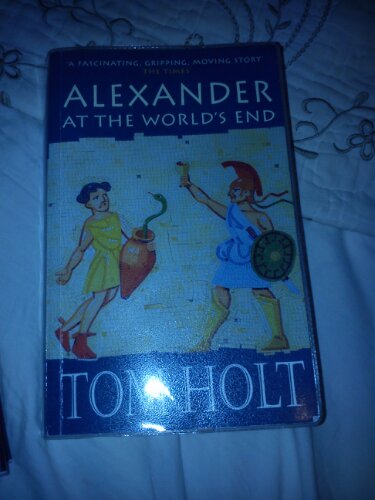
Review: ‘Alexander At The World’s End’ by Tom Holt

image

Abacus 2000
This edition printed 2011

Originally published by Little, Brown and Company, 1999

This is one of the books I got from the library a couple if weeks ago. I’ve read a few of Tom Holt’s comic fantasy novels but I hadn’t known he’d also written historical novels. It was a pleasant surprise.

‘Alexander At The World’s End’ tells the tale of Euxenus son of Eutychides, who started life in Athens and ended up as governor if Alexandria-at-the-End-of-the-World, in Sogdiana (otherwise known as Iskander, 50 miles NE of Tashkent). When he was a youth his father arranged for him to be apprenticed to a philosopher so that he could learn a trade. Unfortunately he choose Diogenes, the Yapping Dog, the Cynic, the man who told Alexander the Great to get out of his light.

Under Diogenes’s tutelage Euxenus learnt Yapping Dog philosophy, and politics. He made a good living at it in Athens, the the assistance of an invisible snake in a jar. Unfortunately Phillip of Macedon is making a nuisance of himself, and Euxenus is one of the lucky, lucky ambassadors sent to Pella to discuss the matter. It went badly.

But not for Euxenus, who managed to make the acquaintence of young Prince Alexander while rounding up bees, gain Queen Olympias’s favour (her snake obsession came in handy for a change) and get a job tutoring the Prince and his Companions.

Completely ill equiped for such a position, Euxenus throws himself into his work with all his usual dedication until Philip decides to send Euxenus and a couple of thousand Illyrian mercenaries he no longer needs off to Olbia on the Black Sea to found a colony.

After many years and assorted adventures Euxenus returns to Athens and settles down on the old family farm. Time passes, Euxenus becoming the good farmer his family always assumed he’d never manage to be, until his once pupil, now king of the known world, sends a couple of soldiers for him.

Alexander needs a governor for his newest city, in Sogdiana, so Euxenus must once more go travelling, this time across Asia, because when Alexander wants something, Alexander gets. In his new home Euxenus once again tries to build the Perfect Society and write his History, which is very difficult for a man constantly looking the wrong way when important events are taking place.

Funny yet poignant, this novel explores the difference between who we really are, who we believe ourselves to be and how the world sees us. It’s really quite sadly beautiful. It’s also a grand history lesson and philosophy primer. Written with the deft touch of a great storyteller, gripping from first to last and full of detail, I would heartily recommend this novel.

Rose

New books from the library

I went for a trip to the library today, to take back a book and came home with three more.

image

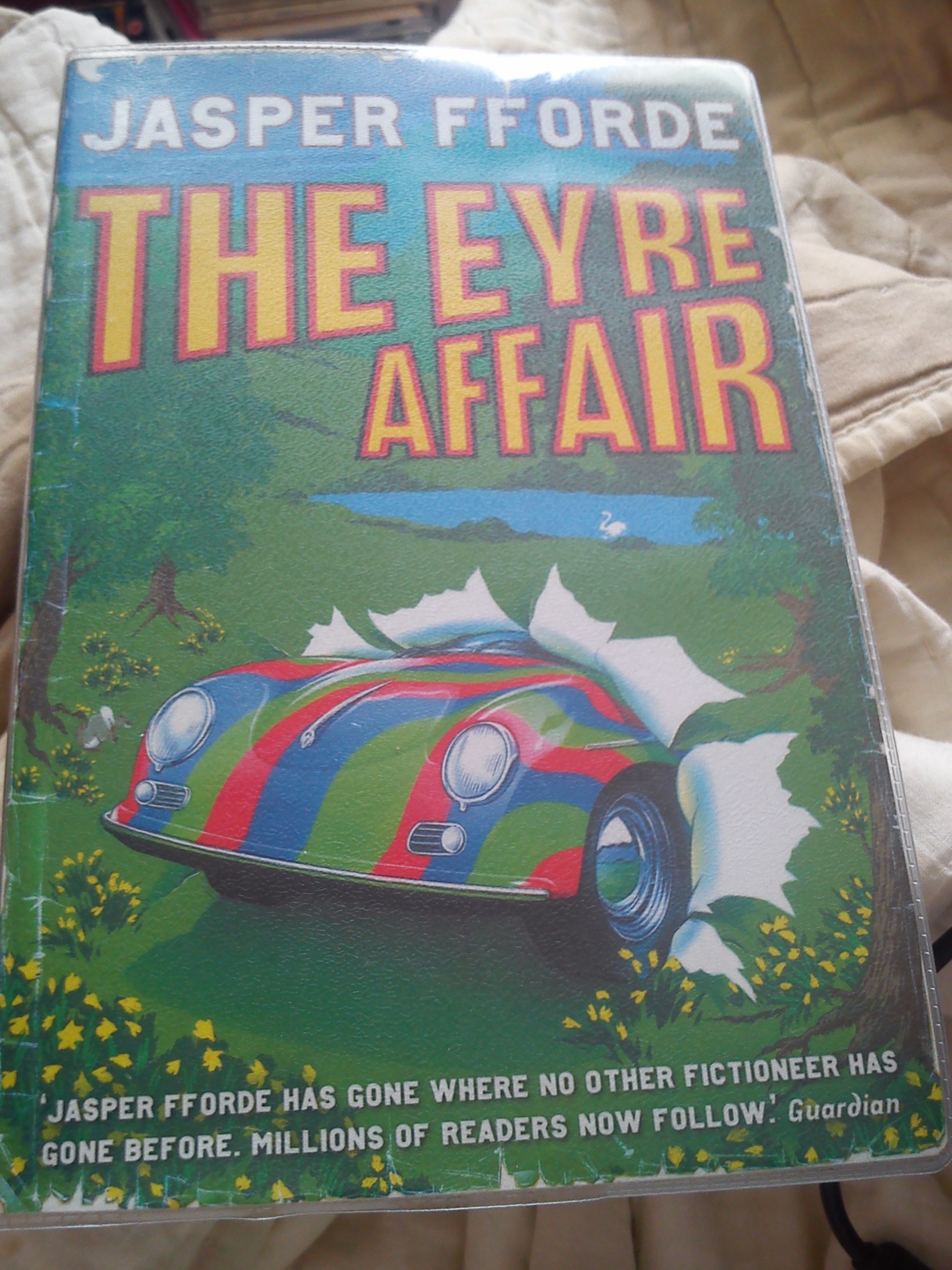
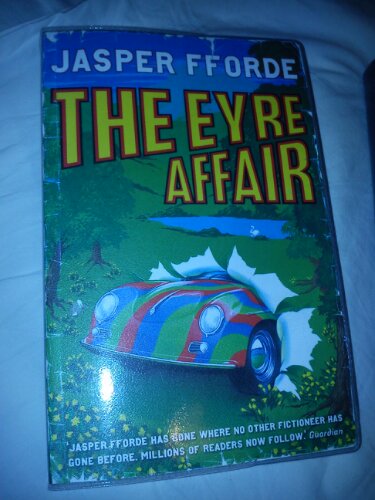
I’ve read a few Jasper Fforde books, so I thought I’d give this one a go. It features a recurring character Thursday Next.

image

It’s been a while since I read any classic horror and one of the librarians brought this book to my attention.

image

I love Tom Holt’s comic fantasy, this is the first historical fiction novel of his I’ve read though. I’m a decent way into it already and it’s very enjoyable do far.

Expect reviews sometime in the next few weeks.

Got to go to the day job tomorrow, so I shall disappear for a few days. Bye,

Rose

Review: ‘The Science of Discworld IV Judgement Day’ by Terry Pratchett, Ian Stewart & Jack Cohen

Ebury Press
2013

image

I had plans for this afternoon, then I thought ‘I’ll just read a bit, I need to finish it before Thursday’; the afternoon disappeared. If that’s not the best compliment to a book I don’t know a greater one.

This is the forth installment of the ‘Science of Discworld’ books, the first was published in 1999 and as the authors point out things have changed in the last 14 years.

Theories have been tested in new ways and been modified as new information had been made available. And that is the central argument of this book. Science is uncertain and ever questioning. Faith does not question, it merely ignores data that doesn’t fit.

Interweaving this discussion with a short story about Roundworld, the pretty bauble accidentally made when the Wizards of Unseen University made a booboo in the first Science of Discworld book, the authors illustrate their arguments using the best method possible when trying to explain concepts to Pan narrans : storytelling.

A radically fundamental sect of the Church of Om demands that the wizard hand over Roundworld. The Patrician decides to hold a tribunal into the matter. Into this milieu comes Margery Daw, librarian of Four Farthings, London, England, Earth. Highly educated and intelligent, with a firm belief in truth, and also the best runner at Roedean in her day, Margery has been transported to Discworld by the Unseen University’s Great Big Thing. Purely accidentally.
Continue reading “Review: ‘The Science of Discworld IV Judgement Day’ by Terry Pratchett, Ian Stewart & Jack Cohen”

Review of several e-books

I had a bit of a foray in to Amazon the other day and found several free e-books (thanks to the freebie page at  http://www.everythingbooksandauthors.com) and read them quite quickly. Most were short stories but one,‘Georgiana Darcy’s Diary’, is probably more of a novella. Since I took the time to read to them I thought I should probably review them.

Georgiana Darcy’s diary: Jane Austen’s Pride and Prejudice Continued

Anna Elliott, with illustrations by Laura Masselos

2011

Wilton Press

It’s 1814 and the war with Napoleon is coming to an end, Elizabeth and Darcy have been married a year, Georgiana is 18 years old and still living at Pemberley with them, and their Aunt De Bourgh has organised a house party. She’s trying to marry Georgiana off too some suitable gentleman.

Georgiana feels the need to start writing a diary again, and starts writing about her life. Sick of the fawning fortune hunters, Georgiana is in love with her cousin Colonel Fitzwilliam. Unfortunately rumour tells her he is engaged to someone else, and when he returns to Pemberley to recover from a wound taken at Toulouse she is determined not to give in to her feelings.

‘It is a truth universally acknowledged that a young lady of rank and property will have packs of money- or land-hungry suitors yapping around her heels like hounds after a fox.

In the interests of not giving the whole plot away, all I’ll say is the denouement of the storyline is fairly obvious. I mostly liked the story but was slightly unsatisfied by it. I would be interested to read the other two books in this Pride and Prejudice Chronicles, Pemberley to Waterloo, and Kitty Bennet’s Diary.

3/5


Cait the Cat Burglar (55 Portobello Road)

Christine London

2013


Cait is a waitress, stranded in London as she tries to earn money to send home to her sick mother and sister in America. Bribed and threatened in to becoming a thief by the sinister Rothwell, Cait tries to steal the work of an Australian musician. The first time she fails miserably. There were croquet hoops involved.

At work the next day her target comes in for a meal and Cait finds herself questioning her resolve.


This short story is entertaining, although I found it a little too soppy for my taste and too much ‘fairy-tale ending’. I’m not sure I’d bother to read the series of books that this short story is a part of.

2/5


How to talk to girls at parties, A short story

Neil Gaiman

2006

Headline

Originally published 2006 and republished as an e-book 2013 with an exclusive first chapter from Neil Gaiman’s new book, ‘The ocean at the end of the lane’, due out mid-June. Vic and Enn are going to a party Vic heard about from his friend Alison, unfortunately they end up at entirely wrong party with interesting consequences. It’s a fun little story, but then I like Neil Gaiman’s work, having read a couple of his books. He’s a truly original writer.

4/5


A Little Bit of Everything for Dummies 20th Anniversary Edition

John Wiley & Sons, Inc

2011

This book is exactly what it says on the cover, a sample of their published work since the first …For Dummies book in 1991. Covering everything from Windows 7 to Puppies to Sex, this book is an interesting one to flip through.

3/5


And that’s the lot for now.

Bye,

Rose



Review: ‘Etiquette & Espionage’ by Gail Carriger

image

Finishing School Book the First
2013
Atom

Fourteen years old and not at all ladylike, thats Sophronia Angelina Temminnick. She’s the youngest of the Temminnick girls and a terrible bother to her mother. After an incident involving a dumb waiter and a trifle, Sophronia is packed off to finishing school.

But Madam Geraldine’s Finishing Academy for Young Ladies of Quality is not quite what she expects. After an eventful journey she arrives to find a werewolf waiting and no obvious way aboard.

Making several new friends and learning to be ladylike, Sophronia becomes embroiled in a plot which sees her clambering around engine rooms, confronting thieves and setting fire to her mother’s gazebo. She also learns how to curtsey properly and to dance.

Set several decades before the author’s previous series, ‘The Alexia Tarrabotti Series’ and featuring characters from that series as children, this book is an admirable addition to her body of work and suitable for YA readers. The characters are interesting, well-rounded and develop as the novel progresses. The plot is engaging and mystery elements intriguing.

I enjoyed Gail Carriger’s earlier books and would recommend this new series. Now I just need to get the next book in the series.

Bye

Rose

Review: ‘Irenicon’ by Aiden Harte

Irenicon

The Wave Trilogy Book 1

Aiden Harte

2012

Jo Fletcher Books

Sofia Scaligeri is Contessa of Rasenna, or she will be when she turns seventeen. If she lives that long. Her inheritance, the once great city of Rasenna, is divided. It is divided by jealousy, petty rivalries and old vendettas. It is also divided by the Irenicon, an unnatural river blasted through the city when the Engineers of the Concordian Empire sent the Wave to pacify the fractious city. Divided and weak, the people of Rasenna have retreated to their towers, leaving only to send raids into enemy streets.

When a young Concordian Engineer is sent to Rasenna to bridge the Irenicon the locals are suspicious, and the habitual violence blossoms into the opening stages of a civil war.  Opposing Towers circle each other, probing for weaknesses and delaying the bridges construction.

But the bridge must be built or the city will be destroyed once and for all when the Twelfth Legion arrives at the end of summer. Somehow Sofia, Giovanni the Engineer, and the Small People of Rasenna must find a way to unite the city before that happens. They are hampered by the suspicion and violence that inhabits the hearts of their people. They must have Faith in a world of Reason in order to succeed. Victory has it’s price and they will all have to pay it; Rasenna, and all of Etruria will have to change. But everyone has their secrets and not even love might be able to save them.

It took me a while to get in to this book, but once I got past the first dozen or so pages and managed to make sense of what was going on I couldn’t put it down. Sofia’s story of self discovery and personal evolution – from thug being given orders by her guardian to self-aware leader, and Rasenna’s concurrent transformation from divided, poor, violence ravaged, once-great city into a peaceful, wealthy and united community, is an interesting study in politics. There’s something of the polemic to this novel – we can only make things better if we build bridges and end violence; but ignore that if you want and enjoy the story. The characters are well written and sympathetic; their growth as characters explained sensibly, and the story line is good. A mix of historical adventure and fantasy, and an AU reworking of the Middle Ages where Rome was defeated by another Empire and Jesus died during Herod’s Massacre of the Innocents leaving the distraught Mary to pass on the message, and the water has it’s own consciousness.  This novel entertains and provokes thought. 3/5

The next part ‘The Warring States: Book 2 of the Wave trilogy’ is out this month; the library is ordering it for me. I’ll let you knoiw what I think.

Review: Ben Aaronovitch ‘Whispers Under Ground’

Review: Ben Aaronovitch ‘Whispers Under Ground’
2012
Gollancz

Ben Aaronovitch returns with his third DC Peter Grant novel. And what a return! It’s much more enjoyable than the second novel in the series, ‘Moon Over Soho’, although you really do have to read all three to pick up some of the long running story lines. The novel is narrated, as always, by DC Grant as he attempts to solve the murder of an American senator’s son, in London studying art and living with a half-fae with an inability to tell the truth when asked a direct question. Obviously there’s something a bit weird about the murder – like how on earth the deceased got where he did – so the Folly is called in to help the Murder Squad investigate. More precisely, DC Grant and PC Lesley May (unofficially officially).

It starts with a body on the underground, Baker Street appropriately enough, just before Christmas. It ends with an arrest just after Christmas. In between there is magic, sewer luge, rivers holding illegal raves, geek humour, an underground pig-powered pottery works, and a perplexed FBI agent. This is a very enjoyable book; a mix of the ever popular murder mystery, police procedural and supernatural mystery genres. It’s done exceedingly well; the story moves forward at a good pace, the characters are well rounded and realistic, and the dénouement is suitably surprising/sensible. There’s no deus ex machine here, despite the fact that two of the investigation officers are trainee wizards and one of the suspects is only slightly human.

Five out of five from me

Rose

Review: ‘Who Needs Mr Darcy?’

Jean Burnett

2012

Sphere (Little Brown Book Group)

Opening at Pemberley in September 1815 and concluding aboard a ship to Brazil in 1818, this novel follows ‘The adventures and exploits of the bad Miss Bennet’. Lydia Wickham, married three years and widowed at Waterloo, when her husband had the decency to die in battle (although not as heroically as Lydia was telling people), is at a loose end. Currently in residence at Pemberley, living as a dependant of her humourless brother-in-law Darcy and her sister Lizzy, Lydia dreams of escape, of London, Paris and Lord Byron, of making her fortune by marriage to a rich man and dancing among the fashionable world at Almack’s. She has become her husband’s mirror image. Darcy wants rid of her, and Lydia is eager to be got rid of, provided she can have an allowance from her relatives and the freedom to do whatever she wants.

By subterfuge Lydia gets her way and travels to London to stay with the impecunious and immoral Selena and Miles Caruthers, friends from her days as an army wife. On the way she is robbed by a handsome highwayman, in London she plays with marked cards and becomes involved with a banker. Travelling to Brighton she meets the Prince Regent, becomes involved in a murder and robbery, and is kidnapped by her highwayman

Eventually Lydia finds her way to the no longer fashionable Bath, as her banker is arrested and she acquires a new admirer. Plans are made for Paris, but first she must go to Pemberley. Here a letter arrives from Longbourne; Kitty, who Lydia has kept informed of all her adventures, has had an attack of conscience and drops Lydia in it up to her neck. Sent away to be a companion to a rich, elderly widow (it was that or the asylum, suitable husbands not being forthcoming) in Bath, Lydia despairs.

Until she hatches a plan and her employer is persuaded to end her retired life and go to the Continent. Lydia is ecstatic and finally gets to see Paris and Venice. But her past catches up with her and she is forced to work for the British Government in a delicate matter.

This Lydia is has learnt no restraint, no humility or respectability. She is as immodest, reckless and ignorant as would be expected from the youngest Bennet girl. She blames all her misfortunes on others and takes no responsibility for her actions. She sees her family as interfering, disapproving and spiteful.

She is not an endearing character at all, and the plot has too much gothic extravagance about it to be very enjoyable, and yet I raced through this novel. More could have been made of the royal intrigue, financial scandal and international politics, which are the main drivers of the plot and which effect Lydia’s fate the most, but the story, like it’s narrator is rather shallow. Leaving Lydia and her criminal beau aboard ship and bound for Brazil clearly leaves the way open for a sequel should the author choose to pen one.

I think this would have been a fun book, in the mould of Regency romances, if the main character had been an original rather than a pale attempt at writing Lydia Bennet. Jean Burnett simply does not write Lydia Bennet as well as Jane Austen drew her two hundred years ago. The character is a flat caricature. It’s enjoyable enough I suppose but I wouldn’t go out and buy it. That’s what the library is for.

And that is all I have to say on the subject.

Bye,

Rose

Review: The City’s Son: Book 1 of the Skyscraper Throne

Tom Pollock

Jo Fletcher Books (Quercus)

2012

I picked this up in the library about two weeks ago and it’s taken me a while to get through it. I think it’s meant to be a YA fantasy, but I had trouble deciding who the target audience were. The main characters were certainly adolescent, but it could as easily be read by adults.

Set in contemporary London the story follows the adventures of teenage graffiti artist Beth Bradley and her best friend and poet of the streets Pen (Parva Khan) as they get drawn into the war between the Urchin Prince, Filius Viae, and Reach, the Crane King.

Switching between the viewpoints of Beth and Filius the story tells of the midnight encounter with a railwraith by Beth and her involvement with Filius, as Pen is fighting her own battles. Betraying her only friend after one particular night of artistic revenge on a bullying teacher, Pen loses Beth to the hidden London. Beth’s father goes in search of her and Pen comes along to help. Unfortunately they are ambushed by Reach’s minion ‘The Wire Mistress’ who takes Pen as her avatar.

Meanwhile Beth and Filius are trying to build an army while waiting for his Mother, the Goddess of the Streets to return and help them; an army of statues, and lamp people, and one homeless Russian. Plus a person made of rubbish.

In fighting the war many battles are won and lost, lives lost and choices made. Sometimes you have to make a deal, and pay the price in the end. But the price of victory might not be worth paying. Beth has to decide as she becomes Filia Viae to Filius’s Filius Viae.

Although it took me a while to read this, I enjoyed it and will probably read the next one. The book feels allegorical; do we allow skyscrapers and things of glass and steel to destroy the life found in old city streets, is it progress or the killing of a place to change it? Renewal or ripping away of life? These are clearly pressing matters to think on and a balance or compromise has to be found, as Beth does. We have decisions to make, will we choose right, strike the right bargains and are we willing to pay the price for our choices?

Bye, for now

Rose