Imprint: FLAME TREE PRESS Fiction: FICTION / Science Fiction / Military Product format: Hardback Price: £20.00; $24.95 ISBN: 978-1-78758-542-3
AD 2118. Humanity has colonised the Moon, Mars, Ceres and Europa. Captain Ellisa Shann commands Khidr, a search and rescue ship with a crew of twenty-five, tasked to assist the vast commercial freighters that supply the different solar system colonies. Shann has no legs and has taken to life in zero-g partly as a result. She is a talented tactician who has a tendency to take too much on her own shoulders. Now, while on a regular six-month patrol through the solar system, Khidr picks up a distress call from the freighter Hercules…
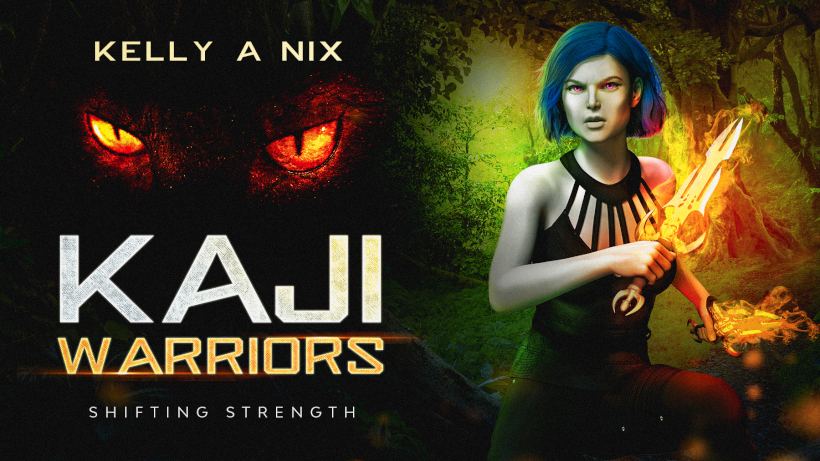
Atae is a hybrid, a Kaji half-breed, living on the capital planet of the Kajian Empire. In a culture dictated by strength and honor, Atae’s father pushes her to prove herself worthy of being Kaji.
At the elite Sula Academy, hybrids like Atae compete alongside the Kaji purebreds, warriors with the ability to transform into savage battle beasts. Atae and her packmates prepare for the Sula Academy Tournament, which will determine their fate within their warrior culture, but a close brush with death threatens Atae’s position in the competition and forces her to confront her weaknesses.
Atae must find the strength to escape a spoiled prince’s wrath, survive her first crush, and help her packmates complete the Tournament, all while keeping the biggest secret of her life from her father. And she must do it without losing her true self in the process.
Hardcover, 176 pages Published January 22nd 2019 by Tor.com (first published May 2nd 2017) ISBN 1250214718 (ISBN13: 9781250214713)
In a corporate-dominated spacefaring future, planetary missions must be approved and supplied by the Company. Exploratory teams are accompanied by Company-supplied security androids, for their own safety.
But in a society where contracts are awarded to the lowest bidder, safety isn’t a primary concern.
On a distant planet, a team of scientists are conducting surface tests, shadowed by their Company-supplied ‘droid — a self-aware SecUnit that has hacked its own governor module, and refers to itself (though never out loud) as “Murderbot.” Scornful of humans, all it really wants is to be left alone long enough to figure out who it is.
But when a neighbouring mission goes dark, it’s up to the scientists and their Murderbot to get to the truth.
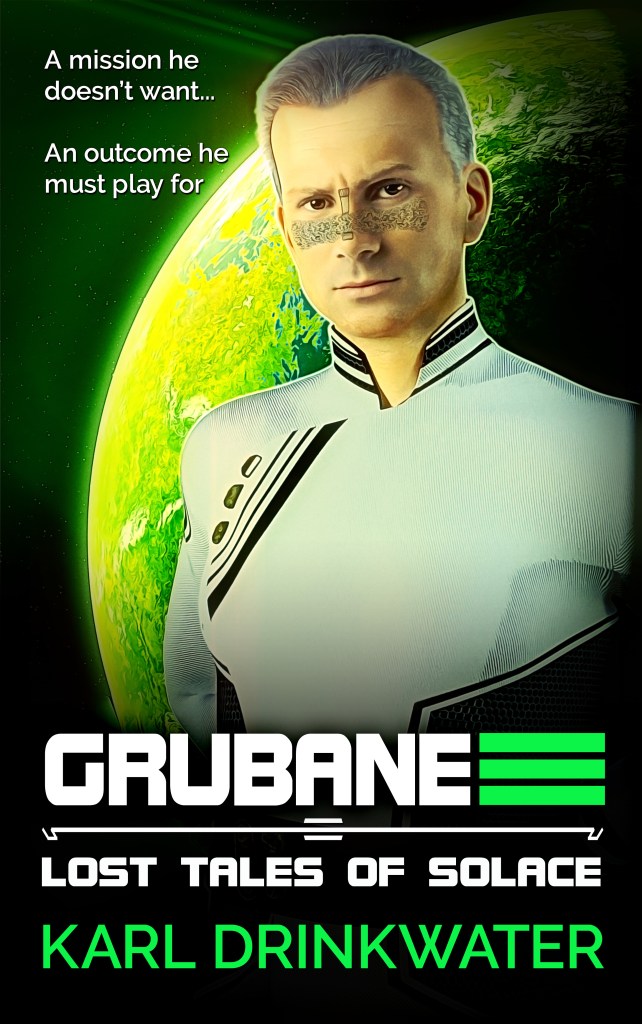
Major Grubane is commander of the Aurikaa, the most feared cruiser in the UFS arsenal.
His crew is handpicked and fiercely loyal. Together, they have never failed a mission, and their reputation precedes them.
But this time he’s been sent to a key planet that is caught up in political tensions at the centre of the freedom debate. What he thought was a simple diplomatic mission turns out to be the hardest choice of his career. His orders: eliminate one million inhabitants of the planet, and ensure their compliance.
Grubane has also rediscovered an ancient game called chess, and plays it against the ship AI as a form of mental training. But maybe it could be more than that as he finds himself asking questions. Can orders be reinterpreted? How many moves ahead is it possible for one man to plan? And how many players are involved in this game?
Caught up in a space station turf war between gangs and corrupt law, a lone asteroid miner decides to take them all down.
When an asteroid miner comes to Station 35 looking to sell her cargo and get back to the solitude she craves, she gets swept up in a three-way standoff with gangs and crooked cops. Faced with either taking sides or cleaning out the Augean Stables, she breaks out the flamethrower.
The Rosie Synopsis
‘Jane’ or ‘the Miner’ desperately needs food and fuel, so she puts in to an asteroid-based space station, Station 35. Here she is ripped off by the ore company, finds three rival gangs in control and at each others’ throats, while the ‘decent’ population, lead by ‘Mr Shine’ hunker down in the lower depths of the station, except bar-owner/chef Takata and Station Master Herrera, who both refuse to be forced out of the galleria. Jane decides she’s going to clean up the Station and hand it back to ‘decent folks’.
Plans don’t exactly go as expected.
Basically, have you seen any of those old westerns, the ones based on Japanese films, like Seven Samurai, reworked as westerns, or Clint Eastwood’s work, like Fistful of Dollars? Think that aesthetic, but in space.
The Good
The novel calls on the traditions and tropes of westerns and on those westerns based on Japanese films, and obviously on the original Japanese work. So, the protagonist isn’t named, or only briefly, there are rival gangs and corrupt law officers, the place is far from anywhere with no help coming. I have seen an interesting collection of movies over the years but even if I haven’t seen the specific films, I know enough and can get the feeling over the originals, that the book’s references and plot points make sense.
An example of this tradition is in the naming of the protagonist. The ‘Miner’ is unnamed, given nicknames and only once is her real name and some clue about her identity revealed. This is going to be familiar to lovers of dodgy 60s Westerns based on Japanese books and films. Clint Eastwood famously play ‘The Man with No Name’ in the Dollars Trilogy. If you get the aesthetic and understand the tradition it stands in, this is marvelous fun. It’s not the first ‘spaghetti western in space’ sci fi novel, but it’s the first I’ve read and I liked it.
The pace is fast and choppy, moving between Jane and a character called Steven, although he doesn’t go by that name initially – he’s known as Screwball. They are nominally on the same, then opposed to each other and finally they’re allies. Jane doesn’t like people, preferring to stay out in space, mining and tending her orchids and bonsai trees on her little ship. Steven is a hired thug, working for Feeney, the original crime boss on Station 35. Over the course of the book Jane discovers she doesn’t actually hate humans as much as she thinks she does, and Steven finds himself questioning his life choices after a series of unexpected and painful events.
Basically, they follow the character arcs expected in the genre. They both play hero and anti-hero roles at different points and they both have similar motives initially – they need money. They both become more self-aware and ‘better people’ due to their experiences although acknowledging that they aren’t heroes.
As you can imagine from the foregoing, I found the characterisation enjoyable and fitting perfectly for the genre of the book.
The origins of the dispute and the background of the Station are mentioned in different places in the narrative, so the reader learns more as the Miner does. There are logical reasons for Station 35 being where it is when she arrives. None of the characters are surplus to requirements and the main characters as fairly well fleshed out.
Herrera’s insults are fabulous.
The Not-So-Good
Not much. I’d have liked to know more about the ‘universe’ and Herrera gets a bit characateurish at times.
The Verdict
I enjoyed reading this book, it’s given me hours of enjoyment over the three days I spent reading it. I was on the edge of my seat a lot of the time.
I treat myself to a book subscription, the SFF Fellowship from Goldsboro Books. Goldilocks, by Laura Lam was the April book. It arrived yesterday. I was a bit distracted by a crochet project yesterday afternoon and this morning, but once I got myself organised, I sat down and read my new book.
The Earth is in environmental collapse. The future of humanity hangs in the balance. But a team of women are preparing to save it. Even if they’ll need to steal a spaceship to do it.
Despite increasing restrictions on the freedoms of women on Earth, Valerie Black is spearheading the first all-female mission to a planet in the Goldilocks Zone, where conditions are just right for human habitation.
The team is humanity’s last hope for survival, and Valerie has gathered the best women for the mission: an ace pilot who is one of the only astronauts ever to have gone to Mars; a brilliant engineer tasked with keeping the ship fully operational; and an experienced doctor to keep the crew alive. And then there’s Naomi Lovelace, Valerie’s surrogate daughter and the ship’s botanist, who has been waiting her whole life for an opportunity to step out of Valerie’s shadow and make a difference.
The problem is that they’re not the authorized crew, even if Valerie was the one to fully plan the voyage. When their mission is stolen from them, they steal the ship bound for the new planet.
But when things start going wrong on board, Naomi begins to suspect that someone is concealing a terrible secret — and realizes time for life on Earth may be running out faster than they feared . . .
My Review
This was a slow burner. Narrated by the main character’s daughter, Iris, in 2063, we learn of events in 2033. A group of women scientists and engineers steal a shuttle to get to Atalanta, a ship they helped design and build but from which they had been booted by a misogynist government.
Led by Dr Valerie Black, CEO of Hawthorn, the company originally tasked with designing the Atalanta and planning the trip, and adoptive mother of main character, Naomi Lovelace, an astrobiologist, Dr Hart (ship’s surgeon), her wife Jakkie Hixson, pilot, and Lebedeva, the engineer, steal a shuttle and then the Atalanta and head for Mars to make the jump to Cavendish, an Earth-like exoplanet, around Epsilon Eridani, now renamed Ran. But things aren’t quite going as expected and when a new infection appears on Earth that kills fast, secrets come to light that make the four subordinates question Dr Valerie Black.
I sat and read this in 6.5 hours, I couldn’t put it down. The slow build of tension as Naomi realises things aren’t quite what they ought to be and she loses her hero-worship of the woman who raised her is the main drive of tension, while the science in the science fiction is enough to keep a science buff interested without bogging down a non-science geek.
Valerie was a really vivid character, who was fully realised, while the others had flashes of life but were often in the background. I have seen other readers say they felt the characters were a bit flat, but I think that it might be deliberate. We are reading from the point of view of Iris Lovelace Kan, the second daughter of Naomi, and Dr Black’s son, Evan Kan; for her the most important people are obviously her mother and grandmother. They loom large in her psyche and so they are more realised in her story. I felt like I was reading a biography written by someone a little too close to the people involved, in that sense, with the characterisation.
The plot is taut and breathtaking, or at least I struggled to remember to breathe while I was reading. I really enjoyed the book, although I’d have liked some more background on how the world got from here to there. It’s hinted at, a gradual erasing of rights, a rise in right-wing ideology, ignored until it smacked people in the face.
We can see this happening already. It’s a warning, but there’s also hope. After the disaster changes were made, and although it wasn’t enough early enough, people survived.
Given it’s VE Day here in the UK and our precious government are using it to whip up nationalist fervour, again, and the dodgy lot they have running her native U.S., I think it’s entirely prescient for Lam to write about changes 13 years from now, where the world is a mess, people still don’t believe climate change is real despite the refugees and wildfires, and rights are eroded for anyone not a rich, white man. The dream of utopia, espoused by Dr Black isn’t an option, nor is running away to another planet. We just have this one, this one chance, to sort things out, to change.
We’re at a turning point. Which way do you want to go?
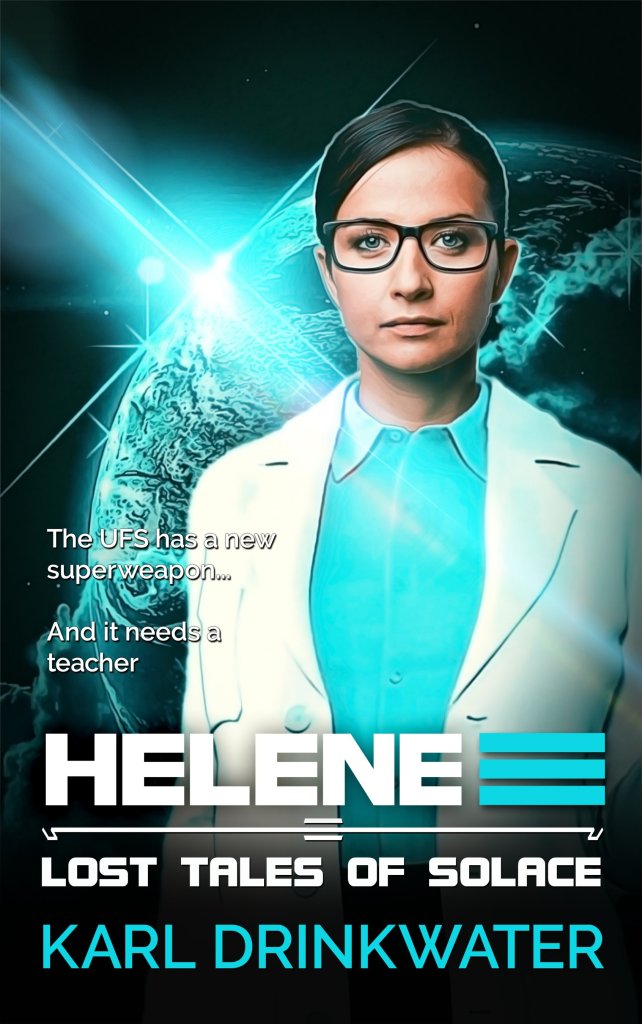
Dr Helene Vermalle is shaping the conscience of a goddess-level AI.
As a leading civilian expert in Emergent AI Socialisation, she has been invited to assist in a secret military project.
Her role? Helping ViraUHX, the most advanced AI in the universe, to pass through four theoretical development stages. But it’s not easy training a mind that surpasses her in raw intellect. And the developing AI is capable of killing her with a single tantrum.
On top of this, she must prove her loyalty to the oppressive government hovering over her shoulder. They want a weapon. She wants to instil an overriding sense of morality.
Can she teach the AI right and wrong without being categorised as disloyal?
Lost Tales of Solace are short side-stories set in the Lost Solace universe.
Paperback Published: 7th July 2019 I.S.B.N.: 978-1-911278-14-6
E-book Published: 15th April 2019 I.S.B.N.: 978-1-911278-13-9
The legendary Lost Ships exist, and they harbour nightmarish horrors. Opal knows. She barely survived her first encounter with one.
Despite escaping, she failed to find what she was looking for: her lost sister. Now Opal must board a second derelict Lost Ship to seek answers, and it’s even more monstrous, a sickening place of death and decay. To make things worse, the military government wants her, dead or alive. Considering their reputation, dead may be better.
To find her sister, Opal will risk everything: her life, her blood, her sanity. There’s always a price to pay. Armed with her wits, an experimental armoured suit, and an amazing AI companion, she might just stand a chance.
CHASING SOLACE by Karl Drinkwater, is now available. Sequel to the sci-fi horror Lost Solace, where a lone woman explores a strange and terrifying spaceship recently returned from somewhere else. Hints of Aliens, Event Horizon, and Pandorum add to the suspense.
THE HITCHHIKER’S GUIDE TO THE GALAXY meets 1984. In the near-future, all decision-making is automated, until one man makes a brazen choice of his own, with global consequences.
Welcome to QualityLand, the best country on Earth. Here, a universal ranking system determines the social advantages and career opportunities of every member of society. An automated matchmaking service knows the best partners for everyone and helps with the break up when your ideal match (frequently) changes. And the foolproof algorithms of the biggest, most successful company in the world, TheShop, know what you want before you do and conveniently deliver to your doorstep before you even order it.
In QualityCity, Peter Jobless is a machine scrapper who can’t quite bring himself to destroy the imperfect machines sent his way, and has become the unwitting leader of a band of robotic misfits hidden in his home and workplace. One day, Peter receives a product from TheShop he absolutely, positively knows he does not want, and which he decides, at great personal cost, to return. The only problem: doing so means proving the perfect algorithm of TheShop wrong, calling into question the very foundations of QualityLand itself.
Hardcover, 352 pages
Published January 7th 2020 by Grand Central Publishing (first published September 22nd 2017)
ISBN:1538732963 (ISBN13: 9781538732960)
My Review
I recieved a copy of this novel from Orion in return for an honest review.
In a world where everything is controlled by algorithms, and a few massive corporations control everything and know everything about you, Peter Jobless is a Level 9 Useless who runs his grandad’s second hand shop. Except repairing anything is illegal and he just has a building full of damaged goods. He keeps getting sent pink dolphin dildoes and doesn’t want them. When a beautiful stranger hi-jacks his car his solution presents itself. Helped by Kiki, the beautiful stranger, and a collection of slightly faulty AI controlled devices including a drone afraid of heights, a sexdroid that can’t get it up and a battle robot that can’t follow orders, he seeks justice. Meanwhile, there’s an election campaign taking place, between a rabidly right-wing ideologue and an android with progressive ideas. Eventually Peter and the new president meet, with explosive results.
I really rather enjoyed this book. It was funny, insightful and the characters were sympathetic, even the despicable ones. The author tackles questions of AI development, consumer and business ethics, nationalism and how we make the world a fairer place with humour and no preaching. It does really seem that logical explanations can’t beat emotions in politics, but John of Us tries.
In a post-apocalyptic world the human race has evolved beyond us through genetic engineering – and we’ve been left behind to make amends for the damage inflicted on the earth.
The reversal of the extinction of long lost animals is key to our reparations and all of these are housed in the Museum of Evolution – along with another species of human that hasn’t existed for 30,000 years.
Elise belongs to the lowest order of humans, the Sapiens. She lives in an ostracised community of ecological houses, built to blend with an idyllic landscape. Deciding to widen her stagnating life in the manufacturing base, she takes a chance opportunity to become a Companion to a previously extinct species of human.
But Elise has secrets of her own that threaten to be exposed now that she is away from the safety of her home. And while living in the museum, Elise realises that little separates her from the other exhibits…