Review: “Atheism: Genetics to Geology and Much More Science” by Maurice de Bona Jr.

I offered to review this book because the title suggested it would be of interest to someone of my education and background. I was wrong. Within the first twenty pages I became frustrated by the author’s polemic, ignorance of the subjects, scientific and historical, on which he was commenting, disjointed arguments and outdated assumptions in statements such as ‘’Under monotheism, man shifted from a maternally structured society to a paternally structured society’’ and ‘’There was a time religious men feared science.’’

Among the basic mistakes the author makes is to suggest that matter can’t be created or destroyed only change form, and that ‘Electricity, for example, is a faster moving, less consolidated form of matter than the matter that comprises a rock.’ He is wrong, it is energy which is neither made nor destroyed but merely changes form. It’s called the conservation of energy. Electricity is the movement of electrons through a substance and rocks are made up of atoms in a crystal structure.

The author makes contradictory statements as well as blatantly incorrect ones. He also displays latent racism and sexism on occasion. Examples:
(1) ‘The average European cranial capacity is 90 cubic inches. The Hottentot natives have a capacity of about 65 cubic inches. Some Hindus have capacities as low as 45 cubic inches. This approaches the capacity of gorillas.’
(2) ‘Women, in general, have a greater sensitivity to emotions, such as love, than men. They are less capable of separating love and sex than men. Many women convince themselves that sex without love is impossible.’
He has a terrible habit of dumbing down his prose, assuming all readers will be as historically uneducated as well as scientifically ignorant, and that all atheists have the same beliefs as he does, despite claiming that he doesn’t.
I looked at the sources the author provided. Only four were less than ten years old, many much, much older. With such outdated attitudes I am not surprised he had had to find outdated sources to back his assertions.
The author clearly has a problem with religion but his sweeping generalisations about the nature of religion and the religious, and his ham-fisted attempts at scientific refutation of some religious beliefs does nobody any good. His tract may provide those with no education some basic, if inaccurate, knowledge, but anyone with even a basic education will be frustrated with this book.

Don’t bother with it.

It took me a good couple of months to read and I had to force myself to finish it. I wanted to punch the author after about ten pages. The spelling is atrocious (even if one takes Americanisms into account) he’s bombastic and insulting. Sorry I got really riled by this book. If you believe in something poorly disguised insults to your intelligence and education will not convince a person to take someone’s arguments seriously. if you are already an atheist or agnostic poorly constructed sources will do nothing to strengthen your resolve. Scientific arguments for evolution and the obvious great age of the Universe are strong enough that the this sort of pamphlet are no longer necessary.

Rant over, sorry again,

Rose

Review: The wisdom of the Shire: A short guide to a long and happy life

Noble Smith

Hodder & Stoughton

2012

As I said yesterday, I don’t read self-help books but I got sucked in by the Tolkien canon concept. There’s a reason for this; I get the feeling that the authors of such books are a bit smug. They might not be, but why would you write a book telling people how to live, or reach enlightenment, or how to pull, if you don’t believe that you know it all already and are kindly dispensing your wisdom to the world? So I’m a bit cynical; I don’t care how long you’ve been a Tolkien ‘enthusiast’, otherwise known as a fan, have you got something new to say, or are you just taking advantage of the fact that the ‘Hobbit’ films are popular at the minute?

As it turns out Mr Smith has nothing new to say on living a good life: sleep when you’re tired, only take what is sufficient to life, don’t be greedy or grasping, be a good neighbour and friend, treat the earth with respect and be a part of your community. None of this is new, but using the characters from The Hobbit and The Lord of the Rings as his exemplars is. Much of the information asterisked as footnotes are obvious, irrelevant to the main text or things already known by those who are fans of Middle Earth.

All that being said, Mr Smith is passionate about the subject and that is obvious from his writing and the personal examples included affected me. His plan for a small ‘Hobbit garden’ is an interesting extra, he missed out Sam’s nasturtiums though :D. Most of all it has pushed me back to my copy of The Lord of The Rings, which sits accusingly on my bedside table, demanding to know when I am going to carry on reading it? The answer is, later, after I’ve made my pack up for work tomorrow.

I wouldn’t particularly recommend this book as weekend reading, but if you happen to see it in the library and like Middle Earth it would be a new approach to the works of Tolkien.

Bye,

Rose

I really should finish reading what I’ve started first, but still…

This morning I took my nephew to the library to get some more books and to take my book back. I had no intention of getting another book, since I still have two other books to finish reading, but then I saw this book, ‘The Wisdom of the Shire’ by Noble Smith.

I don’t generally go in for ‘self-help’ books but I have a thing for the works of JRR Tolkien and the book seemed to be a different take on the whole world of Middle Earth. So I’m going to read it. But first I’m going to follow Mr Smith’s advice and get some sleep because I’m tired.

I’ll let you know what I think of the book when I finish it. Have a nice afternoon, and I hope you’re all safely in your Hobbit-holes nice and warm in this cold weather.

Bye,

Rose

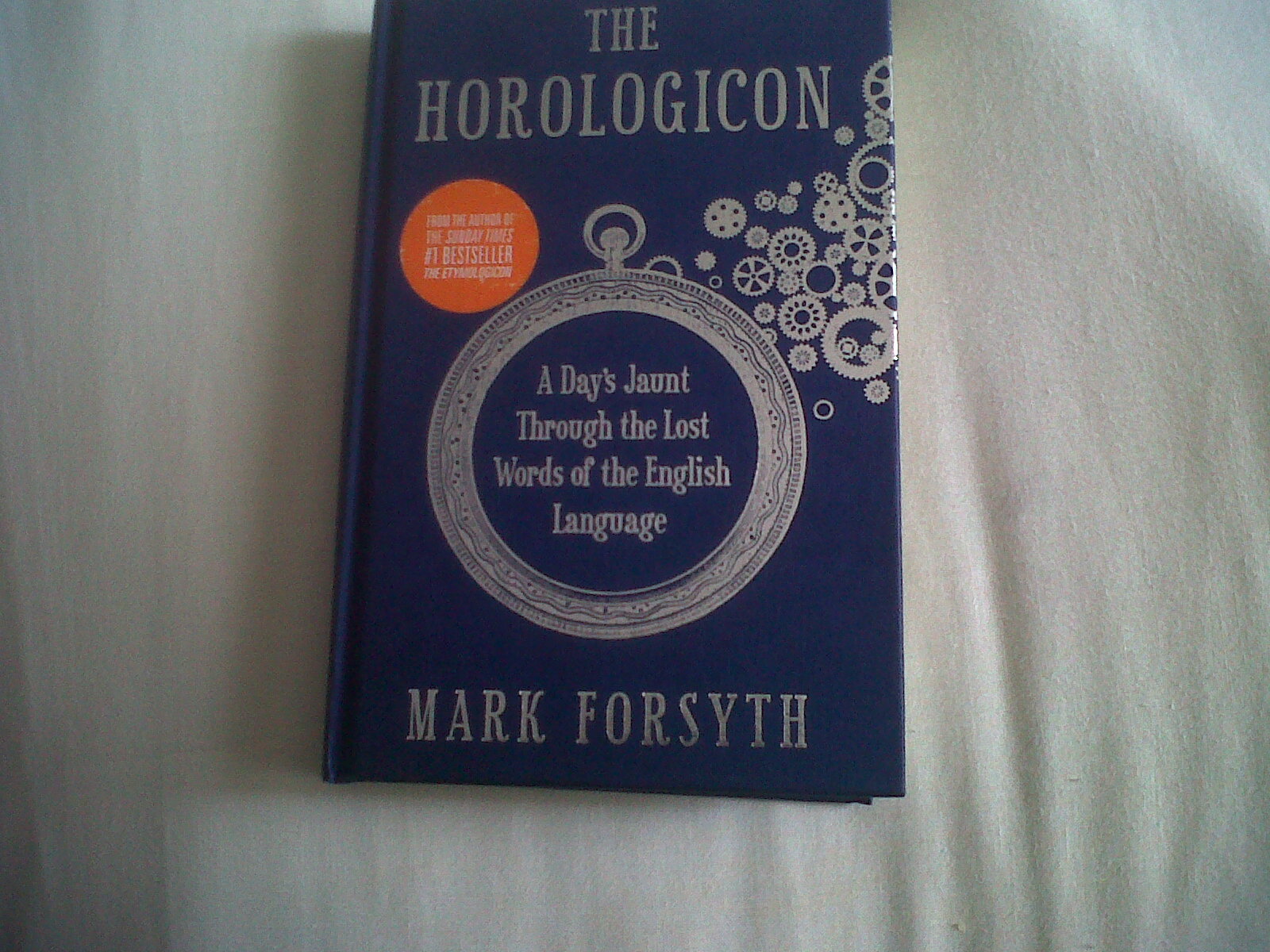
Review: ‘The Horologicon: A day’s jaunt throught the lost words of the English language’ by Mark Forsyth

The Horologicon: A day’s jaunt through the lost words of the English Language

Mark Forsyth

Icon Books

2012

I’ve just finished reading this book. The author doesn’t recommend reading it straight through, instead treating it as a reference work to be consulted at the appropriate hour of the day, unless one wishes to go mad. I used to read dictionaries for fun (don’t ask) so, really, it’s quite probable that I am already mad. That being the case, I’ve spent the past couple of morning’s making my way through this witty volume.

I laughed like a drain all the way through. Mark Forsyth is a clever writer; his talent for finding and using obscure words is truly remarkable. No longer will I suffer from utcare; I shall rise from my bed and take up this little volume. And when Bulls’s Noon comes I shall probably still be looking through it.

I really must get his first book, The Etymologicon; if it’s as good as The Horologicon I am certain of a good read.

I heartily recommend this book if you’re interested in the lost words of the English language, ever feel tongue-tied, in need of new ways to insult your boss without getting the sack, or just want a new word to say that you, or somebody else, are drunk.

Mark Forsyth blogs at

http://inkyfool.blogspot.com

And his Twitter is @inkyfool

Bye for now,

Rose

Review: Happily Ever After: Celebrating Jane Austen’s Pride and Prejudice by Susannah Fullerton

Review: Happily Ever After: Celebrating Jane Austen’s Pride and Prejudice

Susannah Fullerton

Frances Lincoln Limited Publishers

2013


While I was in the British Library on Monday I saw a few books about Jane Austen and Pride and Prejudice, and being a little bit of a Janeite I couldn’t resist buying this book for the train journey home. It is a fairly substantial hardback of 225 pages illustrated with drawings and photographs from the various editions of the book and film/tv adaptations that have been made. It took me a bit longer than the train journey to read, but certainly made the time pass agreeably.

The contents cover everything from the writing of Pride and Prejudice to the characters and various adaptations in books and films, and the ‘selling’ of Pride and Prejudice. Who knew you could get skateboards with quotes on them?

It is fairly obvious that the book was published to coincide with the 200th anniversary of the publication of Pride and Prejudice. The writer is clearly enamoured of her subject and holds definite opinions about it. It is enjoyable to read, and covers many interesting topics. The book is informative and would probably have been useful to my younger self when I was studying Pride and Prejudice for my GCSE English Literature. I particularly found the discussion of translating P&P interesting. The fine irony of Jane Austen, her wicked wit, cannot be easy to translate, although anyone who gives it a go deserves a medal for trying.

However, there is a slight feeling of snobbery and prejudice against anyone who dares to adapt the original (personally I like ‘Pride and Prejudice and Zombies’ – it’s funny) and the authoress also becomes repetitive at times. We all know P&P is a great book; you don’t need to tell us a dozen times a chapter.

Borrow it from the library if you’re studying Pride and Prejudice, only buy this book if you really can’t resist.

As ever, that’s just my opinion. Happy reading,

Rose