About the Book A Book of Secrets tells the story of a West African girl hunting for her lost brother through an Elizabethan underworld of spies, plots and secret Catholic printing presses.
Susan Charlewood is taken from Ghana (then known as Guinea) as a baby. Brought to England, she grows up as maidservant in a wealthy Catholic household. Living under a Protestant Queen in late 16th Century England, the family risk imprisonment or death unless they keep their faith hidden.
When her mistress dies Susan is married off to a London printer who is deeply involved in the Catholic resistance. She finds herself embroiled in political and religious intrigue, all while trying to find her lost brother and discover the truth about her origins.
The book explores the perils of voicing dissent in a state that demands outward conformity, at a time when England is taking its first steps into the long shadow of transatlantic slavery and old certainties about the shape of the universe itself are crumbling.
A Book of Secrets gives a striking new perspective on the era and lets one of the thousands of lost Elizabethan voices, speak out loud.
Pub date: 4 MARCH 2021 ISBN 13: 978-1-913193-54-6 EPUB: 978-1-913193-55-3 Price: £8.99
Twenty floors above the shimmering lights of the Hamburg docks, Public Prosecutor Chastity Riley is celebrating a birthday with friends in a hotel bar when twelve heavily armed men pull out guns, and take everyone hostage. Among the hostages is Konrad Hoogsmart, the hotel owner, who is being targeted by a young man whose life – and family – have been destroyed by Hoogsmart’s actions.
With the police looking on from outside – their colleagues’ lives at stake – and Chastity on the inside, increasingly ill from an unexpected case of sepsis, the stage is set for a dramatic confrontation … and a devastating outcome for the team … all live streamed in a terrifying bid for revenge. Crackling with energy and populated by a cast of unforgettable characters, Hotel Cartagena is a searing, stunning thriller that will leave you breathless.
“A perfect blend of science fiction and alternate history”
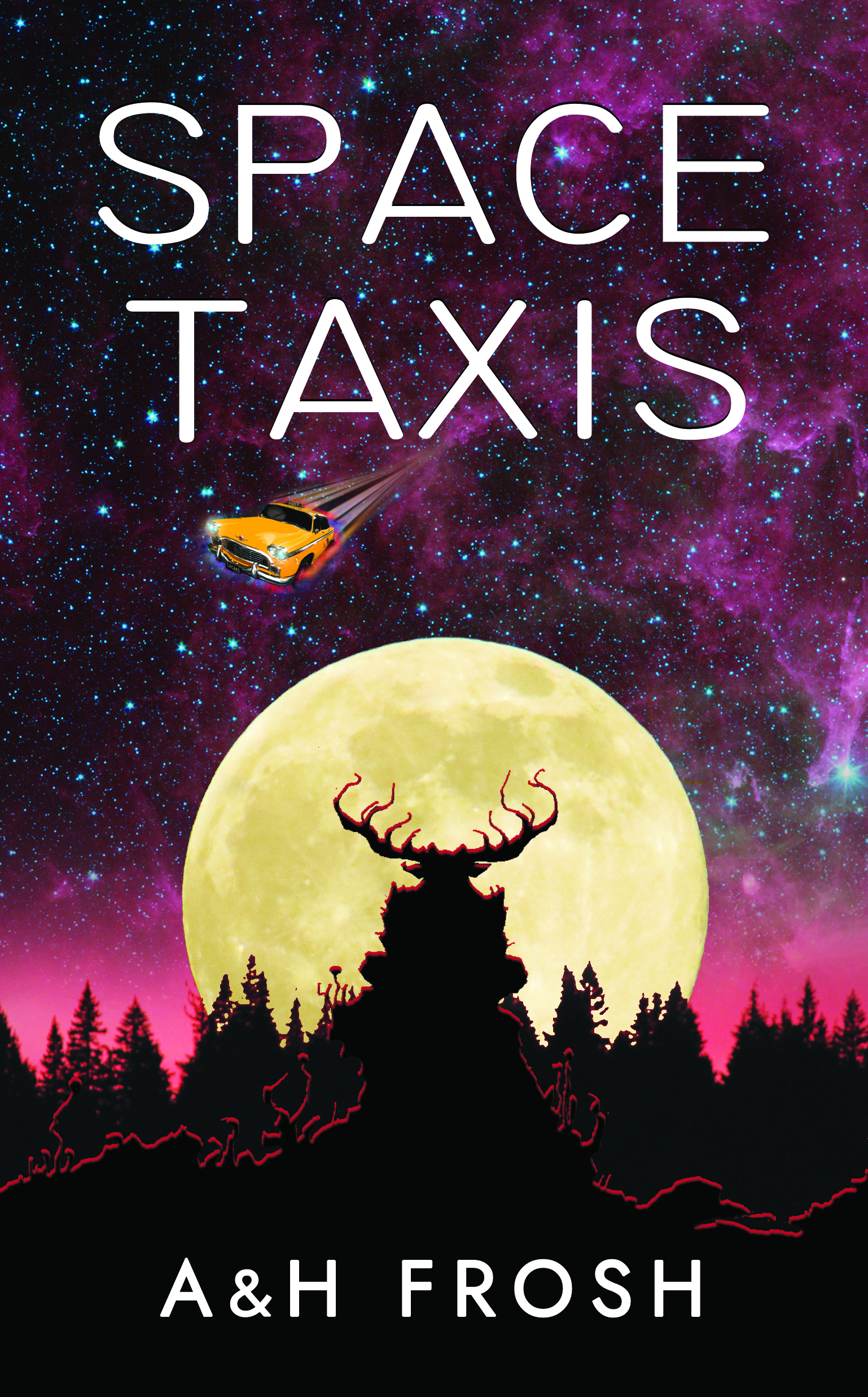
He’s abducted by aliens to the planet Vost.
He’s saving up for his fare home.
But he’s got the small matter of a planetary apocalypse to deal with first…
In 1977 a New York Cab driver Mike Redolfo is abducted by aliens after being mistaken for a renegade scientist. Meanwhile, back in 1944 a mysterious man and his Jewish fiancée are fleeing across Nazi-occupied Europe.
Redolfo tries to keep a low profile on his new world whilst earning his fare home, but unwittingly gets involved with a shady gang of alien criminals, inadvertently bringing the planet to the brink of catastrophe.
As the link between the timelines becomes clear, Redolfo must discover secrets from the past that may hold the key to saving the planet.
If you like The Hitchhiker’s Guide to the Galaxy, Kurt Vonnegut’s Slaughterhouse 5, and Frank Herbert’s Dune, you’ll love this gripping and entertaining sci-fi mystery thriller.
Hardcover, Goldsboro exclusive signed and numbered edition (1000) with sprayed edges, 336 pages Published February 2021 by Tor Books
Sixth Sense meets Stranger Things in T. L. Huchu’s The Library of the Dead, a sharp contemporary fantasy following a precocious and cynical teen as she explores the shadowy magical underside of modern Edinburgh.
When a child goes missing in Edinburgh’s darkest streets, young Ropa investigates. She’ll need to call on Zimbabwean magic as well as her Scottish pragmatism to hunt down clues. But as shadows lengthen, will the hunter become the hunted?
When ghosts talk, she will listen…
Ropa dropped out of school to become a ghostalker. Now she speaks to Edinburgh’s dead, carrying messages to the living. A girl’s gotta earn a living, and it seems harmless enough. Until, that is, the dead whisper that someone’s bewitching children–leaving them husks, empty of joy and life. It’s on Ropa’s patch, so she feels honor-bound to investigate. But what she learns will change her world.
She’ll dice with death (not part of her life plan…), discovering an occult library and a taste for hidden magic. She’ll also experience dark times. For Edinburgh hides a wealth of secrets, and Ropa’s gonna hunt them all down.
My Review
I got this book from Goldsboro Books as part of their ‘SFF Fellowship’ monthly club. Its beautiful, and the ribbon is so soft. My signed copy is number 533 of 1250 of the first edition, with sprayed edges. The edges are a map of Edinburgh. The cover reminds me very much of Ben Aaronovitch’s Rivers of London books. I like them as well. Must get caught up on reading them.
The Rosie Synopsis
Ropa is a gobby, spunky teenager, the bread winner for her small, impoverished family in an Edinburgh devastated by some past disaster. Her grandmother is some sort of magician who knits, Ropa is a ghostalker who finds her way into the titular library, via her friend Jomo. She becomes a member of the library and casually starts to learn magic by reading. At the library, she meets Priya, a disabled healer with an adrenalin junkie streak.
Ropa makes her living taking messages between the dead and the living. One of the ghosts, Nicole, keeps bothering her about finding her missing son. Gran persuades Ropa to do the job for Nicole. This leads Ropa into a dangerous world, and answers the mystery of how there ‘national treasure’ looks so young.
The Good
I really enjoyed this book. It kept me entertained for all 330 pages.
Ropa and her family and friends are really defined, interesting characters. I want to know more about how her Gran came to knit a scarf for Callahan in the past. People at the Library know who Gran is, but no-one is telling Ropa.
Ropa carries the story, and as a first person narrative we only know what she knows, which means there are a lot of secrets yet to be revealed. I want to know what happens next. I enjoyed the differences in personality between Ropa and Priya, and their developing relationship. I can’t tell whether they’re flirting with each other or not. Jomo is going to be so disappointed if they are.
I liked how the complex history of Edinburgh and the changes that made it a dystopian hell are woven into the story, and want to know more. The snobbery of the magicians and scientists towards ‘allied trades’ is so reminiscent of 18th and 19th century medical doctors and their attitudes to non-doctor medical practitioners – surgeons, apothecaries and herbalists – I can only surmise that that is what the author is modelling them on?
There’s a lot of detail in this novel and the author has clearly worked out how the magic works in his world. I like that. It intrigues me, and makes me want to read the next book.
I love the fact that the disabled character in this book is a fully fleshed out human being, not a sad, pathetic character lamenting what she can’t do or desperately seeking a cure for her disability – that trope gets boring and is insulting. Thankfully these days disabled characters are more often getting to be in on the action.
I think this novel is an adult novel but it’s not dark or horrifying at all, so I think it would be suitable for teenagers too. The main character is a teenager as are her closest friends.
The Not-So-Good
There’s a lot going on and the author has crammed it all in, so there are plenty of lines to follow for future stories but it could have been overwhelming for some readers. I hope the author explores a lot of the background information he has put into this first novel.
The Verdict
Excellent novel, highly entertaining and I can’t wait for the next one.
Paperback, 208 pages Published November 23rd 2020 by Pen and Sword History ISBN:1526755262 (ISBN13: 9781526755261)
Delve into the world of the unorthodox burial in seventeenth-century England, including mass interments in times of disease, the burial of suicides, and the unconventional laying to rest of English Catholics.
Death was a constant presence in the lives of the rich and poor alike in seventeenth-century England, being much more visible in everyday existence than it is today. It is a highly important and surprisingly captivating part of the epic story of England during the turbulent years of the 1600s. This book guides readers through the subject using a chronological approach, as would have been experienced by those living in the country at the time, beginning with the myriad causes of death, including disease, war, and capital punishment, and finishing with an exploration of posthumous commemoration. Although contemporaries of the seventeenth century did not fully realize it, when it came to the confrontation of mortality they were living in wildly changing times.
My Review
Thanks to Rosie Crofts at Pen & Sword for sending me a copy of this book. It is one of many that I am working my way through.
This book covers the ways people died, how they were buried and how they were remembered in 17th century England. It’s a very specific subject, and it’s rather fun to read about a single subject sometimes. Sometimes I like learning about specific subjects as well as wider ranging books. This one was fascinating.
Humans have a habit of thinking that how things are now are how things have always been. In life and death. But that’s not always true. And this is one of those ways in which things are the same and different. People still die, are disposed of and are remembered, and most are buried in consecrated ground.
People don’t die from the plague anymore, and rarely die in war, Catholics don’t get buried in ditches and people who complete suicide aren’t buried at cross-roads with a stake through the heart. We don’t hang criminals either.
Which is nice.
This book covers the various ways people died, how they acted on the deathbed, funerals, unusual burials and how people remembered the dead. It has some interesting photographs and extracts from primary documents, to illustrate the descriptions.
I found the writing easy to read. I read a large chunk in one sitting and then had to finish the last chapter some weeks later due to other commitments. I could pick up the thread fairly easily and get back right into the book.
If you want to read a different perspective on the turbulent years of the 17th century, and you’re interested in death, I recommend this book.
For my friend Nicky: There are some good tips on ancient gravestones you could follow up for photographing.
PUBLICATION DATE: 4 MARCH 2021 | ORENDA BOOKS | PAPERBACK ORIGINAL | £8.99
The passionate, young police officer Sam Shephard returns in a taut, atmospheric and compelling police procedural, which sees her take matters into her own hands when the official investigation into the murder of a local businessman fails to add up…
The New Zealand city of Dunedin is rocked when a wealthy and apparently respectable businessman is murdered in his luxurious home while his wife is bound and gagged, and forced to watch. But when Detective Sam Shephard and her team start investigating the case, they discover that the victim had links with some dubious characters.
The case seems cut and dried, but Sam has other ideas. Weighed down by her dad’s terminal cancer diagnosis, and by complications in her relationship with Paul, she needs a distraction, and launches her own investigation. And when another murder throws the official case into chaos, it ’s up to Sam to prove that the killer is someone no one could ever suspect.
Paperback, 592 pages Published July 21st 2020 by Orbit ISBN:0316519545 (ISBN13: 9780316519540) Series: Burningblade & Silvereye #1
Hardcover, Goldsboro exclusive signed and numbered edition with sprayed edges, 550 pages Published 2020 by Head of Zeus
Blurb
Long ago, a magical war destroyed an empire, and a new one was built in its ashes. But still the old grudges simmer, and two siblings will fight on opposite sides to save their world, in the start of Django Wexler’s new epic fantasy trilogy
Gyre hasn’t seen his beloved sister since their parents sold her to the mysterious Twilight Order. Now, twelve years after her disappearance, Gyre’s sole focus is revenge, and he’s willing to risk anything and anyone to claim enough power to destroy the Order.
Chasing rumours of a fabled city protecting a powerful artefact, Gyre comes face-to-face with his lost sister. But she isn’t who she once was. Trained to be a warrior, Maya wields magic for the Twilight Order’s cause. Standing on opposite sides of a looming civil war, the two siblings will learn that not even the ties of blood will keep them from splitting the world in two.
My Review
Warning, there will be spoilers.
I have both my very pretty hardback special edition, and the paperback edition. The hardbacks are gorgeous and I do tend to collect 1st edition hardbacks, signed if possible, but for everyday reading. paperbacks are easier. Yes, I break the spines, that’s why I have multiple copies of books. I got a really solid god and black bookmark with my Goldsboro Books edition, so I haven’t dogeared the pages in this one.
The Rosie Synopsis
The blurb isn’t accurate. Gyre’s sister Maya was taken by the Twilight Order when she was five; in the process Gyre lost his eye. A year later their mother died of grief and their father stopped caring for Gyre. In the years that have passed Gyre has left home, joined the rebels in Deepfire and has been hunting for a way to bring down the Order and the Dawn Republic, whom he blames for destroying his family.
Gyre falls in with a mysterious thief named Kit, who is working for people with very deep pockets and a desperate need for a specific artefact hidden in the vaults of Deepfire’s dux. The mission to retrieve the item turns disastrous after the rest of the rebels are betrayed, so Gyre and Kit seek out the clients in order to ask for a second chance.
Maya has been raised by the Centarch Jaedia for twelve years, barely remembering her birth family. She is a good little agathia – a student training to become a Centarch, a skilled used of a type of magic called daiat, power drawn from the sun.
When Maya and another agathia, Tanax, a scout called Vos and Arcanist Beq (a sort of an engineer of magical artefacts) are sent to Deepfire on a mission for the Council of the Order, to collect a very powerful artefact, things go badly wrong. It doesn’t help that Tanax is the protégé of the Dogmatist factions’ leader, and that he believes Maya has been sent to foil the mission.
Maya and Beq realise there is something very bad happening in the city and that the dux, Raskos is corrupt, but how corrupt shocks them. And the corruption goes all the way the the Council. In an expedition into the city, the pair meet the rebels, accidentally, and then are drawn into Raskos’ plans. In anger, Maya exposes the duxes corruption, meets her brother in battle and then gets arrested for treason.
Then things become complicated. As the siblings realise that they are on opposite sides and the people calling the shots are not what they seem, their individual paths meet at the Leviathan’s Womb, where horrific monsters guard a construct that could destroy everyone.
The Good
The worldbuilding, the characters, the plot. It was all good.
It’s a big book so I read it in stages, usually a couple of hundred pages at a time, with a week or so’s break in between. It was a really easy book to read, and to get lost in. But I got a bit overwhelmed if I spent too long there so I had to put it down and rest. The world is very vivid, from the dank tunnels of Deepfire to the glory of the Forge (the baths sounded amazing!), to the cold of the Splintered Mountains, it was glorious.
The main characters are Gyre and Kit, and Maya and Beq, who are also romantically inclined towards each other. The relationships progress differently, as Kit is very forthright, and Maya and Beq are incredibly inexperienced. Those two are adorable. The romance isn’t a driving factor in the plot, but an incidental part of the character’s development and individual stories. The real drivers are family love and revenge. Gyre wants revenge for the destruction of his family, Maya wants to defend her mentor/pseudo-mother Jaedia from accusations of treason, they both don’t kill each other twice because they love each other.
The story is told from Maya and Gyre’s perspectives, in alternating chapters, denoted by a mask or a burning sword. That was really helpful as the change of perspective could have been confusing. I enjoyed seeing events from both sides, through their different beliefs and perspectives.
The plaguespawn, dhakim and ghouls are really quite awful creatures, but for a part of the novel you get their perspectives as they travel with the main characters. The war between the ghouls and the Chosen was much more complicated than humanity is allowed to know or believe, and the Order are complicit in keeping people ignorant. They also control what pieces of ancient technology left over from the war that ordinary people are allowed to use. Their control of the Republic has driven some people into desperate straits but they refuse to take responsibility, while the ghouls and dhakim straight up hate humans and prey on the weak. They’re more honest about their predation, and don’t hide behind words.
The Not-So-Good
Who were the Chosen, why did they have advanced technology while 400 years later people are playing with scraps? And how long do I have to wait for book two?
Inside the sprawling forests of Ontario, Canada lives a friendly black bear named Melly. One of Melly’s favourite things to do is EAT! And many of the delicious fruits she snacks on wouldn’t grow without the help of some very important little forest creatures.
What the World Needs Now: Bees! explores the vital role busy, busy bees play in helping plants to grow the food people and animals love to eat.
A message from the Author:
As you might have seen on IG, our UK Shopify online store is now open for business: www.Environmentalkids.co.uk. We are really proud of our set up in the UK. All books in the series are printed in and shipped from the UK, which means we can pass along shipping savings to the customer, and the books have the lowest carbon footprint possible.
100% recycled paper, biodegradable lamination, vegetable-based inks and carbon-balanced printing we use, and now more than ever, these are books you can feel REALLY good about buying.
Paperback, 128 pages Published December 8th 2020 by Tordotcom ISBN:1250786134 (ISBN13: 9781250786135) The Singing Hills Cycle #2
“Dangerous, subtle, unexpected and familiar, angry and ferocious and hopeful. . . . The Empress of Salt and Fortune is a remarkable accomplishment of storytelling.”—NPR
The cleric Chih finds themself and their companions at the mercy of a band of fierce tigers who ache with hunger. To stay alive until the mammoths can save them, Chih must unwind the intricate, layered story of the tiger and her scholar lover—a woman of courage, intelligence, and beauty—and discover how truth can survive becoming history.
Nghi Vo returns to the empire of Ahn and The Singing Hills Cycle in this mesmerizing, lush standalone follow-up to The Empress of Salt and Fortune.
My Review
In The Empress of Salt and Fortune, Chih hears the stories of the Empresses life and that of her loyal companion. In this, Chih is up in the mountains, riding mammoths and being chased by tigers. Tigers who are able to turn into humans.
In order to save their life, and that of their human and mammoth companions, Chih tells a story about an earlier human Scholar who meets a tiger who can become a human. The tiger queen interrupts and corrects the story repeatedly.
This is another story within a story, although more accurately it’s two stories in a story as the tigers tell their version of events and the humans write it down for ‘correction’. And to save their lives. As Scheherazade tells stories to save her life, so Chih tells the story and listens to the tigers’ story in the hopes that the sun will rise and help will come with it.
I should have finished this a month ago but stuff got in the way and really, I rushed from reading the first book to reading this one and it was a bit too much of a change in pace and setting for me. However, this afternoon, after I walked Ezzie, had teas and then waited for the shopping delivery, I picked up this book. The last two thirds flew by in an hour. It was most inconvenient for the shopping to arrive early for a change, but I went back to the remaining pages, gripped with anticipation. How would Chih save them?
Obviously, I’m not going to tell you how, but Chih and the rest are saved, and the tigers leave. There’s a love story in the story within the story, and seeing things through the eyes of the tigers was fun, because they obviously have different priorities to humans.
I enjoyed the evocative descriptions, and the cultures and mythology of the civilisation of the books, which are clearly based on broadly east Asian, possibly more specifically Chinese and Mongolian, history, culture and mythology. I can’t wait to see what Chih gets up to next.
Hardcover, 240 pages Published May 21st 2019 by New York University Press ISBN:1479800651 (ISBN13: 9781479800650)
Reveals the diversity crisis in children’s and young adult media as not only a lack of representation, but a lack of imagination
Stories provide portals into other worlds, both real and imagined. The promise of escape draws people from all backgrounds to speculative fiction, but when people of color seek passageways into the fantastic, the doors are often barred. This problem lies not only with children’s publishing, but also with the television and film executives tasked with adapting these stories into a visual world. When characters of color do appear, they are often marginalized or subjected to violence, reinforcing for audiences that not all lives matter.
The Dark Fantastic is an engaging and provocative exploration of race in popular youth and young adult speculative fiction. Grounded in her experiences as YA novelist, fanfiction writer, and scholar of education, Thomas considers four black girl protagonists from some of the most popular stories of the early 21st century: Bonnie Bennett from the CW’s The Vampire Diaries, Rue from Suzanne Collins’s The Hunger Games, Gwen from the BBC’s Merlin, and Angelina Johnson from J.K. Rowling’s Harry Potter. Analyzing their narratives and audience reactions to them reveals how these characters mirror the violence against black and brown people in our own world.
In response, Thomas uncovers and builds upon a tradition of fantasy and radical imagination in Black feminism and Afrofuturism to reveal new possibilities. Through fanfiction and other modes of counter-storytelling, young people of color have reinvisioned fantastic worlds that reflect their own experiences, their own lives. As Thomas powerfully asserts, “we dark girls deserve more, because we are more.”






 Everything Is Better With Dragons