The unmissable follow-up to the highly acclaimed Children of Time and Children of Ruin.
When Earth failed, it sent out arkships to establish new outposts. So the spaceship Enkidu and its captain, Heorest Holt, carried its precious human cargo to a potential new paradise. Generations later, this fragile colony has managed to survive on Imir, eking out a hardy existence. Yet life is tough, and much technological knowledge has been lost.
Then strangers appear, on a world where everyone knows their neighbour. They possess unparalleled knowledge and thrilling new technology – for they have come from the stars, to help humanity’s lost colonies. But not all is as it seems on Imir.
As the visitors lose track of time and memories, they discover the colonists fear unknown enemies and Imir’s own murky history. Neighbour turns against neighbour, as society fractures in the face of this terrifying foe. Perhaps some other intelligence is at work, toying with colonists and space-faring scientists alike? But not all questions are so easily answered – and the price may be the colony itself.
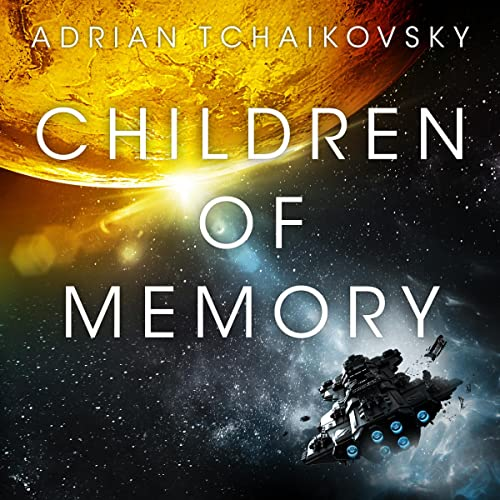
Children of Memory by Arthur C. Clarke Award-winning author Adrian Tchaikovsky is a far-reaching space opera spanning generations, species and galaxies.
- Format: 16 pages, Audible Audio
- Published: November 24, 2022 by Tor
- Language: English
My Review
I have copies of all of the books in this series and have listened to them all as audiobooks.
I found this one really confusing. On the surface it’s simple, a team of Humans, portids, uplifted octopuses, the aggregate lifeform from Nod, and a pair of corvids, visit a new planet, called Imir. Something strange is going on there though. The people are afraid of something outside of their small colony and they don’t know what it is. Things keep going strangely wrong. They keep happening over and over again, in slightly different ways. Miranda, the person who embodies the aggregate lifeform from Nod, is deeply invested in the events and can’t escape from Imir.
The simulation hypothesis is explored in this novel; are we living in a simulation? What is sentience? The ideas are explored through the characters of Gethi and Gothi, a pair of Corvids who need to be together to explore and draw conclusions.
I really liked Gethi and Gothi, they’re funny and drive the plot forward. I love the way they talk back to Avrana Kern and their discussions about sentience, and their conclusion that they aren’t sentient, and also that either everyone is or no one is.
If you enjoyed the first two books in the series I highly recommend this third book. I think this is the final book in the series, which would be a shame, as I want to know where else the sentient species go and who they meet.
 Everything Is Better With Dragons