
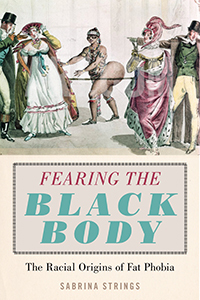
Published: May 7, 2019 by New York University Press
ISBN: 9781479886753 (ISBN10: 1479886750)
Blurb
In her first book, sociologist Strings (sociology, Univ. of California, Irvine) explores the historical development of prothin, antifat ideologies deployed in support of Western, patriarchal white supremacy. Beginning in the aesthetic ideals circulated by Renaissance thinkers and artists and bringing her narrative up into the 1990s, Strings charts how white Europeans and Anglo-Americans developed ideals of race and beauty that both explicitly and figuratively juxtaposed slim, desirable white women against corpulent, seemingly monstrous black women.
The work is divided into three sections. The two chapters in the first part consider how Renaissance white women and women of colour were depicted as plump and feminine, separated by class, yet belonging to the same gender. The second part of the work charts the rise of modern racial ideologies that yoked feminine beauty to Protestant, Anglo-Saxon whiteness. Later chapters and the epilogue consider how Americans normalized the “scientific management” of white women’s bodies for the purpose of racial uplift, a project that continued to situate black women as the embodied Other.
My Review
I’ve been reading this book on and off over the last few months as other commitments permitted; I found it fascinating and always picked up some new information every time I went back to it. I finished it last night with a feeling of disappointment that it wasn’t longer, but also interested in reading more by the author and on the topic.
BMI is, as I have said many times, bullshit, made-up and irrational. That it is still used by the medical profession is a travesty. Historical attitudes to fatness have varied with time and place, but scientific evidence does not support the vilification of fat people. In fact, Ancel Keys, who essentially invented the BMI and pushed for it to replace actuarial tables for insurance and medical purposes, admitted he found fat people ugly and assumed they were unhealthy. You cannot tell anything about a person’s health from a ratio of height to weight, or their appearance.
This book covers Europe and the U.S., because the author is USian, and the U.S. wouldn’t exist without European colonisation, so it covers the period from the Renaissance to the last years of the twentieth century. Five hundred years and three continents it a lot of space and time to cover.
When European’s started Othering people to justify slavery, weight was one of the things they chose to stigmatise. It coincided with Protestant disgust with bodies, with anything that might be fun, and later with changing ideas about ‘polite’ behaviour. By accusing African people of being lazy, gluttonous and dishonest, they could link that to intellect and justify colonisation and enslavement. And of course, to keep Europeans on top of the heap, the same rules had to be applied to Europeans, especially middle and upper class women.
Later still, eugenics came into play and whole new fields of scientific racism and sexism opened up for those white men determined to hold their places at the top of society. In the U.S. one of the ways they did this was to racialise Jewish, Irish, Southern (particularly Italian) and Eastern Europeans as the different groups migrated to the Americas across the 18th and 19th centuries and into the 20th century. They used the same lazy propaganda that earlier European ‘scientists’ had used to racialise and other Africans and then the indigenous populations of the Americas and Australia.
Body size and shape was used as a stick to beat people with. A ‘too thin’ rich white woman was a danger to the nation (whichever nation it was), a ‘too fat’ rich white woman, equally so, at different times. A fat black or African woman – signs of laziness and greediness – moral incontinence and hypersexuality. Because reasons.
Racist shitbags don’t actually have logical reasons, they take their beliefs and make up pseudoscience to support it. Fat hate is the same. It doesn’t matter how much evidence you have to show that ‘normal weight’ doesn’t exist, and that weight variation is just a normal part of human diversity (like the levels of melanin in the skin), they’ll still scream that fat kills.
Strings is a professional, and writes like one, unlike me; I’m just blunt and don’t mind swearing if I think it’s appropriate. I’ve seen other reviews that claim the writing is dry; I disagree. I found it clear and precise, although I would have been interested in more analysis and references from African and African American sources, but I doubt they were available given the systemic erasure and silencing of Black people in the last five hundred years.
The structure of the book puts the different strands of evidence into context and builds on Strings’ argument in a structured and organised way. Strings draws on popular and scientific literature, art and cultural movements to explore the topic and build her arguments. This is not ‘popular history but rewards careful reading and consideration.

 Everything Is Better With Dragons