TBR Pile Review: Who’s Afraid of Gender, by Judith Butler

Format: 320 pages, Hardcover
Published: March 19, 2024 by Allen Lane
ISBN: 9780241595824 (ISBN10: 0241595827)

Description

Judith Butler, the ground-breaking philosopher whose influential work has redefined how we think about gender and sexuality, confronts the attacks on gender that have become central to right-wing movements today. Global networks have formed “anti-gender ideology movements” dedicated to circulating a fantasy that gender is a dangerous threat to families, local cultures, civilization –and even “man” himself. Inflamed by the rhetoric of public figures, this movement has sought to abolish reproductive justice, undermine protections against violence, and strip trans and queer people of their rights. But what, exactly, is so scary about gender?

In this vital, courageous book, Butler carefully examines how “gender” has become a phantasm for emerging authoritarian regimes, fascist formations, and trans-exclusionary feminists. They illuminate the concrete ways that this phantasm displaces anxieties and fears of destruction. Operating in tandem with deceptive accounts of critical race theory and xenophobic panics about migration, the anti-gender movement demonizes struggles for equality, fuels aggressive nationalism, and leaves millions of people vulnerable to subjugation.

An essential intervention into one of the most fraught issues of our moment, Who’s Afraid of Gender? is a bold call to make a broad coalition with all those whose struggle for equality is linked with fighting injustice. Imagining new possibilities for both freedom and solidarity, Butler offers us an essentially hopeful work that is both timely and timeless.

My Review

Interesting, definitely one to re-read and digest. I struggled with parts of the text – it was a bit dense.

The author challenges the phantasm of ‘gender ideology’, pushed by those with a stake in maintaining the cis-heteronormative, patriarchal status quo as part of religious and Right wing ideology. The author takes the reader through the various talking points, and explains how those opposed to equal rights for gender and sexual minorities elide between talking points without logical argument. They assume ‘allowing trans people to live their lives’ automatically means ‘anyone will identify as anything in order to attack children’. There’s no logical way to get from one to the other. This is a way to displace the fear of living in late-stage capitalism, with the attendant global warming and population displacement that comes with it. Instead of focusing our anger and fear on the causes of the world becoming unliveable, humans are distracted by false ghosts, phantasms, bundled under the word ‘gender’.

The book seems to be aimed at a non-academic audience, covering what should be fairly obvious arguments, if you’ve kept up with the whole anti-trans movement. However, it does become very academic and falls into philosophy-speak at times. I did enjoy reading this book, but sometimes, I wish they’d written it in plain English.

It’s late, I’ll write more when I’ve had a think about it.

TBR Pile Review: Gender Heretics – Evangelicals, Feminists and the Alliance Against Trans Liberation, by Rebecca Jane Morgan

Format: 208 pages, Paperback
Published: September 20, 2023 by Pluto Press
ISBN:9780745349015 (ISBN10: 0745349013)

Blurb

For decades, conservative evangelicals and Trans-Exclusionary Radical Feminists (TERFs) have worked hand-in-hand to oppose trans liberation. But how did this alliance come about? What makes it tick? And how can trans people and allies respond?

This book, written by a transfeminist who is also an evangelical Christian, is a history and genealogy of reactionary ideas. Gender Heretics traces how a shared belief in the essential unity of the mind and the body, together with a common fear of ‘dualist’ or ‘Gnostic’ philosophies, first brought these groups into contact in the 1970s.

Morgan explores how theological arguments snaked their way from anti-trans feminist tracts into the everyday practices of evangelical churches today. She offers a hopeful way forward, advocating for a full recalibration of evangelical thought on gender identity and trans activism.


My Review

I bought my copy of this book from Lighthouse Bookshop In Edinburgh in September and I’ve finally got around to reading it. I was intrigued by the title. Over the years I’ve had some run-ins with evangelicals and TER’F’s. Sorry, they ARE NOT FEMINISTS. There’s nothing feminist about hating people because they’re different from you and seeking to prevent people from living authentically, with bodily autonomy. Anyway, one of the things that really confused me was that evangelicals, especially the American ones, hate feminism, but they will align with people who are nominally feminists to spread trans fear, hate and misinformation, and to take away the bodily autonomy of others. They all seem to think the ‘born in the wrong body’ analogy is a universal trans experience and don’t realise it’s an analogy for those who can never understand what it means to have a gender that doesn’t match one’s assigned sex.

Quite often the answer to the puzzle is a simple: well they’re using each other. Possibly, but it’s deeper than that. The evangelicals are hung up on what they perceive as ‘gnostic’ tendencies, and the TERFs are struggling with what they perceive as a body/mind binary. These are essentially the same thing in different words and conceptual frameworks, if I’m reading this book correctly. The author is both an Evangelical Christian and a trans woman feminist academic. She has just the right background to explore the strange relationship between people who hate trans people for nominally feminist reasons, and people who hat trans people for nominally religious reasons. Her lived experience informs the academic exploration, and the quotes from other trans Christians that inform the text are often heart-breaking to read. I just want to hug them and turn into a dragon to breath fire at their attackers.

I’ve been asked if there’s some ‘gendered soul’ before, and been utterly confused, because I don’t believe in souls (I’m agnostic, mostly). So why would I think I have a differently gendered soul in a female body? Apart from anything else I’m genderfluid/agender. I don’t have a gender that I can discern, and what I can discern fluctuates regularly. My body is nominally female in that I have a vulva and uterus, but I’ve never had hormone levels checked, not my chromosomes. For all I know I might have an intersex condition, most people don’t know they’re intersex until they reach puberty or want children and find they have a fertility issue. I couldn’t get a clear answer from that person when I asked how they reached their conclusion about ‘gendered souls’ being a ‘belief of gender ideology’ (and honestly, I think they were repeating TERF talking points). I blocked them not long after because they constantly insulted and misgendered me. Should have barbecued Cassandra (yes, the delusional twit called herself Cassandra because she reckoned Autistic girls were being ‘transed’ and she was the only one warning about it *insert eye-roll here*).

Anyway.

I found this book really interesting and useful, even to those of us who are atheists or agnostics, or are deists of a different religion to the author, because it explains the complex interplay between the two groups leading the anti-trans campaigns that are infecting political, social and religious life in the UK and US at the moment. There is a certain level of knowledge of both evangelical and transphobe beliefs needed, but the author does her best to make things clear. The references to Biblical verses went over my head (I haven’t read the Bible for 25 years, at least) and while I have copies of the Bible floating around the library, I don’t have the energy to look up particular passages so I’m just taking Morgan’s word for it. This is quite niche specialism, but an important one, so I recommend this book to everyone interested in religion and transgender issues.

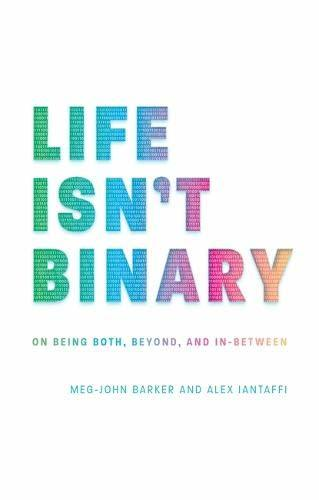
TBR Pile Review: Life Isn’t Binary, by Meg-John Barker and Alex Iantaffi

Format: 237 pages, Paperback
Published: May 21, 2019 by Jessica Kingsley Publishers
ISBN: 9781785924798 (ISBN10: 1785924796)
Language: English

Description

Challenging society’s rigid and binary ways of thinking, this original work shows the limitations that binary thinking has regarding our relationships, wellbeing, sense of identity, and more. Explaining how we can think and act in a less rigid manner, this fascinating book shows how life isn’t binary.

My Review

This book starts with the obvious understanding of ‘non-binary’ in discussing sexuality and gender, and then goes on to discuss non-binary approaches to relationships, bodies, emotions, and thinking. What this really means is that people tend to think in either/or ways, yes/no, black/white, etc. but the authors recommend more and/both thinking about life.

For someone who is non-binary it is an interesting, yet obvious concept. Although I’m autistic and we’re often accused of black and white thinking, I’ve always wanted to ask why? and my conception of conflict as the stories people tell themselves not meshing completely, already allows me to view reality in a way that includes what the authors refer to as ‘multiversal’. The authors use a therapist and Buddhist way of putting it, but it’s the same thing. Our stories are always changing, we’re always in the process of becoming, not completed, not finalised. And we have many stories, depending on who we’re interacting with.

I found this book fairly interesting. I got through the first four chapters in record time, but the last two chapters seemed to drag a bit. It was mostly the last chapter. I found it a bit woo heavy, especially the ‘make an alter to yourself’ reflection point. I understand the authors are interested in Buddhism, and work as therapists, so it’s understandable. It just doesn’t work for me.

It’s a good introduction to non-binary genders and unconventional relationships.

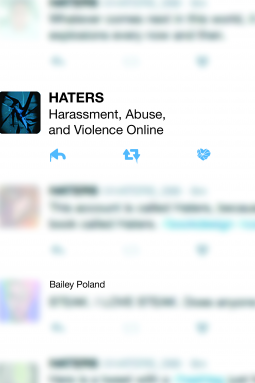
Review: ‘Haters: Harassment, Abuse and Violence Online’ by Bailey Poland

Published by: Potomac Books, University of Nebraska Press

Publication Date: 1st November 2016

I.S.B.N.: 9781612347660

Price: £14.99 (via Amazon.co.uk)

Continue reading “Review: ‘Haters: Harassment, Abuse and Violence Online’ by Bailey Poland”

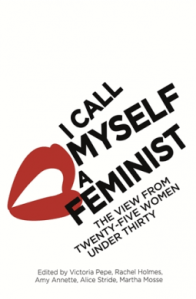
Review: ‘I Call Myself A Feminist’ Edited by Victoria Pepe

Find this one at http://www.amazon.co.uk/Call-Myself-Feminist-Twenty-Five-Thirty/dp/0349006555/ref=sr_1_1?s=books&ie=UTF8&qid=1447087483&sr=1-1&keywords=i+call+myself+a+feminist

Published By: Little, Brown Book Group UK

Publication Date: 5th November 2015

Edition: Paperback

ISBN: 9780349006550

Price: £13.99


Blurb

Is feminism still a dirty word? We asked twenty-five of the brightest, funniest, bravest young women what being a feminist in 2015 means to them.

We hear from Laura Bates (of the Everyday Sexism Project), Reni Eddo-Lodge (award-winning journalist and author), Yas Necati (an eighteen-year-old activist), Laura Pankhurst, great-great granddaughter of Emmeline Pankhurst and an activist in her own right, comedian Sofie Hagen, engineer Naomi Mitchison and Louise O’Neill, author of the award-winning feminist Young Adult novel Only Ever Yours. Writing about a huge variety of subjects, we have Martha Mosse on how she became a feminist, Alice Stride on sexism in language, Amy Annette addressing the body politic and Samira Shackle on having her eyes opened in a hostel for survivors of acid attacks in Islamabad, while Maysa Haque thinks about the way Islam has informed her feminism and Isabel Adomakoh Young insists that women don’t have to be perfect. There are twelve other performers, politicians and writers who include Jade Anouka, Emily Benn, Abigail Matson-Phippard, Hajar Wright and Jinan Younis.

Is the word feminist still to be shunned? Is feminism still thought of as anti-men rather than pro-human? Is this generation of feminists – outspoken, funny and focused – the best we’ve had for long while? Has the internet given them a voice and power previously unknown?

Rachel Holmes’ most recent book is Eleanor Marx: A Life; Victoria Pepe is a literary scout; Amy Annette is a comedy producer currently working on festivals including Latitude; Alice Stride works for Women’s Aid and Martha Mosse is a freelance producer and artist.

Continue reading “Review: ‘I Call Myself A Feminist’ Edited by Victoria Pepe”

Am I old enough yet for people to stop asking

If I’ve got a boyfriend or if I’m getting married/having children?

I turned thirty-two a few days before Midsummer; you’d have thought people would have given up on that nonsense by now. I mean, if I haven’t got round to all that stuff by now, I’m really not going to, am I?Continue reading “Am I old enough yet for people to stop asking”

Ick, people have no manners

I had a fantastic day out in Sheffield yesterday; I’m exhausted, mentally and physically today though. It would have been perfect but for the behaviour of some bad mannered little brats. If that wasn’t bad enough my aching legs carried me past a white-van-man this morning who though shouting insults at me was acceptable. This is a rant, by the way. Read on at your peril.Continue reading “Ick, people have no manners”

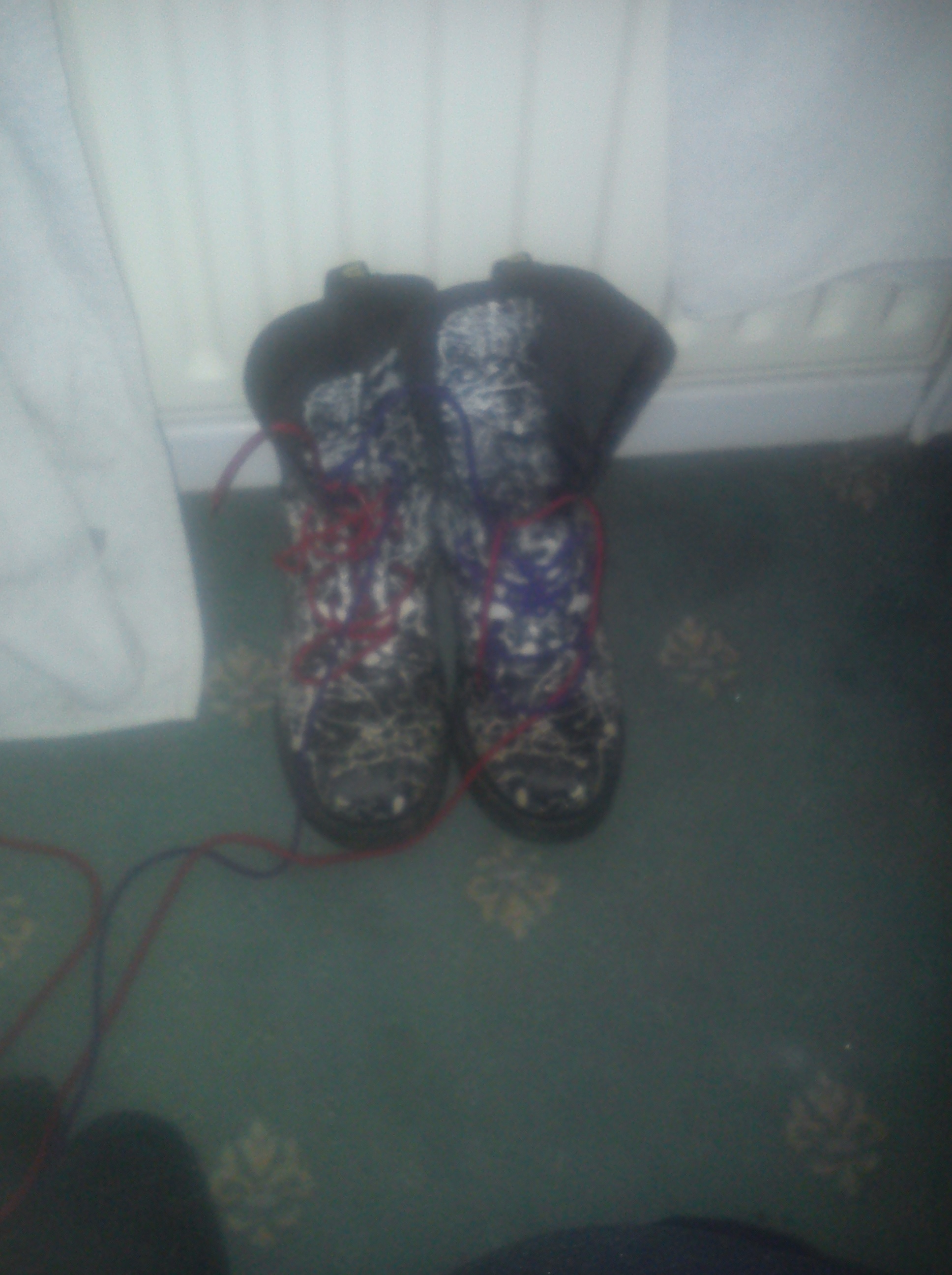
You don’t find my Dr Marten’s attractive? Really? How sad, never mind, I think I’ll survive your disapproval.

Just in case anyone missed the bulletin, women are under no obligation to dress or express themselves only in ways that are attractive to men. And if you think they are, the 1950’s called and would like their misogyny back.
image

(Yes, I am being passive aggressive today; no, I don’t care.)

Continue reading “You don’t find my Dr Marten’s attractive? Really? How sad, never mind, I think I’ll survive your disapproval.”