Review: Under A Metal Sky, by Philip Marsden

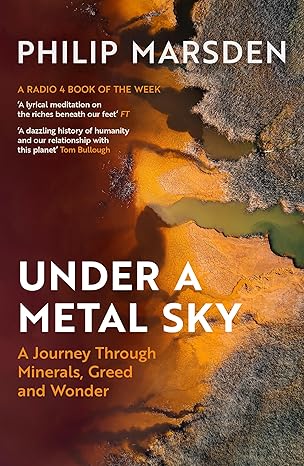
Publisher ‏ : ‎ Granta Books
Publication date ‏ : ‎ 12 Feb. 2026
Language ‏ : ‎ English
Print length ‏ : ‎ 415 pages
ISBN-10 ‏ : ‎ 1783789638
ISBN-13 ‏ : ‎ 978-1783789634

Description

The discovery of minerals beneath our feet has transformed our species. Ochre first prompted humans to express themselves in art; tin and copper helped instigate the Bronze Age and later the Industrial Revolution; silver kick-started the engines of global trade. Each of these substances generated a leap forward in technology, each one opened the imagination a little further – and each one brought with it a cache of unexpected dangers.

Under A Metal Sky begins and ends in Philip Marsden’s homeland of Cornwall, one of the world’s great geological hotspots. Travelling eastwards into Europe, he examines how the extraction of peat propelled the Netherlands to world prominence but also imperilled its very existence. Continuing on up the Rhine by barge, into the heart of the continent, he uncovers more stories of potent and tempting resources, from iron-rich meteorites to radium and mercury, and the gold-bearing mountains of Georgia. At the same time he explores precious seams of ideas, from science to alchemy, mysticism to ecology – and those questing souls who pursued them, likeParacelsus, the Habsburg Emperor Rudolf II, Goethe,William Blake and Marie Curie.

Rich with revelations, Under A Metal Sky traces the dazzling achievements and dark consequences of our ability to extract what we want from the earth, and presents a fascinating new perspective on European history and on our troubled relationship with the natural world.


My Review

This book is subtitled ‘ A Journey Through Minerals, Greed, and Wonder’; it follows the authors journey east from Cornwall to the Caucuses and back, via the Netherlands, Germany, Austria, Serbia, and a whole host of European countries. In each chapter he talks about a different element, metal or mineral, and the connections it has to everything else around it.

The journey is a deeply personal one for the author, starting with his childhood fascination with rock and fossil collecting, to his awe at the ability of early humans to turn lumps of rock into tools and decorations, to dig mines with nothing but antler horn, and the beauty found in the earth. He also discusses the damage resource extraction does to the land and water around it, the continuing harm to life, and the way forward for humans.

Marsden makes the connection to imagination through reference to Rudolf II’s Prague castle/collection/laboratory, Blake’s poetry and copper engraving artwork, and his own awe at the world. It’s actually a rather lovely idea, all things are connected.

We like to put things in little boxes, taxonomy is king. Except everything is connected, temporally and spatially. What happened then effects what happens now, how we react, what we do now, effects the future. What happens here, determines what happens there. We can only see things from where and when we are, usually, and that’s how it’s often treated, as disconnected boxes with discrete edges, but it’s really more of a fluid with occasional clumps. Like a really thick lava erupting form a shield volcano (think Hawaii).

If you’re interested in geology, mining, archaeology, poetry, history, or any of a number of other subjects, I recommend this book. It’s readable, understandable, and gives an interesting personal perspective on some of the many important minerals we depend on.

TBR Pile Review: Who’s Afraid of Gender, by Judith Butler

Format: 320 pages, Hardcover
Published: March 19, 2024 by Allen Lane
ISBN: 9780241595824 (ISBN10: 0241595827)

Description

Judith Butler, the ground-breaking philosopher whose influential work has redefined how we think about gender and sexuality, confronts the attacks on gender that have become central to right-wing movements today. Global networks have formed “anti-gender ideology movements” dedicated to circulating a fantasy that gender is a dangerous threat to families, local cultures, civilization –and even “man” himself. Inflamed by the rhetoric of public figures, this movement has sought to abolish reproductive justice, undermine protections against violence, and strip trans and queer people of their rights. But what, exactly, is so scary about gender?

In this vital, courageous book, Butler carefully examines how “gender” has become a phantasm for emerging authoritarian regimes, fascist formations, and trans-exclusionary feminists. They illuminate the concrete ways that this phantasm displaces anxieties and fears of destruction. Operating in tandem with deceptive accounts of critical race theory and xenophobic panics about migration, the anti-gender movement demonizes struggles for equality, fuels aggressive nationalism, and leaves millions of people vulnerable to subjugation.

An essential intervention into one of the most fraught issues of our moment, Who’s Afraid of Gender? is a bold call to make a broad coalition with all those whose struggle for equality is linked with fighting injustice. Imagining new possibilities for both freedom and solidarity, Butler offers us an essentially hopeful work that is both timely and timeless.

My Review

Interesting, definitely one to re-read and digest. I struggled with parts of the text – it was a bit dense.

The author challenges the phantasm of ‘gender ideology’, pushed by those with a stake in maintaining the cis-heteronormative, patriarchal status quo as part of religious and Right wing ideology. The author takes the reader through the various talking points, and explains how those opposed to equal rights for gender and sexual minorities elide between talking points without logical argument. They assume ‘allowing trans people to live their lives’ automatically means ‘anyone will identify as anything in order to attack children’. There’s no logical way to get from one to the other. This is a way to displace the fear of living in late-stage capitalism, with the attendant global warming and population displacement that comes with it. Instead of focusing our anger and fear on the causes of the world becoming unliveable, humans are distracted by false ghosts, phantasms, bundled under the word ‘gender’.

The book seems to be aimed at a non-academic audience, covering what should be fairly obvious arguments, if you’ve kept up with the whole anti-trans movement. However, it does become very academic and falls into philosophy-speak at times. I did enjoy reading this book, but sometimes, I wish they’d written it in plain English.

It’s late, I’ll write more when I’ve had a think about it.

Review: ‘Ape Mind, Old Mind, New Mind’, by John V. Wylie, M.D.

36668818Published By: BookBaby

Publication Date: 1st January 2018

I.S.B.N.: 9781543919370

Format: Paperback

Price: £11.62


Blurb

Ape Mind, Old Mind, New Mind is a personal memoir by a psychiatrist who gradually discovers from his patient’s descriptions of their mental illnesses that human motivations have been evolved over millions of years for productive engagement rather than competitive fitness. A new uplifting and spiritual view of human nature emerges that is not only consistent with the science of human evolution, but also opens up a simple explanation for such ancient mysteries as self-awareness, reflective thought, and the vast complexity of language.
All other books about the evolution of emotion approach it from the “outside” as an object; this book is about the biological evolution of the “inside” experience of emotion-and-motivation, which can only be known empathetically.

Continue reading “Review: ‘Ape Mind, Old Mind, New Mind’, by John V. Wylie, M.D.”

Review: ‘Comradely Greetings’

The Prison Letters of Nadya and Slavoj

By Nadezhda Tolokonnikova and Slavoj Zizek

image

Translated by Ian Dreiblatt
Introduced by Michel Eltchaninoff

Continue reading “Review: ‘Comradely Greetings’”