Pen & Sword Review: Victorian Murderesses, by Debbie Blake

By Debbie Blake
Imprint: Pen & Sword History
Pages: 232
Illustrations: 25 mono
ISBN: 9781399094511
Published: 11th November 2022

Description

The Victorian belief that women were the ‘weaker sex’ who were expected to devote themselves entirely to family life, made it almost inconceivable that they could ever be capable of committing murder. What drove a woman to murder her husband, lover or even her own child? Were they tragic, mad or just plain evil?

Using various sources including court records, newspaper accounts and letters, this book explores some of the most notorious murder cases committed by seven women in nineteenth century Britain and America. It delves into each of the women’s lives, the circumstances that led to their crimes, their committal and trial and the various reasons why they resorted to murder: the fear of destitution led Mary Ann Brough to murder her own children; desperation to keep her job drove Sarah Drake to her crime. Money was the motive in the case of Mary Ann Cotton, who is believed to have poisoned as many as twenty-one people. Kate Bender lured her unsuspecting victims to their death in ‘The Slaughter Pen’ before stripping them of their valuables; Kate Webster’s temper got the better of her when she brutally murdered and decapitated her employer; nurse Jane Toppan admitted she derived sexual pleasure from watching her victims die slowly and Lizzie Borden was suspected of murdering her father and stepmother with an axe, so that she could live on the affluent area known as ‘the hill’ in Fall River, Massachusetts.


My Review

Thanks to Rosie Crofts at Pen & Sword for sending me this book almost two years ago now. I’ve been busy and I’ve finally got around to reading my Pen & Sword books. I still have a couple of hundred to work through, but I’ll get there eventually. My TBR pile continues to grow, as always.

This book covers the lives of seven well-known women who committed murder in the 19th century. I’ve heard of all of the women, and I’ve even written reviews of books about some of them.

The book is very competently written, covering the lives, murders and deaths of these women. There is little to no sensationalism and the writer draws on sources from the time, especially newspaper articles.

There is little exploration of the social rules and cultural beliefs surrounding each of the women. Why were some of the women found not guilty but socially punished, while some were found guilty and hanged? Why did some feel the need to kill their children? What prevented them from making other choices? Social class and cultural beliefs about a woman’s place and ‘natural character’ are barely mentioned and not explored.

This book is a good, basic introduction to these women and their crimes. You need to start somewhere, and this book has a good bibliography if you find yourself interested in one or other of the women and want to delve further.


About Debbie Blake

Debbie Blake is a freelance writer whose historical articles have been published in various publications in the UK, Ireland, Canada, and the United States. She has written articles for the internet and runs two blogs Women’s History Bites and The Wee History Blog. She is the author of Daughters of Ireland: Pioneering Irish Women and The Little Book of Tipperary, published by The History Press.

Pen & Sword Review: Plagues and Pandemics, by Douglas Boyd

By Douglas Boyd
Imprint: Pen & Sword History
Pages: 216
Illustrations: 20 black and white illustrations
ISBN: 9781399005180
Published: 10th December 2021

£20.00

Blurb

All you need for a plague to go pandemic are population clusters and travellers spreading the bacterial or viral pathogens. Many prehistoric civilisations died fast, leaving cities undamaged to mystify archeologists. Plague in Athens killed 30% of the population 430-426 BCE. When Roman Emperor Justinian I caught bubonic plague in 541 CE, contemporary historian Procopius described his symptoms: fever, delirium and buboes – large black swellings of the lymphatic glands in the groin, under the arms and behind the ears. That bubonic plague killed 25 million people around the Mediterranean. Later dubbed Black Death, it killed 50 million people 1346-1353, returning to London 40 times in the next 300 years. The third bubonic plague pandemic started 1894 in China, claiming 15 million lives, largely in Asia, before dying down in the 1950s after visiting San Francisco and New York. But it also hit Madagascar in 2014, and the Congo and Peru. The cause, yersinia pestis was identified in 1894. Infected fleas from rats on merchant ships were blamed for spreading it, but Porton Down scientists have a worrying explanation why the plague spread so fast.

Any disease can go epidemic. Everyday European infections brought to the Americas by Cortes’ conquistadores killed millions of the natives, whose posthumous revenge was the syphilis the Spaniards brought back to Europe. The mis-named Spanish ’flu, brought from Kansas to Europe by US troops in 1918 caused more than 50 million deaths. Fifty years later, H3N2 ’flu from Hong Kong killed more than a million people.

One coronavirus produces the common cold, for which neither vaccine nor cure has been found, despite the loss of millions of working days each year. That other coronavirus, Covid-19 was NOT the worst pandemic. Chillingly, historian Douglas Boyd lists many other sub-microscopic killers still waiting for tourism and trade to bring them to us.


My Review

I received this book in return for an honest review. I’ve had this book since mid-2021, along with another book on pandemics. I’ve been reading it slowly for the best past of 18 months, around work, blog tours and my sci-fi and fantasy TBR pile.

This book covers ancient and historical pandemics, the great plague of the 14th and 17th centuries, the epidemics since the, the Covid-19 pandemic (still on-going) and possible future pandemics. The book was published in 2021, so obviously it misses everything after early 2021.

The chapters on ancient and historical pandemics were fascinating and easy to read. The chapters on the 1665 plague in London was really interesting, as it draws heavily on the diaries of Samuel Pepys and John Evelyn, and Daniel Defoe’s later book on the plague year, for details of life in London and Chatham.

I found the historical discussion more interesting that the discussion of SARS-CoV-2/Covid-19. There really hadn’t been enough time between the emergence of the pandemic and the writing and publishing of this book. It feels like the author was working on a book about historical epidemics and pandemics, and inserted the covid chapters and potential future causes of pandemics, at the last minute.

The author didn’t critically interrogate some of the things he repeated from the media. There was the odd repeated page in the chapters on historical pandemics, and he uses what can only be described as racist terms to refer to Indian and Chinese people.

This is not a bad book, if you’re interested in historical pandemics, but for analysis of the early months of the current pandemic, there are probably better sources out there.

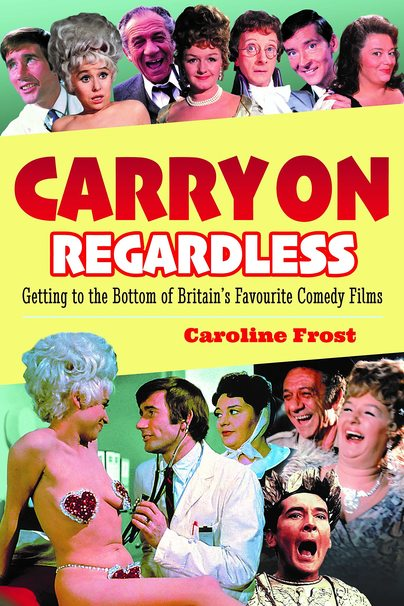
Pen & Sword Review: Carry on Regardless, by Caroline Frost

By Caroline Frost
Imprint: White Owl
Pages: 232
Illustrations: 32 black and white illustrations
ISBN: 9781526774781
Published: 5th May 2022
Expected Re-release Date: 30th June 2022

Blurb

The completely updated story of Carry On, Britain’s largest film franchise, all the way from the gentle capers of the 1950s, through the raucous golden age of the 1960s, to its struggles in the years that followed.

We take a happy walk down memory lane to enjoy again Sid James’s cheeky chuckle, Kenneth Williams’ elongated vowels, Charles Hawtrey’s bespectacled bashfulness and Barbara Windsor’s naughty wiggle.

It all seemed effortless, but exclusive interviews with the series’ remaining stars including Bernard Cribbins, Angela Douglas and Kenneth Cope shed new light on just how much talent and hard work went into creating the laughs. For the first time, the loved ones of some of the franchise’s biggest names – on and off screen – share their personal memories from this unique era.

Was Carry On really as sexist, racist and bigoted as critics claim? Three of the films’ female stars explain why they never felt remotely exploited, plus we take a fresh look at some of the series’ biggest titles and discover that, in reality, they were far more progressive than their detractors would have you believe.

Finally, with constant talk about new films, fresh productions and tantalising speculation about a brand new era of Carry On, we ask – does this unique series still have legs?

My Review

Thanks to the publisher for sending me a copy of this book. It came with my latest box of books from Pen & Sword. I have always enjoyed the Carry On… films, they are a fond memory from my childhood, where we collected the VHS tapes and then the DVDs. I still have the DVDs but got rid of my tapes when I moved out in 2014. I have always been fascinated by the personalities behind the films, especially the ensemble cast of the 60s who come to mind when I think about the films. I’ve been re-watching the films lately. They’re a nostalgic blanket on a wet Sunday afternoon.

I can also quote quite a few lines from most of the films.

This book is an overview of the films, the cast and crew, going from the earliest film, Carry On Sergeant, to the final film, Carry On Columbus. Over the series the films poked gentle fun at institutions, cracked jokes and threw out double entendre all over the place. Unfortunately, by the late seventies, they struggled to cope with changing social mores and the attempts at keeping up with the times fell flat.

Frost writes from a position of fondness and the author clearly enjoyed interviewing as many people as she could who had been involved, and using the auto/biographies of those she could not, to give a positive view of the films. However, she doesn’t give us many details of the actual production process, and she gets repetitive at times. We hear time and time again how much the cast enjoyed filming, and how it was ‘just like going back to school’ every time they went back to Pinewood Studios. It also gets a bit ‘Great British Humour’ at times, all a bit jingoistic.

I found the discussion of criticism of the films interesting. Certainly the sort of stuff they got away with wouldn’t happen now, such as the black face used in Carry On…Khyber and …Up The Jungle. The roles for women could be a bit limited, although as the author points out, many of the women characters were strong, determined women. Carry on Cabby is a fantastic early example. However, the cheap jokes at the expense of women’s appearances is galling, and actually contributed to Joan Sims’ possible Binge Eating Disorder. I thought that Frost’s attitude to the criticism of what she and others refer to as ‘Woke’ and ‘PC’ critics is a bit hypocritical. People have made valid points about the films and the attitudes they display, and you have to be a very canny viewer to realise there’s a bit more going on.

There is a discussion of the likelihood of new Carry Ons…end the book; there are some deluded people out there that think it could happen. I’m sorry, but times and humour have changed. The films are a snap-shot of a time and place, a period of social change that is reflected in the attitudes of the films and the tension between the past and present in the 1960s and early 1970s. The films also worked because they had an ensemble cast of comedic actors. As we saw with the rebooted ‘St. Trinians’ films, what worked in 1960 doesn’t work in the 2000s; social mores and humour have changed, and there is a dearth of the sorts of comedic actors who would be willing to work as part of an ensemble cast, or with the training on stage, TV and film that the cast had.

Over all, it’s okay, but could be better.

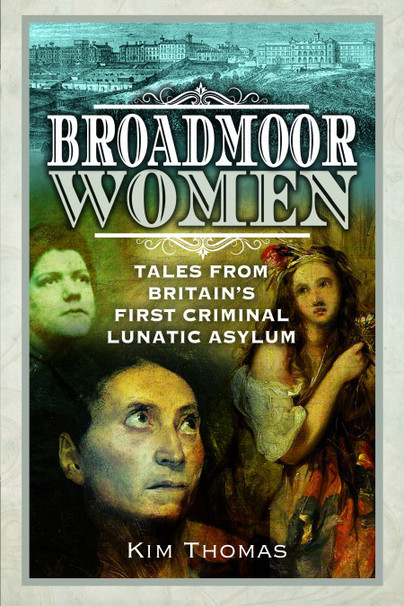
Pen & Sword Review: Broadmoor Women – Tales from Britain’s first criminal lunatic asylum, by Kim Thomas

By Kim Thomas
Imprint: Pen & Sword History
Pages: 192
Illustrations: 20 black and white illustrations
ISBN: 9781526794260
Published: 12th April 2022

Blurb

Broadmoor, Britain’s first asylum for criminal lunatics, was founded in 1863. In the first years of its existence, one in five patients was female. Most had been tried for terrible crimes and sent to Broadmoor after being found not guilty by virtue of insanity. Many had murdered their own children, while others had killed husbands or other family members.

Drawing on Broadmoor’s rich archive, this book tells the story of seven of those women, ranging from a farmer’s daughter in her 20s who shot dead her own mother to a middle-class housewife who drowned her baby daughter. Their moving stories give a glimpse into what nineteenth-century life was like for ordinary women, often struggling with poverty, domestic abuse and repeated childbearing. For some, Broadmoor, with its regime of plain food, fresh air and garden walks, was a respite from the hardships of their previous life. Others were desperate to return to their families.

All but one of the women whose stories are recounted in this book recovered and were released. Their bout of insanity was temporary. Yet the causes of their condition were poorly understood and the treatment rudimentary. As well as providing an in-depth look at the lives of women in Victorian England, the book offers a fascinating insight into the medical profession’s emerging understanding of the causes and treatment of mental illness.

My Review

Rosie Crofts, who does the marketing for Pen & Sword, sent me an email about this book a couple of weeks ago. I sat down and read it over the weekend.

I quite enjoy microhistories; the life of a single person or building can tell you something about the world around them. This book investigates the lives of seven women who were incarcerated in Broadmoor in the first forty years.

Most of them killed their children, one killed her husband and one killed her mother. Most of them had hard lives, limited by social conventions and/or poverty. Respectability was important to them all, and in court could be leveraged by a defendant so that they received a ‘guilty but insane’ or ‘not guilty by reason of insanity’ verdict. Often judges and juries were sympathetic to women who killed new born children in ‘puerperal insanity’ or ‘lactation insanity’. Psychiatrists and doctors didn’t really understand what was going on in people’s minds, and were still clinging to the idea that uteruses could cause madness; one particular belief was that women were so fragile that breast feeding for too long would cause madness.

Some of them had pre-existing mental health conditions before they committed their crimes and hadn’t received any or very limited care. Medical care for mental illness was limited at the time, as people were expected to look after their family members and doctors didn’t really understand how brains and hormones worked. Really bad cases were dropped in asylums and either left or experimented on, observed and drugged. Except in rare cases, like Tukes’ Retreat in York where the Quakers believed in calm, purposeful activity and loving kindness.

They averaged about 7 years in Broadmoor and were often released back to their families. Some husbands started petitioning for their release almost immediately after they were convicted, out of love or desperation for someone to care for their children. Returning to their families was often the worst thing that could happen to the women for several years, since it was the family/home environment that triggered the mental breakdown in the first place.

The regime at Broadmoor in the early years was based on improvement and calm, providing patients with a safe place to recover from their madness, time to heal and return to equanimity before being released. The early superintendents took after Dr. Tuke in their care of the patients; nutritious food, rest and care by sympathetic staff. Their regime was based on the latest (in the 1860s) scientific information. It would still be considered good care, now. Unfortunately, in between 1900 and 2000 there was a change in attitudes from care to abuse and back again. Seriously, I’m working on a project about this for work and it gives me nightmares to think about what happened to people with mental illnesses, learning disabilities or who were otherwise neurodivergent in asylums and residential centres.

I found this book interesting, it humanises the history of Broadmoor and gives us a snapshot into the social conditions of the late Victorian period. It would have been interesting to learn about the lives of the women warders alongside the patients. How did some working class women end up as warders and some as patients?

Could have done with some copy editing.

Pen & Sword Review: The Real World of Victorian Steampunk, by Simon Webb

43972585
Paperback, 168 pages
Published November 13th 2019 by Pen and Sword History
ISBN: 1526732858 (ISBN13: 9781526732859)

In the last few decades, steampunk has blossomed from being a rather obscure and little-known subgenre of science fiction into a striking and distinctive style of fashion, art, design and even music. It is in the written word however that steampunk has its roots and in this book Simon Webb explores and examines the real inventions which underpin the fantasy. In doing so, he reveals a world unknown to most people today.

The Real World of Victorian Steampunk shows the Victorian era to have been a surprising place; one of steam-powered airplanes, fax machines linking Moscow and St Petersburg, steam cars traveling at over 100 mph, electric taxis and wireless telephones. It is, in short, the nineteenth century as you have never before seen it; a steampunk extravaganza of anachronistic technology and unfamiliar gadgets. Imagine Europe spanned by a mechanical internet; a telecommunication system of clattering semaphore towers capable of transmitting information across the continent in a matter of minutes. Consider too, the fact that a steam plane the size of a modern airliner took off in England in 1894.

Drawing entirely on contemporary sources, we see how little-known developments in technology have been used as the basis for so many steampunk narratives. From seminal novels such as The Difference Engine, through to the steampunk fantasy of Terry Pratchett’s later works, this book shows that steampunk is at least as much solid fact as it is whimsical fiction. 

Continue reading “Pen & Sword Review: The Real World of Victorian Steampunk, by Simon Webb”

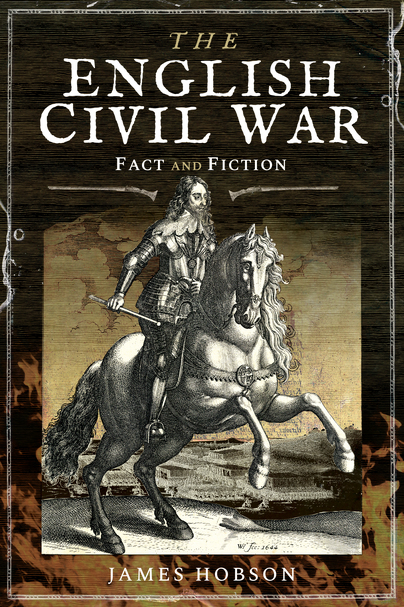
Review: The English Civil War: Fact and Fiction, by James Hobson

The English Civil War
By James Hobson
Imprint: Pen & Sword History
Pages: 135
Illustrations: 40
ISBN: 9781526734877
Published: 9th April 2019

Have you ever found yourself watching a show or reading a novel and wondering what life was really like in the Civil War? Did the war really split families? Was Charles I just too stupid to be King? Did Cromwell really hate the monarchy and did Parliament actually ban Christmas?

In The English Civil War: Fact and Fiction, you’ll find fast and fun answers to all your secret questions about this remarkable period of British history. Find out about people’s lives and how the Civil War affected them. Learn about the role of women and if they merely stayed at home and suffered, and if Cromwell really was always miserable.

James Hobson brings to life the tumultuous and unprecedented period of history that is known as the Civil War. An unfussy yet accurate history, each chapter presents a controversy in itself and sets about dispelling commonly held myths about the Civil War.

Continue reading “Review: The English Civil War: Fact and Fiction, by James Hobson”

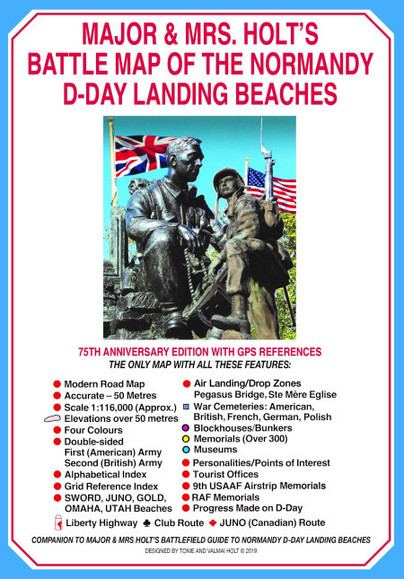
Map Review: Major & Mrs Holt’s Battle Map of the Normandy D-Day Landing Beaches

Major & Mrs Holt’s Battle Map of The Normandy D-Day Landing Beaches
An accompaniment to the best-selling guide to the area, now sold separately.

Showing the sea Assault formations for UTAH, OMAHA, GOLD, JUNO and SWORD Beaches and the air Assault Formations round Ste M Eglise and Pegasus Bridge; the D-Day Objectives and the Ground Gained on D-Day.
Imprint: Pen & Sword Military
ISBN: 9781526764942
Published: 28th October 2019
Price: £5.99

My Review

This map seems fairly detailed and would be useful for someone touring the D-Day Landing beaches if they’re searching for specific sites. No hotels, car parks etc. but the GPS references would make your tour to Normandy easier.

Non-fiction Bonus Reviews #1

I haven’t been feeling great so my reviews are a bit behind. I have a stack of books next to my laptop that I need to tell you all about. I’ve got three Pen & Sword books for you and an indie about comic book history.

Continue reading “Non-fiction Bonus Reviews #1”

Last Reviews of 2018

Honest! I’m not doing anymore this year. I’ve been ill, there’s been a lot of reading time. I’ve been making progress through my Pen & Sword collection.

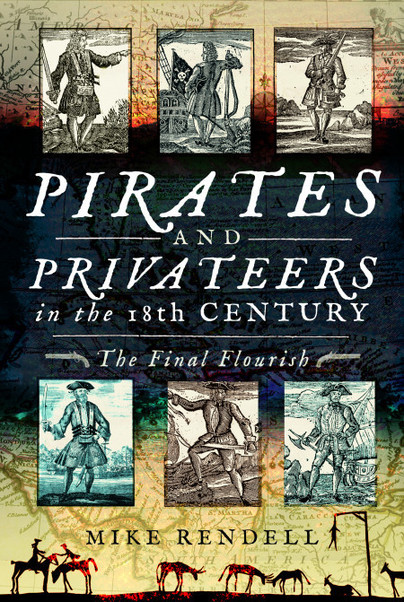
Pirates and Privateers in the 18th Century
Published By: Pen & Sword
Publication Date: 7th November 2018
Format: Hardback
ISBN: 9781526731654
Price: £15.99
Link

Blurb


Pirates and Privateers tells the fascinating story of the buccaneers who were the scourge of merchants in the 18th Century. It examines their lifestyle, looking at how the sinking of the Spanish treasure fleet in a storm off the coast of Florida led to a pirate’s gold rush; how the King’s Pardon was a desperate gamble – which paid off – and considers the role of individual island governors, such as Woodes Rogers in the Bahamas, in bringing piracy under control.

The book also looks at how piracy has been a popular topic in print, plays, songs and now films, making thieves and murderers into swash-buckling heroes. It also considers the whole question of buried treasure – and gives a lively account of many of the pirates who dominated the so-called ‘Golden Age’ of Piracy.

My Review

A very good introduction to the subject, concentrating on the era known as the ‘Golden Age’ of piracy, and while the author notes that piracy is still with us and is the result of systemic inequalities, he doesn’t discuss modern piracy – that is outside the scope of the book. The chapters cover the general history of piracy, biographies of various pirates and colonial officials who sought to deal with them, and the ‘pirate’ sub-genre of crime literature and it’s later developments in novels and other popular culture such as plays and films.

The book was very easy to read, the author writes sympathetically but is realistic about the nature of piracy – not heroes but thieves, rapists and murderers – and explores the myths surrounding pirates and their treasures with a keen eye for poppycock. The book explores only a tiny fragment of the subject, but it is a good starting place for further research.

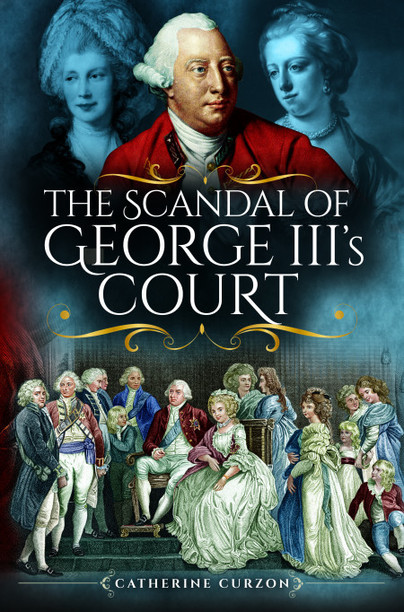
The Scandal of George III's Court
BPublished By: Pen & Sword
Publication Date: 19th November 2018
Format: Hardback
ISBN: 9781473872516
Price: £15.99
Link

Blurb


From Windsor to Weymouth, the shadow of scandal was never too far from the walls of the House of Hanover. Did a fearsome duke really commit murder or a royal mistress sell commissions to the highest bidders, and what was the truth behind George III’s supposed secret marriage to a pretty Quaker?

With everything from illegitimate children to illegal marriages, dead valets and equerries sneaking about the palace by candlelight, these eyebrow-raising tales from the reign of George III prove that the highest of births is no guarantee of good behaviour. Prepare to meet some shocking ladies, some shameless gentlemen and some politicians who really should know better.

So tighten your stays, hoist up your breeches and prepare for a gallop through some of the most shocking royal scandals from the court of George III’s court. You’ll never look at a king in the same way again…

My Review

What a family! I’d be so embarrassed if I was directly related to them. An overbearing matriarch and patriarch, daughters confined to the palace, sons and brothers making ‘unsuitable’ marriages, girlfriends and illegitimate children here there and everywhere, the odd murder. Sounds like most families. Except this one had money and power to back up their behaviour and silence people. And they were the centre of press focus for decades. And what fun the press had with them…

I sat and read this book yesterday after I’d finished reading about pirates. Sometimes a bit of gossip is fun, especially when those concerned have been dead for two centuries. It was fun, amusing. Curzon’s jaunty writing style lends itself to the subject and it’s obvious that the eighteenth century is her passion. She writes sympathetically and makes evenhanded judgements on the truth or otherwise of the rumours and scandal. She uses contemporary sources, later literature and current scholarship to provide a rounded picture of events and the people involved.

This book is a an accessible, fun, introduction to the period and people of George III’s court.