
TBR Review: They Came To Slay: The Queer Culture of D&D, by Thom James Carter

Format: 120 pages, Paperback
Published: July 28, 2022 by 404 Ink
ISBN: 9781912489602 (ISBN10: 1912489600)

Description

Since its inception decades ago, the tabletop roleplaying game Dungeons & Dragons has offered an escape from the real world, the chance to enter distant realms, walk in new shoes, and be part of immersive, imaginative tales as they unfold. More so, in Thom James Carter’s opinion, it’s a perfect vessel for queer exploration and joy.

Journey on, adventurer, as Dungeon Master Thom invites readers into the game’s exciting queer, utopian possibilities, traversing its history and contemporary evolution, the queer potential resting within gameplay, the homebrewers making it their own, stories from fellow players, and the power to explore and examine identity and how people want to lead their lives in real and imagined worlds alike.

Grab a sword and get your dice at the ready, this queer adventure is about to begin.


My Review

This was an interesting little book about D&D and Queer culture, exploring the background and history of D&D, and the use of D&D by Queer people to explore their identities. It’s an interesting essay and the structure is fun. It is a introduction to the game and TTRPGs generally, but if you’re already in the fandom, you might not find much useful in it.

One-Time
Monthly
Yearly

Make a one-time donation – If you want. No pressure.

Make a monthly donation

Make a yearly donation

Choose an amount

£5.00
£15.00
£100.00
£5.00
£15.00
£100.00
£5.00
£15.00
£100.00

Or enter a custom amount

£

Your contribution is appreciated. I put a lot of effort into reading and reviewing books for readers.

Your contribution is appreciated.

Your contribution is appreciated.

DonateDonate monthlyDonate yearly
TBR Pile Review: Who’s Afraid of Gender, by Judith Butler

Format: 320 pages, Hardcover
Published: March 19, 2024 by Allen Lane
ISBN: 9780241595824 (ISBN10: 0241595827)

Description

Judith Butler, the ground-breaking philosopher whose influential work has redefined how we think about gender and sexuality, confronts the attacks on gender that have become central to right-wing movements today. Global networks have formed “anti-gender ideology movements” dedicated to circulating a fantasy that gender is a dangerous threat to families, local cultures, civilization –and even “man” himself. Inflamed by the rhetoric of public figures, this movement has sought to abolish reproductive justice, undermine protections against violence, and strip trans and queer people of their rights. But what, exactly, is so scary about gender?

In this vital, courageous book, Butler carefully examines how “gender” has become a phantasm for emerging authoritarian regimes, fascist formations, and trans-exclusionary feminists. They illuminate the concrete ways that this phantasm displaces anxieties and fears of destruction. Operating in tandem with deceptive accounts of critical race theory and xenophobic panics about migration, the anti-gender movement demonizes struggles for equality, fuels aggressive nationalism, and leaves millions of people vulnerable to subjugation.

An essential intervention into one of the most fraught issues of our moment, Who’s Afraid of Gender? is a bold call to make a broad coalition with all those whose struggle for equality is linked with fighting injustice. Imagining new possibilities for both freedom and solidarity, Butler offers us an essentially hopeful work that is both timely and timeless.

My Review

Interesting, definitely one to re-read and digest. I struggled with parts of the text – it was a bit dense.

The author challenges the phantasm of ‘gender ideology’, pushed by those with a stake in maintaining the cis-heteronormative, patriarchal status quo as part of religious and Right wing ideology. The author takes the reader through the various talking points, and explains how those opposed to equal rights for gender and sexual minorities elide between talking points without logical argument. They assume ‘allowing trans people to live their lives’ automatically means ‘anyone will identify as anything in order to attack children’. There’s no logical way to get from one to the other. This is a way to displace the fear of living in late-stage capitalism, with the attendant global warming and population displacement that comes with it. Instead of focusing our anger and fear on the causes of the world becoming unliveable, humans are distracted by false ghosts, phantasms, bundled under the word ‘gender’.

The book seems to be aimed at a non-academic audience, covering what should be fairly obvious arguments, if you’ve kept up with the whole anti-trans movement. However, it does become very academic and falls into philosophy-speak at times. I did enjoy reading this book, but sometimes, I wish they’d written it in plain English.

It’s late, I’ll write more when I’ve had a think about it.

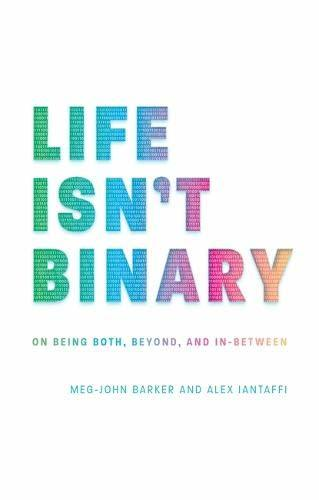
TBR Pile Review: Life Isn’t Binary, by Meg-John Barker and Alex Iantaffi

Format: 237 pages, Paperback
Published: May 21, 2019 by Jessica Kingsley Publishers
ISBN: 9781785924798 (ISBN10: 1785924796)
Language: English

Description

Challenging society’s rigid and binary ways of thinking, this original work shows the limitations that binary thinking has regarding our relationships, wellbeing, sense of identity, and more. Explaining how we can think and act in a less rigid manner, this fascinating book shows how life isn’t binary.

My Review

This book starts with the obvious understanding of ‘non-binary’ in discussing sexuality and gender, and then goes on to discuss non-binary approaches to relationships, bodies, emotions, and thinking. What this really means is that people tend to think in either/or ways, yes/no, black/white, etc. but the authors recommend more and/both thinking about life.

For someone who is non-binary it is an interesting, yet obvious concept. Although I’m autistic and we’re often accused of black and white thinking, I’ve always wanted to ask why? and my conception of conflict as the stories people tell themselves not meshing completely, already allows me to view reality in a way that includes what the authors refer to as ‘multiversal’. The authors use a therapist and Buddhist way of putting it, but it’s the same thing. Our stories are always changing, we’re always in the process of becoming, not completed, not finalised. And we have many stories, depending on who we’re interacting with.

I found this book fairly interesting. I got through the first four chapters in record time, but the last two chapters seemed to drag a bit. It was mostly the last chapter. I found it a bit woo heavy, especially the ‘make an alter to yourself’ reflection point. I understand the authors are interested in Buddhism, and work as therapists, so it’s understandable. It just doesn’t work for me.

It’s a good introduction to non-binary genders and unconventional relationships.

First Review of 2021: Queer: A Graphic History, by Meg-John Barker, Illustrated by Julia Sheele

28957268
Paperback, 176 pages
Published November 15th 2016 by Icon Books
ISBN:1785780719 (ISBN13: 9781785780714)

Blurb

Activist-academic Meg-John Barker and cartoonist Julia Scheele illuminate the histories of queer thought and LGBTQ+ action in this groundbreaking non-fiction graphic novel.

From identity politics and gender roles to privilege and exclusion, Queer explores how we came to view sex, gender and sexuality in the ways that we do; how these ideas get tangled up with our culture and our understanding of biology, psychology and sexology; and how these views have been disputed and challenged.

Along the way we look at key landmarks which shift our perspective of what’s ‘normal’ – Alfred Kinsey’s view of sexuality as a spectrum, Judith Butler’s view of gendered behaviour as a performance, the play Wicked, or moments in Casino Royale when we’re invited to view James Bond with the kind of desiring gaze usually directed at female bodies in mainstream media.

Presented in a brilliantly engaging and witty style, this is a unique portrait of the universe of queer thinking.

My Review

Happy New Year. Let’s hope 2021 is better than 2020.

I treat myself to this book because I had the spare cash and it has been on my wish list for a while. It arrived this morning and I’ve spent a few hours today reading it. I rather enjoyed it. This book is an illustrated introduction to Queer Theory and its history from about the early twentieth century. Introduction is the key word here, if you know something of the subject already it would probably seem simplistic, but for those of us with a bit of amorphous knowledge but nothing specific, things we’ve seen online but haven’t entirely understood, this book is excellent. The emphasis on questioning binaries (man/woman, homosexual/heterosexual), the fixed nature of gender, sex and sexuality, the cultural context of same, was fascinating, and ties in with thoughts I’d already had.

I must recommend this book to people interested in the subject but without the formal academic background usually needed to understand this sort of thing.