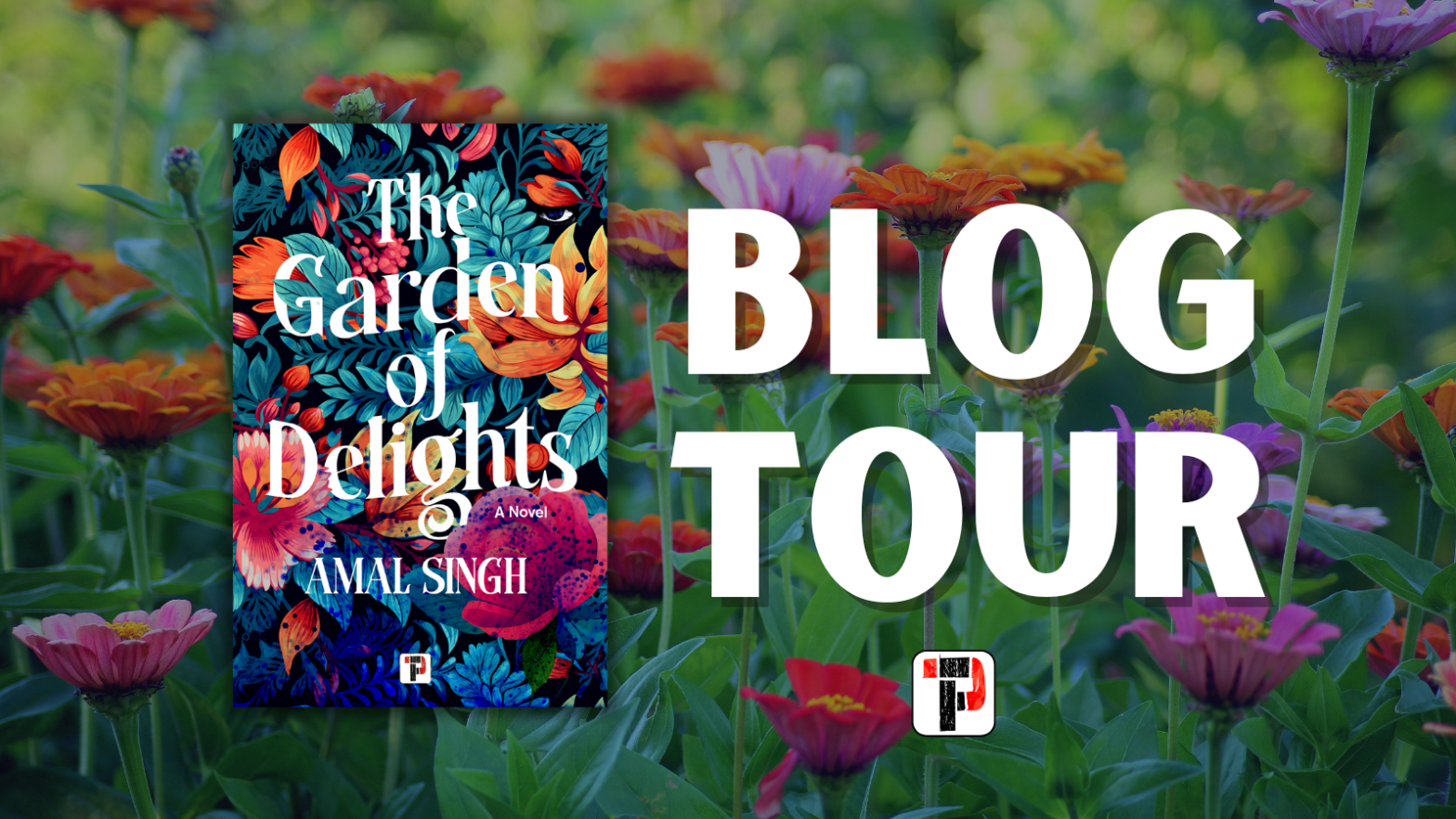
Review: The Garden of Delights, by Amal Singh

Genre – fantasy > mythology > magical realism
● ISBN paperback – 978-1-78758-908-7
● ISBN ebook – 978-1-78758-910-0
● Pricing [USD] $16.95 (PB) / $4.99 (EB)
● Pricing [GBP] £12.95 (PB) / £4.95 (EB)
● Releases 14 May 2024
● Published by Flame Tree Press
● Distributed by Hachette UK

SYNOPSIS

A world where petals are currency and flowers are magic.

A man battling a curse of eternal old age. A girl who can be his boon. But it’s not all tulips and roses. There are also nettles and thorns.
Where Delights persist, Sorrow must follow.

In the city of Sirvassa, where petals are currency and flowers are magic, the Caretaker tends to the Garden of Delights. He imparts temporary magical abilities to the citizens of Sirvassa, while battling a curse of eternal old age.

No Delight could uplift his curse, and so he must seek out a mythical
figure. A god.

When a Delight allows a young girl the ability to change reality, the Caretaker believes he’s at the end of his search. But soon a magical rot takes root in his Garden, and the Caretaker must join forces with the girl and stop it from spreading.

My Review

Thanks to the publisher for sending me a copy of this book and to Anne Cater for organising this blog tour.

The blurb doesn’t do this book justice. Also, the Caretaker doesn’t realise what Iyena could do, and who she was, until after she cures the rot and dies.

Okay, that’s a bit of a spoiler. Iyena dies and is reborn, and it’s magnificent!

We start with an epic battle between a Florral and a Champion, the semi-divine magicians of the Inishtis and Abhadis, two tribes of humans who have been fighting forever. The Inishtis use floral technology; the Abhadis use metal technology. In the centuries that follow the epic battle, two cities rise: Sirvassa, home to floral technology, a stronghold of the Inishtis, a city of flowers and petal rains, and the Garden of Delights, overseen by the Caretaker, one of the few remaining Florrals; and Alderra, industrial capital of the Three Realms, the Abhadis stronghold, a place of flying machines and railways, a place where the Champions still have a home, a city they protect.

The Caretaker, protector of the Garden of Delights, and Sirvassa in general. He gives Delights made from the flowers in his Garden to the people of Sirvassa, giving them a temporary taste of the magic Florrals used at will. He is worried about developments in the city, something is going on, especially after Ministry officers from Alderra arrive and the Mayor of Sirvassa becomes weak. The Caretaker is dealing with his own problems. His experiments in curing the curse have made things worse.

Meanwhile, a girl, 15, arrives in Sirvassa, with her father. Iyena is the daughter of an Abhadi father and and Inishti mother, and born in Alderra. Separated, Iyena has no idea where her mother is or why she left her with her father, but immediately feels at home in Sirvassa, her mother’s home city. Her father is a stern, distant man, who works for the Ministry of Miscellany in Alderra, has brought them to stay with Maani-Ba, her mother’s sister, ostensibly to see about trading agreements between Sivassa and Alderra.

Iyena goes to school, and is enchanted by everything, from learning from books rather than oral learning, to the beasts that pull the carriages, to the fluttering ribbons that cross the city above the roofs, to a boy named Trehan. Making friends and learning about this new society, her maternal inheritance, brings her joy. She learns about the Garden of Delights after Trehan shows off his current Delight. With some forgery, she gets permission to visit the Garden and receives a Delight.

After that it all gets a bit political; there are explosions, sudden changes to the school curriculum and teaching, a fancy dinner at the mayor’s bungalow, fights between the Caretaker and Champions, death and rebirth, freedom and battles to maintain the cultural diversity of the Three Realms.

I was enchanted by this novel. I was about two thirds through it when I got a sense of terrible dread, that Sirvassa would be destroyed by the Minister’s plots; I had to put the book down because I couldn’t face the thought. After a couple of days I went back to the book, because I had to know what happened next. I think I struggled because the sneaky colonialism of Sirvassa by the Alderrans reminded me too much of events in the real world. The wholesale changing of school curricula, the re-writing of history, trying to co-opt Sirvassan cultural traditions, and the ‘if we can’t have it, destroy it’ attitude, remind me of historical colonialism and current colonial states. We’re bearing witness to several such colonial events right now, with all the attendant propaganda, murder and re-writing of history. Anyone with empathy would feel dread at reading it in fiction, when we’re already bearing witness in the real world.

The novel has a much happier ending than the consequences of historical colonialism and the realistic consequences of current colonial efforts. Any Florrals around who can save the world?

The writing is quite lyrical, and compelling reading. The descriptions are beautiful and colourful.

The relationship between the Caretaker and Trulio is paternal, and the way it ends is devastating. The confusing relationship Iyena has with her parents, her distant but present father, and absent but close in memory mother, especially after she meets her aunts, prompt many of Iyena’s actions. She’s pushed from one to the other, by the actions of her father and his friends. I particularly found the relationship between Iyena and Maani-Ba touching. There’s a lot of love and care between them, and secrets. Maani-Ba stands by Iyena when she goes through her change of state, and is instrumental in the rebellion after Iyena becomes afraid of her own abilities. The character development of the main characters is gentle but present.

The touches of Indian culture and inspired mythology, the contrast between the industrial Alderra and the floral Sivassa, the hints of a greater world beyond, really bring the world building to life.

Highly recommended.


ABOUT THE AUTHOR

Amal Singh is a writer of science fiction and fantasy from Mumbai, India. He has numerous short story publications to his credit, in venues such as Clarkesworld, F&SF, Apex, Fantasy, among others. His story What is Mercy?, published in Fantasy Magazine, was longlisted for the BSFA Award in 2021. While he has held jobs of IT Analyst, Database Administration, and SOP consultancy in the past, he is now fortunate enough to do something that involves full-time writing.
By day, he juggles screenwriting, audio-writing, and Creative Production, working on web-shows and movies. In his spare time, he enjoys cooking and running.
amalsingh.substack.com / X: @Jerun_ont


FLAME TREE PRESS is the imprint of long-standing independent Flame Tree Publishing dedicated to full-length original fiction in the horror and suspense, science fiction & fantasy, and crime / mystery / thriller categories. The list brings together fantastic new authors and the more
established; the award winners, and exciting, original voices. Learn more about Flame Tree Press at http://www.flametreepress.com and connect on social media @FlameTreePress

Maria and the Space-Dragons #1 – May 2024 instalment

We continue the story at the tundra base, as Elder Pjang-Nich explains why Maria and Lah-Shah have been called to the distant base.


Chapter 4 – Pjang-Nich explains

Pjang-Nich whistled, a light-screen appeared above the table. A star map lit up on the screen, tool tips showing their location and the location of their target. It was some distance across the galaxy but still easily done with the jump gate system. Pjang-Nich clicked her tongue a couple of times, the screen shifted and zoomed in on the target system.

A star, bigger, older, redder than Ascend’s star, surrounded by two rocky planets and two gas giants. The rocky planets orbited each other. The first gas giant orbited close to the star, while the second gas giant seemed to be nearer to the star than expected, with dozens of moons, squeezing the rocky planets between them.

Review: Wild Treasure, by Hannah Stitfall


My Review

Thanks to Anne Cater for organising this tour. My copy did not from the publisher did not arrive, so I bought myself one. I’m not a fan or the author. their TV shows, or anything like that, I’m interested in both wildlife and Cornwall, since my mum’s maternal family and my step-Dad are Devon and Cornwall (unlike Stitfall who is a blow-in from Essex).

I’ve been a bit of a spotter since I was a kid, but I was never any good at it. I used to enjoy taking my little Osbourne books of birds and coastal life out with me on hikes with my dad and the local walking club, but haven’t really done much since I was 14. I do like to sit in the garden, or allotment, and bird watch. We have a new ecology group at work too, so I’m picking up bits of insect information. Again, I’m not very good at it. I need more practice.

Sorry if I sound grumpy today, I’m in pain. Because of this book. I read an awful lot of my copy on Tuesday, and enthused by the writing, decided to take a walk along the coast near here. The Humber is a SSSI designated area. I walked from the main drag of the Prom to the sand dunes by the swimming pool and then along the paths through the sea grass meadows. They’ve become much more extensive in the last twenty years. the area that used to be beach, on the other side of the swimming pool has changed immensely, with a much more varied habitat of dunes and salt marsh. I kept to the paths, but they got a bit wobbly once I got to the marsh adjacent to Meridian Point and I fell twice trying to cross from the path to the sea wall. got covered in mud. Which, to be honest, is nothing new. I have a cut on my right knee and my left hip is registering its disapproval quite vociferously. I did make it to a bus though and home, so it’s all good.

I saw a heron, and lots of crows and magpies. I think. I didn’t get bitten by anything, which is practically a miracle in itself, and I had a paddle in the water. I took photos of various plants and birds and at some point I’ll attempt to identify them.

Back to the book review.

I enjoyed the writing style, straightforward and descriptive, shading into poetic at times. I loved the photography. It really enthused me about going out and appreciating the local nature (the ‘wild life’ is a different matter altogether – Newquay misbehaviour ain’t got nothing on Cleethorpes in the early hours of a summer Saturday). This book is a celebratory and entertaining trip through the natural calendar of Cornwall, written by someone with a genuine love of wildlife and an ethical approach to nature photography. I recommend it to people who want to see what’s living in their area, if they live in Cornwall or are visiting at any time of year.

Also, my step-Dad tells a fantastic story about Seal Island near St. Ives, involving a boatload of American tourists and an inflatable seal.


Book Review: Thirty Days of Darkness, by Jenny Lund Madsen

PUBLICATION DATE: 9 MAY 2024
PAPERBACK ORIGINAL | £16.99 | ORENDA BOOKS

A snobbish Danish literary author is challenged to write a crime novel
in thirty days, travelling to a small village in Iceland for inspiration,
and then the first body appears…

Copenhagen author Hannah is the darling of the literary community and
her novels have achieved massive critical acclaim. But nobody actually
reads them, and frustrated by writer’s block, Hannah has the feeling that
she’s doing something wrong.

When she expresses her contempt for genre fiction, Hanna is publicly
challenged to write a crime novel in thirty days. Scared that she will lose
face, she accepts, and her editor sends her to Húsafjörður – a quiet,
tight-knit village in Iceland, filled with colourful local characters – for
inspiration.

But two days after her arrival, the body of a fisherman’s young son is
pulled from the water … and what begins as a search for plot material
quickly turns into a messy and dangerous investigation that threatens to
uncover secrets that put everything at risk … including Hannah

Continue reading “Book Review: Thirty Days of Darkness, by Jenny Lund Madsen”

Angry Robot Review: Bluebird, by Ciel Pierlot

Format: 444 pages, Paperback
Published: February 8, 2022 by Angry Robot
ISBN: 9780857669667 (ISBN10: 0857669664)
Language: English

Description

Lesbian gunslinger fights spies in space!

Three factions vie for control of the galaxy. Rig, a gunslinging, thieving, rebel with a cause, doesn’t give a damn about them and she hasn’t looked back since abandoning her faction three years ago.

That is, until her former faction sends her a message: return what she stole from them, or they’ll kill her twin sister.

Rig embarks on a journey across the galaxy to save her sister – but for once she’s not alone. She has help from her network of resistance contacts, her taser-wielding librarian girlfriend, and a mysterious bounty hunter.

If Rig fails and her former faction finds what she stole from them, trillions of lives will be lost–including her sister’s. But if she succeeds, she might just pull the whole damn faction system down around their ears. Either way, she’s going to do it with panache and pizzazz.


My Review

Angry Robot sent me a copy of Bluebird to read while I waited for The Hunter’s Gambit, also by the same author. The Hunter’s Gambit is fantasy and I’m reviewing it in late June. Bluebird is sci fi and I had no review date planned, I just happened to sit down yesterday and read the book. I started reading it when the book arrived, but stuff got in the way, so I only read three chapters. Yesterday, I read the remaining 370 pages. Totally worth spending my Saturday afternoon/evening reading it.

We meet Rig, a Kashrini, who has escaped the human faction Pyrite that took over her species’ homeworld and enslaved her species, when they aren’t murdering them, on a mission to rescue more indentured people. In the process she meets Ginka, from a felidae sentient species who’s species has come under the control of the Ossuary faction of humans. Ginka is a fighting machine with strange technology. And then Rig’s former faction catches up with her. This sends Rig and Ginka on a series of adventures as they avoid and/or fight both Pyrite and Ossuary spies. We get interludes where we find out about Ginao’s background and discover why she is out in space alone.

Rig wants to rescue her sister, Daara (loyal to Pyrite but now imprisoned), and protect her partner, Jane, who is an Ascetic faction librarian; Ginka wants to go home to her husband, Crane. They have allies known and unknown who want freedom. There are two powerful intelligence agencies against them. They might have to take down the factions to do it.

I wish I’d had time to read this earlier, it’s so good! As we journey across space with the pair, and meet various allies and enemies, and both of them almost die, the tension pulls the reader on, to keep turning the page. I needed to know what was going to happen next. We learn about the deeper issues in this ancient space empire, and humans don’t come out of it well. This is a richly imagined space adventure, with well-developed characters. The relationships between Rig and the other characters are fascinating and develop across the 400+ pages as they travel and fight.

The book ends with love and hope. We get happy endings for Rig and Ginka, while Daara has to make her own choices in life. One faction has been beaten and the other two have been forced to back off.

Recommended.

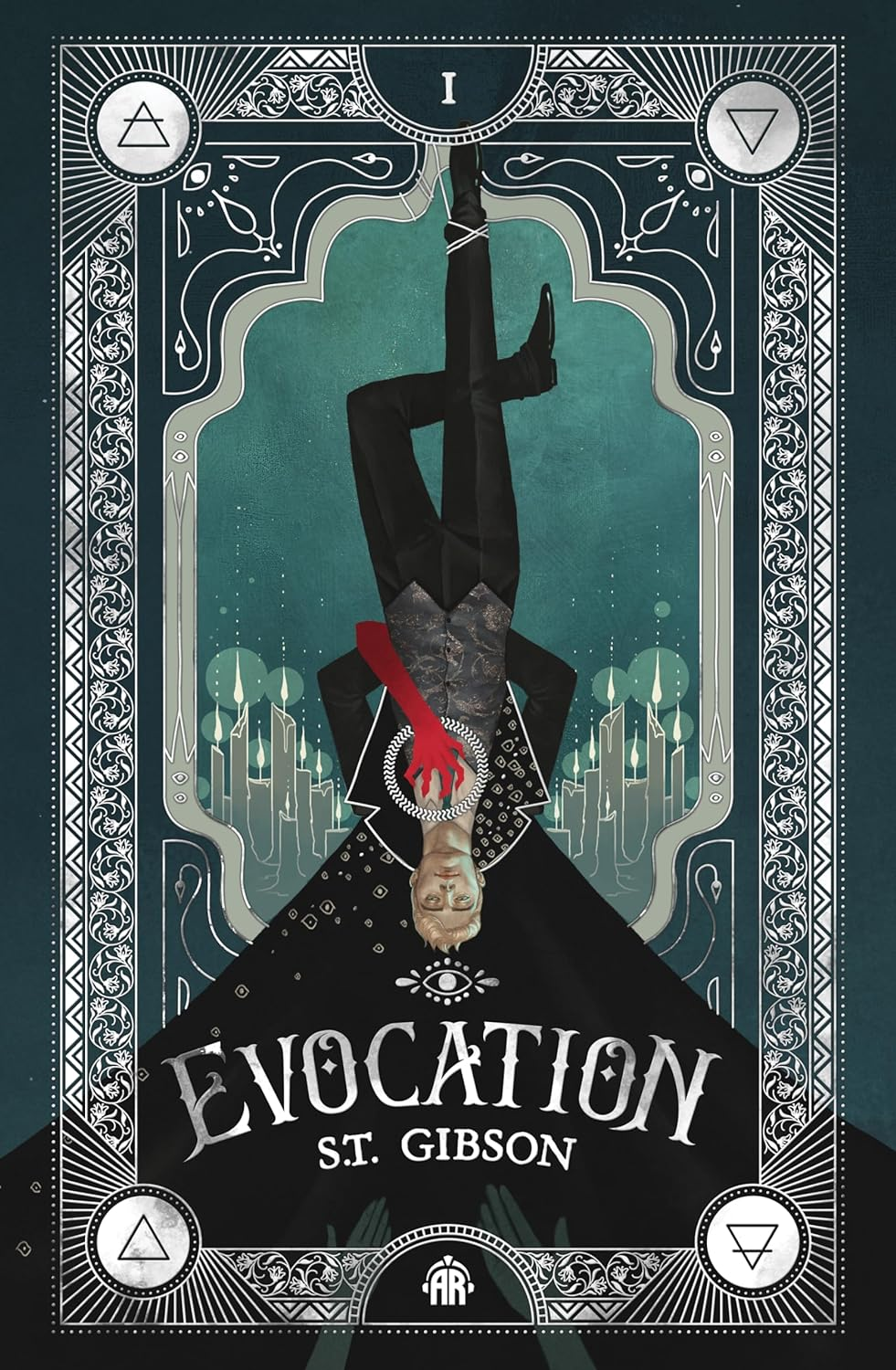
Angry Robot Book Review: Evocation, by S.T. Gibson

Format: 400 pages, Hardcover
Expected publication: May 28, 2024 by Angry Robot Books
ISBN: 9781915202680 (ISBN10: 191520268X)
Language: English

Description

The Devil knows your name, David Aristarkhov.

As a teen, David Aristarkhov was a psychic prodigy, operating under the shadow of his oppressive occultist father. Now, years after his father’s death and rapidly approaching his thirtieth birthday, he is content with the high-powered life he’s curated as a Boston attorney, moonlighting as a powerful medium for his secret society.

But with power comes a price, and the Devil has come to collect on an ancestral deal. David’s days are numbered, and death looms at his door.

Reluctantly, he reaches out to the only person he’s ever trusted, his ex-boyfriend and secret Society rival Rhys, for help. However, the only way to get to Rhys is through his wife, Moira. Thrust into each other’s care, emotions once buried deep resurface, and the trio race to figure out their feelings for one another before the Devil steals David away for good…

The first book in a spellbinding and vibrant new series from The Sunday Times bestselling author of A Dowry of Blood.


My Review

I have a limited edition proof copy of this book, sent by the publisher in December last year. I started reading it in January, but then life and blog tours got in the way, so I managed one chapter before I had to put it down. Last night, I read it all. In about five hours. I think the cover of my edition is way cooler that the standard edition. And I got a mini chocolate bar with my book.

From reading the first chapter I didn’t know if I’d enjoy the book. David is not a likeable character at the start. However, as the story progresses and the reader meets Rhys and Moira, and then other people in their circle, we learn something of them all. David, particularly, makes major character changes over the course of the novel as he becomes sick and is forced to confront his dead father, and a demon. Rhys and Moira are both antagonistic to him at the start, which we learn is due to David misdiagnosing the cause of a haunting in their house and blaming Moira. This is apparently the plot of the novella that precedes this novel. I haven’t read the novella, but picked up some of the story from mentions in this novel.

Rhys has ambitions of becoming important, while Moira suppresses her ambitions under the rules her mother taught her, and David has the insouciance and confidence of old money. They clash, because they all need therapy. David is driven by the fear of failure, of perfectionism, beaten into him by his abusive father. He’s a sober alcoholic, who copes with his stress by obsessively working both as a medium and a lawyer, while maintaining a punishing food and exercise regimen (he’s clearly struggling with orthorexia). Rhys has a load of Catholic guilt about being bisexual, about being an occultist, about having ambition. Moira needs to learn to put herself first sometimes, and to accept her own power.

Moira is the first one to realise, with the help of her friend Kitty, also a powerful magic worker, and wife of one of David and Rhys’ friends at the Society, that there is more than one way to do relationships. Moira at times acts as the hinge that keeps the two men from killing each other, holding them together when they’re falling apart, fighting demons or dying. As the story develops, and they all confront their feelings and trauma, they realise they can form a family that works for them.

It feels a bit like Moira is the one who is doing a lot of the work, of parenting two men in their late twenties who clearly didn’t get the parenting they needed as children. It’s unfortunate that this dynamic is one often found in heterosexual relationships (a woman becoming wife and surrogate mother to a man), and I found criticism of S.T. Gibson in other reviews of this book for that dynamic, but it’s what relationships are often like, and in a book that has demons and magic, the reality is grounding. I enjoyed the character growth they all go through and the resolution is satisfying.

S.T. Gibson is a really talented writer who knows enough about a variety of occult, magic and religious traditions to write convincingly about the many traditions that make an appearance in this book. It was fun playing ‘spot the tradition or folklore reference’ as I read the book. I want more of these books, more adventures for David, Rhys and Moira. And Leda, David’s half sister – who is utterly cool. I reckon if Kitty, Moira and Leda decided to, they could take over the Society, although Lorena would still be more powerful.

Recommended for fans of urban fantasy. Not much sex, for those who aren’t into it, but lots of angst and romance.

TBR Pile Review: Radical Intimacy, by Sophie K Rosa

Format: 208 pages, Paperback
Published: March 20, 2023 by Pluto Press
ISBN: 9780745345161 (ISBN10: 0745345166)
Language: English

Description

An impassioned discussion about the alternative ways to form relationships and resist capitalism.

Capitalist ideology wants us to believe that there is an optimal way to live. ‘Making connections’ means networking for work. Our emotional needs are to be fulfilled by a single romantic partner, and self-care equates to taking personal responsibility for our suffering. We must be productive and heterosexual, we must have babies and buy a house. But the kicker is most people cannot and do not want to achieve all, or any of these life goals. Instead we are left feeling atomised, exhausted and disempowered.

Radical Intimacy shows that it doesn’t need to be this way. A punchy and impassioned account of inspiring ideas about alternative ways to live, Sophie K Rosa demands we use our radical imagination to discover a new form of intimacy and to transform our personal lives and in turn society as a whole.

Including critiques of the ‘wellness’ industry that ignores rising poverty rates, the mental health crisis and racist and misogynist state violence; transcending love and sex under capitalism to move towards feminist, decolonial and queer thinking; asking whether we should abolish the family; interrogating the framing of ageing and death and much more, Radical Intimacy is the compassionate antidote to a callous society.


My Review

I have the Left Book Club edition of this book; the standard cover is plain yellow with black writing. All of the Left Book Club contemporary library have the same cover. I have several of them, this might be the first one I’ve had time to read. I started reading it on Wednesday, and almost finished it, but I had to go to bed, so I finished it off yesterday afternoon.

I thoroughly enjoyed reading this book. It was a thoughtful introduction to some of the ideas presented, and well referenced. I generally agree with the direction of the argument, the capitalist, atomised society we live in, focused on the nuclear family, doesn’t support humans in a healthy way. I think read in conjunction with other books, such as Empire of Normality, by Robert Chapman, which I’ve reviewed in the past, and other books from Pluto Press (which I have, but haven’t had a chance to read yet), this book could be a good base from which to work. The writing style was engaging although slightly shallow at times, with arguments not developed as fully as perhaps some would like. Sex is barely mentioned, because intimacy and sex are not synonymous.

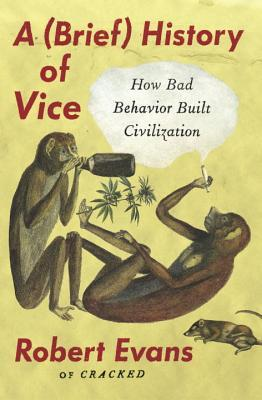
TBR Pile Review: A (Brief) History of Vice, by Robert Evans

Format: 260 pages, Paperback
Published: August 9, 2016 by Plume
ISBN: 9780147517609 (ISBN10: 0147517605)
Language: English

Description

From a former editor at the popular humour site Cracked.com and one of the writers of the bestselling You Might Be a Zombie and The De-Textbook, a rollicking look at vice throughout history, complete with instructions for re-creating debauchery at home.

Part history lesson, part how-to guide, A Brief History of Vice includes interviews with experts and original experimentation to bring readers a history of some of humanity’s most prominent vices, along with explanations for how each of them helped humans rise to the top of the food chain. Evans connects the dots between coffee and its Islamic origins, the drug ephedra and Mormons, music and Stonehenge, and much more. Chapters also include step-by-step guides for re-creating prehistoric debauchery in your modern life based on Evans’s first-hand fieldwork. Readers won’t just learn about the beer that destroyed South America’s first empire; they’ll learn how to make it.


My Review

I really enjoy Robert Evans’ podcast ‘Behind The Bastards’ and thought I’d give this book a read, just for amusement. Apparently he spent the money he was paid for this book on living in a ridiculously big house for a year and almost became homeless. Dafty.

Doing daft things for education and entertainment seems to be Evans’ motivation for a lot of things in life, although he is also a decent conflict zone reporter. This book was written while he was still at Cracked.com, and before he started his podcast. It is a mixture of science, history, anthropology and self-experimentation with a variety of historical intoxicants, from Sumerian early beer, hallucinogens from ancient Greece, nose pipes from Mesoamerica, and the ways tobacco has been used for healing, including as a purgative. I’m surprised only one person ended up in hospital.

The book was entertainingly written and honest about the effects of the various substances tried. I’m not sure the thesis, that ‘bad behaviour’ made civilisation, is substantiated, but it’s an interesting trip through the ancient world, from a very different perspective.