November update: the novel and other things

Good afternoon, loyal readers,

I’ve been a bit quiet lately, haven’t I?

I’m trying to get as much as possible written on my novel; instead of doing NaNoWriMo this year I’m trying to complete my first draft of a novel already over 100,000 words long. I have made some progress but not as much as I would like. I have got closer to the finale and I know what changes I need to make to the original short story that acts as the last three chapters of this book. I also need to make some changes to the work I’ve done on the second book, but that’s a job for next year.

I’ve been distracted by the internet and television package I got at the beginning of the month. Yes, internet is a time-stealer, but having catch-up television and a decent digital connection is even worse (I’ve watched most episodes of series 2 of Arne Dahl and all of the ‘The Last Kingdom’ episode several times – thanks BBC iPlayer). I’ve only just joined the 21st century it seems and my brain isn’t coping well.

I’ve been working on my craft business as well, making stock and uploading it to the Listings page on Rosie’s Wonky Creations, and preparing for craft fairs etc. I have business cards for that business now, which I use as price tags at craft fairs. I’m not making any money so far, in fact it’s costing me a bit, but I’m persistent, and it gets me out of the house occasionally.

My brain is being a brat and keeps disturbing my sleep with brain chatter; it just will not shut up. I do come up with some decent ideas though so I don’t mind, except I’m exhausted all the time. My body finally won the argument last night; I went to bed at seven last night and woke up at ten this morning. For the last two hours I’ve been wide awake, busy with housework, craft business stuff and blog updates. Now I want to nap again. This isn’t good; I blame the cold virus currently infecting me.

I might go for a walk to see if that wakes me up. The dogs are still in season so they’ll have to stay home. They’re getting restless with not having a walk for so long, but they’re still indulging in their favourite hobby regularly: napping.

All the not sleeping and being tired, and having a cold, is interfering with my reading schedule as well as my writing schedule. I have some very good books to review for you all, but I haven’t had the energy. I read a bit on the bus yesterday and I’m going to try to dedicate an hour or two every day, but it all depends on my rather dodgy immune system.

I’m cold and tired, I think it might be nap time,

bye,

Rose

xXx


I want to cry: part 2

I’m home from work and I’ve been able to formulate a few thoughts. I have tried not to talk about religion though, because I still need to get things sorted out in my head about that. I’m not shy about my dislike of the Abrahamic god; he’s a dick. Just because you’re god is a mass murdering wanker doesn’t mean you should be. (I came to this conclusion many years ago, after reading the Bible, rereading it last year did not change my sentiments on the subject).

Actually, scotch that, lets talk about religion then we’ll get on with the politics. The vile specimins of humanity that carried out these attacks do not represent all Muslims any more than Fundamental Protestants or conservative Catholics represent all Christians, etc. My personal opinion is that if your god condones mass murder that’s a god you should avoid. Unfortunately people draw on their beliefs to validate their hatred of others; religion cannot be taken out of the equation,  but it is more complex than religious = bad, not religious = good. Let’s not forget that this is about human beings not Europeans against Middle Eastern people, or Muslims and Christians, or secular vs. religious. People will focus on the religious element and ignore underlying causes for these atrocities, because it’s easier to say that this group or that religion are evil,than to look at the history, the reasons behind the behaviours, the contributing factors, the reason people turn to religion to justify hatred.

Continue reading “I want to cry: part 2”

I want to cry

I’m watching the news, about Paris. In a comments of a blog I read several people have mentioned other massacres yesterday, in Baghdad and Beirut;I followed up by checking the BBC website. In total, approximately 180 died and hundreds more injured yesterday – 127 in Paris, 40 in Beirut, 25 in Baghdad – there may be more deaths to be added. Daesh (IS,ISIS, ISIL) has claimed all three attacks; in the Beirut and Baghdad cases it seems there was a sectarian element, Shia areas were targeted.

It’s heartbreaking, all of it. So many deaths for no reason, so much pain caused for no reason.

And now I have to go to work.

A few links for the story:

http://mic.com/articles/128551/terrorist-suicide-bombing-attack-on-beirut-lebanon-kills-43-and-injures-hundreds?utm_source=policymicFB&utm_medium=main&utm_campaign=social#.rNMrDXl9i

http://www.bbc.co.uk/news/world-middle-east-34810672

http://www.bbc.co.uk/news/uk-34821001


Review: ‘I Call Myself A Feminist’ Edited by Victoria Pepe

Find this one at http://www.amazon.co.uk/Call-Myself-Feminist-Twenty-Five-Thirty/dp/0349006555/ref=sr_1_1?s=books&ie=UTF8&qid=1447087483&sr=1-1&keywords=i+call+myself+a+feminist

Published By: Little, Brown Book Group UK

Publication Date: 5th November 2015

Edition: Paperback

ISBN: 9780349006550

Price: £13.99


Blurb

Is feminism still a dirty word? We asked twenty-five of the brightest, funniest, bravest young women what being a feminist in 2015 means to them.

We hear from Laura Bates (of the Everyday Sexism Project), Reni Eddo-Lodge (award-winning journalist and author), Yas Necati (an eighteen-year-old activist), Laura Pankhurst, great-great granddaughter of Emmeline Pankhurst and an activist in her own right, comedian Sofie Hagen, engineer Naomi Mitchison and Louise O’Neill, author of the award-winning feminist Young Adult novel Only Ever Yours. Writing about a huge variety of subjects, we have Martha Mosse on how she became a feminist, Alice Stride on sexism in language, Amy Annette addressing the body politic and Samira Shackle on having her eyes opened in a hostel for survivors of acid attacks in Islamabad, while Maysa Haque thinks about the way Islam has informed her feminism and Isabel Adomakoh Young insists that women don’t have to be perfect. There are twelve other performers, politicians and writers who include Jade Anouka, Emily Benn, Abigail Matson-Phippard, Hajar Wright and Jinan Younis.

Is the word feminist still to be shunned? Is feminism still thought of as anti-men rather than pro-human? Is this generation of feminists – outspoken, funny and focused – the best we’ve had for long while? Has the internet given them a voice and power previously unknown?

Rachel Holmes’ most recent book is Eleanor Marx: A Life; Victoria Pepe is a literary scout; Amy Annette is a comedy producer currently working on festivals including Latitude; Alice Stride works for Women’s Aid and Martha Mosse is a freelance producer and artist.

Continue reading “Review: ‘I Call Myself A Feminist’ Edited by Victoria Pepe”

Review: ‘Welcome to Night Vale: A Novel’ by Joseph Fink, Jeffrey Cranor

image

Published by: Little, Brown Book Group UK
Publication Date: 20th October 2015   
Edition: Hardcover
ISBN: 9780356504834
Price: £16.99

Blurb

Night Vale is a small desert town where all the conspiracy theories you’ve ever heard are actually true. It is here that the lives of two women, with two mysteries, will converge.

Nineteen-year-old Night Vale pawn shop owner Jackie Fierro is given a paper marked ‘KING CITY’ by a mysterious man in a tan jacket. She can’t seem to get the paper to leave her hand, and no one who meets this man can remember anything about him. Jackie is determined to uncover the mystery of King City before she herself unravels.

Diane Crayton’s son, Josh, is moody and also a shape shifter. And lately Diane’s started to see her son’s father everywhere she goes, looking the same as the day he left years earlier. Josh, looking different every time Diane sees him, shows a stronger and stronger interest in his estranged father, leading to a disaster Diane can see coming, even as she is helpless to prevent it.

Diane’s search to reconnect with her son and Jackie’s search for her former routine life collide as they find themselves coming back to two words: ‘KING CITY’. It is King City that holds the key to both of their mysteries, and their futures . . . if they can ever find it.

My Review

I love the Night Vale podcasts; the utter surrealism of the plot is perfect listening. Unfortunately, it doesn’t work so well in the extended format of a novel. While the plot has some merit, the writing is laboured and after a couple of chapters I found it dull.

I’m disappointed but have to give this one a 2/5

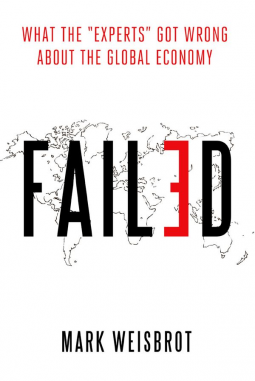
Review: ‘Failed’ by Mark Weisbrot

image

Published by: Oxford University Press
Publication Date: 1st October 2015
ISBN: 9780195170184

Blurb

Why did the Eurozone end up with an unemployment rate more than twice than that of the United States and six years after the collapse of Lehman Brothers? Was crisis in the Eurozone inevitable? What caused the prolonged economic failure experienced by the majority of the world’s low- and middle-income countries at the end of the 20th century?

Failed analyzes and ties together some of the most important economic developments of recent years with the common theme that they have been widely misunderstood and in some cases almost completely ignored. A central argument of Failed is that there are always viable alternatives to prolonged economic failure. Author Mark Weisbrot shows that political agendas are often the root cause of avoidable financial crises and drawing on lessons learned from previous crises, recessions, and subsequent recovers can prevent further failures in the future.

My Review

Interesting yet frustrating information is presented in this book.

The author’s main argument is that the recent recession and current difficulties in the Eurozone have been exacerbated by international financial organisations – the IMF, ECB and EC – in order to force the implementation of policies that would never be accepted by the electorate.

The author then expands the argument to cover historical recessions internationally, such as the Asian recession in the late nineties, and South and Central American financial crises in the first decade of the 21st century. He maintains that the IMF, directed by Washington, could have prevented these problems but chose not to, again in order to force through political changes that couldn’t be made at the ballot box.

If you’ve never considered the role of the IMF et al in politics, this book will be of interest, and an eye opener. If you are aware of the political machinations of the financial sector then it may prove frustratingly basic. The author presents adequate evidence for his claims, but it feels a though the whole book is an extended article, with repeated information padding out the chapters. It could also do with some formatting work. Things didn’t always flow correctly.

3/5