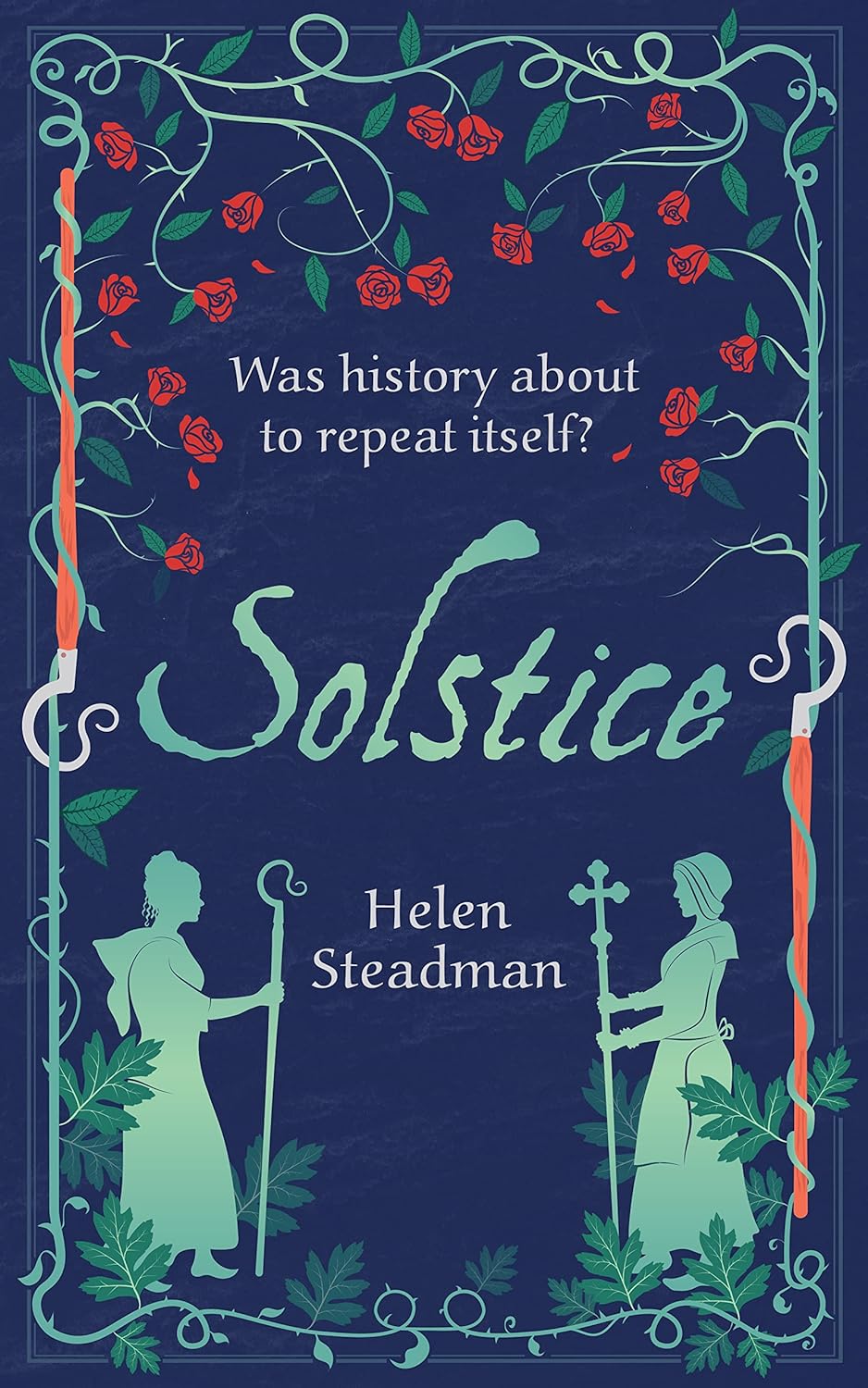
Review: Solstice, by Helen Steadman


My Review

Thanks to Anne for organising this tour and to the publisher for my copy of this book.

Patience Leaton, 20ish, I think, and lean to emaciation, is the daughter of a Vicar. Her family (father Hector, brother Earnest) have been forced from their parish in Ely for reasons hinted at by Patience, to the Durham dales parish of Mutton Clog, a sheep farming village of farmers. The previous vicar has died at a fortunate time for the disgraced Leaton family and they’ve been given the meagre living. Used to a richer life in the town of Ely, and with a puritan conviction, Patience disdains the people of Mutton Clog before they even meet. The Leatons have secrets, and Patience has an urge to find witches.

Young Rose Driver is 16 and a skilled shepherdess on her family farm. The farm is prosperous but life is blighted by her bullying father and widowed grandmother. Her step-mother, May, is her mother June’s best friend. Marriage to Rose’s Widower Da, Andrew Driver, was an escape from an abusive father, and she took her sister Tilly with her.

Rose and Patience meet the day after the Leaton’s arrive in Mutton Clog. Rose also meets Earnest. He seems sweet, intelligent, and very handsome. He charms Rose while Patience looks on id disgust, immediately blaming Rose for Earnest’s behaviour. Patience decides Rose is a witch and goes about finding evidence to prove it.

One day, the pious, hypocritical, zealous Patience sees Rose at her work with the lambing ewes, and believes her to have engaged in a satanic ritual. From then on, everything bad that happens is Rose attempting to kill her. Rose meanwhile has sheep to care for. Earnest comes to visit her at the shepherding shed, and presses his suit, although Rose fights him off.

Things go down hill from there, involving a midsummer millpond, a death at the wool fair, and another at sea, imprisonment at Durham, and a death by hanging. Finally, there’s birth and life returning. Just as it should be.

I must admit that while I first started reading this book 3rd November, thinking it would be a quick read, but then I realised Patience was a bitch out to ruin Rose and that Rose was going to suffer unnecessarily. I put the book down to concentrate on another book I’m reviewing this week, The Lost Supper, because I struggle with stories that involve the unjust punishment of a good character by someone acting from malice. Today, 12th November, I decided to deal with that by looking at the last chapter. It helped, because I knew that I could get through the nasty stuff because I knew Rose would come out of things fairly well, although she loses a lot of people along the way. So I dived in. Took me three hours, maybe, to get through the book in the end, and it wasn’t as upsetting as I though it would be.

Through the novel we discover the lies Patience is telling people, and herself, to hide her family secrets, and I realised she was probably seriously mentally ill, at a time when there was only two possible ways to view mental illness – either madness or witchcraft. Patience is a ‘respectable girl’ so she can’t be mad (poor people or those not considered respectable could be mad, but they were probably curse), and she’s a god-fearing, diligent, vicar’s daughter, so she can’t be a witch.

Even I can tell she’s probably got some sort of religious mania, possibly anorexic, and with some delusions. There’s nothing inherently wrong with having any of these mental illnesses, and with treatment people can live a normal life and none of them usually cause murderous behaviour. Her neighbours and victims put it all down to her being a spoilt miss with too much time on her hands and not enough reading material to keep her mind educated and active. The magistrate in Durham thinks she’s a plain girl jealous of a pretty girl. I get the feeling, if she was in the North American colonies, she’d have murdered dozens. We learn that she has already killed one woman, and as the book goes on, it looks like her mania might actually be the reason her family is forced from Ely. Then we find out something else. Everyone else is always to blame, for Patience. It’s never her fault, her actions cause terrible consequences, but she always pushes it on to her victims.

It’s also interesting that we learn Patience is probably bisexual and is in conflict with herself for being attracted to anyone. She sees sexuality as a sin; her mother is dead to Patience because she is ‘promiscuous’, her brother is cursed with their mother’s promiscuity and needs to be guarded, her attraction to Tilly and Tom is their fault for being wanton (Tilly lifts her skirt up to cross a river, and Tom works shirtless in the graveyard on a hot day). It doesn’t occur to her that her parents’ marriage was loveless, and her mother almost dies giving birth to the twins. It doesn’t occur to her that Earnest is a creep who uses his position as a curate to seduce young women and then blames them for his own actions. It doesn’t occur to Patience that sex is a part of life and some people really enjoy it, and some people don’t, and social conventions will constrain people’s actions, and her religious convictions are constraining her thinking.

Earnest got a better death than he deserved after seducing Rose (and Tilly), blaming her for his actions, and then trying to force her to abort their child. His actions encourage Patience in her campaign against Rose. His behaviour is hypocritical and it seems his father knows how bad he is and is desperate to send him to sea, while Patience believes he’s just young and easily led, not the pillar of religious rectitude that she is. They’re twins; he was born first by a few minutes.

Rose is a steady farmer, daughter and granddaughter of farmers, daughter and granddaughter of herbalists, murdered as ‘witches’. She’s the backbone of her household, and continues to be so after her father dies, until she’s forced to live with the Leatons, who abuse her. Her time in Durham North Gate Gaol is wretched, and so evocatively described. People died before they even got their day on court in gaols, because they had to wait for the quarterly assizes.

Rose’s experiences as a child, which we only learn about when Rose learns about them, and later in court, are foreshadowed in childhood games and fears of going to church. The family she has in Mutton Clog are mostly not blood relatives, but they treat her as their child and grandchild, because that’s the right thing to do. We learn that Rose’s Da is a much worse man than we know from his actions in life, but he helped save Rose from a monster. The psychological damage she received as a child explains many things and it’s actually a fairly reasonable explanation. I don’t know enough about the sort of trauma seeing a violent murder as a young child would cause to be able to say it’s a realistic depiction, but it seems reasonable.

I love the way the community of Mutton Cleg come together to help Rose in gaol and in court; it’s clear no-one understands why Patience is targeting Rose, but they are there to get the truth out. That they will suffer for witnessing to the truth of events from the past and the present occurs to some of them. I haven’t read any of the other books, but the events of this book suggest they are good. I should probably get the first two in the series and The Running Wolf, which is set in 1687, when the baby born at the end of Solstice is an adult.

I’m assuming this book is set sometime in the 1650s or 1660s, during the puritan period. People in neighbouring dales are still having Midsummer Bonfires, and many of them stopped during the Civil Wars of the 1640s (yes, British, not English, because the civil wars engulfed all four countries/both main islands of the archipelago). Mutton Clog is rural enough that it might not have been involved. The church still has stained glass windows and the manse is comfortably furnished, which is very much not puritan practice.

I love the way Rose and the villagers are bemused by the plainness of the Leaton’s clothes and food. Hector Leaton seems to be fairly balanced, in that he’s comfortable with the changes in his housing and, when Tilly joins the household, his meals. He resists a lot of Patience’s stranger ideas and only weakens when he’s grieving; she is consciously manipulative of him. Even after his estranged wife returns and he’s grieving, he’s able to recognise that he was partly responsible for his wife leaving and that he needs to make amends. His actions speak when Patience refuses to record his words.

Tom Verger is an absolute hero in this novel. The history that develops through the novel shows that he was a hero in the earlier novels too. He is stoic and loving, and stands up to bullies for his community.

I really enjoyed this novel; it explores the psychological and cultural environment of the 1650s to explain the witch-obsessions. It draws on real events and realistically describes the lives of rural farmers in Northern England. Finally, it brings the Widdershins series to a satisfying conclusion, with hope and new life.


Helen Steadman’s first novel, Widdershins and its sequel, Sunwise were inspired by the 1650 Newcastle witch trials. Her third novel, The Running Wolf is about a group of master swordmakers who defected from Germany to England in 1687. Helen’s fourth novel, God of Fire, is a Greek myth retelling as seen through the eyes of Hephaestus, perhaps the least well known of all the Olympians.

Helen is particularly interested in revealing hidden histories and she is a thorough researcher who goes to great lengths in pursuit of historical accuracy. To get under the skin of the cunning women in Widdershins and Sunwise, Helen trained in herbalism and learned how to identify, grow and harvest plants and then made herbal medicines from bark, seeds, flowers and berries.

The Running Wolf is the story of a group of master swordmakers who left Solingen, Germany and moved to Shotley Bridge, England in 1687. As well as carrying out in-depth archive research and visiting forges in Solingen to bring her story to life, Helen also undertook blacksmith training, which culminated in making her own sword.


Review: Mr Stoker and the Vampires of the Lyceum, by Matthew Gibson

Format: 280 pages, Paperback
Published: May 28, 2023 by Book Guild
ISBN: 9781915603869 (ISBN10: 1915603862)

Blurb

London, September 1888. Jack the Ripper roams the streets. A scream rings out from beneath the stage of the Lyceum Theatre…

A young ‘actress’ has been attacked, suffering peculiar bite wounds to her neck; an event that announces a series of strange, vampiric happenings, and thrusts an unwitting Bram Stoker – acting manager of the Lyceum and aspiring author – into the limelight, and the action.

Increasingly perplexed by the unsettling behaviour of his ‘Guv’nor’, the brilliant but mercurial actor, Henry Irving, and Irving’s acclaimed leading lady, Ellen Terry, Stoker soon starts suspecting the worst. And then, another attack reveals a vicious Prussian baron, returned to London as a vampire seeking revenge…

Alive with Gothic intrigue, reversal and surprise, Mr Stoker will keep the reader enthralled and confounded until its final, shocking scene – indeed, until its very last word.

‘This is a fully realised Gothic world, a stimulating mix of homely familiarity and lurking menace which will engage readers of all ages.’ David Punter, author of The Literature of Terror

Continue reading “Review: Mr Stoker and the Vampires of the Lyceum, by Matthew Gibson”

Review: Trouble, by Katja Ivar

  • PUB DATE: January 19, 2023
  • MARKET: Nordic Noir
  • BINDING: Paperback B-Format
  • PRICE: £9.99
  • EXTENT: 224 pages
  • ISBN: 9781913394-776

The third in the series featuring Hella Mauzer, to follow on the success of Evil Things and Deep as Death.
A Nordic Noir of the first-order set in Helsinki in 1953. A dark political thriller at the heart of the Cold War; a novel about ruthless ambition and betrayal, but also about the challenges of being a single professional woman in post-war Europe.

Helsinki, June 1953, at the heart of the Cold War. Hella, now a reluctant private investigator, has been asked by her former boss at the Helsinki murder squad to do a background check on a member of the Finnish secret services. Not the type of job Hella was hoping for, but she accepts it on the
condition that she is given access to the files concerning the roadside death of her father in 1942, at a time when Finland joined forces with Nazi Germany in its attack against the Soviet Union. German troops were sent to Finland, the Gestapo arrived in Helsinki and German influence on local
government was strong, including demands for the deportation of local Jews.

Colonel Mauzer, his wife and other family members were killed by a truck in a hit and run incident. An accident, file closed, they said. But not for Hella, whose unwelcome investigation leads to some who would prefer to see her stopped dead in her tracks.

Continue reading “Review: Trouble, by Katja Ivar”

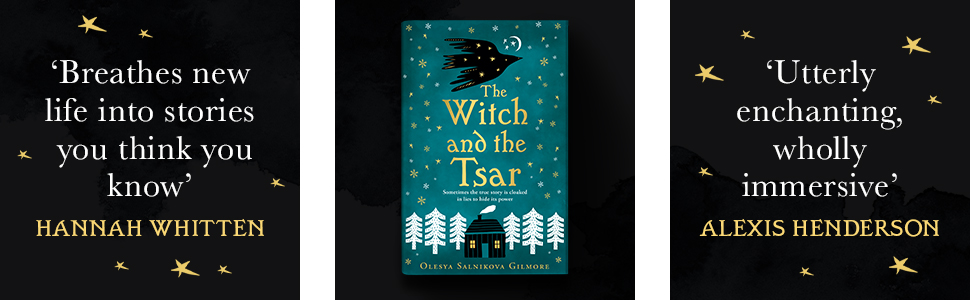
Review: The Witch and the Tsar, by Olesya Salnikova Gilmore

As a half-goddess possessing magic, Yaga is used to living on her own, her prior entanglements with mortals having led to heartbreak. She mostly keeps to her hut in the woods, where those in need of healing seek her out, even as they spread rumours about her supposed cruelty and wicked spells. But when her old friend Anastasia—now the wife of the tsar and suffering from a mysterious illness—arrives in her forest desperate for her protection, Yaga realizes the fate of all of Russia is tied to Anastasia’s.
Yaga must step out of the shadows to protect the land she loves.
As she travels to Moscow, Yaga witnesses a sixteenth century Russia on the brink of chaos. Tsar Ivan— soon to become Ivan the Terrible—grows more volatile and tyrannical by the day, and Yaga believes the tsaritsa is being poisoned by an unknown enemy. But what Yaga cannot know is that Ivan is being manipulated by powers far older and more fearsome than anyone can imagine.

Continue reading “Review: The Witch and the Tsar, by Olesya Salnikova Gilmore”

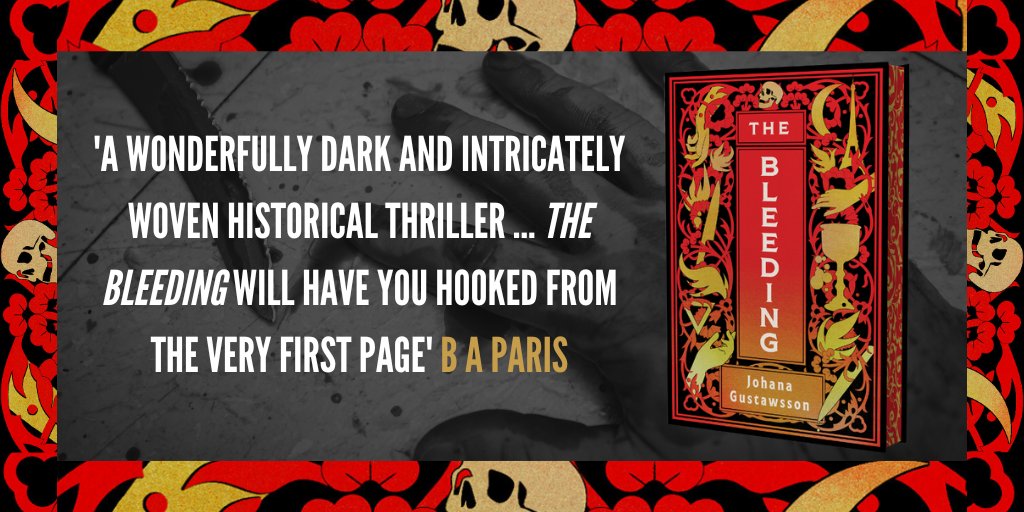
Review: The Bleeding, by Johana Gustawsson, translated by David Warriner

PUBLICATION DATE: 15 SEPTEMBER 2022
HARDBACK ORIGINAL | £16.99 | ORENDA BOOKS

Blurb

1899, Belle Époque Paris. Lucienne’s two daughters are believed dead
when her mansion burns to the ground, but she is certain that her girls
are still alive and embarks on a journey into the depths of the spiritualist
community to find them.

1949, Post-War Québec. Teenager Lina’s father has died in the French
Resistance, and as she struggles to fit in at school, her mother introduces
her to an elderly woman at the asylum where she works, changing Lina’s
life in the darkest way imaginable.

2002, Quebec. A former schoolteacher is accused of brutally stabbing her
husband – a famous university professor – to death. Detective Maxine
Grant, who has recently lost her own husband and is parenting a
teenager and a new baby single-handedly, takes on the investigation.
Under enormous personal pressure, Maxine makes a series of macabre
discoveries that link directly to historical cases involving black magic and
murder, secret societies and spiritism … and women at breaking point,
who will stop at nothing to protect the ones

Continue reading “Review: The Bleeding, by Johana Gustawsson, translated by David Warriner”

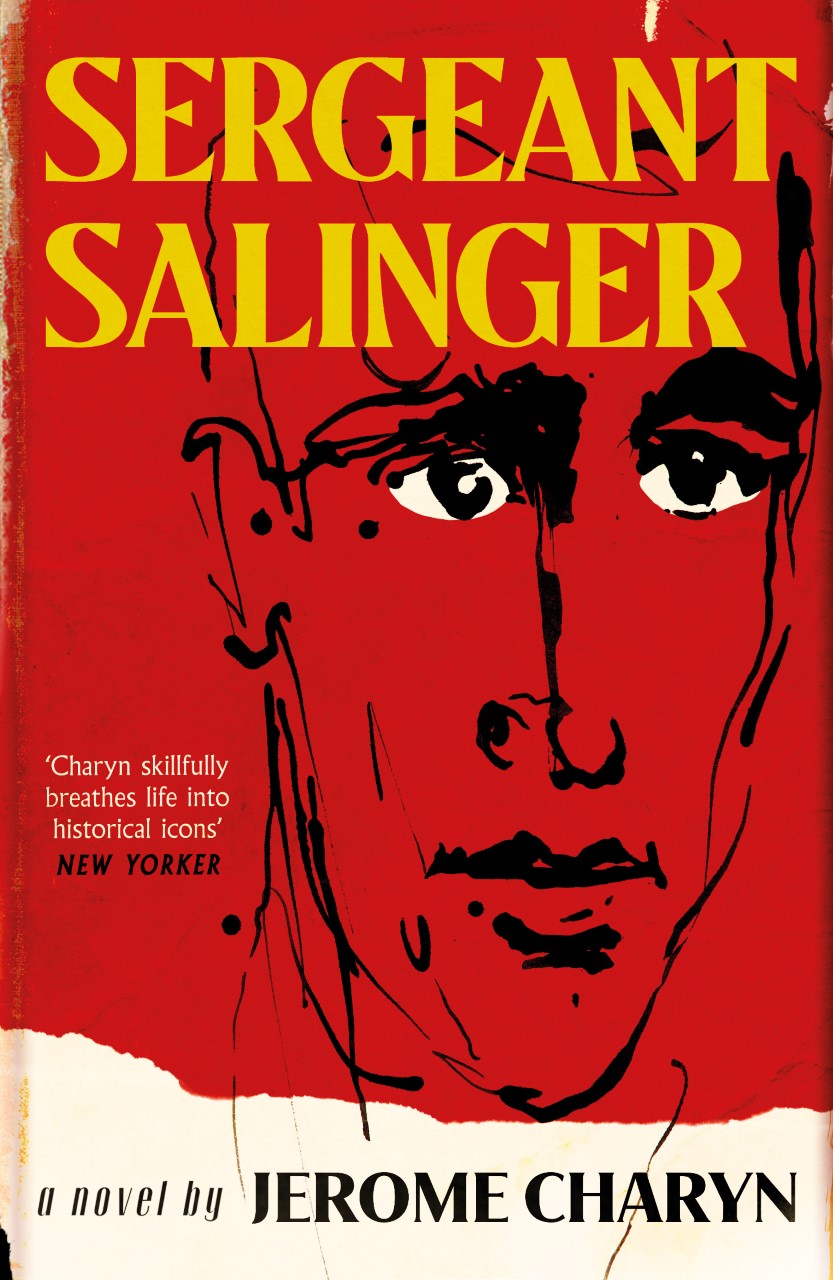
Review: Sergeant Salinger, by Jerome Charyn

21 Oct 2021 | 9780857304711 | Format: Paperback Original | £9.99

Grounded in biographical fact and reimagined as only Charyn could, Sergeant Salinger is an astonishing portrait of a devastated young man on his way to becoming the mythical figure behind a novel that has marked generations.

2021 marks the 70th anniversary of the first publication of The Catcher in the Rye.

J.D. Salinger, mysterious author of The Catcher in the Rye, is remembered today as a reclusive misanthrope. Jerome Charyn’s Salinger is a young American WWII draftee assigned to the Counter Intelligence Corps, a band of secret soldiers who trained with the British. A rifleman and an interrogator, he witnessed all the horrors of the war – from the landing on D-Day to the relentless hand-to-hand combat in the hedgerows of Normandy, to the Battle of the Bulge, and finally to the first Allied entry into a Bavarian death camp, where corpses were piled like cordwood. After the war, interned in a Nuremberg psychiatric clinic, Salinger became enchanted with a suspected Nazi informant. They married, but not long after he brought her home to New York, the marriage collapsed. Maladjusted to
civilian life, he lived like a ‘spook,’ with invisible stripes on his shoulder, the ghosts of the murdered inside his head, and stories to tell.

Continue reading “Review: Sergeant Salinger, by Jerome Charyn”

Novella Review: The Wolf Skinned, by Jack Johnson

The Wolf Skinned (The Wolf Skinned Saga Book 1) by [Jack Johnson]
The Wolf Skinned is the first book in a series which chronicles the saga of Ulf The Wolf Skinned, a blood hungry Viking Berserker. Ulf is one of Odin’s sacred warriors known as a Ulfhednar; clothed in a wolf’s skin, he leaves a trail of death and pain wherever he goes. At the tender age of 17 he already has a fearsome reputation as his adopted father Eric Bloodaxe’s deadly hound of war. And by the end of the year 915 AD, every Saxon will know and fear the name, Ulf The Wolf Skinned. Link Here

My Review

I quite like historical fantasy, and historical fiction, especially stuff from the Anglo-Saxon period. It’s even better if some of the main characters were real, but unknown generally and going on an adventure. In this novella, Lady Ælfwynn of Mercia, daughter of Æthelflæd of Mercia and her husband Æthelred, has an adventure among the Vikings, and meets Ulf, a berserker.

Set in 915, five years after Æthelred’s death, when Edward of Wessex and Æthelflæd of Mercia continued to fight the Vikings as their father Alfred the Great, of Wessex, had done. In history, Æthelflæd died in 918, just before the Vikings of York were to kneel to her, and Ælfwynn took control of Mercia, but only for a few months. Before the end of the year she had been taken to Wessex by her uncle Edward and he took control of Mercia. His son became the first King of the English. No one knows what happened to Lady Ælfwynn. I personally think she was locked up in a nunnery so no one could object to her uncle’s theft of her throne. It wasn’t unheard of for a royal woman to become a nun, and it was unusual for a woman to rule alone.

Jack Johnson gives Lady Ælfwynn an adventure to rival the real adventures of her mother.

Lady Ælfwynn is doomed to marry a man of Northumbria that she doesn’t like, until the Vikings arrive to rescue the Berserker Ulf from captivity in Durham. Ulf and Ælfwynn run away from the fighting and head to York to join up with Ulf’s adopted father, Eric Bloodaxe. On their journey, they get to know each other and fall in love. In York, the Vikings are concerned about having Edward of Wessex’s niece in their halls as a ‘hostage’.

When the Lady of Mercia arrives with her brother and prospective son-in-law at the gates of York, it seems a battle is inevitable. Eric Bloodaxe tries to discuss terms with the Lady, but things don’t go well.

There is a battle. There is treachery. It’s very exciting.

And I want to know what happens next.

Luckily I know the author, so I’ll get to read the next instalment before it’s published. I got to read this one in an earlier stage.

I thought the descriptive writing was excellent and the little bits of magical reality add an enchanted element to the narrative. The Gods are certainly playing with people’s lives. It’s hinted at, subtly, that Odin is abroad in England.

One-eye’d trouble-making git.

I enjoyed the characterisation of Ælfwynn and Ulf, and the development of their relationship. Their relationship is loving and based on friendship and shared difficulties, before it becomes physical, which I liked.

The battles are very invigorating and exciting to read. They are written with a dreamlike reality. This is because the author sees them in his mind and writes what he sees.

If you like Bernard Cornwall’s Uhtred of Bebbenburg books or the TV series based on them, or the TV series Vikings, this novella is for you.

ARC TBR Pile Review: She Who Became The Sun, by Shelley Parker-Chan

56337658. sy475
Paperback, 416 pages
Published July 22nd 2021 by Mantle 
ISBN1529043395 (ISBN13: 9781529043396)

Blurb

She’ll change the world to survive her fate . . .

In Mongol-occupied imperial China, a peasant girl refuses her fate of an early death. Stealing her dead brother’s identity to survive, she rises from monk to soldier, then to rebel commander. Zhu’s pursuing the destiny her brother somehow failed to attain: greatness. But all the while, she feels Heaven is watching.

Can anyone fool Heaven indefinitely, escaping what’s written in the stars? Or can Zhu claim her own future, burn all the rules and rise as high as she can dream?

She Who Became the Sun by Shelley Parker-Chan is a re-imagining of the rise to power of Zhu Yuanzhang. Zhu was the peasant rebel who expelled the Mongols, unified China under native rule, and became the founding Emperor of the Ming Dynasty. 

Continue reading “ARC TBR Pile Review: She Who Became The Sun, by Shelley Parker-Chan”

Review: The Walls of Rome, by Robert M Kidd

The Walls of Rome

218 BC. Sphax is seventeen and haunted by the brutal murder of his parents at the hands of Rome. After ten years of miserable slavery he will make his last bid for freedom and go in search of Hannibal’s army and his birthright. He will have his revenge on the stinking cesspit that is Rome!

Destiny will see him taken under the wing of Maharbal, Hannibal’s brilliant general, and groomed to lead the finest horsemen in the world – the feared Numidian cavalry that would become the scourge of Rome.

From the crossing of the great Rhodanus River, Sphax’s epic journey takes him through the lands of the Gaul to the highest pass in the Alps. This is the story of the most famous march in history. A march against impossible odds, against savage mountain Gauls, a brutal winter and Sphax’s own demons.

This is more than a struggle for empire. This is the last great war to save the beauty of the old world, the civilized world of Carthage, Greece and Gaul. The world of art and philosophy – before it is ground into dust by the upstart barbarity of Rome.

Purchase Links

UK – https://www.amazon.co.uk/Walls-Rome-believe-climbed-Hannibal-ebook/dp/B08MQMRDMM

US – https://www.amazon.com/Walls-Rome-believe-climbed-Hannibal-ebook/dp/B08MQMRDMM

Giveaway to Win the A Hostage of Rome (Book 3) to be dedicated to the winner, & a signed dedicated copy too (Open INT)

http://www.rafflecopter.com/rafl/display/33c69494422/?

*Terms and Conditions –Worldwide entries welcome.  Please enter using the Rafflecopter box below.  The winner will be selected at random via Rafflecopter from all valid entries and will be notified by Twitter and/or email. If no response is received within 7 days then Rachel’s Random Resources reserves the right to select an alternative winner. Open to all entrants aged 18 or over.  Any personal data given as part of the competition entry is used for this purpose only and will not be shared with third parties, with the exception of the winners’ information. This will passed to the giveaway organiser and used only for fulfilment of the prize, after which time Rachel’s Random Resources will delete the data.  I am not responsible for despatch or delivery of the prize.

Continue reading “Review: The Walls of Rome, by Robert M Kidd”

Review: A Book of Secrets, by Kate Morrison

Jacaranda | 25 March 2021
Paperback| Historical Fiction| £8.99
ISBN: 9781913090678| eISBN: 9781909762701

About the Book
A Book of Secrets tells the story of a West African girl hunting for her lost brother through an Elizabethan underworld of spies, plots and secret Catholic printing presses.

Susan Charlewood is taken from Ghana (then known as Guinea) as a baby. Brought to England, she grows up as maidservant in a wealthy Catholic household. Living under a Protestant Queen in late 16th Century England, the family risk imprisonment or death unless they keep their faith hidden.

When her mistress dies Susan is married off to a London printer who is deeply involved in the Catholic resistance. She finds herself embroiled in political and religious intrigue, all while trying to find her lost brother and discover the truth about her origins.

The book explores the perils of voicing dissent in a state that demands outward conformity, at a time when England is taking its first steps into the long shadow of transatlantic slavery and old certainties about the shape of the universe itself are crumbling.

A Book of Secrets gives a striking new perspective on the era and lets one of the thousands of lost Elizabethan voices, speak out loud.

Continue reading “Review: A Book of Secrets, by Kate Morrison”