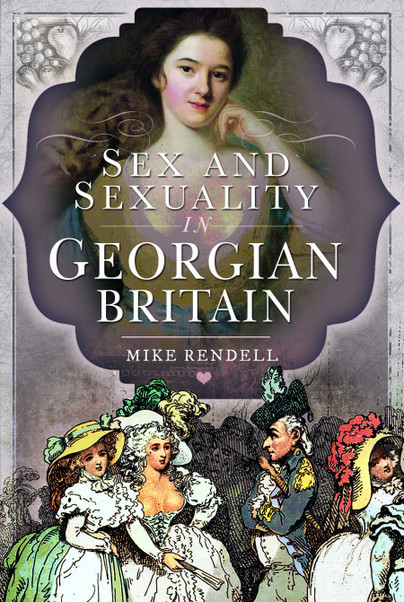
By Mike Rendell Imprint: Pen & Sword History Pages: 216 Illustrations: 30 black and white illustrations – integrated and 8 page mono plates ISBN: 9781526755629 Published: 29th October 2020 Price: £10.49 was £14.99
Peek beneath the bedsheets of eighteenth- and early nineteenth-century Britain in this affectionate, informative and fascinating look at sex and sexuality during the reigns of Georges I-IV. It examines the prevailing attitudes towards male and female sexual behaviour, and the ways in which these attitudes were often determined by those in positions of power and authority. It also explores our ancestors’ ingenious, surprising, bizarre and often entertaining solutions to the challenges associated with maintaining a healthy sex life.
Did the people in Georgian Britain live up to their stereotypes when it came to sexual behaviour? This book will answer this question, as well as looking at fashion, food, science, art, medicine, magic, literature, love, politics, faith and superstition through a new lens, leaving the reader enlightened and with a new regard for the ingenuity and character of our ancestors.
Hardcover, 336 pages Published May 2nd 2019 by Fourth Estate ISBN13: 9780008293871
‘I am a fat person and I love my body. I feel lucky to be able to say that – it has taken a lot of work and a lot of time. I want to tell you what I have learned and how I got here.’
In Happy Fat, comedian Sofie Hagen shares how she removed fatphobic influences from her daily life and found self-acceptance in a world where judgement and discrimination are rife.
From shame and sex to airplane seats, love and getting stuck in public toilets, Sofie provides practical tips for readers – drawing wisdom from other Fat Liberation champions along the way.
Part memoir, part social commentary, Happy Fat is a funny, angry and impassioned look at how taking up space in a culture that is desperate to reduce you can be radical, emboldening and life-changing.
My Review
I ordered myself this book last year when it was published. I’ve just had the time to read it, and I read it fairly quickly. The early chapters made me cry because they covered some very distressing topics, and the later chapters have information that I already knew from reading Health At Every Size by Linda Bacon and The F**k It Diet by Caroline Dooner. While those books are focused on the diet industry, this book is more biography and encouragement to self-love. I found the writing moving and amusing by turns. I enjoyed the inserted interviews and the illustrations. It’s a good introduction to the fat liberation movement.
Alexandra Wilson was a teenager when her dear family friend Ayo was stabbed on his way home from football. Ayo’s death changed Alexandra. His death compelled her to enter the legal profession to search for answers. As a junior criminal and family law barrister she finds herself navigating a world and a set of rules designed by a privileged few. A world in which barristers sigh with relief at the retirement of a racist judge: ‘I’ve got a black kid today and he would have had no hope.’
In her debut book In Black and White, Alexandra beautifully re-creates the tense court room scenes, the heart-breaking meetings with teenage clients and the moments of frustration and triumph that make up a young barrister’s life.
Alexandra speaks with raw honesty about her experience as a mixed-race woman from a non-traditional background in a profession that is sorely lacking in diverse representation. A justice system in which a disproportionately large number of black and mixed-race people are charged, convicted and sent to prison.
She shows us how it feels to defend someone who hates the colour of your skin or someone you suspect is guilty, and the heart-breaking youth justice cases she has worked on. We see what it’s like for the teenagers coerced into county line drug deals and the damage that can be caused when we criminalise teenagers.
Her account of what she has witnessed as a young mixed-race barrister is in equal parts shocking, compelling, confounding and powerful. Alexandra’s story is unique in a profession still dominated by a section of society with little first-hand experience of the devastating impact of violent crime.
In SatNav We Trust – a search for meaning through the Historic Counties of England is a journey through ideas of science and belief, all the while searching for meaning and a bed for the night. Or was that the other way around?
On May 1st 2013 I set off from Oxford on the trip of a lifetime. It wasn’t a trip around the world or up the Himalayas, I set off to visit every one of England’s 39 historic counties. These are the counties that used to exist before all the boundary changes that chopped Yorkshire into bits, got rid of evocative sounding names such as Westmorland, and designated the big cities as metropolitan boroughs. I wanted to visit England as it used to be, although that’s not quite how it turned out.
In SatNav We Trust started out as a travelogue exploring all the usual suspects, spectacular landscapes, architectural or engineering wonders, historic towns with their cathedrals and castles. However, it soon developed into a journey through ideas and beliefs, an exploration of how the rational and the apparently irrational jostle for position in human experience. The book discusses our fundamental scientific understanding of the universe when, deep inside us, we might be as irrational as a box of frogs. This context, the exploration of England—the places stumbled across with no day to day plan, created the backdrop for these ideas.
ISBN: 978-1-5272-6030-6
Summary
The book takes the form of a journey through one English county a day. Rather than having a plan, other than a rough anticlockwise direction of travel, the trip was largely spontaneous. This unplanned nature is what drives the narrative, similar to the way a MacGuffin drives a story, and opens the possibility of stumbling across unintended experiences.
The journey is taken in a fifteen-year-old 4×4 referred to throughout as The Truck, along with a sat nav referred to as Kathy (actually the voice of Kathy Clugston from Radio 4). Rather than paying for hotels this was a camping trip to keep the costs down. The logistics of finding somewhere to camp each night provided further challenges. All of these inconveniences, and the unexpected solutions that followed, provided useful metaphors for concepts that arose in the philosophical exploration.
The result of this unplanned approach is that the story only covers the areas of the counties passed through. There are no descriptions of the obvious locations in each county because the journey simply didn’t pass that way. However, this means that there were unplanned encounters with places such as a village falling into the sea, the wonderfully mad Tees Transporter Bridge, or accidentally driving a speedboat with two drunk blokes without any consideration about how to get ashore.
The past few months have made us realise that change is inevitable – sometimes good but sometimes it can be cruel and makes your world go out of control. We might experience anxiety, low moods, night sweats, exhaustion or worse. We lose all hope and feel that there is nothing to look forward to. Little Book of Hope helps you find your way back again – through Reflections to guide you through the difficult times, together with: Family. Friends. Rest. Time – for yourself. Walk. Talk. Cry. Grieve. Meditate. Pray. Accept things. Patience. Dedicated to all those around the world who have lost hard but loved much – that you may re-discover Hope and welcome the beautiful pleasure of joy back into your lives.
Where are all the women philosophers? • A beautifully illustrated introduction to twenty of the most important and underrepresented women philosophers, from 400BCE to the present day • In 2015, women accounted for only 22% of philosophy professors at the top 20 US universities; in some fields of philosophy there has been almost no increase in the number of women since the 1970s • Three of the most comprehensive histories of philosophy published in the last 20 years have made little or no mention of women
The history of philosophy has not done women justice: you’ve probably heard the names Plato, Kant, Nietzsche and Locke – but what about Hypatia, Arendt, Oluwole and Young?
The Philosopher Queens is a long-awaited book about the lives and works of women in philosophy by women in philosophy. This collection brings to centre stage twenty prominent women whose ideas have had a profound – but for the most part uncredited – impact on the world.
You’ll learn about Ban Zhao, the first woman historian in ancient Chinese history; Angela Davis, perhaps the most iconic symbol of the American Black Power Movement; Azizah Y. al- Hibri, known for examining the intersection of Islamic law and gender equality; and many more.
For anyone who has wondered where the women philosophers are, or anyone curious about the history of ideas – it’s time to meet the philosopher queens.
PAPERBACK 978-1-78965-135-5 3 September 2020 £10.99 / $14.99 / €11.66
From 1983 until 1991, Glam Metal was the sound of American culture. Big hair, massive amplifiers, drugs, alcohol, piles of money and life-threatening pyrotechnics. This was the world stalked by Bon Jovi, Kiss, W.A.S.P., Skid Row, Dokken, Motley Crue, Cinderella, Ratt and many more. Armed with hairspray, spandex and strangely shaped guitars, they marked the last great era of supersize bands. Where did Glam Metal come from? How did it spread? What killed it off? And why does nobody admit to having been a Glam Metaller anymore?
‘Gratitude is the wine for the soul. Go on. Get drunk.’ Rumi
Being grateful is easy…
…when everything goes according to plan.
But how do you keep at it no matter what life throws at you?
Enter 365 Days of Gratitude, the undated daily journal that will help you stay on track.
After years of barely surviving her own emotional minefield, writing coach Mariëlle S. Smith discovered the transformative power of practising gratitude. But, like no one else, she knows that cultivating an attitude of gratitude is easier said than done.
Complete with inspiring quotes, daily prompts, and recurring check-ins, the 365 Days of GratitudeJournal encourages you to create a sustainable gratitude practice too.
Ready to commit to the life-changing power of gratitude? Order your copy of the 365 Days of Gratitude Journal now.
By Malcolm Clegg Imprint: Pen & Sword Transport Pages: 144 Illustrations: 200 black and white illustrations ISBN: 9781526760425 Published: 7th August 2020
This volume covers the final decade of British steam, looking at steam traction in a wide variety of geographical locations around the British Railways network.
The book covers a wide variety of classes of locomotives, that were withdrawn during the last decade of steam traction, some examples of which are now preserved.
Malcolm Clegg has been taking railway pictures since the early 1960s and has access to collections taken by friends who were recording the steam railway scene during this period.
This book is a record of his and other people’s journeys during the last decade of steam in the 1960s.
My Review
This book is a collection of photographs from the 1960s of steam engines. The author has clearly been taking pictures for a long time and this was an interesting time in British transport. When the rest of the world was moving to diesel and electric, Britain stayed with steam. Then the government destroyed the network in favour of motorways and private transport, because the minister in charge had a vested interest in road building. New engines were scrapped when they still had thirty years of working life in them. What a travesty!
The book is substantial and covers a large range of engines, with captions giving details of the engine pictured and the place, if known. The images are in black and white which adds to the nostalgia of the book. The book is glossy and substantial, which is useful for those who are interested in trains of the era, reconstruction and reclamation of trains that they might find, or railway model enthusiasts.
Price: £13.99 ISBN: 9781526756688 Published: 18th May 2020
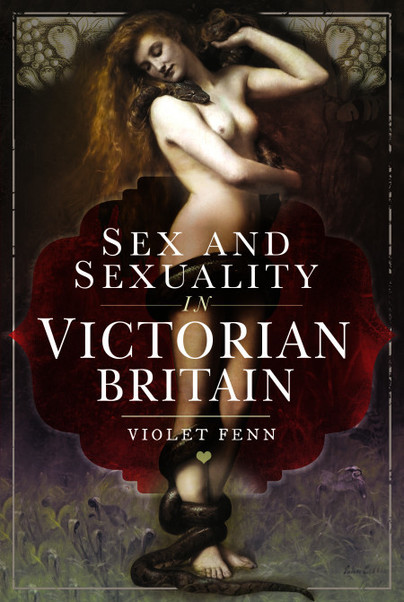
Peek beneath the bedsheets of nineteenth-century Britain in this affectionate, informative and fascinating look at sex and sexuality during the reign of Queen Victoria. It examines the prevailing attitudes towards male and female sexual behaviour, and the ways in which these attitudes were often determined by those in positions of power and authority. It also explores our ancestors’ ingenious, surprising, bizarre and often entertaining solutions to the challenges associated with maintaining a healthy sex life.
Did the people in Victorian times live up to their stereotypes when it came to sexual behaviour? This book will answer this question, as well as looking at fashion, food, science, art, medicine, magic, literature, love, politics, faith and superstition through a new lens, leaving the reader uplifted and with a new regard for the ingenuity and character of our great-great-grandparents.







 Everything Is Better With Dragons