
Book Description
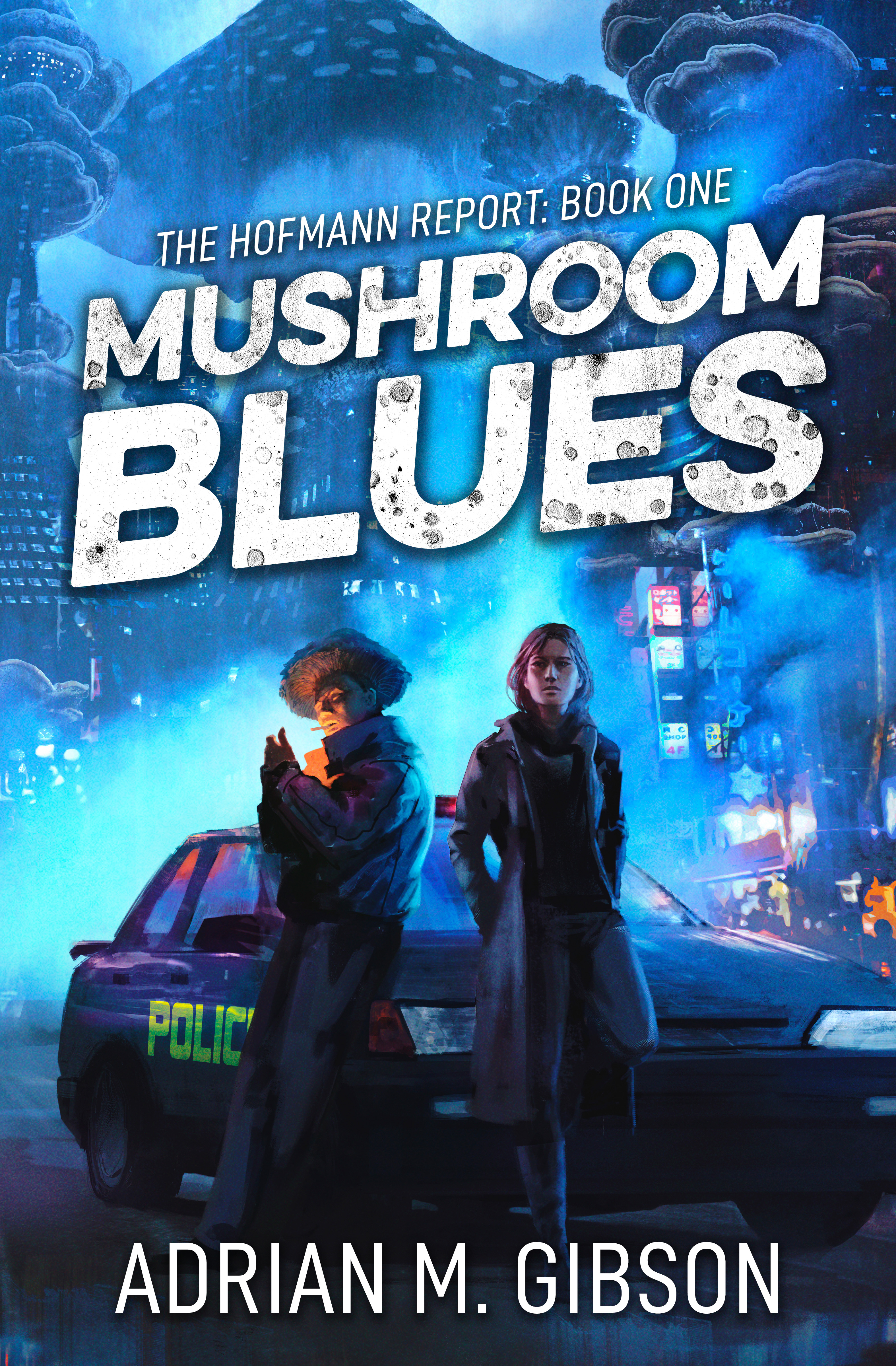
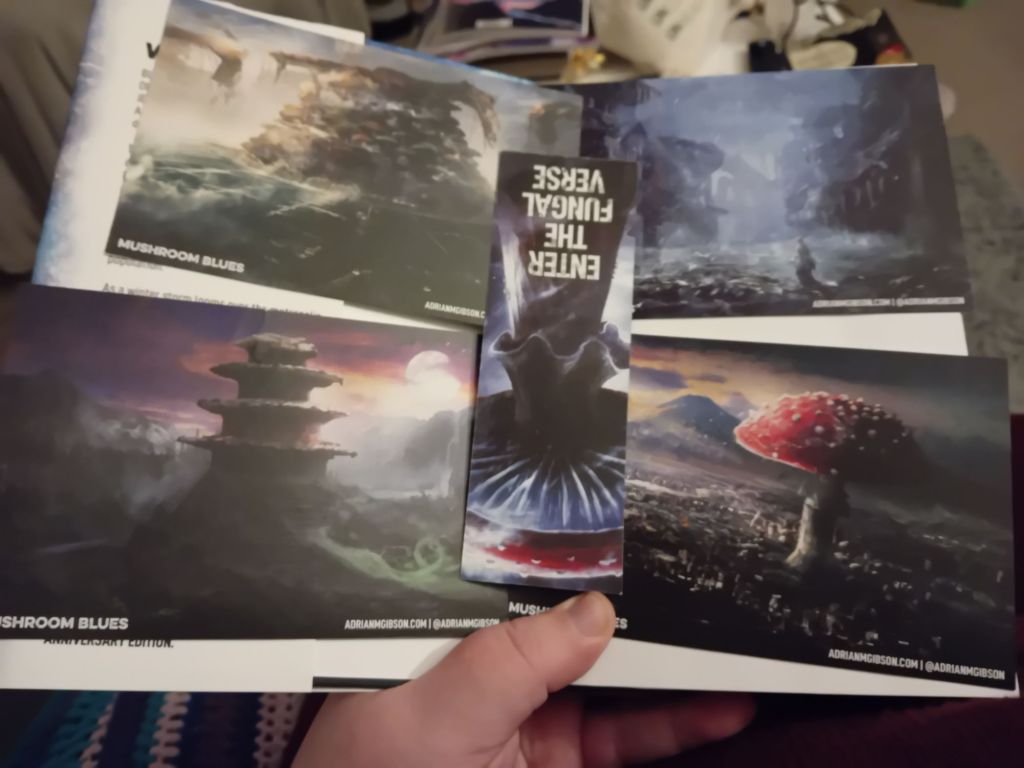
ENTER THE FUNGALVERSE. Blade Runner, True Detective, and District 9 meld with the weird worlds of Jeff VanderMeer, Philip K. Dick, and China Miéville in Adrian M. Gibson’s award-winning fungalpunk noir debut, now with a foreword from acclaimed author Nicholas Eames and six pieces of original interior artwork.
Two years after a devastating defeat in the decade-long Spore War, the island nation of Hōppon and its capital city of Neo Kinoko are occupied by invading Coprinian forces. Its fungal citizens are in dire straits, wracked by food shortages, poverty, and an influx of war refugees. Even worse, the corrupt occupiers exploit their power, hounding the native population.
As a winter storm looms over the metropolis, NKPD homicide detective Henrietta Hofmann begrudgingly partners up with mushroom-headed patrol officer Koji Nameko to investigate the mysterious murders of fungal and half-breed children. Their investigation drags them deep into the seedy underbelly of a war-torn city, one brimming with colonizers, criminal gangs, racial division, and moral decay.
In order to solve the case and unravel the truth, Hofmann must challenge her past and embrace fungal ways. What she and Nameko uncover in the midst of this frigid wasteland will chill them to the core, but will they make it through the storm alive?
SPFBO X 2nd place. Shortlisted for the British Fantasy Award for Best Newcomer. Winner of the FanFiAddict Award for Best Indie Debut, the Literary Titan Gold Book Award, and the Next Generation Indie Book Award.
My Review
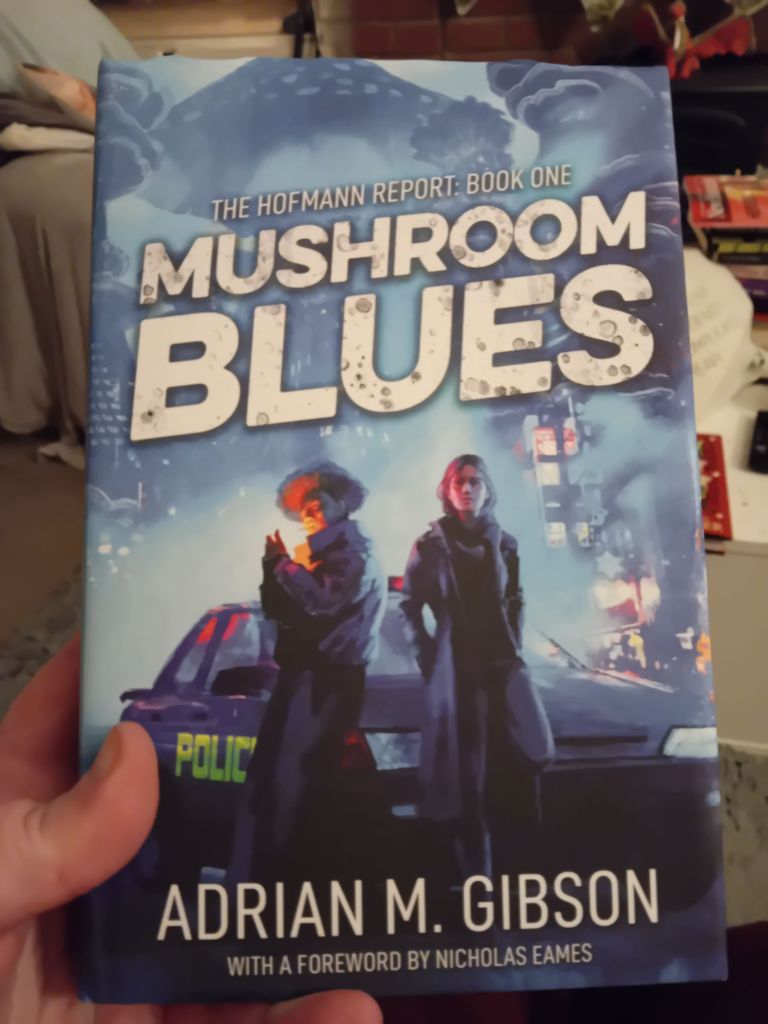
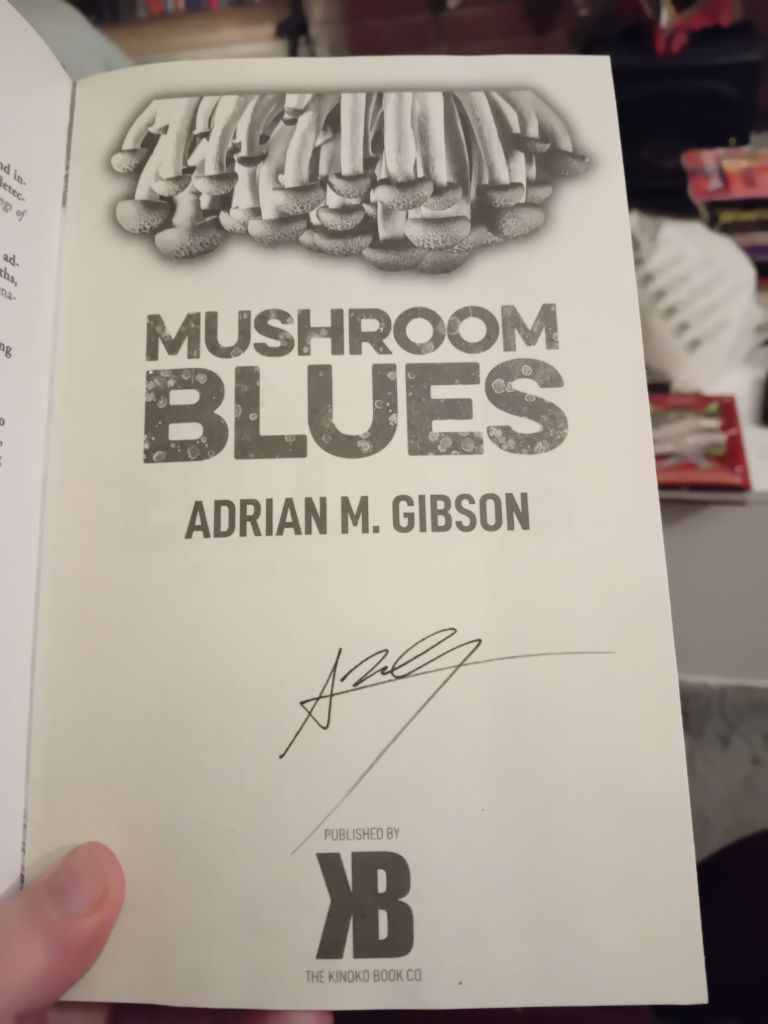
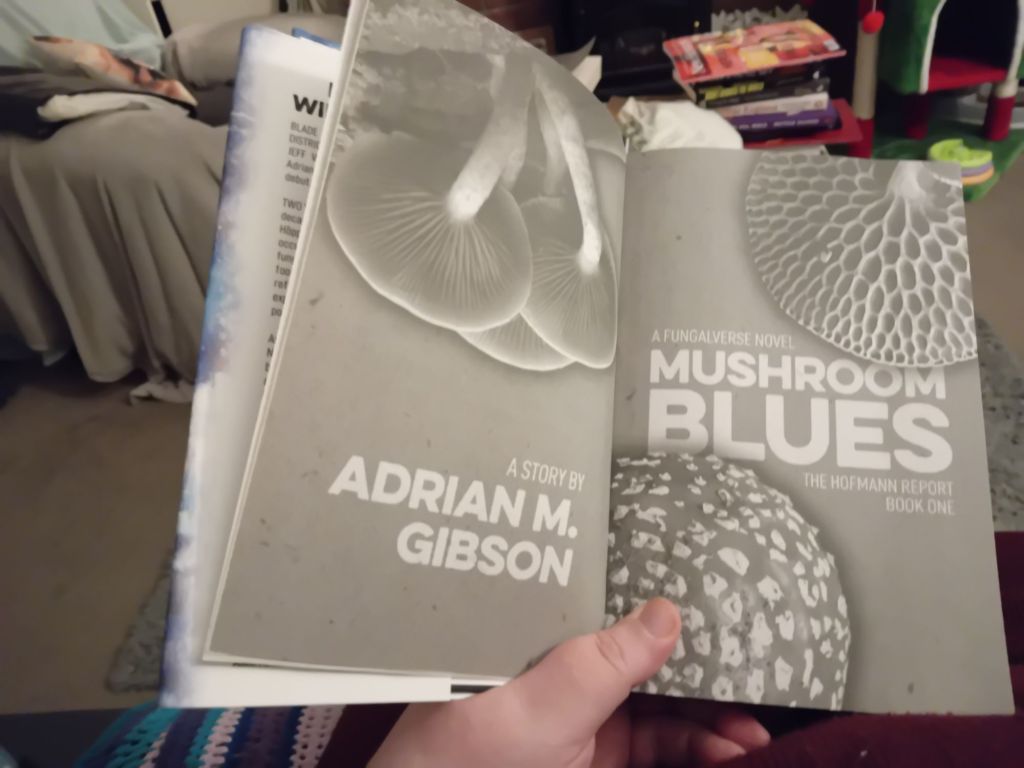
I picked this book up at World Fantasy Convention 2025 in Brighton, from the Broken Binding table in the dealers room. I got a lovely signed and illustrated hardback edition. Usually I’m uncomfortable with mushrooms – I saw that episode of Hannibal where a killer was using bodies to grow mushrooms and one of the victims was alive and sprouting, and I’ve had an issue ever since. It’s weird, anything with parasites also upsets me, but I managed to read Alien Clay, so I can manage to read Mushroom Blues.
This novel was originally self-published in 2024 and did well in a variety of awards. The edition produced with The Broken Binding is a hardback, signed and illustrated. It’s published by Kinoko Book Co. which is hard to find anything about, so I’m assuming it’s the name the author has chosen for his self-publishing venture. Gibson is, according to his bio, “an award-winning Canadian SFF author, podcaster, illustrator, and tattoo artist. He is the creator of the SFF Addicts podcast, which he co-hosts with fellow authors M.J. Kuhn and Greta Kelly. The three host in-depth interviews with an array of science fiction and fantasy authors, as well as writing masterclasses.”
This is his debut novel. And it’s really quite enjoyable. We follow Hofmann, a detective sent from the homeland to work for the NKPD, and she’s struggling. In a world of men, she’s a divorced older woman in recovery from alcoholism – caused by the job, worsened by the death of her daughter in a car crash Hofmann caused. She hates mushrooms. Not just the people of Hoppon, but mushrooms in general – she can’t see them or eat them without feeling sick. And she’s stuck in a place where humans are a minority, and the majority are fungal people who live in fungal architecture. It’s her worst nightmare. She’s been fed a load of manure in the form of propaganda and holds all sorts of prejudices about the Hopponese.
Children are going missing. Hipponese and ‘half-breeds’ – mixed human and Hipponese children. An Elder finds the dismembered body of one of the children on a sacred island. The NKPD assign the job to Hofmann, and the force’s only Hopponese officer, Koji Nameko, since he was the one to first arrive and to speak to the elder who found the body.
They uncover the fates of the missing children and race to prevent a disaster that involves Nameko’s own family at a major midwinter festival.
As the pair investigate, Hofmann finds herself overcoming her prejudices and learning to appreciate the culture of the people her own are occupying. She even eats mushrooms and doesn’t vomit, at one point.
It’s obviously based, in part at least, on conditions in Japan between 1945 and 1970. After the bombing of Nagasaki and Hiroshima, the yanks imposed a military occupation on Japan. Japan had been the aggressors, attacking China and Russia from the 1930s, before joining the Axis Powers (Germany, Italy, Japan) and attacking Hawaii in 1940. There are still people alive who were children at the time and had relatives who fought with British, Commonwealth/Imperial forces in the Pacific, and who have inherited hate for Japanese people. Australian forces were expecting a Japanese invasion, British colonies around the Pacific were invaded and occupied. We’ve all heard about the horrors of Singapore and the POW camps that murdered thousands.
After the war, the USian Americans felt particularly aggrieved, as though they were the only ones to lose people in horrible ways, to be traumatised. And they took it out on the ordinary people of Japan during their occupation. Soldiers and civilian occupiers had been fed a diet of dehumanising propaganda for years and as a result treated everyone as though they were personally responsible for the actions of prison camp guards and commanders.
No one gets out of this looking good, by the way. There were massacres of people protesting for equal treatment in their own home, soldiers killed with impunity, the General in charge was a nutter. Japanese survivors of the hydrogen bombs were stigmatised because of fears of mutations and genetic damage and the institution of the Japanese Emperor got out of everything without a stain. Blame bad advisors, for the throne is divine and can do no wrong. Where have we heard that before?
Anyway, I recommend learning a little post-war Japanese history, after reading this novel, because the context adds depth.
Of course, this book is about an imaginary world, an imaginary war, and imaginary species, an imaginary occupation…
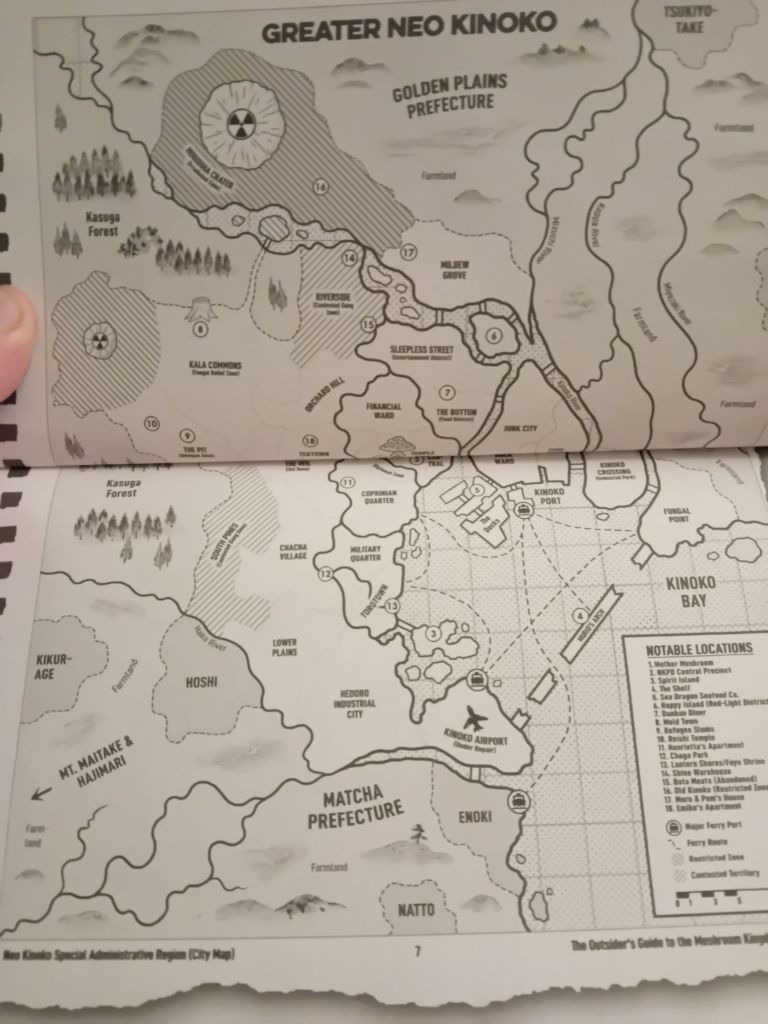
The mystery is well-paced throughout and the climactic race to stop the murder of children and incite a riot at a temple is exciting and balanced by the post action resolution. The description of the city is a blend of cyberpunk futurism and early 20th century detective noir, gritty and flashy, destruction and growth. The main characters develop as people and we learn about their back grounds as they move through the story. It was a quick read, although it’s not a short book, and I really couldn’t put it down.
Recommended, can’t wait for the next one.
 Everything Is Better With Dragons