
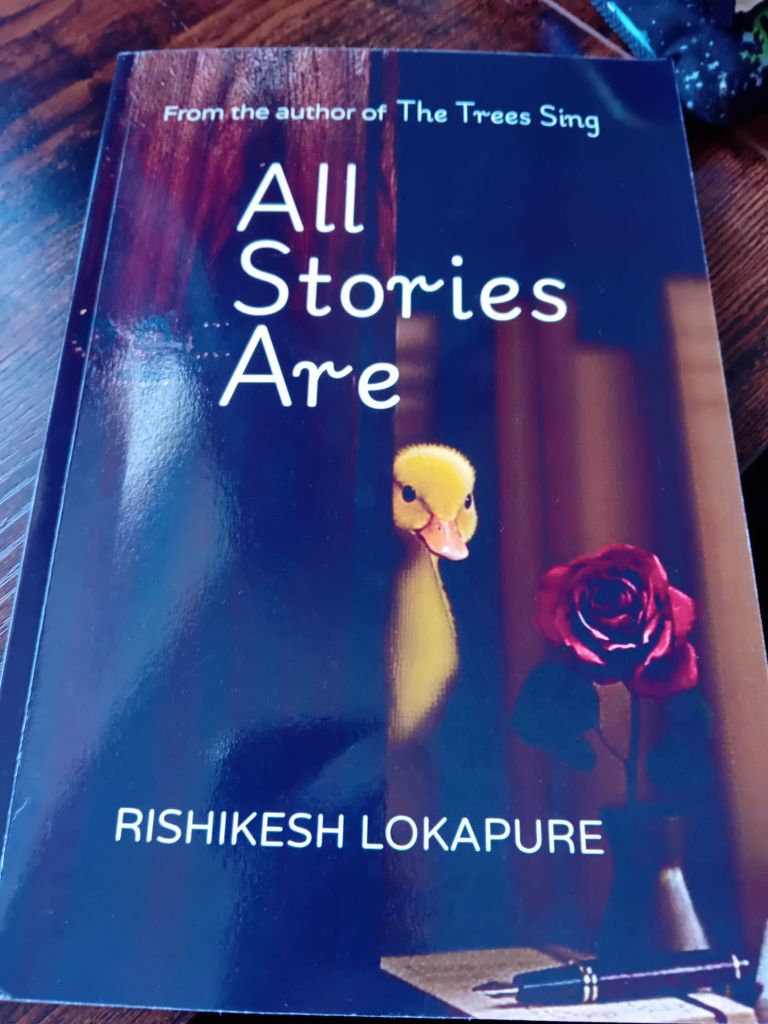
Published: November 19, 2025 by Independently published
ISBN: 9798271958212
Book description
All Stories Are is a compelling and profound collection of six short stories following six distinct individuals on the edge of self-discovery. Through beautifully visualised and deeply observed narratives, All Stories Are looks at the resilience, vulnerability, and the intricate, hidden codes we build around ourselves.
If you enjoy thought-provoking literary fiction that focuses on human struggle and the search for simple, powerful truths, this collection will resonate long after the final page is read.
My Review
The author emailed me months ago about reviewing this short story collection and I’ve finally had a couple of hours without any demands, so I’ve read it today.
The first of six stories is about love and Alzheimer’s Disease. Dementia is devastating, not just to the individual but to their family and friends. You lose a person by pieces, they die while still alive. If they’re lucky, they’ll have someone who can always be there and remind them who they are in the morning. If they’re unlucky, they don’t. The character in the story, Alisha, is lucky, she has her Enrique, until he disappears on an adventure holiday. Then she has their diary to remind her who she is and where she is. Alisha sets off into the jungle to find Enrique with her diary and not much else.
I was deeply affected by this story. I didn’t cry while reading it, but it brought up memories that have made me cry since. Two people in my life had dementia of one sort or another. My Gramps was lucky, until he had to be hospitalised for something else. The last time I saw him he cursed at me so my sister took me for a cup of overpriced hot chocolate in the hospital café so mum and our gran could talk to him. When we went back he’d calmed down and wanted to know why I was so upset. He died a few days later. My great uncle Jim was lucky, at least until great Auntie Eva died. He didn’t know who she was when she died, but then he lingered for years and a cousin of my dad’s went to visit when she could, but it wasn’t the same. For me, he died 10 years before he passed away, when he forgot who Auntie Eva was. He wasn’t uncle Jim anymore. The lingering death is easier to deal with, once they get to the point where they aren’t there anymore. You grieve while they’re still alive. The sudden death while they still know who they are, even if things are jumbled, is harder. I think. Your milage may vary.
The second story is about a boy called Zillah, who shadows a teacher about to retire and learns confidence in himself, only to lose the teacher on the day when he was going to take her place temporarily. It’s a rather sweet story about finding out what you’re good at when you have the chance. Sometimes one teacher taking an interest in a student can work miracles.
The third story is about a physicist and a proud parent, who by chance meet on an aeroplane heading to the same university graduation. The physicist is young and talented and has heavy expectations of herself. The parent is on his first flight, and is facing his fears in order to support his daughter, the first person in his district to graduate with a science degree. They each discover something about themselves on the flight. I enjoyed this story, the rapport between the characters is built slowly and delicately, and the speech at the end made me cry.
The forth story is about an artist who goes to a bridge every night to sketch the people contemplating death. He may or may not fall into the lake at the end. I was confused by this one. I understood the idea – artists sketch people as they make what is possibly their final decision, but I don’t know if the ending was quite clear.
The fifth story is about a blind librarian who develops his own system of book classification using flowers and groves in the woodwork to map his way around. I think technically he’s a library assistant, if he doesn’t have a degree in library sciences (yes, that’s a thing). A woman comes in looking for a specific book and they trade quotes about the importance of fiction as they navigate the library together.
The final story follows a man, or possibly a boy, age is hard to tell, as he navigates the trip to the bus stop. I think he has a learning disability or is Autistic, or both. He follows another person who has a support worker with him. The main character Mateo focuses on socks. Elias has ducklings on his socks, Liesha has black stockings. Focusing on the socks and Liesha’s audible instruction helps Mateo get to the bus stop even without the written instruction his mum usually puts in his jacket pocket. They navigate overwhelming street noise and the shock-stress of kids playing footie with a can running past them (I know this feeling) and safely make it to the bus stop. There’s a passing reference to a sunflower lanyard (I wear a sunflower pin these days because that way I can wear my Discworld lanyard) that clue’s the reader into the fact Mateo has a hidden disability if you know what it’s referencing. Little victories, like getting to the bus stop semi-independently are not to be sniffed at. After an incident on a bus when I was 14, I refused to get a bus until I was 17, I was so distressed. I still struggle with buses at 43 – mainly because people do not know the meaning of indoor voice and the anxiety about buses makes it hard to leave the house.
Each story has a ‘moral’, a bit like a fable, but they’re not moralising. Each story is separated by a line drawing, which could almost be a colouring page and a possible journaling page, if you wanted to make notes after reading each story. It’s the sort of book where you read a story and contemplate the meaning, for you, of the story, before moving on.
This short collection was thoughtfully written and the illustrations fun.

