

Price: £16.99https://www.lunapresspublishing.com/product-page/spec-fic-for-newbies
Description
Release Date March 28, 2023.

Locus Recommended Reading List 2023
BSFA for Best Non-Fiction, Shortlist 2024
BFS for Best Non-Fiction, Shortlist 2024

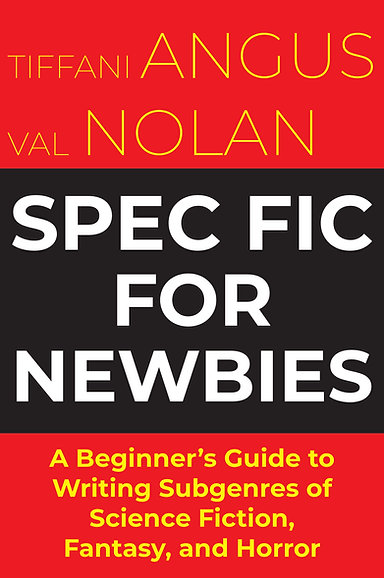
Spec Fic For Newbies: A Beginner's Guide to Writing Subgenres of Science Fiction, Fantasy, and Horror. Tiffani Angus (Ph.D.) and Val Nolan (Ph.D.) met at the 2009 Clarion Writers’ Workshop in California and since then have collaborated many times as fans and scholars on panels for SFF conventions and writing retreats.Working together on this book and combining their experience as SFF writers and as university lecturers in Creative Writing and Literature made perfect sense!

Every year they see new students who want to write SFF/Horror but have never tried the genres, have tried but found themselves floundering, or, worse, have been discouraged by those who tell them Science Fiction, Fantasy, and Horror are somehow not “real” literature.

This book is for all those future Science Fiction, Fantasy, and Horror writers. Tiffani and Val are approaching these three exciting fields by breaking them down into bite-sized subgenres with a fun, open, and contemporary approach.Each chapter contains 10 subgenres or tropes, with a quick and nerdy history of each derived from classroom teaching practices, along with a list of potential pitfalls, a description of why it’s fun to write in these subgenres, as well as activities for new writers to try out and to get them started!
My Review
I bought this book at FantasyCon 2023. I’ve got quite a collection of Academia Lunare books now, mostly genre stuff and Tolkien books. Look at the Luna Press Publishing website, under non-fiction and academic, to get a sense of the books I mean. Most of the are small, A6 size, usually with monographs on a uniting subject matter.
This book is different.
It’s a guide to the sub-genres of SFFH, with two writing exercises for each sub-genre. I’m not exactly a ‘newbie’, but I don’t know all of the sub-genres, and it was interesting to read about the ones they included.
I enjoyed to quick tour and chatty writing style of this book, especially the genre and sub-genre histories. This book is informed by years of teaching by both authors, and it shows. They’ve clearly come across the same mistakes time and time again, but the enjoyment of both spec fic and teaching also really shines through. I could easily devour a volume on each sub-genre by these authors, but I’m weird like that. I like depth and breadth. I don’t think that’s a criticism of this book, but if you’re expecting in-depth discussions of the nuances of each sub-genre you’re not going to get that. The book provides broad overviews of each sub-genre with reference to specific tropes or movements within the sub-genre.
I enjoyed the tour of 30 sub-genres and the writing left me want more on some subject and no more about others (splatterpunk for example, is really not my thing). There’s enough to get you started on any sub-genre, and that’s what this book is for.
If you’re looking for something to read in a specific sub-genre, I think you could flip to the section in this book and find a place to start in a new sub-genre, because the authors provide lots of examples of works – both film and literary – that sit in a sub-genre.
There are also lots of references if you want to follow up on a particular statement or idea. I like references. More references and access to a database of papers, please. Because I don’t have enough to read…
I found the writing exercises prompted me to come up with new ideas and think it’ll be useful when I’m struggling to put an idea down on paper. I’ve got an idea about zombies and cruise ships, but it’s not going anywhere yet… Anyway, the activities make up a small section of each sub-genre entry, but the information packed in before them informs the activities. I think for a writer at any stage of their career, the activities will prompt the brain to try something new. If you’re a new writer they’ll give you a place to start, and for experienced writers they’re a reminder and refresher when your brain is fried. The writing advice found throughout the text is useful and explained well.
While I read this book from start to finish, I think it could be a good ‘dipping’ book, for those having a go at a new genre or sub-genre. There’s always something new to try – nobody could have written in all thirty of the sub-genres in this book – so dipping in and out as the mood takes you can give the writer practice in a variety of stories.
I have already recommended this book to a very new writer (my nibbling is doing creative writing as part of their OU Open Degree – I’m so proud!) and will be buying volume 2 at FantasyCon in three weeks – Francesca, make sure there’s a copy put aside for me, please!
I mentioned on my book Instagram that I was reading this book and Dr Angus kindly told me to contact her if I need any PhD advice, which I thought was lovely.

And now, I’m going to bake some bread.
 Everything Is Better With Dragons