
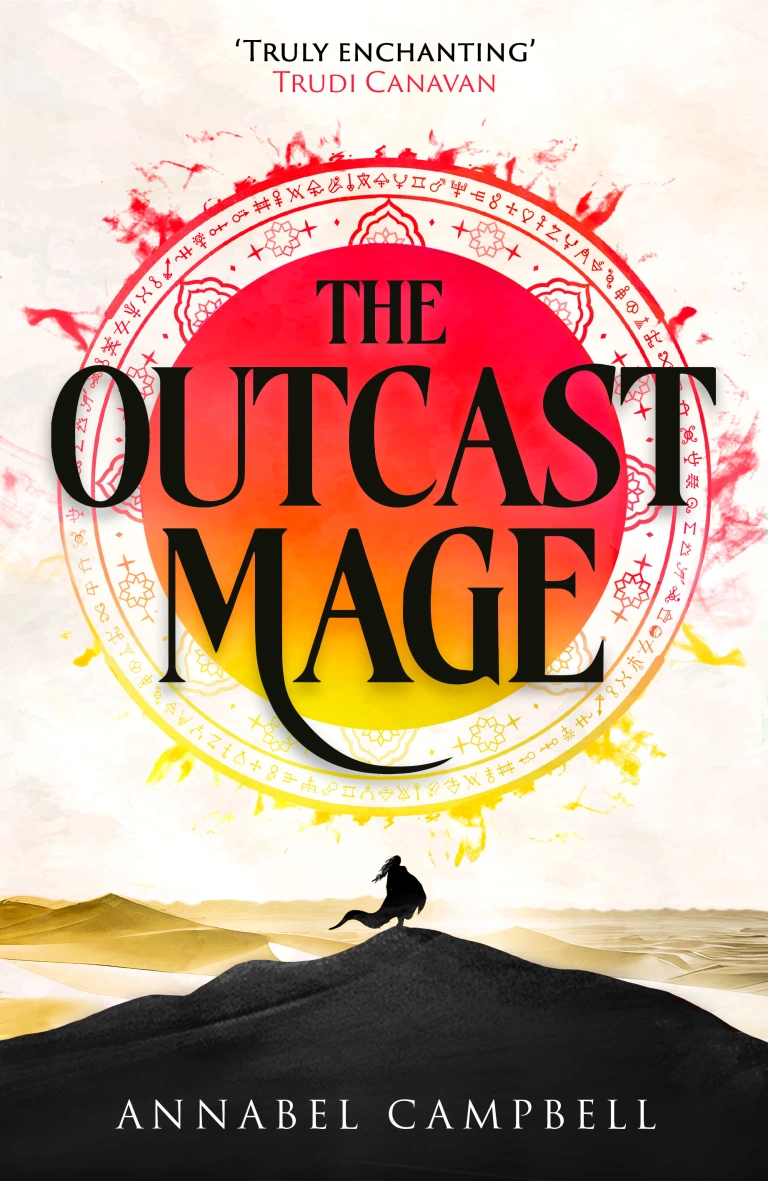
Coming From Orbit (UK & US) January 2025
In the city of Amoria, where magic rules all, Naila is the ultimate conundrum. A student under the watchful eye of Amoria’s sprawling Academy, Naila is undeniably gifted, yet she has never been able to harness her abilities. And time is running out. If she fails, she’ll be forced into exile, or worse – consumed by her own magic.
For decades mages and the magicless Hollows have lived side-by-side peacefully. But now that peace is threatened as old resentments bubble over. A powerful anti-Hollow faction led by Amoria’s most influential mages is determined to cast the Hollows out. With her Hollow background, Nalia is in danger of being exiled from everything she knows and everyone she loves if she cannot unlock her power.
When a tragic incident threatens her place at the Academy, Naila is saved by Haelius Akana, the most powerful living mage. A scholar and fellow outcast, Haelius is fascinated by Naila’s inability to use magic. Eager to help someone in whom he sees so much of himself, he stakes his position at the Academy on teaching her. Trapped in the deadly schemes of Amoria’s elite, Naila must dig deep to discover the truth of her powers – or watch the city she loves descend into civil war.
About the author
Annabel writes fantasy with fierce female characters and disaster wizards, and believes everything is improved by dragons.
She lives in a tiny village in Scotland, where most of her neighbours are sheep. She has a PhD in cardiovascular science, and when not making things up for a living, she works as a Medical Writer.
Her other joys are red wine, playing games, or showing you too many pictures of her dog.
First a disclaimer: I know Annabel and her husband. We met in 2021 at Fantasycon. We all follow each other on various social media sites and meet up every year at Fantasycon to have a catch-up (usually between panels). I made their new baby a blanket this year. Annabel’s husband got over -excited because it was a hexagon and hexagons are his favourite shape. Annabel asked for my address at Fantasycon so that her publicist could send me a copy, no strings attached, for making the baby a blanket.
If I’d known I could get books in return for making blankets for authors’ children, I’d have started making them years ago.
I joke.
I only make blankets for the children of people I like or I’m related to. It takes about 10 hours to make a decent sized blanket and yarn ain’t free. A double bed sized blanket will take a lot longer and cost a lot more than a baby blanket. And my hands hurt from the repetitive motion.
If I make you a blanket, be honoured. It means I care about you.
Disclaimer two: There will be spoilers. Sorry, not sorry.
My Review
I was very excited to receive this book last week, and spent most of yesterday afternoon, evening, and into the night reading it, all 420 pages. I kept reading because it was so good. I was thoroughly entertained. It reminded me of Trudi Canavan’s Black Mage trilogy or Tamora Pierce’s The Immortals quartet. The relationship between Naila and Haelius is much healthier than the relationship between Sonea and Akkarin or between Daine and Numair; Naila is frightened of him because he’s a powerful wizard in a place where she’s frequently victimised by people much more powerful than her. They build a relationship based on trust when he starts to teach her and develop a strong friendship. They make sacrifices for each other and respect each other’s pre-existing friendships.
It’s not creepy! Do you know how rare it is for the teacher-student dynamic to not be creepy in fantasy novels? It was refreshing! Adults act like adults, young people are treated in an age-appropriate manner by adults and act like teenagers! Ko’ani and Naila listen into adult conversations, insist they’re not children, and sneak out when they should be studying.
Amoria is a city in balance, between mages who run the city, and non-mages, who deal with the outside world via trade with the neighbouring city of Jasser. The balance is tilting towards the mages when a powerful mage politician holds rallies against the non-mages in the city, and a non-mage is killed by a mob of mages. Other events start blighting the city – artifacts stop working, food plants die, the city starts to fall apart, literally. There are riots. Caused by mages pretending to be non-mages.
Oriven uses events to take power from the Assembly to become supreme leader. He’s a classic fascist. The death of the food plants is his ‘Reichstag Fire’ moment. He’s been collecting power for years, using people to manoeuvre himself into a position where he could take control, justifying it with his hatred of non-mages. Non-mages are the outgroup who are both weak (for not having magic) but also powerful (because they trade with the outside world). It’s not heavy handed, you need to know history to understand the parallel. It’s well done and I loved the reveal in the epilogue. I really need Ko’ani to fuck over Oriven and her mother in book two, since they’re responsible for Malek’s death. I liked Malek, he’s a lovely bloke, who loves his family and friends, doesn’t hate Haelius and Neila for being different, and just wants to work at his trade as an artificer.
There are dragons. Look, this website is called ‘Everything Is Better With Dragons’ for a reason. I like dragons. Annabel likes dragons. We agree on the whole ‘add dragons to everything’ front. Her dragons are the embodiment of the four classical elements of air, earth, fire, and water. Two of the dragons in the book have been ‘twisted’, driven mad, while the third is hunting them with a being akin to a deity. Naila’s magic appears to be the ability to control dragons, mad or not, especially those linked to water. I loved the descriptions of the different types of dragons, their unique qualities based on their elemental affiliation.
The magical system of this world is well thought out. Mages and magi (Dahrani mages) use the magic that is born from anima, the ‘primary element’. Most mages use the magic, but some, including Naila and the mysterious beings Oriven meets in the epilogue and the dragon-rider, can use the anima itself. In Ellanth, mages are considered to be the children of a chaos goddess and are persecuted, while in Dahran magi are forced to become soldiers as children, in order to keep the Ellanth out of Dahran. The description of Naila using magic, once she works out how to use the artefact, and the way she sees the world through the sight of the anima, is really well written.
The world is fleshed out strongly around Amoria and Dahran, but the rest of the planet is a mystery as yet. I liked the map, with the inset of Amoria. The idea that the desert that surrounds the city was caused by the construction of the city is clever, when you consider the magical system. It also helps isolate Amoria from the rest of the world. Given that the original population were refugees from Ellanth running for their lives, hiding behind a desert is probably a good idea. But over the centuries, trade with Dahrani had brought new people and traditions into the city. This has led to the increase in non-mages in the city and linguistic changes. For some, the changes have enriched the city and their lives. For other mages the changes are frightening, leading them to fall into hate and fear. I don’t know if you’ve ever looked at monocultural places that have gradual changes in culture, population, and, language? You get one power hungry dickhead, and the place can turn into hell. Allyn Oriven is the isolationist, fascist, dickhead in this instance.
Amoria reminds me of one of those ancient Hellenic city states that hived off from the main Greek city states in the first millennium B.C.E. People from a city state like Athens would leave to set up another settlement, in the Mediterranean, the Aegean, North Africa, Anatolia, or the Levant. Over time, the population would become more like the surrounding population, but speak a dialect of Greek. Someone coming from the original city state would be able to communicate, and would recognise social conventions and structures, but would probably have a rather snobbish attitude about it.
Or maybe, it’s like those British Raj colonies in India, where in the 1920s people from old colonial families, were acting like it was 1880s and Victoria was still alive. Hanging on to old customs and refusing to acknowledge that the world was changing, or that they’re of mixed heritage. Ellanth is one of the 19th century European empires, always fighting with someone, always pushing into places they weren’t wanted. Alternating between worshipping war and worshipping the collecting of knowledge, as Ellanth alternates between control by the god of war and the god of knowledge, all in the name of the empire.
Dahran is definitely the Arab states. Omar, my friend, you’ve definitely influenced Annabel with this culture. The language, cultural traditions, religion (monotheism), and, architecture, are all derived from Arabian templates. It’s quite cool that the author has drawn on both her own and her husband’s heritage to build this world.
I enjoyed the way Naila’s wonder at the world outside of Amoria is described, from the perspectives of the adults (Entonin the priest and Karameth, a Dahrani nobleman working as a bodyguard) who have taken over looking after her, once Haelius helps her get out of the city. Entonin is surprised at her innocence and finds himself developing sympathy for her; he’s also a little repulsed by the magic that saves him repeatedly. He has some insight into his reasoning over the course of their journey across the desert from Amoria to Awasef, and his treatment by his Order start to shift his perspectives on the world and the empire his Priesthood are currently ruling. I’m looking forward to more of Entonin and Karamath’s journey.
Larinne and Dailem Tallace are interesting examples of people who tried to correct the course of the state from inside the state. They both fail. Larinne engages in food smuggling to help non-mages but doesn’t step in when her non-mage staff are disappeared. She’s put in a difficult position by her relationship with Haelius. Dailem joins the Justice in order to temper the abuses they all know are going to happen. She engages in unjust actions, like arresting the visiting Ellanth priest, Entonin, because she assumes he’s working with the non-mage trade council to take over the city for the empire. She becomes a collaborator after she blames Haelius for Malek’s death. I think they’re both going to be confronted by knowledge of Oriven’s actions by Ko’ani and their own complicity, in the second book. You can’t work with fascists, you can’t temper their regimes, you just have to stop them.
All in all, I really enjoyed this book and look forward to the next book in the series. Good worldbuilding, excellent character development, and, dragons!

 Everything Is Better With Dragons
2 Comments