Title and subtitle: Unashamed: Why do people pay for sex? Author: Elizabeth G. Publisher: Whitefox Formats: Hardback, paperback, ebook, audiobook Page count: 272 pages Recommended Retail Price (RRP) (£): Hardback – £19.99, Kindle – £7.99, Audiobook – £0.99 (with Audible membership) or £16 Genre(s): Memoir, Female empowerment, human sexuality, the sex industry, self-help. Publication status: Published on 28th March 2024 Amazon link: https://www.amazon.co.uk/dp/1915635799
Unashamed: Why do people pay for sex? BLURB
Elizabeth G. was twenty-two years old and travelling around Australia when she came across a job opportunity at an erotic massage parlour in Sydney. Fast forward eighteen years and she had built up a trusted list of regular clientele working as a high-end London escort and was frequenting some of the city’s most exclusive hotels.
This is an inspirational story of resilience and self-belief in the face of adversity. It gives a fascinating insight into what it’s like to work week in and week out as a sex worker and how it feels to hide who you are from your friends and family. It’s about understanding why a person would pay for sex in the first place. It’s about the positive effects of sex work. It’s about love, connection, nurture and healing. It’s about change. It’s about acceptance. It’s about hitting rock bottom and picking yourself back up, time and time again. It’s about growth, embracing the struggles and learning from your mistakes. And, above all, it’s about breaking through the barriers of shame, and staying true to yourself no matter what.
In shedding a spotlight on the sex industry, Elizabeth hopes to challenge the misconceptions and shame surrounding sex work, and to help provide better protection for those who are forced into the industry as a result. Unashamed is a no-holds-barred, taboo-busting account of the life of a sex worker, and what it’s like to build a highly successful career in a multimillion-pound industry that exists largely in the shadows. If you want to feel inspired and embrace yourself as a sex worker, or develop an understanding of the profession, or you simply want to eradicate shame in any aspect of your personal life, then look no further.
Publication date Thursday, May 23, 2024 Price £16.99 ISBN-13 9781800961982
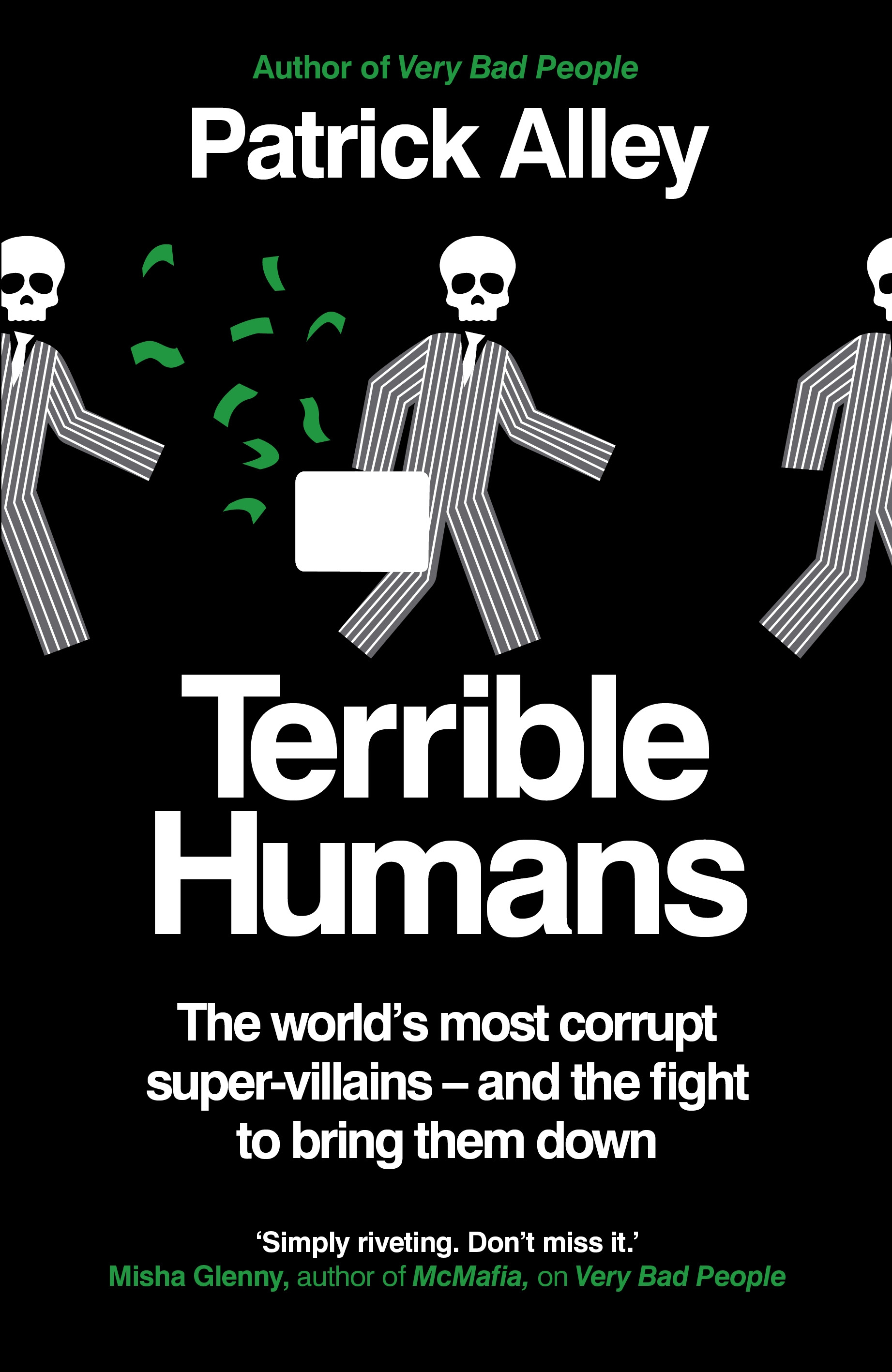
Description A small number of people, motivated by an insatiable greed for power and wealth, and backed by a pinstripe army of enablers (and sometimes real armies too), have driven the world to the brink of destruction. They are the super-villains of corruption and war, some with a power greater than nation state and the capacity to derail the world order. Propping up their opulent lifestyles is a mess of crime, violence and deception on a monumental scale. But there is a fightback: small but fearless groups of brilliant undercover sleuths closing in on them, one step at a time.
In Terrible Humans, Patrick Alley, co-founder of Global Witness and the author of Very Bad People, introduces us to some of the world’s worst warlords, grifters and kleptocrats who can be found everywhere from presidential palaces to the board rooms of some of the world’s best known companies. Pitted against them, the book also follows the people unravelling the deals, tracking the money and going undercover at great risk. From the oligarch charged with ordering the killing of an investigative journalist to the mercenary army seizing the natural resources of an entire African country, this is a whirlwind tour of the dark underbelly of the world’s super powerful and wickedly wealthy, and the daring investigators dragging them into the light.
Thanks to Anne Cater for organising this tour. My copy did not from the publisher did not arrive, so I bought myself one. I’m not a fan or the author. their TV shows, or anything like that, I’m interested in both wildlife and Cornwall, since my mum’s maternal family and my step-Dad are Devon and Cornwall (unlike Stitfall who is a blow-in from Essex).
I’ve been a bit of a spotter since I was a kid, but I was never any good at it. I used to enjoy taking my little Osbourne books of birds and coastal life out with me on hikes with my dad and the local walking club, but haven’t really done much since I was 14. I do like to sit in the garden, or allotment, and bird watch. We have a new ecology group at work too, so I’m picking up bits of insect information. Again, I’m not very good at it. I need more practice.
Sorry if I sound grumpy today, I’m in pain. Because of this book. I read an awful lot of my copy on Tuesday, and enthused by the writing, decided to take a walk along the coast near here. The Humber is a SSSI designated area. I walked from the main drag of the Prom to the sand dunes by the swimming pool and then along the paths through the sea grass meadows. They’ve become much more extensive in the last twenty years. the area that used to be beach, on the other side of the swimming pool has changed immensely, with a much more varied habitat of dunes and salt marsh. I kept to the paths, but they got a bit wobbly once I got to the marsh adjacent to Meridian Point and I fell twice trying to cross from the path to the sea wall. got covered in mud. Which, to be honest, is nothing new. I have a cut on my right knee and my left hip is registering its disapproval quite vociferously. I did make it to a bus though and home, so it’s all good.
I saw a heron, and lots of crows and magpies. I think. I didn’t get bitten by anything, which is practically a miracle in itself, and I had a paddle in the water. I took photos of various plants and birds and at some point I’ll attempt to identify them.
Back to the book review.
I enjoyed the writing style, straightforward and descriptive, shading into poetic at times. I loved the photography. It really enthused me about going out and appreciating the local nature (the ‘wild life’ is a different matter altogether – Newquay misbehaviour ain’t got nothing on Cleethorpes in the early hours of a summer Saturday). This book is a celebratory and entertaining trip through the natural calendar of Cornwall, written by someone with a genuine love of wildlife and an ethical approach to nature photography. I recommend it to people who want to see what’s living in their area, if they live in Cornwall or are visiting at any time of year.
Also, my step-Dad tells a fantastic story about Seal Island near St. Ives, involving a boatload of American tourists and an inflatable seal.
Format: 208 pages, Paperback Published: March 20, 2023 by Pluto Press ISBN: 9780745345161 (ISBN10: 0745345166) Language: English
Description
An impassioned discussion about the alternative ways to form relationships and resist capitalism.
Capitalist ideology wants us to believe that there is an optimal way to live. ‘Making connections’ means networking for work. Our emotional needs are to be fulfilled by a single romantic partner, and self-care equates to taking personal responsibility for our suffering. We must be productive and heterosexual, we must have babies and buy a house. But the kicker is most people cannot and do not want to achieve all, or any of these life goals. Instead we are left feeling atomised, exhausted and disempowered.
Radical Intimacy shows that it doesn’t need to be this way. A punchy and impassioned account of inspiring ideas about alternative ways to live, Sophie K Rosa demands we use our radical imagination to discover a new form of intimacy and to transform our personal lives and in turn society as a whole.
Including critiques of the ‘wellness’ industry that ignores rising poverty rates, the mental health crisis and racist and misogynist state violence; transcending love and sex under capitalism to move towards feminist, decolonial and queer thinking; asking whether we should abolish the family; interrogating the framing of ageing and death and much more, Radical Intimacy is the compassionate antidote to a callous society.
My Review
I have the Left Book Club edition of this book; the standard cover is plain yellow with black writing. All of the Left Book Club contemporary library have the same cover. I have several of them, this might be the first one I’ve had time to read. I started reading it on Wednesday, and almost finished it, but I had to go to bed, so I finished it off yesterday afternoon.
I thoroughly enjoyed reading this book. It was a thoughtful introduction to some of the ideas presented, and well referenced. I generally agree with the direction of the argument, the capitalist, atomised society we live in, focused on the nuclear family, doesn’t support humans in a healthy way. I think read in conjunction with other books, such as Empire of Normality, by Robert Chapman, which I’ve reviewed in the past, and other books from Pluto Press (which I have, but haven’t had a chance to read yet), this book could be a good base from which to work. The writing style was engaging although slightly shallow at times, with arguments not developed as fully as perhaps some would like. Sex is barely mentioned, because intimacy and sex are not synonymous.
Format: 260 pages, Paperback Published: August 9, 2016 by Plume ISBN: 9780147517609 (ISBN10: 0147517605) Language: English
Description
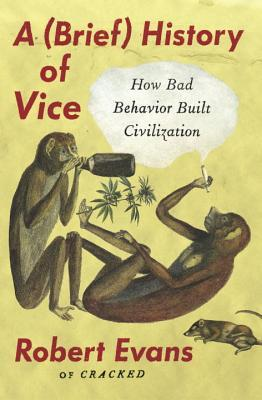
From a former editor at the popular humour site Cracked.com and one of the writers of the bestselling You Might Be a Zombie and The De-Textbook, a rollicking look at vice throughout history, complete with instructions for re-creating debauchery at home.
Part history lesson, part how-to guide, A Brief History of Vice includes interviews with experts and original experimentation to bring readers a history of some of humanity’s most prominent vices, along with explanations for how each of them helped humans rise to the top of the food chain. Evans connects the dots between coffee and its Islamic origins, the drug ephedra and Mormons, music and Stonehenge, and much more. Chapters also include step-by-step guides for re-creating prehistoric debauchery in your modern life based on Evans’s first-hand fieldwork. Readers won’t just learn about the beer that destroyed South America’s first empire; they’ll learn how to make it.
My Review
I really enjoy Robert Evans’ podcast ‘Behind The Bastards’ and thought I’d give this book a read, just for amusement. Apparently he spent the money he was paid for this book on living in a ridiculously big house for a year and almost became homeless. Dafty.
Doing daft things for education and entertainment seems to be Evans’ motivation for a lot of things in life, although he is also a decent conflict zone reporter. This book was written while he was still at Cracked.com, and before he started his podcast. It is a mixture of science, history, anthropology and self-experimentation with a variety of historical intoxicants, from Sumerian early beer, hallucinogens from ancient Greece, nose pipes from Mesoamerica, and the ways tobacco has been used for healing, including as a purgative. I’m surprised only one person ended up in hospital.
The book was entertainingly written and honest about the effects of the various substances tried. I’m not sure the thesis, that ‘bad behaviour’ made civilisation, is substantiated, but it’s an interesting trip through the ancient world, from a very different perspective.
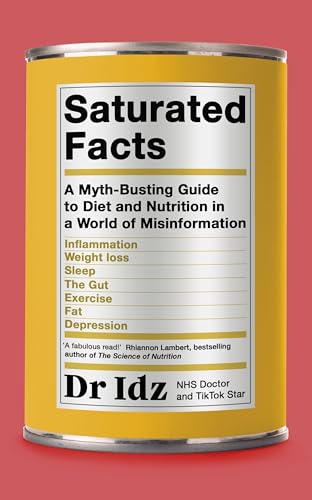
Publisher : Penguin Life (14 Mar. 2024) Language : English Paperback : 272 pages ISBN-10 : 0241588227 ISBN-13 : 978-0241588222
Are carbs the enemy? Am I getting enough protein? Should I worry about inflammation? Do calories count? And do any diets really work?
We are constantly bombarded with advice on how to live a ‘healthier’ life. From the benefits of intermittent fasting and the keto diet, to the growth of veganism and the dangers of inflammation, poor-quality, dubiously sourced information on how we can live and feel better is everywhere. But where should we turn for advice we can trust?
Dr Idrees Mughal (Dr Idz), an NHS doctor with a masters in nutritional research and a board certification in lifestyle medicine, has made it his mission to educate, inspire and empower the public when it comes to diet and lifestyle. His signature videos have attracted millions of followers online, and now he’s collected this wealth of information in his first book, Saturated Facts – your science-backed guide to living better.
Whether you’re looking to lose weight, sleep better, avoid disease or just have more energy as you go about your day, Saturated Facts is the comprehensive guide you need to make smarter decisions about your health.
My Review
This book arrived on publication day. I spent a couple of days reading and digesting it. There was a lot to think about. I’m interested in nutrition science, I’ve read a few other books on the subject, and I’ve even done a couple of level 2 nutrition courses. I like the science. The human body and how it processes food is fascinating and not generally as simple as people believe. It really is more complicated than individual nutrients and calories in-calories out.
I really liked the structure of this book, the references to specific studies and scientific consensus, and all the sources are listed at the back. There should always be sources! It made my brain happy to read this book. Dr Mughal makes the scientific papers legible to the non-specialist and lay reader (I did chemistry, biochemistry and geology, and I understand autism paper, everything else I need translating). I appreciate the effort. I also appreciate the author’s debunkings of myths.
A lot of the information wasn’t new to me, but the level of detail was, and I found that satisfying. The nutrition advice is sound, as far as I know and I generally eat quite well roughly following the advice, something I learnt years ago. I think this book would be really useful for people needing a clear explanation, backed up by named sources, before they engage in a change in diet.
I read a couple of statements in the book, also ostensibly supported by scientific sources, but which are actually a bit dodgy. In fact I found some of them rather upsetting and ignorant.
The first is a reference to Autistic people and faecal transplants, and how after a faecal transplant Autistic children showed ‘less autistic symptoms’. For a start that paper you referenced, Dr Idz, was from October 2005 and has already been debunked by better people than me. Common criticisms include: the children weren’t asked if it helped, their parents were asked for their subjective observations; the language used by the researchers was prejudicial and biased – comparing autistic children vs ‘healthy’ children; the researchers failed to consider the fact that autistic people often have gastric difficulties and limited diets due to sensory sensitivities so it’s hard for us to get balanced diets when we need our safe foods. If children are forced to eat food that upsets them either digestively or sensorily, they will have ‘more autistic symptoms’, because they’re in pain! Strangely enough, you’d probably be grumpy if you can’t eat something because it makes you want to vomit from the texture/taste/smell/sight (baked beans, mushy peas, avocado, I’m looking at you, or not actually because bleurgh) or because your belly hurts because you’re having a response to the food. Children don’t have the words, often, to specifically describe their pain or to work out the cause. This is especially true of those with other complex conditions or who struggle with verbal speech. Instead of giving us faecal transplants, try working out what’s causing the problems in the first place?
If you use a paper that’s so thoroughly wrong to make a point, why should I trust you’re other citations? I know about autism. I don’t know as much about nutrition, you could be bullshitting me and passing it off as scientific consensus. Also, the phrase ‘in mice’ is important in some of the cited papers about helping fat people be less fat.
On to the second one. Doctors and health care professionals generally engage in a lot of anti-fat bullying. I generally get nurses, for some reason, telling me I need to lose all the weight or I’ll get a horrible illness and die. Completely ignoring my genetics, my actual lifestyle, my medical conditions and neurotype. Doctors get funny when I need procedures that require anaesthetic (if you can mutilate healthy stomachs in the name of weight loss, you can do a fucking colposcopy under anaesthetic, stop being a dick about it). Doctor Mughal does in fact acknowledge the anti-fat biases of his colleagues but moves on extremely quickly and seems to push it off as a minor issue. On the subject of fatness he’s quite contradictory – it’s a disease that needs treatment, but also fat people are responsible for being fat, fat people are treated badly by doctors but doctors can’t help their biases.
And Dr Idz is no better than the rest of them on that count. He doesn’t question statements about fat people being more anxious (what do you think happens when people are bullied all their lives?) and doesn’t question the cause and effect of fatness and type-2 diabetes, even though genetics has been shown to be more of an influence than body size.
I’m fat so of course I must live on take aways and sit around all day. Who can afford to live on takeaways? Plus they upset my digestion. I probably have some sort of irritable bowel conditions (or as I call it ‘the anxiety shits’) and I have a hiatus hernia. Also, autistic food pickiness. I know what I can and can’t eat. But still, I like learning more about this stuff as a science-minded person. Don’t be too shocked, will you?
He also misunderstands the purpose of fat activism – it’s a movement for equality. Even if fat people lost that magical 10% of their starting weight, there would still be lots of fat people in the world, and we shouldn’t be excluded from participating in life, shouldn’t be denied healthcare and employment, and we shouldn’t be bullied because of ignorance and prejudices. That’s it. It’s not a difficult concept.
So, over all, watch it if you’re fat and kinda sensitive about stuff, because this book repeats a lot of the biased bollocks we already hear from HCPs, but when he sticks strictly to nutritional advice, Dr Idz really does a good job of explaining the science in an easily understandable way, with citations, mostly from the last decade, with a small number of exceptions (yes, I looked). I like citations, have I mentioned that.
I gave this book a 3/5 on GoodReads purely for the autism bollocks he repeated without question. I’d have got a 4 or 5 if he’d refrained from that and I hadn’t started questioning his sources.
Publication date Thursday, February 29, 2024 Price £22.00 EAN\ISBN-13 9781804191002
Description
Making dinner from scratch can feel like a chore – often half the battle is trying to find something that’s quick, nutritious and, most importantly, delicious. But delicious doesn’t have to mean demanding.
After their debut book, Sunday Times bestseller It’s All About Dinner, Kitchen Sanctuary is back – this time focusing on quick and easy meals, all made in 30 minutes or less!
With chapters such as Champion Chicken; Moreish Meat; Fantastic Fish; Vitally Veggie; Perfect Pasta; Rice, Noodles, Grains and Bread; Snack Suppers; Super Sauces – as well as a section dedicated to Smart Shortcuts containing Nicky’s top tips for speeding up dinner – you’ll be able to whip up a range of fabulous meals for the whole family, every day of the week, no matter how little time you have.
Publication date Thursday, February 29, 2024 Price £20.00 EAN\ISBN-13 9781914240829
Description “This is a heart-breaking story, beautifully told. I hope it finds a million readers”. – Andrew O’Hagan
John MacDonald must find his mother.
Born into the slums of Glasgow in the late ’70s, a 4-year-old John’s life is filled with the debris of alcoholism and poverty. Soon after witnessing a drowning, his mother’s addictions take over their lives, leaving him starving in their flat, awaiting her return.
A concerned neighbour reports her, and he is forcibly taken away from his mother and placed into the care system. There, he dreams of being reunited with her. His mind is consumed with images and memories he can’t process or understand, which his eventual adoptive parents silence out of fear as he grows into a young man within a strict Catholic and Romany Gypsy community.
This memoir is about how John found his way to his true identity, Juano Diaz, and how, against all odds, his unstoppable love for his mother sets him free.
Published by Monoray in February 2024 at £10.99 in Paperback.
Description
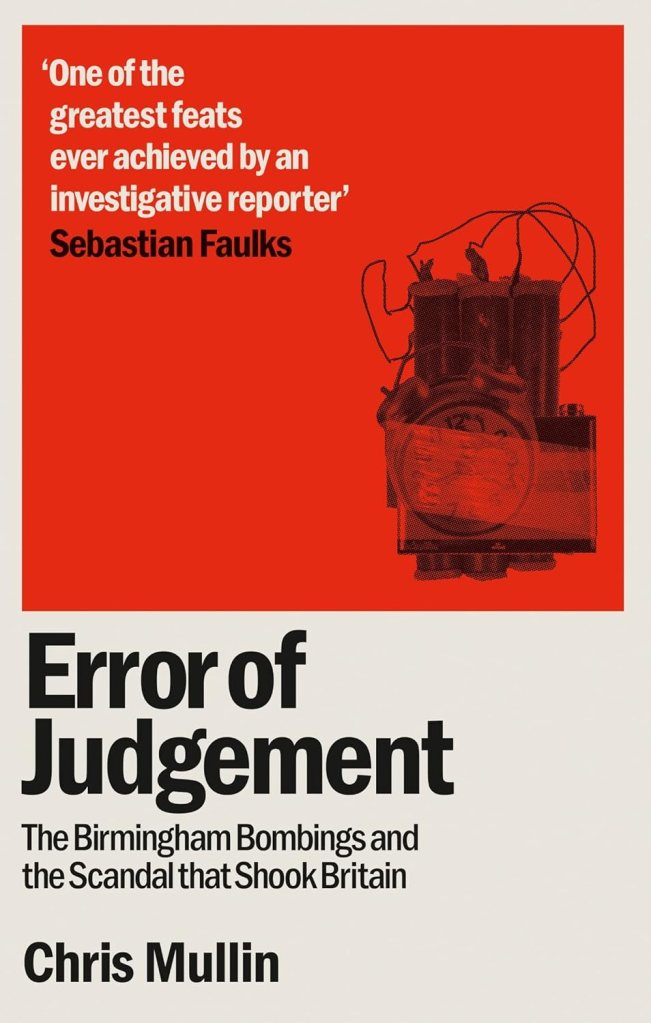
Error of Judgment lit a fire under the political and legal establishment when it was first published, shattering the prosecution case against six Irishmen wrongly convicted of with the Birmingham bombings and going on to change the course of British legal history. It also resulted in significant reforms to the legal system and the quashing of many other wrongful convictions.
Now 50 years on from the bombings and with a new preface and several new chapters covering the aftermath of the case, this new edition of Error of Judgement tells the complete story of one of Britain’s most significant miscarriages of justice.
On the evening of 21st November 1974, bombs planted by the IRA in two crowded Birmingham pubs exploded, killing 21 people and injuring at least 170. Within a day of the explosion, six men – Paddy Hill, Gerry Hunter, Richard McIlkenny, Billy Power, Johnny Walker and Hughie Callaghan – were arrested and charged. All were found guilty.
Methodically, with total clarity and a tone that is both gripping and impassioned, investigative journalist Mullin unpicked every detail of the case, revealing gaping holes in the prosecution case and an establishment determined to close ranks. Error of Judgement is a graphic illustration of what can go wrong when our police and criminal justice system is under pressure to get results and how difficult it is to persuade those responsible to own up once mistakes become obvious.
Publication Date: 28th January 2024 £12.99 ISBN: 9781805142256 Thema subject category: DNC – Memoirs paperback 216 x 138 mm 320 pp Portrait Author location: Hastings
Have you ever struggled with your mental health, your terrible relatives or a dysfunctional relationship? Or simply wondered what the hell is wrong with you? This story is for you.
Finley recounts their chaotic life with deadpan humour and honesty, wryly embracing their colourful lovers and a series of futile attempts to fix them. When a catastrophic encounter in France sends them into meltdown, they wind up receiving daily psychoanalysis on the NHS with a cast of unsettling characters – mainly the therapists.
On leaving hospital, Finley stitches their life back together, living for a short time with a Bristol theologian before finding domestic bliss with a transgender civil servant. A cutting-edge approach to mental illness eventually leads them to a key revelation about their past, and they finally understands themself through the lens of their history. Aware at last of what they had survived, they face an agonising decision about their future.