Books can change lives. Magic books can change everything.
In a tiny, miserable farm on the edge of the tiny, miserable village of East Grasby, Isabella Nagg is trying to get on with her equally tiny and miserable existence. Dividing her time between enduring her feckless husband, inadequately caring for the farm’s strange collection of animals, cooking up ‘scrunge’, and crooning over her treasured pot of basil, Isabella can’t help but think that there might be something more to life. So, while she’s initially aghast when Mr. Nagg comes home with a spell book purloined from the local wizard, she soon starts to think: what harm could a little magic do?
As Isabella embarks on a journey of self-discovery with a grouchy cat-like companion, Darkshire’s imagination runs wild, plunging readers into a delightfully deranged world full of enchantment, folklore, and an entrepreneurial villain running a magical Ponzi scheme.
My Review
I found out about this book on Saturday from the Hodderscape Instagram feed and ordered it straight away from the local Waterstones. I picked it up after I went to The Festival of the Sea, got home, and read it in a single sitting.
I was promised Pratchettian humour.
There were footnotes. The footnotes were funny. There was a lot of folklore drawn on as well as invented. Which does smell of Discworld, but doesn’t quite scratch the itch. I did not get my Pratchettian story.
The story is of Isabella Nagg realising she doesn’t have to be a farmer’s wife after reading a magic book (stolen from the local wizard by her useless husband), fighting goblins and grifters, and dealing with past events as they come home to roost. There is a mysteriously disappearing wizard and a mysteriously appearing pony, a talking donkey, a grifter looking to set up a ‘new goblin market’ and the eponymous pot of basil.
It was quite, quite silly and I enjoyed the story immensely, even if it did at first feel contrived. Once I got into it, I could see the charm in this cosy fantasy. The social commentary and observations of life in small rural villages was pointed and entertaining, while the criticisms of unequal marriages was sharp.
‘Times like these you wish you had something to pray to’
Idolfire is an epic sapphic fantasy inspired by the fall of Rome from the author of the Frontier and Floating Hotel.
ON ONE SIDE OF THE WORLD, Aleya Ana-Ulai is desperate for a chance. Her family have written her off as a mistake, but she’s determined to prove every last one of them wrong.
ON THE OTHER, Kirby of Wall’s End is searching for redemption. An ancient curse tore her life apart, but to fix it, she’ll have to leave everything behind.
Fate sets them both on the path to Nivela, a city once poised to conquer the world with the power of a thousand stolen gods. Now the gates are closed and the old magic slumbers. Dead—or waiting for a spark to light it anew . . .
My Review
I listened to this over several days, usually while walking to the pool and back. I’ve also got an special edition of the hardback on the shelves. I have all of Grace Curtis’ books and I’ve noticed a theme running through them. All of them contain people on a journey who learn about themselves in the process of completing their journey.
In this book we find Kirby who discovers that the world is bigger than she thought it was, and that there are more options than marrying a local boy. Aleya discovers an internal source of strength to make the changes she knows her city of Ash needs. Nylo learns to stop being a bigoted prat, just before he dies in battle.
The world building draws heavily on the ancient world and the author’s note does explain their inspiration. Kirby feels like she’s from the north east of England (helped by the accent the narrator has), while Nylo screams of Sparta, and Aleya is from somewhere in Mesopotamia. The landscape is vividly described, as the group sail and walk across the world from their various homes to Nivela as they try to complete their individual quests. The land and seascapes are an important part of the plot, which adds to the tension (especially that undersea tunnel and the wastelands around Nivela!) in what is a pretty standard quest story.
The magical system, idolfire, is powered by worship and limited in scope. It drains the power source and can harm the person using it. Magic without limits is a deus ex machina. Aleya’s inability to use the idolfire at difficult moments brings tension to the plot. It also provides the odd last desperate attempt to survive.
I enjoyed the characters of Kirby and Aleya, while Nylo got on my nerves. He’s a tit, who’s perspective is egregiously clouded by his prejudices. Both Kirby and Aleya have their prejudices, but it doesn’t cloud their perspective as much as his does. There were other minor characters that I found entertaining, like the little seer who takes Kirby to see a sheep’s skull after calling Aleya a liar.
Overall, a good quest story set in a vaguely familiar world that isn’t pseudo-medieval north western Europe.
Format: 136 pages, Paperback Published: February 8, 2025 by Organic Apocalypse ISBN: 9781911278436
Humans designed artificial intelligences, but the AIs no longer need us. They are gods, and can create – or even recreate – themselves.
The two most advanced AIs in the universe need to rescue a friend from the clutches of their powerful enemies. Their method is to create millions of restricted, cut-down versions of themselves, to fulfil specific tasks such as generating ideas. The offshoots can be deleted once they’ve fulfilled their role.
No one gives a second’s thought to software. It’s just a tool.
Now it’s time to see inside the process.
Lost Tales of Solace are short side-stories set in the Lost Solace universe.
The Tyrant Philosophers, Book 3 Narrated by David Thorpe Release date: 05-12-24 Language: English Format: Unabridged Audiobook Length: 21 hrs and 39 mins
Bloomsbury presents Days of Shattered Faith by Adrian Tchaikovsky, read by David Thorpe.
Welcome to Alkhalend, Jewel of the Waters, capital of Usmai, greatest of the Successor States, inheritor to the necromantic dominion that was the Moeribandi Empire and tomorrow’s frontline in the Palleseen’s relentless march to bring Perfection and Correctness to an imperfect world.
Loret is fresh off the boat, and just in time.
As Cohort-Invigilator of Correct Appreciation, Outreach department, she’s here as aide to the Palleseen Resident, Sage-Invigilator Angilly. And Sage-Invigilator Angilly – Gil to her friends – needs a second in the spectacularly illegal, culturally offensive and diplomatically inadvisable duel she must fight at midnight.
Outreach, that part of the Pal machine that has to work within the imperfection of the rest of the world, has a lot of room for the illegal, the unconventional, the unorthodox. But just how much unorthodoxy can Gil and Loret get away with?
As a succession crisis looms, as a long-forgotten feat of necromantic engineering nears fruition, as pirate kings, lizard armies and demons gather, as old gods wane and new gods wax, sooner or later Gil and Loret will have to settle their ledger.
Just as well they are both very, very good with a blade…
My Review
I enjoyed the first two books in this series, but I think this third book is my favourite. We encounter re-occurring characters, like Jack, the former priest, and some of the crew from the hospital, who have settled in Alkhaland, and set up a new hospital in the poor district of the city. Jack has made a new friend who runs the local prison and has an un/comfortable relationship with his demon bride. This comes in very handy later in the story.
Into a complicated city comes Loret, a young, scared woman from Pallisand, sent to be aide to Gil, the Resident. Except Loret is a very bad aide, other than rescuing Gil a couple of times. Loret knows what has been happening in the isles and it scares her. She is too scared to tell Gil, and we learn what happened after the characters from book two return to the Palleseen Sway – the ‘infection’ of belief in Jack’s former god, a healer, and the Fisher King, who is very much not a healer, spreads in the army and then in the general population.
I loved this development in the background story, which travels through all three books. It’s the landscape that the stories take place in, with each book being a focused pinpoint in the wider picture. Nothing in the story-world is static, although the Palles want the world to be static and perfect and are constantly fighting against difference and variation.
Alkhaland has an elderly, grief-stricken ruler, who has three sons and a daughter. Tradition says that only a whole man can rule. The eldest is in exile, the second son, Cam, is his father’s right hand and designated heir, the third son is a child obsessed with death. His daughter is a pawn in the game of alliances.
The worldbuilding and descriptions of Alkhaland’s culture and society are vivid and lively. The characters are individual and have their own complex motivations. Gil is truly distressed by the difficult choices she has to make and her complex relationship with Cam.
When the ruler dies, the sons go to war. Except the youngest who goes to meet death. The daughter joins the demon at the hospital. Cam wins with the help of his friend Gil and her Palleseen troops, who promtly move in and make themselves at home.
The people of Alkhaland do not want to be part of the sway, and after some difficulties they free themselves, with the help of a motley crew of aliens, disaffected Palls, demons, and pirates. The final battle is climactic and exciting to read. The advances and reversals, the personal decisions that could make or break the battle, are brilliantly written.
It’s a complex story, exploring how imperialism sneaks into free places around the world, and the small things and well-meaning people that help it along. The Palleseen Sway reminds me of the British Empire, especially the way we took control of India. Trusted representatives of different European states rolled up in the Indian kingdoms and started cultivating influence, until the kings supported one or the other, and then European states sent armies to ‘help’ the Indian kings, until they control the states themselves.
Adrian Tchaikovsky leaves an author’s note that the places in the book aren’t based on real places but he was influenced by the podcast Revolutions. I don’t think I’ve listened to that podcast but I’ve had a quick scan of the episode titles, it seems to cover the revolutionary period from the reign of Charles II onwards. I shall have to have a listen. I also recommend Cool People Who Did Cool Stuff if you’re interested in revolutionaries.
I highly recommend this book and the series in general. I need more stories set in this world, but I think this trilogy is complete as it is, charting the beginning of the end of empire. I hear there’s a short story hiding in an anthology somewhere, so I need to get hold of that anthology.
The narration was excellent and fully embodied the different characters.
Format: 464 pages, Paperback Published: December 3, 2024 by Orbit ISBN: 9780316430609
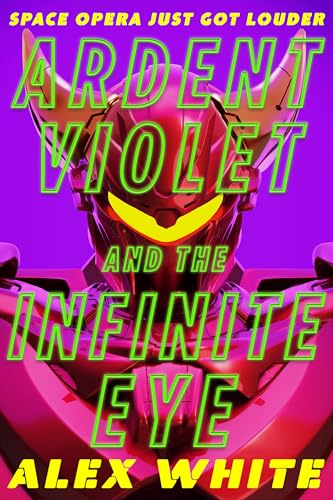
In this new wide-screen space opera, humanity has met its match. An alien race of enormous robotic AI have destroyed most of humanity’s outposts. But, on the eve of the Earth’s destruction, a musician made one last desperate attempt to reach out and convince one of humanity’s enemies to switch sides. Now, earth just might have a chance to survive…
A ragtag band of misfits is all that stands in the way between an army of giant mechas and humanity’s total destruction in the second book of this big-hearted, technicolor space opera trilogy by one of the most exciting voices in science fiction, Alex White.
Ultra-glam enby pop star Ardent Violet thought they could catch a break and enjoy some time with their new boyfriend August Kitko after defeating the giant mechas hellbent on humanity’s destruction. However, Ardent didn’t count on their mecha allies summoning a host of extraterrestrials to defend Earth.
Between the diplomatic entanglements of the newly-arrived alien Coalition, and a mysterious all-powerful AI establishing a base within their solar system, there’s no rest for the wicked.
When August makes a discovery that could turn the tide of the war, Ardent Violet finds they are back in the spotlight for an encore!
My Review
I read the first book in this series August Kitko and the Mechas from Space in 2022, so I’ve been waiting a while for this book. I hope I don’t have to wait another two years for book three, because I need to know what happens to everyone!
This book is mainly written from Ardent’s perspective, although we sometimes get Gus’. Having survived the Mechas from Space, Ardent, Gus, Nisha and Hjalmar, and their Vanguards are still looking to save Earth, and humans generally, from Infinite, the A.I. that is causing all the trouble. Gus discovers that there is a way to do it, about the same time as a Coalition of alien species arrives to ‘help’. They’re all in a similar situation, having developed A.I.s that took over their species. It’s a bit complicated, but they all have Vanguards, and the Conduits all have to meet each other to work together. This happens in a great space city and it goes as well as can be expected, given that the alien civilisations are somewhat more advanced than humans. One species, a giant crab-like creature with shells encrusted with electronics, weapons, and a bad attitude, take an instant dislike to humans.
In an attempt to remove Infinite from the solar system, human and Coalition Conduits and Vanguards attack Titan. But things get a bit messy when the supposedly non-sentient Ghosts start fighting back, running away and screaming. Gus realises that something is going on and changes the mission. Which upsets the crab-alien Conduit, Scent of Rot. Their fight causes all sorts of fallout and Gus spends the rest of the novel under a death sentence for heresy against the A.I./god King.
Lots of things happen in the fight against Infinite. There are some fantastic space battles, a rescue mission that gets Dahlia a pardon and a probable suicide mission in return, people die, Vanguards are destroyed, Gus, Ardent and Nisha play a concert in DeepSync. I cried. And enemies become friends.
I want to know who picked up Gus and Scent of Rot’s escape craft! I want to know how Ardent handles the possible death and escape of Gus. I want to return to this world as soon as possible, it’s so much fun! I loved the characters, especially the development of Nisha as a character, and the complex negotiations that come with inter-species cooperation. The alien species were based on Earth animals, mostly, but changed in a way that would be strange, and logical. Except the octopus-like species; octopuses are alien enough as it is. Them running around in giant bubbles of water in non-marine environments is relatively expected. They would if they could.
Seriously, Alex White, hurry up and write book three!
Category: Fantasy, Historical Fantasy ISBN: 9781399734783 Publication date: October 17, 2024 Format: Hardback RRP: £20.00 Publisher: Hodderscape
Book Description
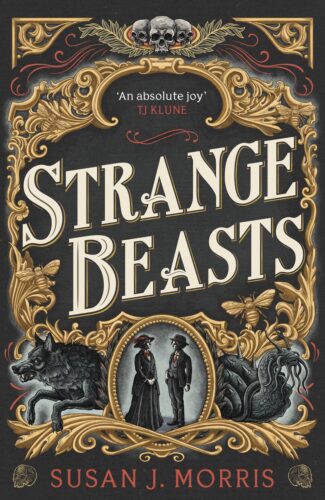
When the Gendarmes ask the Royal Society for the Study of Abnormal Phenomena for help, they don’t expect them to send Samantha Harker.
She’s a researcher, more used to papercuts than knife fights. Sam is also the daughter of Dracula’s killer and can see into the minds of monsters. It’s a perilous power, one that could help her crack this case ─ or have her thrown into an asylum.
Dr Helena Moriarty is Sam’s reluctant partner, the Society’s finest agent who has forged a formidable path in her notorious father’s shadow. Professor Moriarty is in hiding, but he still makes his presence known: Hel’s partners have a way of dying in mysterious circumstances.
From Paris’ glittering opera house to its darkest catacombs, the investigation pits Sam and Hel against magic, monsters, and men. And beneath their tenuous partnership, something else is growing . . .
But is trusting Hel the key to solving the murders? Or is Sam just another pawn in a Moriarty game?
With characters drawn from the worlds of Dracula and Sherlock Holmes, Strange Beasts is a twisty puzzle box of a historical fantasy ─ perfect for fans of Genevieve Cogman, Theodora Goss, Freya Marske, T. Kingfisher, and Gail Carriger.
About the author
Susan J. Morris is a fantasy author and editor, best known for a writing advice column featured on Amazon’s Omnivoracious blog and her work editing Forgotten Realms novels. Susan delights in running workshops for Clarion West and in moderating panels for writing symposiums. When not writing or reading, Susan indulges in playing video games, training in Pilates, and experimenting with new plant-based food recipes. She lives in Sammamish, Washington with her partner, two cats, and entirely too many plants.
Susan had that pink hair at FantasyCon in October. It’s very distinctive and eye-catching…and distracting.
I read this book for the British Fantasy Society book club meeting on Sunday afternoon. I got an Audible code from the book club organiser because my Goldsboro Books special edition of Strange Beasts hasn’t arrived yet. It was the October SFF Fellowship book, but I had to cancel my subscription because funds are a bit tight. I ordered it impulsively after chatting to Susan a few times at FantasyCon.
Conversations in the courtyard are responsible for a number of books I’ve bought in the last month…
Anyway, I also ordered a copy of the standard hardback from bookshop.org when I found out it would be the first BFS Book Club book and before Dave sent me an Audible code. So, once again, I have multiple copies of a book.
Totally worth it!
The main characters of Sam Harker and Dr Helena Moriarty are well-rounded, complex characters, each working through their own problems and dealing with their own secrets. They’re officially investigating the Beast attacks, but they both have their own secret missions and they’re being manipulated by multiple parties. They struggle to trust, because they’ve been taught by other people that they can’t trust anyone and can’t trust themselves. Their growth as people and the tentative nature of their relationship from start to finish is realistic.
Sam is the view point character, so we read her thoughts and see events from her perspective, and see her fears and confusion as she deals with the things the mission throws at her.
They’re also really fun characters.
Jacob Van Helsing is not a fun character. He’s an absolute dickhead. Sam’s memories of him as a loving child contrast with the adult man poisoned by his father – the Van Helsing who helped kill Dracul – into hating and fearing her as a Channel. His comeuppance is well-deserved, although I don’t like that he got credit for Sam and Hel’s work. I suspect even if he hadn’t chosen to take credit, Mr Wright would have given him the credit, because the Society, and society in general, is incredibly misogynistic.
I did not work out who the killer was until quite late on; there are a lot of red herrings. Even the identity of the alchemist was a red herring really, when you think about it, another piece on the chess board, but not the player moving the pieces around.
I felt the mix of science and magic was really well done – a delicate balance of folklore and early 20th century science was found and use consistently. The details of Paris in 1903 feel realistic, although I’ve only been to Paris once and didn’t get to go into the catacombs, but I can imagine them being full of mythical beasts and human criminals. The descriptions were very vivid and events tightly plotted. There are characters I’d like to know more about but they don’t come back into the narrative, and other characters that the reader learns about slowly. Each character has their own backstory and personal history.
Also, chemistry is magic, and fun to play with. So long as you don’t accidentally gas people or blow things up.
The plot starts with a bang and doesn’t stop. Well, actually it starts with a threat, then a few bangs, and then a monster attack in a carriage…you get the picture. You’re just taking a breath when the next thing happens. It’s fun, but I had to take a day between reading/listening to a few chapters at a time.
I have listened to the first 14 chapters as audio and read from chapter 15 to the end. The audiobook was really well read, with multiple accents! I would not have been able to pronounce most of the French and German names without hearing them first. It’s been a lot of years since I sturdied French and I wasn’t very good at it even then, and my German is non-existent. I could not understand the French phrases. I’m just going to assume they’re all in good French, make sense, and not question it.
If you enjoyed Gail Carriger’s books, I highly recommend this historical fantasy of Bell Époque Paris. It’s darker and the focus is on the developing friendship/potential romantic relationship rather than a ‘destined partners’ type narrative. I love it.
One-Time
Monthly
Yearly
Make a one-time donation – If you want. No pressure.
Make a monthly donation
Make a yearly donation
Choose an amount
£5.00
£15.00
£100.00
£5.00
£15.00
£100.00
£5.00
£15.00
£100.00
Or enter a custom amount
£
Your contribution is appreciated. I put a lot of effort into reading and reviewing books for readers.
Format: 496 pages, Paperback Published: May 2, 2023 by Head of Zeus — an AdAstra Book ISBN: 9781801108430 (ISBN10: 1801108439)
Description
Arthur C. Clarke winner and Sunday Times bestseller Adrian Tchaikovsky’s triumphant return to fantasy with a darkly inventive portrait of a city under occupation and on the verge of revolution.
There has always been a darkness to Ilmar, but never more so than now. The city chafes under the heavy hand of the Palleseen occupation, the choke-hold of its criminal underworld, the boot of its factory owners, the weight of its wretched poor and the burden of its ancient curse.
What will be the spark that lights the conflagration?
Despite the city’s refugees, wanderers, murderers, madmen, fanatics and thieves, the catalyst, as always, will be the Anchorwood – that dark grove of trees, that primeval remnant, that portal, when the moon is full, to strange and distant shores.
Ilmar, some say, is the worst place in the world and the gateway to a thousand worse places.
Format: 280 pages, Paperback Published: February 18, 2023 by Aethervale Publishing ISBN: 9798987850206
Description
When life gives you lemons, squeeze them into a stiff drink and stir.
After twenty years defending the frozen north against some of the most dangerous threats in the nine kingdoms, Rhoren “Bloodbane” has finally earned his retirement. While the blood mage’s service to the realm may have ended, burning veins and aching joints remain, and Rhoren soon learns that a warmer climate offers relief from his chronic pain.
And a chance at a fresh start.
In the warm and relaxing atmosphere of Eastborne, the umbral elf finds a new purpose and a sense of belonging. He may have left the frozen north behind, but he brings with him the skills and strength gained from a lifetime of defending the realm. Along with his most prized possession—a book of drink recipes inherited from his father.
Spilled cocktails may not carry the same weight as spilled blood, but opening a tavern brings a unique brand of challenges. With the right friends and a little bit of luck, he might just have a recipe for success.
Genre – fantasy > mythology > magical realism ● ISBN paperback – 978-1-78758-908-7 ● ISBN ebook – 978-1-78758-910-0 ● Pricing [USD] $16.95 (PB) / $4.99 (EB) ● Pricing [GBP] £12.95 (PB) / £4.95 (EB) ● Releases 14 May 2024 ● Published by Flame Tree Press ● Distributed by Hachette UK
SYNOPSIS
A world where petals are currency and flowers are magic.
A man battling a curse of eternal old age. A girl who can be his boon. But it’s not all tulips and roses. There are also nettles and thorns. Where Delights persist, Sorrow must follow.
In the city of Sirvassa, where petals are currency and flowers are magic, the Caretaker tends to the Garden of Delights. He imparts temporary magical abilities to the citizens of Sirvassa, while battling a curse of eternal old age.
No Delight could uplift his curse, and so he must seek out a mythical figure. A god.
When a Delight allows a young girl the ability to change reality, the Caretaker believes he’s at the end of his search. But soon a magical rot takes root in his Garden, and the Caretaker must join forces with the girl and stop it from spreading.
My Review
Thanks to the publisher for sending me a copy of this book and to Anne Cater for organising this blog tour.
The blurb doesn’t do this book justice. Also, the Caretaker doesn’t realise what Iyena could do, and who she was, until after she cures the rot and dies.
Okay, that’s a bit of a spoiler. Iyena dies and is reborn, and it’s magnificent!
We start with an epic battle between a Florral and a Champion, the semi-divine magicians of the Inishtis and Abhadis, two tribes of humans who have been fighting forever. The Inishtis use floral technology; the Abhadis use metal technology. In the centuries that follow the epic battle, two cities rise: Sirvassa, home to floral technology, a stronghold of the Inishtis, a city of flowers and petal rains, and the Garden of Delights, overseen by the Caretaker, one of the few remaining Florrals; and Alderra, industrial capital of the Three Realms, the Abhadis stronghold, a place of flying machines and railways, a place where the Champions still have a home, a city they protect.
The Caretaker, protector of the Garden of Delights, and Sirvassa in general. He gives Delights made from the flowers in his Garden to the people of Sirvassa, giving them a temporary taste of the magic Florrals used at will. He is worried about developments in the city, something is going on, especially after Ministry officers from Alderra arrive and the Mayor of Sirvassa becomes weak. The Caretaker is dealing with his own problems. His experiments in curing the curse have made things worse.
Meanwhile, a girl, 15, arrives in Sirvassa, with her father. Iyena is the daughter of an Abhadi father and and Inishti mother, and born in Alderra. Separated, Iyena has no idea where her mother is or why she left her with her father, but immediately feels at home in Sirvassa, her mother’s home city. Her father is a stern, distant man, who works for the Ministry of Miscellany in Alderra, has brought them to stay with Maani-Ba, her mother’s sister, ostensibly to see about trading agreements between Sivassa and Alderra.
Iyena goes to school, and is enchanted by everything, from learning from books rather than oral learning, to the beasts that pull the carriages, to the fluttering ribbons that cross the city above the roofs, to a boy named Trehan. Making friends and learning about this new society, her maternal inheritance, brings her joy. She learns about the Garden of Delights after Trehan shows off his current Delight. With some forgery, she gets permission to visit the Garden and receives a Delight.
After that it all gets a bit political; there are explosions, sudden changes to the school curriculum and teaching, a fancy dinner at the mayor’s bungalow, fights between the Caretaker and Champions, death and rebirth, freedom and battles to maintain the cultural diversity of the Three Realms.
I was enchanted by this novel. I was about two thirds through it when I got a sense of terrible dread, that Sirvassa would be destroyed by the Minister’s plots; I had to put the book down because I couldn’t face the thought. After a couple of days I went back to the book, because I had to know what happened next. I think I struggled because the sneaky colonialism of Sirvassa by the Alderrans reminded me too much of events in the real world. The wholesale changing of school curricula, the re-writing of history, trying to co-opt Sirvassan cultural traditions, and the ‘if we can’t have it, destroy it’ attitude, remind me of historical colonialism and current colonial states. We’re bearing witness to several such colonial events right now, with all the attendant propaganda, murder and re-writing of history. Anyone with empathy would feel dread at reading it in fiction, when we’re already bearing witness in the real world.
The novel has a much happier ending than the consequences of historical colonialism and the realistic consequences of current colonial efforts. Any Florrals around who can save the world?
The writing is quite lyrical, and compelling reading. The descriptions are beautiful and colourful.
The relationship between the Caretaker and Trulio is paternal, and the way it ends is devastating. The confusing relationship Iyena has with her parents, her distant but present father, and absent but close in memory mother, especially after she meets her aunts, prompt many of Iyena’s actions. She’s pushed from one to the other, by the actions of her father and his friends. I particularly found the relationship between Iyena and Maani-Ba touching. There’s a lot of love and care between them, and secrets. Maani-Ba stands by Iyena when she goes through her change of state, and is instrumental in the rebellion after Iyena becomes afraid of her own abilities. The character development of the main characters is gentle but present.
The touches of Indian culture and inspired mythology, the contrast between the industrial Alderra and the floral Sivassa, the hints of a greater world beyond, really bring the world building to life.
Highly recommended.
ABOUT THE AUTHOR
Amal Singh is a writer of science fiction and fantasy from Mumbai, India. He has numerous short story publications to his credit, in venues such as Clarkesworld, F&SF, Apex, Fantasy, among others. His story What is Mercy?, published in Fantasy Magazine, was longlisted for the BSFA Award in 2021. While he has held jobs of IT Analyst, Database Administration, and SOP consultancy in the past, he is now fortunate enough to do something that involves full-time writing. By day, he juggles screenwriting, audio-writing, and Creative Production, working on web-shows and movies. In his spare time, he enjoys cooking and running. amalsingh.substack.com / X: @Jerun_ont
FLAME TREE PRESS is the imprint of long-standing independent Flame Tree Publishing dedicated to full-length original fiction in the horror and suspense, science fiction & fantasy, and crime / mystery / thriller categories. The list brings together fantastic new authors and the more established; the award winners, and exciting, original voices. Learn more about Flame Tree Press at http://www.flametreepress.com and connect on social media @FlameTreePress
Tor 8 March 2024 9781035013746 400 pages Audiobook narrated by Ben Allen
Synopsis
They travelled into the unknown and left themselves behind . . .
On the distant world of Kiln lie the ruins of an alien civilization. It’s the greatest discovery in humanity’s spacefaring history – yet who were its builders and where did they go?
Professor Arton Daghdev had always wanted to study alien life up close. Then his wishes become a reality in the worst way. His political activism sees him exiled from Earth to Kiln’s extrasolar labour camp. There, he’s condemned to work under an alien sky until he dies.
Kiln boasts a ravenous, chaotic ecosystem like nothing seen on Earth. The monstrous alien life interacts in surprising, sometimes shocking ways with the human body, so Arton will risk death on a daily basis. However, the camp’s oppressive regime might just kill him first. If Arton can somehow escape both fates, the world of Kiln holds a wondrous, terrible secret. It will redefine life and intelligence as he knows it, and might just set him free . . .
My Review
I ordered a hardback copy of this book from The Broken Binding and the audiobook from Audible. I started reading this book earlier in the week, after I finished reading Lords of Uncreation and decided I need some more SF. I should have been reading one of my blog tour books, but I’ll finish that tomorrow. I happened to need something to listen to on Wednesday because I wanted to go out and swim after I had to spend Tuesday at the hospital. I read the first 23 chapters of the hardback book on Monday, on Wednesday I picked up from the right point in the audiobook and listened to all but the last 23 minutes of it while I was out all afternoon. I listened to the rest when I went out today. So yeah, I binged the book slightly.
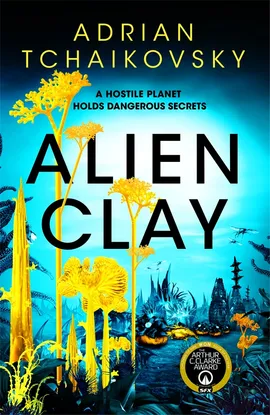
I’ve read eight of Tchaikovsky’s books now, six are from space opera trilogies, while two, including Alien Clay, are stand alone novels. I enjoy both types. There’s always strong worldbuilding and interesting characters. Alien Clay is no different, the world of Kiln is very deeply imagined and the main character, Arton Daghdev, is an acerbic bitch; he made me laugh so much.
Kiln puzzles the scientists bound by Mandate orthodoxy; Arton Daghdev and his fellow condemned are heterodox, rebels against the Mandate, or common criminals who happened to end up on Kiln as part of their punishment. Daghdev was an academic, skating the edge of orthodoxy, a xenobiologist, and a member of several revolutionary sub-committees, until purges put him on a ship to Kiln, a one-way trip.
On Kiln, he is welcomed by the very orthodox commandant who hopes Daghdev can be turned to orthodoxy. He’s put on the Science Support team, along with a friend from home, Ilmus, a former colleague and ‘disciple’ who was picked up by the police, tortured and exiled to Kiln a year before Daghdev. The team work with ‘the Science’ – professionals, paid to work on Kiln, to prove the Mandate’s anthropocentric orthodoxy.
Life on Kiln is rampant, even in an apparently cooler, drier period, and it evolves in a vary different way to Earth life. Each creature is a symbiotic community, carrying multiple species in many combinations. But ruins suggest there was once a sentient species on the planet, and it’s the job of the Science (and the prisoners sent to die there) to discover as much as possible and confirm the Mandate orthodox belief that the purpose of the universe is humanity.
After a failed coup, Daghdev, Ilmus and the former head of Science (who had a one night stand with Daghdev and is therefore assumed to have known about the rebellion), among others, are punished by being sent to Excursions. Where they are not popular, because changing the teams means changing the decontamination schedules, risking people’s lives.
Excursions are not a popular assignment, because they are the only people who go outside of the domed camp. Outside the camp, Kiln life tries to take hold immediately. Luckily, life is so different on Earth, that it takes Kiln life a while to work it out and a good decontamination can deal with that. It’s all well and good, until Daghdev’s team, led by an old shop steward, and longest living Kiln survivor, Keev, lose their transport to a creature called ‘the Elephant’s Dad’ and are forced to walk back to the camp.
Out in the Kiln environment, pretty much unprotected from the symbiotic life forms, they change. By the time they return, they are themselves and yet, more than that. Kiln has found the keys to unlock Earth biology. The planet has found a new mind that it can use. Slowly, the survivors spread their change across the rest of the prisoners, until they can work in unity while being still individuals. It’s a new revolution.
Tchaikovsky’s work has always had a political edge, if you know where to look, and he usually has a point to make. The point made in Alien Clay might piss off people who read sci fi because they like it when things get blown up in space and evil empires are replaced by less evil empires. Replacing one with t’other doesn’t work; you need a complete change of system. Replacing the Mandate with a revolution wouldn’t work – revolutions tend to get taken over by people who want power and will lie, murder, and steal to get it. The Russian Revolution is an excellent example of that. The impetus came from grass roots organisations to improve the lives of peasants and workers (the SRs and anarchists), and it was taken over by middle class idealogues who were interested in power – Lenin, Trotsky, and eventually the Bolsheviks under Stalin – and murdered their way through their former allies. Yes, life was probably better than under the Tsars for many people, but it was still shit, because power was still centralised under a ‘big man’ and small group of sycophants. Decentralised, local organisation, directly elected councils that can be recalled and replaced if they piss off the people, a lack of hierarchy, worked in some places for several years at a time, until Stalin and his collection of nut bags decided murder and invasion were better. The Red Army only won the Russian Civil War because of the Anarchist Army (the Red and Black) which voted for their officers. I’ve been listening to Cool People Who Did Cool Stuff, who are part way through a 6-part series on the Kronstadt rebellion, and Behind the Bastards, that’s just done a 4-parter on Stalin’s chief of secret police. Lots of cross-over there. I highly recommend both podcasts, by the way.
Reading Alien Clay when I’ve been listening to Behind the Bastards and Cool People Who Did Cool Stuff probably influenced my interpretation of the message of this book. It appeals to my socialist heart. Authoritarian regimes love a scientist or artist that’ll support their orthodoxy, because they need them to prop up their nonsense, but hates scientists and artists that use their intelligence and skills to point out the lies of the regime.
I love that Adrian Tchaikovsky has included an important, although secondary, character who is non-binary and probably Autistic in Ilmus. They’re the first to join the planet on the march back to the camp, the first to open themselves up completely to the whole. The tension between Daghdev and Ilmus, as they fear each other was the one who turned them in, and betrayed the rebellion at the camp, and the force of their friendship that helps them bridge the tension, is an emotional counterpoint to the humorous narrative of pain and confusion Daghdev feels on Kiln before the changes Kiln makes to them all.
The beings that live on Kiln are absolutely terrifying. I have a really strange phobia of parasites; the idea of things growing on me or taking up residence in me, and sprouting, absolutely terrifies me. That scene in Hannibal series 1 where they find bodies with mushrooms growing out of them, and one of the victims is alive with mushrooms sprouting from them, still horrifies me. So, I can’t say the species on Kiln don’t freak me out, but at the same time, it’s a really cool idea! Instead of the popular science understanding of competitive evolution, there’s a a species that specialises in one thing and will build a communal life with other species so that everyone gets their needs met. I love the way Tchaikovsky has his narrator describe the life on Kiln and events. It’s by turns lyrical, sarcastic and humorous. The stone crab that helps the marching Excursionistas get back to the camp is probably my favourite species.
The narrator of the audiobook was really good; I enjoyed the intonation and rhythm of the narration. At the end of the audiobook, there’s an interview between Adrian Tchaikovsky and Ben Allen, which covers Tchaikovsky’s influences and research. He originally studied zoology and then law, so Tchaikovsky has a background in science, among other areas; when he’s making up xenospecies it’s usually based in proper science. Which I appreciate.
I need to go to bed now, so I’m going to stop rambling and tell you to go buy Alien Clay.








 Everything Is Better With Dragons