
Publication date : 12 Feb. 2026
Language : English
Print length : 415 pages
ISBN-10 : 1783789638
ISBN-13 : 978-1783789634
Description
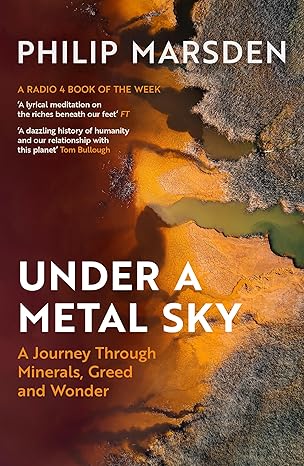
The discovery of minerals beneath our feet has transformed our species. Ochre first prompted humans to express themselves in art; tin and copper helped instigate the Bronze Age and later the Industrial Revolution; silver kick-started the engines of global trade. Each of these substances generated a leap forward in technology, each one opened the imagination a little further – and each one brought with it a cache of unexpected dangers.
Under A Metal Sky begins and ends in Philip Marsden’s homeland of Cornwall, one of the world’s great geological hotspots. Travelling eastwards into Europe, he examines how the extraction of peat propelled the Netherlands to world prominence but also imperilled its very existence. Continuing on up the Rhine by barge, into the heart of the continent, he uncovers more stories of potent and tempting resources, from iron-rich meteorites to radium and mercury, and the gold-bearing mountains of Georgia. At the same time he explores precious seams of ideas, from science to alchemy, mysticism to ecology – and those questing souls who pursued them, likeParacelsus, the Habsburg Emperor Rudolf II, Goethe,William Blake and Marie Curie.
Rich with revelations, Under A Metal Sky traces the dazzling achievements and dark consequences of our ability to extract what we want from the earth, and presents a fascinating new perspective on European history and on our troubled relationship with the natural world.
My Review
This book is subtitled ‘ A Journey Through Minerals, Greed, and Wonder’; it follows the authors journey east from Cornwall to the Caucuses and back, via the Netherlands, Germany, Austria, Serbia, and a whole host of European countries. In each chapter he talks about a different element, metal or mineral, and the connections it has to everything else around it.
The journey is a deeply personal one for the author, starting with his childhood fascination with rock and fossil collecting, to his awe at the ability of early humans to turn lumps of rock into tools and decorations, to dig mines with nothing but antler horn, and the beauty found in the earth. He also discusses the damage resource extraction does to the land and water around it, the continuing harm to life, and the way forward for humans.
Marsden makes the connection to imagination through reference to Rudolf II’s Prague castle/collection/laboratory, Blake’s poetry and copper engraving artwork, and his own awe at the world. It’s actually a rather lovely idea, all things are connected.
We like to put things in little boxes, taxonomy is king. Except everything is connected, temporally and spatially. What happened then effects what happens now, how we react, what we do now, effects the future. What happens here, determines what happens there. We can only see things from where and when we are, usually, and that’s how it’s often treated, as disconnected boxes with discrete edges, but it’s really more of a fluid with occasional clumps. Like a really thick lava erupting form a shield volcano (think Hawaii).
If you’re interested in geology, mining, archaeology, poetry, history, or any of a number of other subjects, I recommend this book. It’s readable, understandable, and gives an interesting personal perspective on some of the many important minerals we depend on.


